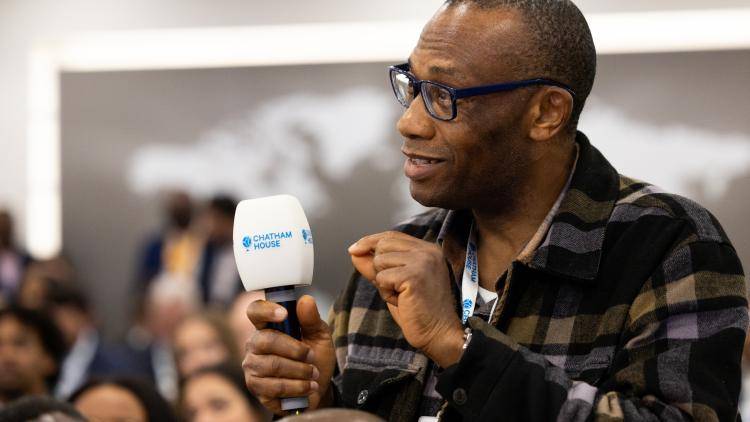
Stephanie Flanders
We should kick off. Thank you very much for joining us and I know we also have, in theory, many hundreds joining online, which is exciting. I said – we were discussing this earlier and I, sort of – you know, every conversation that I have about anything, it seems, currently, ends with talking about AI. So, at least at this point, with – this is the plan to talk about AI, it, kind of, has the advantage of that.
It’s – I should say, I’m Stephanie Flanders. I’m Head of Economics and Politics at Bloomberg and actually, as part of my job hosting ‘Trumponomics’, I was having a conversation with Andrew Ross Sorkin yesterday and it, sort of, reminded me that there’s a really – you know, he’s just written this book, ‘1929’, and, you know, now, as then, we have an enormous chunk of the US economy and certainly the US Stock Market, which means the world economy and the world Stock Market, all betting on the future potential of AI. Just as you had the betting on the potential of electrification and, you know, RCA and all these companies were soaring upwards in the boom years of the late 1920s.
Big difference with that time is how much fear there is about that technology and even a, sort of, popular revolt, one feels, brewing. You certainly, you’ve been reading about it at the, sort of, commencement speeches and things in the US, booi – people being booed when they mention AI. There was a fantastic poll that the NBC did last week, finding that AI is now more unpopular than Donald Trump and ICE. In fact, the only things that are more unpopular than I – than AI are Iran and the Democratic Party, so, yeah.
So – but the interesting thing is, I think, you also have, even among those within companies who are betting on this potential of AI and trying to implement it, adopt it in their companies, you, sort of, sense and we may hear a little bit, there’s a, kind of, creeping question mark about how that – you know, whether it’s really adding to productivity. And there was – I don’t know, some of you might have seen the John Burns-Murdoch [means John Burn-Murdoch] column on this, but there’s been quite a few things about, you know, studies showing if you look at, like, Coders, which has probably been, you know, the highest adoption, most useful to them to do – to use AI, the pre – the quantity of what they do goes up a lot. Not clear that the quality goes up by nearly as much and actually, the, sort of, uptake of those new products they’re producing is quite low. So, maybe the demand for those things that we can most easily use AI for may turn out to be quite inelastic, which would be a problem for some of these great earnings forecasts.
Anyway, we’ll probably get into some of these things. We have a, kind of, range of speakers who can talk to the policy side of this, the practical side of implementing it and take a more, sort of, academic long view. Speaking first I think will be Blake Lawit, who’s the Chief Global Affairs and Legal Officer for LinkedIn, and they obviously have a real eye on the ground, particularly in this, kind of, knowledge bit of the economy, seeing how the labour market may or may not be affected. Baroness Minouche Shafik, I couldn’t possibly list all the other things that she’s done, both in Washington and here, but she’s currently Chief Economic Adviser to the Prime Minister. And Professor Carl-Benedikt Frey, who is Associate Professor of AI & Work at the Oxford Internet Institute, but also most recently, is it the end of progress, no?
Professor Carl-Benedikt Frey
‘How Progress Ends.’
Stephanie Flanders
How Progress Ends.
Professor Carl-Benedikt Frey
Yeah.
Stephanie Flanders
Really thinking about what kind of societies produce, invention and productivity and raising a question about its inevitability. So, we’re going to have, I think, just a few minutes from each speaker, bit of a conversation and then, we’re going to include questions from here and from online. But Blake, why don’t you kick us off.
Blake Lawit
Thanks, Stephanie. So, as you say, everybody’s been having lots of conversations about AI and one of the things that always comes up is, ‘To what extent is AI affecting jobs right now?’ And at LinkedIn, we have what is really a pretty amazing real-time view of what’s happening in the economy. We have over a billion profile from the platform globally, millions of jobs, companies, skills, and we definitely have looked at the data, because this is the thing that everybody’s talking about and concerned about. And what we see right now is while hiring is slow, it’s slower than it has been, it’s about 24% down on our hiring rate and how we look at it. In the UK, since the pandemic, about 10% down year-over-year. But as far as we can tell, that hiring slowness seems much more driven by macroeconomic conditions, like a rise of interest rates that we saw in 2022, a general conservativism, what I call small c conservatism, around businesses, around hiring and then, critically, around – we see on our platform job transitions are at a ten-year low.
So, and if you think about it, most people all think about hiring rate is about what are the new jobs? But most of the job changes and most of the hiring in the economy happens when people switch jobs. So, if people are small – workers are small c conservatives – feeling small c conservative, like you were, sort of, talking about, that leads to less movement in the job market. Now, you might say, ‘Blake, well, how do you know this isn’t due to AI?’ and I can see that you were thinking about it, the way you were right about to go. So, let me answer the question before you do.
One of the things that we’ve done is we’ve really looked at the industries and the parts of the career that you’d expect to be most impacted, and while we do see that hiring rate’s down, it’s not down to a greater degree than other places. So, in mar – in professions like marketing, customer service, admin, yes, the marketing – the hiring rate’s down, but not different than the rest of the economy. Again, you’re going to ask me next, what about entry level, right? So, that’s what everybody wants to know. I’ve got two university aged kids. You cannot have a conversation with people – with parents around my age, people worried about this. But what we’ve seen so far is – yeah, there we go, there we go. Anybody else want to raise their hand on that one? There we go. What we’ve seen again, is the hiring rate is slower, but it’s not disproportionately lower, it’s in line.
So, what we can do at LinkedIn as one of these real-time views is being, essentially, an early warning system. Where are we seeing the impacts? And the answer is we haven’t seen it yet. Doesn’t mean it’s not going to happen and we have this real-time dataflow; we’re going to keep looking. So, what are we seeing? When it comes to AI a couple of things. We are seeing some job growth and job creation in certain pockets, right? In the United Kingdom, about a little less than 100,000 jobs being created over the last few years. That’s in things like AI Engineer, that’s our fastest growing job year over year, but not just that. There’s also jobs like data annotation, folks who are working in data centre construction, etc.
So – and I’d say more broadly, what we really think is something that should be focused on is skills, because we do see that these AI literacy skills, so not just the technical skills, you know, who can do the prompt engineering, who can create the tools, but how are we going to use these tools, right? Whether it’s the, sort of, more basic things like Copilot or ChatGPT or more broadly, this AI adoption across – in all sorts of different professions, whether it’s business development, education, healthcare, etc., AI literacy is really an in-demand skill. So, it really comes down to, in the end, are people going to be – are they going to have the technical skills? Yes, some people need to have that. Do they have the literacy skills, the people who are going to be having those things where you’re using it to edit, create, iterate and, you know, get more productive? And you know, we’ll see if they – that happens or not, and ultimately, whether or not the human skills are still there.
Because at the end of this, the humans are still going to be there. Somebody’s going to need to tell these bots and agents and AI what to do and hopefully, if this is done right, we’re going to have the time and space to be more strategic in how we work. And when we do, those human skills of communication, collaboration, judgment, curiosity, those are going to be the people, firms and I think countries, that ultimately win.
Stephanie Flanders
Okay. Next time you should just give me a script of the things that you want me to be like – well, you know, and serve, you know.
Blake Lawit
Well, we didn’t…
Stephanie Flanders
No.
Blake Lawit
…do that before, sorry, yeah, that…
Stephanie Flanders
Minouche, Minouche Shafik.
Baroness Minouche Shafik
So, thank you, thank you very much. Happy to be here. I wanted to co – start by kind of – I want to talk about the economic dimensions of AI, the economic consequences of AI, and I want to start by just framing it as the, sort of – think about what happened with globalisation. If you recall, globalisation in the, you know, 80s and 90s, was triggered by a technological revolution in communications and transport, all those containers that made it possible to diversify supply chains around the world. And we didn’t manage that very well and, you know, the anti-globalisation backlash in economic policy, the rise in populism, is in many ways the aftermath of the fact that we didn’t manage that revolut – that technological revolution very well, and so, my hope is that we can do this one a little bit differently.
And in terms of the prize, the prize, potentially, is very large. Most estimates over the potential productivity gains from AI adoption are in the, kind of, .3 to .7% gains in total factor productivity. That sounds like a small number. If you’re an Economist, you get very excited about that kind of a number, because productivity is – you know, the power of compounding is so large that that could mean huge improvements in people’s living standards. So, the prize is big and what we find when we look at the adoption data is that most firms are using it. Something like nine out of ten companies say they have – they’re using AI in some way, and in most cases, though, that is not at scale. Two thirds say it’s not at scale.
Everybody’s running pilots, everybody’s doing things like getting a Copilot licence or, you know, that kind of level of adoption, but it has not yet become transformative. Just yesterday, I was at an AI adoption summit that the government was hosting with many, many CEOs. You might’ve been there for some of it, and it was so interesting. All of them said the same thing, ‘We’re all adopting – we’ve all run pilots, but scale is difficult,’ and you only get the big productivity benefits from transforming your business processes and the way you do work.
I actually think the pressure on the productivity gains will come initially from the disruptor AI native companies rather than incumbents. Think about what happened with mobile banking. In the beginning, you had some disruptor banks that were completely online, these, so-called challenger banks, and then eventually, the main high street banks developed mobile banking apps. And so, you had true massive innovations of business models and then the incumbents, kind of, catch up.
So, at the moment we’re not seeing big productivity gains as a result of AI, if you look at the data. You know, it’s – remember the famous Solow quote of, ‘I can see computers everywhere except in the productivity statistics’?
Blake Lawit
Hmmm.
Baroness Minouche Shafik
It’s like that with AI, we don’t really see it on the productivity statistics, and I agree with you, we don’t even see it in the labour market statistics. And, you know, we’ve looked – we’ve got an observatory in the government that looks at what’s happening in the labour market in the UK. There is no evidence yet of massive displacement as a result of AI, and if you look at the global data, including in the US, there’s one piece of research I’ve found that has – says there has been disruption to the youth labour market, but of course…
Blake Lawit
Hmmm hmm.
Baroness Minouche Shafik
…being Economists…
Blake Lawit
It’s not…
Baroness Minouche Shafik
…people dispute that data and there’s no consensus on it. So, exposure to AI, and we’ve all seen the lists of jobs that are doomed, exposure to AI does not mean displacement, because as you’ve said, jobs are a bundle of tasks. There’s a bit that can be replaced by AI, but there are other bits that won’t be, and the proportion of jobs that are really highly, highly exposed, like coding, are yeah, 3% of the total number of jobs.
What does this mean, though, for governments and what should policymakers being doing, I think is a very important question, and I think the first thing I’d say is that the focus needs to be as much on diffusion as it is on frontier technology. The productivity gains will not come from having the coolest model. They will come from companies and people adopting it, and so, we should be paying a lot of attention to diffusion. What does that mean? Things like looking at regulatory reforms and regulatory obstacles to adoption. You know, if you’re a Lawyer, it’s unclear whether you could use your client data to train a proprietary AI model without asking each client’s permission every time you use their data. That’s an unce – a regulatory uncertainty that needs to be clarified.
Blake Lawit
Hmmm.
Baroness Minouche Shafik
Same with med – with Doctors. If I’m using an agentic AI agent to take notes from my GP meeting with a patient, is that a medical device that agentic AI tool? Do I need to regulate that differently? And so, there’s a whole bunch of regulatory issues that I think we need to be…
Blake Lawit
Hmmm hmm.
Baroness Minouche Shafik
…looking at, which we are looking at, to see how do we facilitate adoption? As well as looking at the regulatory issues around privacy and security and safety. And so, thinking about that regulatory framework to make adoption happen in a sensible way is key.
And then the final thing I’d say on policy is thinking about what it means for the labour market and how can we do this in a way that’s pro-business but also pro-labour? I personally don’t think you can identify the jobs that are at risk, because if you type into any AI agent, ‘Which jobs are at risk of AI?’ you’ll get a different list, because nobody really knows and it’s very fluid. And even LinkedIn, who seize a lot of the job market, would probably, you know, not be able to identify exactly which jobs are vulnerable.
So, what we need is a systemic approach, where you have a decent safety net, so if people do lose their jobs, they have unemployment insurance and they have time to look for another job, and you’ve got decent active labour market policies so that people can be retrained and reskilled throughout their lives to move into new jobs. Some countries are really good at this. Famously, the Nordics, the Scandinavians, have really good active labour market policies.
Blake Lawit
Hmmm.
Baroness Minouche Shafik
Most countries are not, and that was arguably what we got wrong on globalisation, is we didn’t have mechanisms to help people through the transition and so, that would be my big, kind of, policy takeaway of what we need to do better.
Blake Lawit
Interesting.
Stephanie Flanders
Carl.
Professor Carl Benedikt Frey
So, well, first of all, it’s a real pleasure to be here and so, thank you for invitation. And so, I agree, we’re not seeing much of an impact of AI yet, other than certain pockets like translation services and coding. We’re not seeing a labour market impact, we’re not really seeing a productivity impact, either. But I think going forward, we will see quite significant change and that change will happen in three ways, and I think it’s already beginning to take off.
And so, one is that AI is going to make a lot of knowledge work, many professional services easier to do. It’s a little bit like GPS technology for taxi services. Knowing the name of every street in London is no longer a particularly valuable skill. So, anybody with a driver’s licence can now get into their car and act as a Taxi Driver. And if AI makes accounting easier, what does that mean? Well, it means that more people can do it. It means there will be more competition, and because accounting services are tradeable as well, it might mean that if you’re in London, you’re competing with somebody at Manilla – in Manilla who will do it a much lower price. And so, I think there is a new wave of globalisation coming as a result of this and we can hope that we will get this more right than we did in the previous way.
Secondly, I do think there will be outright automation and mostly, that will come from task restructuring, right? So, we didn’t automate the way of the laundrettes by building a robot that walked down to the well and performed the motions of handwashing. We did that by inventing the electric washing machine. And so, in many domains where the environment is structured by humans, like in factories and warehouses, we can purpose build these structures for robots, and I think in transportation and logistics, etc., we are moving into a world, gradually, of full automation. We have been talking about it for a long time, to be clear, and so, it’s hard to get the timing right, but I think that world is arriving.
And then perhaps more – bit more speculatively, I think we’re likely to move into a world of more self-service, as well. So, if my boiler breaks down, I’m not going to call the Heat Engineer straightaway any longer. I’m going to ask AI what’s wrong and see if I can fix it myself. I’m not going to be able to fix it every time, but it means that in some instances, the Heat Engineer will lose the job, and I think that way, AI is going to have an impact on manual trades, as well.
Blake Lawit
Hmmm.
Professor Carl Benedikt Frey
Now, what is harder to know, and those things are hard to know, as well, to be clear, what’s even harder to know is what kind of new jobs will be emerging as a result of that, because that’s also not set in stone. It depends on policy choices, right? And so, large firms, they have scale, they’re more likely to use AI for automation and process improvements. Younger companies, they don’t have scale. They’re more likely to use AI for product developments that create new industries and create new jobs, and that’s, by the way, also what’s going to be driving productivity growth over the long run.
If all we have done since 1800 was automation, we would have productive agriculture, we would have cheap textiles and basically, nothing else, right? No vaccines, no antibiotics, no rockets, no airplanes, etc., right? So, most growth comes from doing new and previously inconceivable things, and that means that we need to embrace entry and that means that when we regulate AI, we need to think about regulations that is pro-competitive rather than anti-competitive.
And the final point I’ll make regarding the future of work, which I think is probably a bit more important than technological capabilities, is what do humans want? What do we want as consumers and what do we want as citizens? Even today, I could go to dinner with my wife and sit in a giant vending machine and have our dinner, but for some reason, we still prefer the interaction with the human Waiter or Waitress. I could go my yoga at home in front of the laptop, if I did yoga, I could, at least, but most people seem to prefer to go to the studio. And so, I think there are a range of questions about which kind of domains do consumers actually prefer to interact with humans rather than AI tools, even if AI tools are better, and which domains do we actually prefer as citizens to interact with AI versus humans?
In some privacy domains we may have concerns over privacy, we may prefer to interact with a human, but for privacy reasons, we might also prefer to interact with AI. If I’m buying something very embarrassing at the grocery shop, I will probably use the self-service checkout rather than a Cashier. And so, I think there are a lot of unknowns there that will also have a significant impact on how the labour market develops. And so, it’s not about – just about the technology. It’s really about the policy choices and human preferences, as well.
Stephanie Flanders
Of course, there’s so many things there. Just given your – and your – the focus of your book, as well, is, sort of, on US and China, I do want to, sort of, throw at you a – there’s a, sort of, stylised view of the different approaches that China and the US and Europe are taking on AI, or particularly China and the US. And I just, kind of, want to test it out on you on whether that’s a – kind of, the right way of thinking about it. The view is China is just focusing on, or at least is mainly focusing not on this race for AGI…
Professor Carl Benedikt Frey
Hmmm hmm.
Stephanie Flanders
…but on the proven route to productivity growth that comes from automation and from – I mean, I take your point about things, but, you know, their focus is on the industrial side of the economy, not on putting bots in the hands of individuals. Of course, that comes with potential, but also, you know, lots of downsides that we’re already seeing. And there’s a, sort of, sense coming from this that China maybe has it right and the US is, kind of, going down this path that’s going to have all of these side effects for society and much – and at least uncertain gains for the economy. So, I – what do you think of that, sort of, caricatured description?
Professor Carl Benedikt Frey
I think there are two points worth mentioning there. So, we tend to talk about adoption, but the more relevant question is, what are we adopting for, right? So, if we’re all adopting AI for email, it’s not going to have a much of an impact on productivity. If we’re adopting AI for product development and scientific discovery, it has a fair chance to drive productivity growth, right? So, if we look around the world, most people, most countries have adopted computers, but you don’t see productivity convergence as a result of that, and the reason for that is people are using computers for different things.
The second part, I think, is if you take a map and you look at the geography of space innovation in the 1960s and in the 2010s, it’s the same map, and so agglomeration effects matter and whether early breakthroughs happen matter for agglomeration. So, talent and capital tend to flow to where breakthroughs happen and that creates dynamism. That creates new firms and I think it is important not to lose sight of the innovation still matters. So, yes, adoption is what drives productivity growth, because if we don’t implement the technology, we’re not going to grow the economy, but the dynamism over the long run is also really important.
And I think the key question with regard what’s happening in the US is that basically, all of the foundation model providers, they’re really doubling down on large language models, in particular, and we don’t really know if the future of AI is large language models or small language models or models of something else. And that means that the field could potentially still be wide open and Europe might actually still have a chance to even lead in innovation. So, when I look at the American approach, I don’t so much worry about, you know, the lack of adoption. I think, actually, I mean, America’s leading Europe in adoption as well, by some margin. I’m more worried by [inaudible – 25:35] American about their – the unhedged bets on large language models, in particular.
Stephanie Flanders
But it’s also a bet on individual, sort of, entirely decentralised adoption insofar as its adoption, not on the productive sector of the economy on these, kind of, core – and I just wonder whether you think that’s a – that seems to be an element of what – of the two strategies and they’re very different?
Professor Carl Benedikt Frey
Yeah, but I think – I mean, the – figure out all of these use cases comes from experimentation, right? So, if you look – if you take the computer evolution, it’s very confined to the United States and it’s very confined to firms in particular that have – that are more decentralised, where workers have greater decision-making autonomy, because they are the ones figuring out the use cases. And if they don’t have that decision-making autonomy to scale up and use what works, then you’re going to be slow to adapt. So, I don’t think that’s primarily a question of industrial strategy. I think that’s primarily a question of how organisations are managed and the degrees of autonomy people have in experimenting.
Stephanie Flanders
Minouche, I mean, just following on from that. I mean, you mention – you highlighted diffusion, which is, obviously, is the key to all of the productivity growth. I guess the – and you’re sitting inside Number 10. Our history – I mean, one of the main factors that has caused this productivity stagnation in the US…
Baroness Minouche Shafik
Hmmm.
Stephanie Flanders
…UK, which has been so, you know – has left our economy 25% smaller than it would’ve been since the…
Baroness Minouche Shafik
Hmmm.
Stephanie Flanders
…global financial crisis, has been a lack of diffusion. We still have very productive people at the frontier, companies at the frontier, but it’s not – we’ve not had diffusion. If adoption is about that and it’s about lifting some of those rules that you talked about…
Baroness Minouche Shafik
Hmmm.
Stephanie Flanders
…that maybe mean that we’re – raise, you know, these concerns about privacy, rules that we put in place, if we in – if adoption means lifting that, those are two quite big obstacles, right?
Baroness Minouche Shafik
Hmmm hmm. I think it’s definitely true that, you know, adoption is the key to the productivity gains and, you know, if you look at productivity in the UK, it has been stagnant for almost 20 years, particularly after the financial crisis. You know, we were, sort of, trundling along at nice 2% of GDP growth, 2% total factor productivity growth, for a long time. It plummeted with the financial crisis and then stagnated after COVID. So, getting that right is key.
I do think that, you know, you can imagine a world in which the large language models become somewhat commoditised and that the real productivity gains come from adoption and smaller models. So, you know, the Chinese now have half the world’s industrial robots and, you know, that’s a deliberate strategy ‘cause they’ve got demographic decline, they’re going to have fewer workers. If they’re going to be the global manufacturing centre, they’re going to need to automate very, very quickly, and that’s a deliberate strategy.
Many, you know, many companies you could imagine in the UK will be huge beneficiaries of smaller models, whether it’s in drug discovery or whether it’s in financial services or whether it’s in professional services. And so, I think figuring out quite strategically where are those opportunities and what are the regulatory obstacles to them is quite important, and privacy is a big one, safety is another one.
I’m not – how would I put it? There is a view that if you have good guardrails, you can drive faster…
Blake Lawit
Hmmm hmm.
Baroness Minouche Shafik
…and so, I’m not persuaded that a free for all is the best way to promote adoption, but you do have to be very strategic about how you do it. Because some things are obstacles which – you know, there was recently a consultation among businesses around what’s slowing adoption for you. I think more than 700 companies replied, but they – you know, every sector had its issues. The legal sector had its issues on client privacy. The accounting sector had issues around, you know, commercial law and la, la, la.
So, everyone has their own issues. There are some crosscutting issues, particularly around privacy, things like GDPR that I think affect everyone, and so, I think one has to be quite forensic and think about, okay, in this sector, what do we do to get the balance right between regulation and having guardrails? I think that’s the answer.
Stephanie Flanders
And Blake, I mean, this also relates to a question from [Kakerjan Bardiaf – 30:25]…
Blake Lawit
Hmmm.
Stephanie Flanders
…which is, you know, ‘What’s the single most important step that employers in both the public and private sectors can take right now to maximise the productivity of AI adoption, while addressing the concerns of working professionals?’
Blake Lawit
Again, I think that the biggest skill – the biggest barrier to adoption right now is skills, right? And a lot of that – and so, we’ve seen that – again, like, as I was mentioning before, the most in-demand skills for Lawyer – not for Lawyers. I’m actually, I’m not sure for Lawyers, but for a number of different industries, really it is around AI literacy. So, we’re – what we’re – in all of these – all these industries for all these employers, the question is, and I’m sure folks are having this conversation all the time, how do you get people to actually use it and how do they do it in a way that actually matters and can be measured?
There’s actually no one answer to this, right? It has to do with what you’re trying to accomplish, like my – like Carl was, sort of, saying. I think he’s trying to be practical about this. Pardon me. What’s the thing that you’re trying to accomplish and then, how can AI be a practical tool to help you with that?
Stephanie Flanders
Yeah, and has there been – ‘cause there is this discussion around token maxing and all these things.
Blake Lawit
Yeah.
Stephanie Flanders
I mean, how much are employers actually stepping back and saying, ‘Hang on a minute, I was going to maybe replace these workers, but these tokens seem to actually be more expensive than the people and I don’t know what value I’m getting out of it’? I mean…
Blake Lawit
Here’s the thing.
Stephanie Flanders
…has there been a reassessment?
Blake Lawit
Humans respond to whatever incentives you put in front of them. So, like, you do have employers who – and some of them, like Uber had a situation, sort of, it’s been out there, where they went through their entire budget for tokens within the…
Stephanie Flanders
Three months.
Blake Lawit
…first three months.
Stephanie Flanders
Yeah.
Blake Lawit
I don’t know this for sure, but I bet there was a lot of discussion within that firm about how everybody needs to be doing this and what can be measured often is driven. So, I suspect, I don’t know this for sure and so, I’m speculating, but I’m sure that there were different ways that they were, sort of, saying, ‘We’re going to measure people based on how much – how many tokens they’re using.’ What you’re going to get more and more is you’re going to be like, ‘Okay, we’re going to need to tie token use to outcome,’ right? Because if you have a measurement that’s just based on the use, then use is going to go up. But if you have it based on what – if you have it tied to an outcome and in any kind of product development situation, what matters is not – the process is there to get to an outcome.
And so, what you’ll see is you’ll see firms, basically, tying more and more how are they using the tools in a way that can be tied to whatever that business is trying to accomplish? And we – and you’ll be seeing ROI measure within it. With – it happens within our company, it’s happening within every company, or what…
Stephanie Flanders
Okay…
Blake Lawit
…I would expect.
Stephanie Flanders
…but I’m smiling because the takeaway from the first part of the conversation was that you don’t know what’ll – you know, it has to be about it being in the hands of people and…
Blake Lawit
Well…
Stephanie Flanders
…you maybe don’t know what the out – you – in order to really learn and think about a new way of doing things that’s going to produce the real productivity, the changing the business models, you need to have played around with these things. And if you’re going to be – actually, the cost – the upfront cost…
Blake Lawit
Those two things are not…
Stephanie Flanders
…is too big.
Blake Lawit
…inconsistent, because experimentations, the results of which need to be measured, right? So, yes, you want to have a portfolio strategy, you want to be able to put the tools on lots of people. You want to outlet – you want to – you don’t necessarily – you don’t want to – you want to approach this with a sense of humility. We don’t actually know what the answer is going to be or what the most productive use case is going to be, but that doesn’t mean you don’t measure what the outcome is.
Stephanie Flanders
Okay. Do either of you want to – this, sort of, general feeling of people are starting to look at the cost and, you know, I guess you could – at the extreme, it could be, like, sort of, Concorde, you know, you can do the supersonic travel, but actually, in the end, it’s the – you know, are there some bits of this which are going to end up just not being worth the cost, or is the cost just going to fall so much that it doesn’t matter?
Professor Carl Benedikt Frey
Ah, I think businesses naturally always look at the cost of doing things, but all – I think there’s also a fear of missing out dynamic here, that if you are not an AI adopting company, markets are probably likely to discount that, and so, I think that has a dynamic of itself. At the same time, that if you look at some of these Chinese, if I may, they are significantly cheaper. If you took humans, we are much more computer and data efficient than any AI algorithm, right? So, it suggests that, you know, if we use also as the baseline, there’s a lot of improvements for computer and data efficiency and I think costs will come down. So, I don’t think that’s going to be a key bottleneck over the long run, although I might be wrong about that.
And I just want to come to – on one point that you made about the incentives, because I think it’s important, and so, you know, every new productivity tool that we get, we can do one of two things, right? You can use it to do more, you can drill more holes, or you can use it to dig deeper, right? And so, if you take my own line of work, that’s academia, I can use it to do more projects or I could dig dreets – try to dig deeper into one particular thing. And what we’ve seen since the computer revolution with the personal computer and the internet is that people are doing more projects at any given point in time, and the more projects you do, the more thinly your attention is spread across them, which means that you’re less likely to make any breakthrough.
And so, the incentives that were put in place really has a very significant impact on what people do with these tools, right? And so, it’s really the interaction between these technologies and the institutions that we need to look so carefully at, and I think we still don’t, you know, really have a solid understanding for how existing organisational structures and the incentives people face often interact with these – the adoption of these tools.
Blake Lawit
I’m just going to, if it’s okay, build on that for a second, ‘cause I do think it’s a – really a key point, which is that – and it’s one of the things that comes up as we look at trends, like okay, we’re going – there’s going to be more and more agentic workflow and then you’re going to have agents talking to agents and then people are like, ‘Well, what are the humans going to do?’ But I think if you look at it, the purpose of the agents is to give humans agency. We’re still going to be in the spot where we have to make the – we have to direct the work; we have to decide what’s important and we need to apply a level of judgment. It’s actually going to become – have even more of a premium.
So, again, these human skills, even if there is, sort of, a sense of automation and the, you know, the bots are running out there, somebody’s going to need to direct the work and decide what’s important and that’s not going away. So, I just – I’m going to plus one my friend Carl, over there.
Stephanie Flanders
Hmmm hmm. Minouche, I wanted to – just on this, ‘cause there’s also a few questions about how government can intervene specifically, especially in straightened budgetary times. And I guess related to that, there is a, sort of – the nice thing to say about this, if you’re a certain kind of government, is we’re going to encourage more worker friendly adoption, or, you know, adoption that is about enhancing people’s skills rather than just replacing them.
Baroness Minouche Shafik
Hmmm.
Stephanie Flanders
Do you think that’s even realistic? You know, there’s some debate about whether it’s realistic to do that. Is that a goal?
Baroness Minouche Shafik
Hmmm. So, I do think it is a goal, but I think one also has to recognise that by definition, productivity means more output per worker. So, it means you need fewer workers to produce the same or more products, so – is the definition of productivity.
Blake Lawit
Literally, yeah.
Baroness Minouche Shafik
But the question is, will those workers have other things they can do that will be productive? And so, it is certainly true that some jobs will change and a few jobs will completely disappear, but at every technological revolution we have this discussion and people panic, and in reality, people find other jobs and new jobs are created that we don’t even begin to think about. Like…
Blake Lawit
Yeah.
Baroness Minouche Shafik
…prompt engineering was not a job…
Blake Lawit
No.
Baroness Minouche Shafik
…ten years ago, and now, suddenly, it’s become rather an important one…
Blake Lawit
Hmmm hmm.
Baroness Minouche Shafik
…and so on. So, I – you know, I’m not laissez faire about it, but I do think that there’s a certain degree of alarmism which is probably disproportionate and I think is probably a little bit of the aftermath of the anti-globalisation thing. I think, also, some of the – you know, in financial services, in the city, we used to always say someone was ‘talking their book,’ which means they were talking up what they were invested in ‘cause they wanted to increase the assets – the value of the assets that they held.
Blake Lawit
Hmmm hmm.
Baroness Minouche Shafik
And there’s a little bit of that going on in the AI world, that people are talking their book and making it sound like you can, you know, run a company without any employees in the future and you can provide government services without any Civil Servants and so on and so forth. And so, there’s – I think one has to discount talking their book a little bit.
Blake Lawit
There may be some financial incentives related to some of…
Baroness Minouche Shafik
Exactly.
Blake Lawit
…that talk, possibly.
Baroness Minouche Shafik
Exactly, exactly.
Stephanie Flanders
Although some of the – yeah, some of the owners of these big AI companies have – or leaders of them, have actually been the ones who’ve talked most scarily about the losses of jobs. But anyway, I know I – well, we should…
Baroness Minouche Shafik
And so…
Stephanie Flanders
…probably go to…
Baroness Minouche Shafik
…I actually asked one of them this exact question and the response was, ‘It’s because they want to appear human.’
Stephanie Flanders
And they also say they’re going to pay taxes, but I, you know, I’ll believe it when I see it. The – so, we’ve had some of the questions from online, but we’d love to give an opportunity to people here. Maybe just take – maybe take a few together, since we’ve got some very eager ones. So, I’ll take – actually, we’ll just take from this block and then – so, these three, yeah, at the back there, and then these two.
Stuart Bowllas
Hello, thank you. My name is Stuart Bowllas. I’m here with the Department of Business and Trade. My question is, when new technology comes around, you have, like, certain jobs which are like a transition. So, when you had telecommunications, you had for a few decades, like, Switch Operators. That job doesn’t exist anymore. How can we make sure that the jobs we start potentially promoting to the workforce are not jobs which may only exist for 15 years? How long with prompt engineering be a job which you can say that’s my career, and how can you prevent people saying, ‘Oh, I’m 25, I’m going to do that,’ and then by time you’re 35, this is not an industry anymore?
Stephanie Flanders
So, I just want to go to those two, as well. I suspect part of that is going to be about, you know, we all do lots of different jobs in our career now, but no.
Baroness Minouche Shafik
Okay.
Member
Hi, yes, please. So, I come from a corporate background and of course, I’m very much in technology. So, question would be adoption to AI amongst the grassroots level is very low, mainly because of trust, costs, of course, AI affluency, so what do you think the barriers are to get that past the grassroots level AI beyond what it is today compared to enterprise?
Stephanie Flanders
Yeah, and just in front of you, as well, I’m just going to do just a few.
Peter Matthew Cook
Peter Matthew Cook, member of Chatham House. Interested to ask about sovereign AI and how important that is going to be in terms of, you know, future of global competitiveness, in terms of you talked about tokens, cost of tokens and the risk as this gets going that it gets monetised by US companies and actually becomes very costly for us. So, how important is it for us to develop sovereign AI?
Stephanie Flanders
Okay, those are three great questions. I don’t know, there’s – so the transitional jobs, the grassroots adoption and the sovereignty. Who wants to dive in?
Blake Lawit
I can di – jibe in on the transitional jobs questions first. I think it’s a good question. I think we also need to approach it with a sense of humility and not necessarily knowing what the outcome’s going to be and, you know, careers change. Like on the LinkedIn side, what we’ve seen is that we estimate that for jobs now, the average role, the skills necessary to do that job has changed 25% in the last few years and expect that maybe 70% of the average job, that those skills are going to change by 2030. So, like, even if your job’s not – even if you’re not changing jobs, job’s, kind of, changing on you.
But the thing I like to think about this, just as an analogy, think about, like, what Bookkeepers were doing, you know, before Excel, right? They – a lot of them were, essentially, Ledger Keepers and Scrivners, right? You know, Bartleby, you know, ‘cause I’m in London. So, that changed, right, where – and everybody would’ve been, like – if you didn’t know anything, you’re like, ‘Well, we have the spreadsheet now, well, we don’t need Bookkeepers more.’ And instead, what happened is you had a huge increase in the number of people using these tools in the financial industry. Now, some of them used that for all sort of financial modelling that helped govern these. Some of them used them to create CDOs, right?
So, it can be for good, it can be for bad and we add – pardon we. We don’t exactly know where it’s going to go and we need to approach it with a sense of humility. We do know that, like, there’s no hiding out and just not – and being, like, I don’t need to change my skills and I’m going to be able to hunker down for the long run. We’re going to need to approach it with a sense of adaptability, which will, you know, will be challenging for all of us. It’s – nobody likes their cheese moved.
Baroness Minouche Shafik
Yeah.
Stephanie Flanders
And on this – I mean, the – I guess particularly on the grassroots adoption, I mean, I guess there is this fear, there’s a, kind of, dystopian future that is sometimes painted of just, it’s going to be – will be like everyone else, it’s, sort of, high – it’ll be exac – the existing inequalities will be exacerbated…
Baroness Minouche Shafik
Hmmm hmm.
Stephanie Flanders
…because my AI won’t be the same as the billionaires’ AI and it won’t be the same as the – you know, another person in the bus’s AI. I mean, it’s – how worried are you…
Baroness Minouche Shafik
Yeah.
Stephanie Flanders
…about that?
Baroness Minouche Shafik
I mean, I think that it is striking that, I think probably less – you know, half the UK population has never used AI in any form. That’s probably not very surprising, actually, and if you go to other countries, it’s probably quite similar, and so, there is…
Stephanie Flanders
Is that including, like, haven’t used Google, ‘cause if you’re using Google now, aren’t you…
Baroness Minouche Shafik
Well…
Stephanie Flanders
…using AI?
Baroness Minouche Shafik
…I think – I guess I’m thinking more of – yeah, you’re right, Google today, the Google Search has become an AI tool, that is true. I was thinking more in terms of, kind of, ChatGPT, Claude, those kinds of things, and I suspect, actually, quite a lot haven’t used Google either, now that I think about it. Well, just think about the demographics, right, older people tend to not be comfortable using it. And so, one has to overcome that hurdle of willingness to try, and I think it’s – as you implied, Stephanie, a lot of it is going to be embodied in things they’re not even aware that they’re using it, but it is implicit in, you know, when you make an appointment for the GP, that it’ll be using AI in order to optimise the time of your appointment or whatever it is. So, there’ll be – it’ll be embedded in things.
But yes, I do think there is a hurdle that we have to overcome in terms of public education and getting people – kind of, demystifying it a little bit for people.
Member
Do you think maybe trust has been an issue…
Baroness Minouche Shafik
Yes, I…
Member
…in terms of people using…?
Baroness Minouche Shafik
…think there is an issue of trust and I think there’s also a little bit of technophobia and discom – we all – you know, we all have older people in our lives who don’t want to use a mobile banking app and don’t want to – you know, right? And there’s a hurdle to overcome there in terms of familiarity.
I think just on the sovereign AI question, on that, I think we do have to think a little bit strategically about, you know, which data do you want to hold, where, from a sovereign perspective? And it’s – you know, I think every country will have to make decisions about certain data for privacy or national security reasons, you want to be able to hold on your territory. Whereas other things are probably less important and that is a strategic decision.
Professor Carl Benedikt Frey
Two quick points, if I may. So, I think on sovereign AI, I don’t think it’s a – I mean, it’s – depending what you mean by sovereign AI, I don’t think it’s feasible. And so, in the end of the day, that global value chain is going to be a global value chain and I think the best thing you can do is making sure that you control one or two of those chokepoints and that you have leveraged yourself, and I think that’s what you need to aim for with regard to sovereign AI.
On the skills, I think it’s certainly true that if you’re talking about technical skills, you will need to update those fairly regularly to stay relevant in the labour market, but I think there are also some human intrinsic skills which are going to become more important that you may not have to update to the same degree, right? So, if AI writes your letters and everybody else’s, the meeting becomes more important, because how otherwise do you distinguish yourself in such a world? And so, the idea that those kind of social skills are going to matter maybe more than some of the technical skills, is obviously frightening for an Academic, but I think that’s a reality that we will be looking at.
And I think when it comes to AI use, going forward, it’s probably not going to be that different from your smartphone, right? These firms have an incentive to make it as easy as possible to use these tools. And so, you know, if my two-year-old can navigate the smartphone, you can imagine what he will be able to do with the AI. That might be frightening me as well, by the way, but it’s a different conversation.
Stephanie Flanders
Alright.
Blake Lawit
Just…
Stephanie Flanders
Let’s get a few more…
Blake Lawit
Can I briefly weigh in on the sovereignty point…
Stephanie Flanders
Yeah, sure.
Blake Lawit
…or do you want to go out?
Stephanie Flanders
No, no, go ahead.
Blake Lawit
Okay, just briefly on the sovereignty point. I think it’s important to look at it from a practical perspective and every country needs to do that, because ultimately, there’s no sovereignty without security and resilience. So, if it – like, when you’re talking about a sovereign AI, it’s going to need to be stored and you need to make sure that that data’s secured and that if something happens to it, there’s a resiliency to it. So, you – so for the countries around the world that are thinking about that, that really makes sense to look at it in a practical way and what your options are right now and what you need to build towards in the future.
Stephanie Flanders
Yeah, and I can’t – there’s a few questions about a gap with developing countries. I mean, that’s the – you know, a lot of countries…
Blake Lawit
Hmmm hmm.
Stephanie Flanders
…are not – and Minouche knows this very well from her time in other institutions, but, you know, there’s a lot of countries that don’t get to choose to create a chokepoint and don’t necessarily…
Baroness Minouche Shafik
No.
Stephanie Flanders
…get to choose to protect all of those things if they want to have the benefits, so I think that’s…
Blake Lawit
That’s right.
Stephanie Flanders
There’s a gentleman here and over on that side.
Simon Puxley
So, Simon Puxley from Moody’s Analytics. As we, I think entirely reasonably, adopt safe AI systems, or try to, what are the strategic advantages we’re giving up to nations or jurisdictions where they simply have fewer rules?
Stephanie Flanders
I can’t remember where – yeah, over…
Luciano Balbo
Who, me?
Stephanie Flanders
Hmmm.
Luciano Balbo
Yes, Luciano from Impact. I guess my question is on we’re discussing a lot about whether there’s going to be more work or less work and what to do to make sure that people still have a job. But in the conversation of what’s the future work, perhaps one of the option is that there is no work, and I think the assumption here is that that’s – that future is bad and perhaps exploring whether that’s the case or the counterfactual is something that needs to be discussed, as well.
Baroness Minouche Shafik
Yeah.
Stephanie Flanders
Alright, and there was one more. Yeah, the lady here and then we’ll go in this way.
Niki
Hi, my name is Niki. I’m with LSE. My question is, today we talk about – a lot about the productivities, but I think panellists also mentioned about the meaning of work and how people, kind of, navigate their life within this transitions. So, I just wonder how policy can reflect this, like, non-monetary aspect of work, ‘cause work is a lot of time how people identify themselves in a society, interact with the society and the community. So, if – yeah, of course, we have a data to guide us through, you know, policies to improve productivity, but how we can have a policies to guide us through for a happier life for individuals? Thank you.
Stephanie Flanders
Hmmm, okay, well, if we get a chance, we’ll go – we will go back, but I think just to, sort of, add to that, because it’s, sort of, somewhat related, ‘Does the panel’ – this is from Fawaz Shah, ‘Does the panel believe there was societal cost of widespread AI use that go beyond safety and privacy, for example, diminished critical thinking, reduced creativity, emotional dependence on AI systems?’ I mean, those – again, these, kind of – these risks that come from a very individual based approach to adoption. But who wants to kick off? There’s a, kind of, race to the bottom question and then nature of work and humanity, just a small one.
Baroness Minouche Shafik
I’ll just take nature – yeah, exactly.
Blake Lawit
Yeah, yeah.
Baroness Minouche Shafik
I’ll take nature of work, if that’s – I mean, I am deeply sceptical about proposals to have universal basic income because there won’t be any work left and we’re all going to stay at home and get a cheque from the tech bros to spend more time on our screens. I just…
Blake Lawit
You didn’t point…
Baroness Minouche Shafik
…don’t buy it.
Blake Lawit
…to your right there, did you?
Baroness Minouche Shafik
I can’t…
Blake Lawit
I couldn’t…
Baroness Minouche Shafik
I did. I just – there have been many, many pilots of universal basic income, several hundred of them around the world, randomised control trials, blah, blah, blah. They have all failed. There’s a litt – you know, in some – a few cases, they’ve made people a little bit happier getting a cheque every month of let’s just call it £500, or $500 or something, but in general, they have not been successful, and of course, from an economic point of view, it’s – you just can’t – the scale – the numbers don’t work, actually. You just can’t pay – you can’t generate enough surplus to pay people enough to be idle.
And I also do believe, to the question here, that work has value in terms of, you know, giving people a sense of purpose and contributing to society, and I don’t want to sound too preachy about it, but I do think that everyone who can contribute should be asked to contribute to society. You know, the basic – in a previous life I wrote the book on the ‘Social Contract,’ and the basic social contract in every society is society invests in you when you are young, expects you to contribute in middle age, and then looks after you when you’re old. That’s the deal, and you take out that middle bit from age, sort of, 20 to 60ish, and you’ve fundamentally broken the social contract in every society.
Now, I would say there may be less work and if you look historically, humans used to work about – have to work about 80 hours a week in order to survive and then it went down to 60 and then it went down to 40. We’re currently at around 35ish, and I would not be surprised if the number of hours we work fell, especially given demography and hopefully, gains in productivity, but I do think people are going to continue to work…
Stephanie Flanders
So, do you want…?
Baroness Minouche Shafik
…and that’s a good thing.
Stephanie Flanders
There was also this, kind of – I mean, it relates to it, but the, sort of, unmeasured – I mean, we may just have a – a lot of this is about cultural – changing cultural norms. So, we may feel differently about work or the value that we contribute may not be measured in the same…
Baroness Minouche Shafik
Way.
Stephanie Flanders
…way…
Baroness Minouche Shafik
True.
Stephanie Flanders
…potentially.
Professor Carl Benedikt Frey
I mean, this is above my pay grade, frankly, but I do think that human flourishing consists to a large degree of life satisfaction. That’s tied to income. It also consists of meaning and that’s closely tied to work, and work and business are very deeply ingrained in our societies. It’s gives us meaning in sense of being productive. It’s also something that signals status or not and that is not going to go away quickly. That doesn’t mean that there isn’t a possible – oh, there is no world without work where people have meaning, right? So, before the Industrial Revolution, people worked, but they didn’t have jobs in the modern sense.
Blake Lawit
Hmmm hmm.
Professor Carl Benedikt Frey
And so, you can still derive meaning from community, from family, from volunteering, from doing other things, but I think it’s going to be hard to also rebuild those communities because a consequence of the Industrial Revolution is that we no longer live surrounded by our families and loved ones. We are much more geographically mobile, and so, I think it – you know, creating a post-work society with meaning infrastructure, if you can call it that, will take a long time, if we ever get there, and it will be an enormously disruptive process.
Blake Lawit
Yeah, but…
Stephanie Flanders
Sorry, go ahead. Did you…?
Blake Lawit
To your question. At LinkedIn, we actually spend quite a bit of time of thinking about the meaning of work and what it has to do with people’s personal identity and their professional identity, right? It’s a lot of how we built our entire business and product. So, I think that you’re onto something very deep and important here, that how – like, we don’t want to just sit back and have a cheque. We want to create meaningful work in our lives, and this is actually reflected in polling in the United States.
Like, people across the political spectrum in the United States agree on very little. One of the things that they do agree on is they are supportive of government intervention to help them have good meaningful jobs and they’ll take that over a cheque or the government doing nothing. Because, you know, just in a colloquial way, I haven’t met anybody who watched the movie WALL-E and saw everybody sitting around on the motorised chairs, drinking the sodas, and being like, ‘That’s the life for me.’
Stephanie Flanders
Uh-huh. Okay, the – we haven’t – this is touching a little bit on the race to the bottom thing, but I think the other – the question online, this is the last question…
Professor Carl Benedikt Frey
Hmmm.
Stephanie Flanders
…so, we all go off on a high, this has been the most upvoted question, ‘Are we months away from a large public and/or private sector security disaster due to misapplication of AI?’
Baroness Minouche Shafik
Err, err.
Professor Carl Benedikt Frey
Hmmm.
Stephanie Flanders
Now, in different ways, you’re all in quite a good position to answer this. You may not want to answer this, but it is a lurking fear. When we talk about adoption and I mean, we haven’t talked very much about safety and that’s partly ‘cause we were – that wasn’t the focus of the discussion. Minouche mentioned ‘guardrails’, but I mean, that is lurking. This is also related to this trust issue and related to the adoption issue, a real fear, which I have to say my fear does not go down when I talk to someone who knows more about it than I do, whether it’s mythos or other things, capacity to rob a lot of banks around the world. So, in history we’ve tended to make big decisions and big actions only when something really bad happens. Is that what we’re waiting for with AI, Blake?
Blake Lawit
Well, I – here’s what I can say. I think that you can – you – what you’ve seen on the – like, in the last week, the Trump admission – administration issued an executive order, at least with the first steps of having some amount of review of frontier models. That’s different from where they were and that’s, in part, because of, from public reporting, discussions that happen within the administration after seeing what the potential of Anthropic’s Mythos model could be.
So, I am – I’m not a security expert, I’m not in those meetings, but that’s a change and I expect it’s because of people starting to really grapple with, you know, what the future could bring. And I think what you want is you’d want the companies that are leading in the space and governments to be working together to make sure we avoid those kinds of results.
Stephanie Flanders
Minouche.
Baroness Minouche Shafik
I – you know, actually, to end on a positive note, the UK…
Stephanie Flanders
Haven’t got to Carl.
Baroness Minouche Shafik
Yeah, well, that’s right, you can be grim, you can be grim. The UK has something called the AI Safety Institute, which is arguably the best in the world at precisely these kinds of problems. So, for example, they were given pre-release access…
Professor Carl Benedikt Frey
Hmmm.
Baroness Minouche Shafik
…to Mythos to test it.
Stephanie Flanders
British banks still don’t have it.
Baroness Minouche Shafik
But they are – well, it’s not released yet, right? So, it’s in pre-release and they’re going to – and they’re working with the banks actively to try and make sure that they’ve got defences in place at the moment. And so, you know, you do need public policy and regulatory intervention to make sure that these things are not released to the public until some of those safety concerns have been addressed. So, that’s a good thing and, you know, the UK hosted the first AI Safety Summit and brought together all the leading people working on these issues and so, that was very important.
I think the only thing I’d say is that I agree with you that this is very fastmoving and it needs international co-operation, because, you know, we all know this stuff is so interconnected that even if you have good rules in one country, the spillover risks are very, very high. And so, this is an area where at some point, we are going to need some kind of standard setting in terms of when models can be released and what the criteria, the safety criteria is, that will govern that. And we’re – because of the competition element at the moment between countries, the scope for that kind of co-operation on AI safety is not high, but I think it’s inevitable that we will have to get there.
Stephanie Flanders
Carl, I mean, given your – the, sort of, long view you can take in the, sort of, global perspective and the analysis of, like, the nature of invention, trial and error being a pretty big part of that, feels like the err – the pote – the error that you can commit when you have people with a lot of open source technology that’s getting more and more powerful, could be quite significant this time around.
Professor Carl Benedikt Frey
Yeah, I think the first train ride in Britain killed a Member of Parliament and so, you know, technological change…
Stephanie Flanders
Very true.
Professor Carl Benedikt Frey
…can throw up a wide range of surprises. Look, I’d be…
Stephanie Flanders
I’m sure he was opening the train line, famously, yes.
Professor Carl Benedikt Frey
I’d be very surprised if there is no national security challenge that has a material impact on the development of AI. I think a key question is how significant will that be? I honestly don’t know. I have no insider information on this topic. It may not be the end of AI technology, just the way that the first railroad ride was not the end of the railroads, but it will probably prompt some more rules and regulation around it, and rightly so.
Stephanie Flanders
And some international co-operation, conceivably. Alright, well, thank you very much, Blake, Minouche and Carl, for a fantastic discussion, and to all of you [applause].