Ana Yang
Alright, okay, welcome everyone, welcome to Chatham House and welcome to the first day of London Climate Action Week here at Chatham House. I hope you have plenty of water and you’ve survived all the commuting in London today, and we are, sort of, predicted for a – quite a hot week ahead of us.
So, my name is Ana Yang. I’m the Director of Environment Society Centre here at Chatham House, and I have the pleasure of hosting three amazing speakers today and in the context of ‘Making the case for COP in a fractured geopolitical environment.’ But before I do that, I just want to say, you know, Chatham House, we have been convening on big issues in the last 100 years on international affairs related issues and thank you for joining us and make this as our continued tradition. I also want to plug that next year, the famous Chatham House Rule, one rule, not rules, the famous Chatham House Rule is going to turn 100 years old. So…
Member
Hmmm hmm.
Ana Yang
…yeah, start to think about how is that rule – how has it been useful and then, how can we make it more useful in this current fragmented world?
So, the session today is on the record, so it’s going to be recorded and it’s going to be livestreamed, as well, and also, we definitely encourage you to tweet using the hashtag @CH_Events and @ChathamHouse. And also, so just the way that it’s going to flow is each of the COP Presidents and the COP President-Designate will have five to seven minutes to give their initial remark, and then I’ll pose each one of them a question, then I’m going to open for plenary. And also, for those who are joining online, I’m going to try to multitask to catch people here and then to catch people online. So – also, before I go – oh, yes, let me not forget. I also want to thank – for this event to come together, to put three COP Presidents in one room, is a massive collective effort. From our country programmes, Galip, Mohammed and Tighi from the Africa Programme, as well, and also our colleagues from Sebadi and ICS. So, they’ve been our permanent strategic partner to bring this conversation on bringing Brazil into Chatham House.
So, what I’m going to do is introduce – oh, yeah, sorry, for a little bit of introduction, so we have Ambassador André Corrêa do Lago, President of COP30, Brazil. Minister Murat Kurum, Minister of Environment, Urbanization and Climate Change of the Republic of Türkiye and COP31 President-Designate, and also Minister Gedion Timothewos, Minister of Foreign Affairs of the Federal Republic of Democratic – sorry, Federal Democratic Republic of Ethiopia, COP32 President-Designate. And I think just while we’re all thinking about everything that we need to implement on climate change, we’re also living in a highly fractured, dynamic, geody – geopolitical dynamic, so I invite you to reflect with us in your initial remark. Thank you very much.
André Aranha Corrêa do Lago
Thank you very much, Ana. It’s really amazing that we are the three together, and I think it’s the first time that we are the three together. So, I have to thank Chatham House and Sebadi for being able to have us here and it’s a very inspiring moment to be together, and I’m very glad to share some initial ideas. And I believe that COP30, to understand COP30, we have to remember that it was a personal decision of President Lula as soon as he was elected President, to go to Sharm El-Sheikh as an – a President-Elect, with another government that was not exactly close to his, as a delegation of Brazil. And President Lula announced that he would host COP30, he would be a candidate, obviously, because the region had to approve, but – and that he wanted to do it in the Amazon.
So, this was one of the first decisions of President Lula and as soon as he became President, I came back to be Secretary for Climate of the Ministry of Foreign Affairs and we started discussing how – what was the COP he was envisiniging [means envisaging]? And I think that this is the kind of leadership that was really very inspiring to all of us in the team, is that President Lula wanted, first of all, to strengthen multilateralism. President Lula was completely convinced that multilateralism was at risk and that we needed, as Brazil, who – that had so many roles in multilateralism, to strengthen this multilateralism that was so important to him, the climate multilateralism that was born, by the way, in Rio in 1992.
So, first, it was this. The second is that he said, ‘Look, people, you are all discussing about consensus. You have this negotiation that very few people understand. We have to be able to tell people how this process changed their life.’ And the third thing he asked is that he said, ‘This process cannot be only insight the UNFCCC and the Paris Accord as a structure, because to implement what we decide under the UNFCCC and the Paris Accord, we are going to need everybody. So, how are we going to call everybody to participate in that effort?’
So, we – that’s the basis on which we structured the COP30, and basically, we wanted to have a very strong COP on negotiations, a very strong COP on implementation and a very strong COP politically. So, in the negotiations, obviously, there are incredible rules, as you know. We need consensus, we need consensus even to approve an agenda, so we have to play by the rules, and the countries know the rules very well. Negotiations are very experimented in that. I was supposed to have understood something because I’ve been a Negotiator since 2001. So, he had expectations that I understood the process. So, let’s – he – I don’t know if he’s convinced, but anyway.
Then, on the second side, which was implementation, we thought of restructuring the Action Agenda. The Action Agenda was a wonderful idea that came with the Paris Accord, of – to be able to involve other stakeholders, business, local governments, NGOs, Academics. I mean, to bring everybody that has to help the implementation of what countries were negotiating, because only countries can negotiate. And so, we decided to structure it as something that could use one of the most important decisions that the COPs ever took, which was the GST, the Global Stocktake in Dubai.
The Global Stocktake in Dubai – the Global Stocktake of the Paris Accord was to identified what we did very well and what we still had to do. So, if we had this exercise, why not use this exercise as the basis for the Action Agenda so that the Action Agenda becomes an instrument of implementation of the GST, of the Global Stocktake and the Paris Accord? And the third dimension would be the political dimension, in which he would bring things that he believes that neither one nor the other could bring to the process.
So, I think that in the negotiations it was quite clear, we tried, we had a wonderful team and we were able to negotiate things that had never been negotiated before, like trade and other issues, but in the Action Agenda was somehow a very big surprise how much the idea of that new structure, how much it was understood immediately and it brought exceptional results. And by the way, Türkiye is demonstrating this by showing an engagement in the Action Agenda that is, I think, going to strengthen it enormously.
What was the third one? The third one is that when we explained to the President what could not be – that could not enter the negotiation and could not be politically so important in the Action Agenda, would not make so much advance, and he decided to have this idea of the roadmaps, of the roadmap on fossil fuels and the roadmap on deforestation. Why those two roadmaps? Because they are two elements, two sentences of the Global Stocktake that had reached consensus and both had dates. Both mentioned what we had to do, fossil fuels in this decade and the other one by 2030.
So, we – in the summit, which is an, essentially, political meeting, the President launched the idea of the roadmaps…
Ana Yang
Hmmm hmm.
André Aranha Corrêa do Lago
…and we’ll talk about it later. But in the others, the structure, it worked so well, I think, because we could feel in Belém that the world wants this process to work.
Ana Yang
Yeah.
André Aranha Corrêa do Lago
The world – so, a very important part, the United States left the process, no other country left the process. So, everybody committed to the negotiation. 56 decisions were adopted by consensus. Action Agenda, the structure worked beautifully, countries engaged in an amazing way, business engaged like never before, cities, Scientists, I mean, it was really wonderful to see, and civil society, with this special dimension of being in the Amazon, in which obviously, civil society was essential in which indigenous peoples and African descent people, everybody participated actively in the COP.
So, I think this is what we believe that we brought with COP30 is that delivering on the negotiation and strengthening the multilateralism, delivering in the Action Agenda that allows everybody to participate, because in the Action Agenda, you don’t need consensus. The Action Agenda is about coalitions, coalitions of countries with countries, cities with cities, with business, with countries. I mean, we can find the best formula as long as we are going ahead to fight climate change in the few years that science tell us that we have, and that’s the spirit of the mutirão, this word that now everybody pronounces admirably, she pronounces very well because you don’t know, but she’s Brazilian.
So – and we – with that and with the roadmaps, I believe that President Lula – the – President Lula’s desire to make this COP quite unique COP, and the ‘COP of the Truth,’ was achieved.
Ana Yang
Thank you, Ambassador, thank you. Minister, thank you.
Minister Murat Kurum
[Mother tongue – 18:42-33:00].
Ana Yang
Thank you. We look forward to lots of concrete results. Minister Gedion Timothewos, thanks you. The floor is yours.
Minister Gedion Timothewos
Thank you very much. Let me start by thanking Chatham House for convening us here today. It’s also my first time meet the Presidents of COP30 and the President-Designate of COP31. Thank you for making us feel so presidential.
So, in – let me start by – my remarks by noting a rather extreme weather event that we are witnessing in London, right? We – from what I hear, these are supposed to be the highest temperatures on record for this time of the year in London. Now, when something like this happens in London, it might require a lifestyle change for some people. You have to pick your wardrobe or your air conditioning on that kind of thing. But when these kind of things happen in most parts of the world, what it entails and its impact is not on lifestyle, it is on livelihoods and even on life itself.
So, because my country’s one of those countries that are – that could be considered as a frontline for the climate crisis and for climate change, there has been a deep national commitment to address this issue head-on through various policy interventions and initiatives. Just to cite a few of these initiatives, the Green Legacy Initiative, through which we have implemented a very massive forestation, national forestation programme. Huge investment on green renewable energy infrastructure, as well as an EV mandate which was introduced two years ago, requiring virtually all new import of vehicles to be electric vehicles. These are just a few of the significant policy interventions that we have tried to implement nationally to do our part in the co – in our collective action to respond to the climate crisis.
But this is a global challenge, this is a collective challenge, so what we do nationally in Ethiopia at a national level, is not enough. So, we have also tried to play our part in the continental African effort to respond to this crisis. So, very recently, we hosted the African Climate Summit 2, which some of you attended, and that led to our desire to move to a more global role and involvement in the COP process. So, I wanted to lay that as a background and coming to what we intend to achieve through COP32, what our priorities are, what our focus will be. In that regard, let me stress the importance of continuity.
Ana Yang
Hmmm.
Minister Gedion Timothewos
We believe that Brazil has done an excellent job in steering the negotiations and in reorganising the Action Agenda and those priorities. We are confident that Turkey will also continue to play a very important leadership role alongside Australia. So, adding on top of what others have done, building upon the foundations of previous presidencies, that is very important for us. An overarching principle for us in Amharic is the word that we call ‘medemer’. Literally, it would mean addition, so it’s adding upon what others have done, but in the same direction, with the same objective, but synergy and complementarity. So, that is an overarching principle that we take going into this responsibility.
So, we have also tried to assess not only the mandate that will come to us from previous COP decisions, but we have also tried to look at the global landscape, increasing geopolitical rivalry, less emphasis on institutionalised co-operation and more one-on-one engagement and transactions and also a pushback against the science of climate change. So, taking all of this into account and the adverse, if not outright hostile environment it creates for a COP process, we have tried to see how we should position ourselves in this context.
So, within this context, by working closely with those who come before us, what we’d like to do is reignite hope and restore faith in the multilateral process. Show everyone that look, the process still works, it is relevant, it matters and despite all the buzz and the constant media commentary, there is still willingness to collaborate globally and address common global challenge. And we also take into account the fact that ours would be the COP before the second global stocktake. So, we believe that that gives us a very important platform to shape the agenda for years to come. We want it to be a COP with a lot of emphasis on implementation, investment and growth. You know, Ethiopia would be the first LDC to host the COP process, so highlighting and underscoring the necessary, indispensable synergy between development, growth and climate action, these are really important priorities for us.
I am conscious of our time limitations, so for now, I’ll stop here and then I will come back with the Q&A. Thank you.
Ana Yang
Thank you. So, we have – I just might – yeah, we have about 20 minutes. I’m going to take ten minutes and then use the privilege that I have of a Chair to ask you questions, and then we’ll have ten minutes to grab a couple of lucky people to ask questions, and here online, as well. Can I start with you, Minister from the end, ‘cause you waited for the opportunity just for the – as a – so that you have fir – speaking – first to speak? What – when you think – as you said, right, you have the national commitment, you also have these global commitments. I’d like to hear your current thought about how do you think the COP hosted by Ethiopia is going to ha – is going to achieve outcome and impact for the continent? How does that interplay in a different level?
Minister Gedion Timothewos
Thank you very much. So, as I have tried to indicate earlier, I mean, we started with the Africa Climate Summit 2.
Ana Yang
Yeah.
Minister Gedion Timothewos
So – and we believe that Africa spoke collectively, in a unite – in unison about how we see the continent within this conversation as – not just as a continent that is vulnerable and affected by climate change, but also as a continent of solutions, as a continent with its own leadership and agency. And so, it is with that frame of mind that we approach this responsibility, and we are also very mindful of the fact that when we got the responsibility towards COP32, the African Group of Negotiators was unanimous in its support for Africa.
So, this is a global mandate, a global responsibility, but a responsibility that we have accepted and that we will discharge representing the African continent, while being honest brokers whom – who’ll convene inclusively, who’ll take into account the concerns and viewpoints of all of the parties, small, big, from close by or from a far. But we will be exercising our responsibilities, discharging these responsibilities, on behalf of the continent and highlighting the needs and also, the capabilities that countries like ours bring to the table, not just from our continent, but from other continents, as well.
Ana Yang
Thank you. Minister Kurum, could you talk – you talked quite a lot about the 35x35, which is the electrification target. Could you tell us more about how it connects to Brazil’s – about the Brazil, what was launched in Brazil as one of the roadmaps to transition away from fossil fuel, in your vision how these two agendas connect?
Minister Murat Kurum
[Mother tongue – 44:11-46:14].
Ana Yang
Thank you. On that same – thinking about, Ambassador André, as a relay game, and then we have the privilege of having three COP Presidents, how – what are the – what are some of the issues, topics on agendas, that you would like your colleague to take forward?
André Aranha Corrêa do Lago
Hmmm. No, I think that it was very clear, the – that we all understand that this is a process, so we are building upon. By the way I love the words that you are going to use, how do you say it?
Minister Gedion Timothewos
Medemer.
André Aranha Corrêa do Lago
Medemer. So, it’s the mutirão…
Ana Yang
Mutirão and medemer.
André Aranha Corrêa do Lago
…of Ethiopia, and I love that because I think that this is something that we’re building together. And so, I think that the process of having different Presidents every year is something that gives a dynamic to the COPs and even if people sometimes say that, ‘Oh, we don’t need so many COPs,’ which I totally disagree, but the fact is that it brings to the world the discussion of climate change every year in November. And I think this is absolutely essential that we keep, because there are lots of other issues that are at the top of the news.
So, I think it’s this spirit of building upon what others did and I think that there is a full understanding and also, with the Australia in the negotiation, the – because among the many decisions that were made in Belém in the negotiation, we reached consent on some very important issues, like adaptation, like a just transition and other issues, that will continue to be perfected. So, this process, I think that the process of COP is very well understood by Parliamentaries, because Parliamentaries know that even if you have the law, you continue. It’s not a process that ends; it’s a constant exercise. So, I’m – I very much trust these two Presidents to continue in an extraordinary way the legacy that I received from my previous colleagues.
Ana Yang
Thank you. I’m going to sneak one question to you, because soon you can say whatever you want to, afterwards.
André Aranha Corrêa do Lago
Yeah.
Ana Yang
So, we can hold that for next time when you come back here.
André Aranha Corrêa do Lago
Yeah, next time.
Ana Yang
But what you can share in public on record, what is your biggest takeaway fro – or your biggest insight, or just, like, just running the whole COP30, all the good things and also all the challenges?
André Aranha Corrêa do Lago
Now, I think maybe the best takeaway is that if you open the COP to more and more stakeholders, you see how much the world wants to discuss and solve, as much as possible, the challenges of climate change. So, for instance, if you take the cities, for instance, cities sometimes are frustrated because they cannot negotiate, it’s true. Business also is very frustrated that they cannot negotiate, but the truth is that only countries can negotiate and the rules are very clear, but if you open the way, like we opened the way for cities, for business, to have an enormous role on implementation, I think this changes everything. And what are the two – the three elements that change everything? First is the urgency. I think that when we created the rules, we first, wanted to be right. So, developing countries, developed countries, we were on all these fights, but we thought that it was going to be much more faraway. Now it’s much closer. So, we need to have more results and that’s why we completely agree that we need action, we need to show that things are moving.
The second thing I believe that changed enormously is that technology, also, is showing to us new things that we thought would take years, but most of all, the price of solutions has gone down in such a significant way that we have to rethink what we can do. So, I believe that really, we have opportunities now and that’s why I hope that the two roadmaps will have a strong impact in showing that yes, it is possible to do it and each country will have to choose its own path, but there are many elements that are not known yet, or that are less known and that can be a very positive impact.
Ana Yang
Thank you. It’s enabled the agency, right?
André Aranha Corrêa do Lago
Hmmm hmm.
Ana Yang
I think ultimately, is we all want to have some kind of aden – agency to move…
André Aranha Corrêa do Lago
Yeah.
Ana Yang
…towards the same target. Okay, I have a lady way on the back. I’m going to take two or three questions. Any more? Okay, I’m going to pick you, Henry, just because you’re fitting in front of me and then there’s another lady over there.
Cathy Yitong Li
Thanks, I’m too short, so I’ll stand up. Thank you so much, everyone, Cathy here. Having had the pleasure of focusing on the UNFCCC since my teenage years and now passionate about the co-operation across the Rio Conventions on Climate, Biodiversity and Land – and thank you, André and Luiz and others, for the leadership, as COP30 presidency, on driving this forward, including in negotiations. And also, of course, to Minister Kudum for your team, of identifying the real synergies as one of the core priorities of the Action Agenda. So, I guess my question is for Your Excellency, as COP32 President, what is your view on fostering synergies on climate, biodiversity, land, both across conventions and on the ground in action, as well as continuing the legacies of previous presidencies? Thank you.
Ana Yang
Thank you. Did you – sorry, did you say your name and organisation? I forgot to ask. I’m sorry, you sh – before…
Cathy Yitong Li
Cathy Yitong Li.
Ana Yang
…you ask the question…
Cathy Yitong Li
I work at BirdLife International.
Ana Yang
Thank you, and then I have Henry, who I know who he is and then, there’s a lady who is sitting, yeah, there.
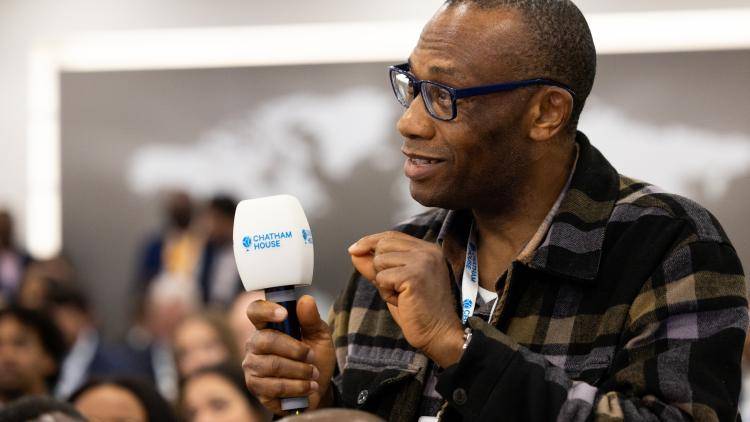
Henry Throp
Hi, Henry Throp, University of Oxford. My question is for Minister Timothewos.
Minister Gedion Timothewos
Yes.
Henry Throp
In 2050, four out of ten babies will be born in Africa and Ethiopia will be – have the fifth largest population of under 18s. What would you say – how would you respond to the idea of COP32 being the children’s COP and what practically could be done to ensure these young people have a safe and healthy upbringing?
Ana Yang
Nice question.
Liliia Akatova
Hi everyone, I’m Liliia Akatova, Policy Analyst at the London School…
Ana Yang
I’m not sure it’s working.
Liliia Akatova
Oh…
André Aranha Corrêa do Lago
Yeah.
Liliia Akatova
…I’ll try and…
André Aranha Corrêa do Lago
Or I’m getting…
Ana Yang
I – could you give the – sorry, I think that is not working, sorry.
André Aranha Corrêa do Lago
But…
Ana Yang
Your question’s definitely working. I just couldn’t hear…
Liliia Akatova
Can you hear me now?
Ana Yang
Yeah.
André Aranha Corrêa do Lago
Yes.
Liliia Akatova
Okay, I’m Liliia Akatova, a policy Analyst at the London School of Economics, and I have a question for the Minister Murat Kurum. You mentioned circular economy as one of the main action points on your agenda and also, increasing recycled content and increasing recyclability, and my question is, can you elaborate a little bit more on what this entails and is that related to some extent to the Global Plastic Treaty negotiations? [Mother tongue].
Ana Yang
Thank you. Okay, so we have – sorry, my brain went a little bit kaput. So, the connection between climate, land, biodiversity, the COP for children and also, on circular economy and waste and plastic. I think there are questions – two questions for you…
Minister Murat Kurum
[Mother tongue].
Ana Yang
…Minister Kurum, and then a question on the COP for children, which now is stuck in my head.
Minister Murat Kurum
[Mother tongue – 54:39-59:20].
Ana Yang
Thank you.
Minister Gedion Timothewos
Alright, quickly in two minutes let me reflect on the two really interesting questions that I have received. On biodiversity, climate and land, you know, Ethiopia happens to be a country with a very substantial ecological diversity. We have lowlands that are 100m below sea level and also in the same country, mountain peaks that are above 4,000m. So, with that ecological diversity, there is also a lot of biological diversity between flora and fauna. So, pre – we understand the importance of preserving this for various reasons, so connecting it with climate, land and also food systems, agriculture, these are things that we are interested in and as our strategies and priorities evolve, this is something I would look into even further.
Now, on young people, children, I agree with you. You know, according to some projections I have seen, around 2051, in every four people would be on the African continent. So, I was saying to colleagues earlier that ‘Everyone is from Africa, but very soon, most people will be on Africa, as well.’ And so – and it is a very young population. For Ethiopia, right now, we have a population of around 130 million people. Two third are very, very young. By Ethiopian standards, I am considered to be an elder uncle.
So, taking this into account, I mean, and also the nature of the topic we are dealing with, it is definitely about the future and the future of these young girls and boys. So, we are also trying to see how we can involve them in the COP process in various ways, as volunteers, as contributors to, or as observers of the process. So, we are trying to think through these issues and we appreciate your input. Thank you very much.
Ana Yang
Thank you. So, we’re coming to the hour, but I would – yeah, we – I – can I ask – I’m going to give 30 seconds for each of the President for you to do a call to action, right? If you want the panel – with the – for the ple – the people here in the pan – in the plenary and also people online watching, like, what is your call to action? So, Ambassador, would you like to start?
André Aranha Corrêa do Lago
No, but I will.
Ana Yang
Sorry, I should have given you a, sort of, a heads up.
André Aranha Corrêa do Lago
Yes.
Ana Yang
But from your heart.
André Aranha Corrêa do Lago
Yes, from my heart. So, first, maybe that belief in multilateralism and the belief that the structures that we have created are imperfect but have to be used in the best possible way. So, we cannot think that action will come from undoing what we already have. Action has to come from using much better what we have done, and I think all these years, we have built quite a solid structure for us to do the right thing.
Ana Yang
Amazing, love that. Minister Kurum, 30 seconds, calling – call to action?
Minister Murat Kurum
[Mother tongue].
Ana Yang
30 seconds.
Minister Murat Kurum
Uh-huh.
Ana Yang
Okay.
Minister Murat Kurum
[Mother tongue – 63:52-64:17].
Ana Yang
Love it, and Minister Timothewos.
Minister Gedion Timothewos
Thank you. Call for action in 30 seconds, I will simply say keep hope alive and come to our Addis.
Ana Yang
I love that. Thank you very much [applause].