Meat alternatives – non-traditional protein sources intended to be used and consumed in a similar way to meat products – are available around the world. Some of these have long been readily available in certain regions. For example, the Quorn meat substitute brand, launched in the UK in 1985, uses fermentation technology to create mycoprotein (a type of single-cell protein) from the soil fungus Fusarium and is well established in many Western markets. Insect proteins, already in the mainstream in some Asian markets, are used by a growing number of companies in Europe and North America in products for human consumption and in animal feed.
In recent years, the interest, innovation and investment in meat analogues – non-traditional protein sources that are designed to be direct, imitative substitutes for conventionally produced meat – have increased significantly. Technologies are delivering, or are expected to deliver, products that have the potential to reduce traditional meat consumption without a drastic shift in eating behaviours. These developments coincide with the growing realization that, for environmental and public health reasons, reducing global traditional meat consumption is both necessary and desirable.
Two broad categories of meat analogues – advanced plant-based ‘meat’ and cultured meat – mark a particularly radical departure from the traditional meat and non-meat options seen to date. The driving principles in their production are mimicry and efficiency – principles identified by Mark Post, the innovator behind the first lab-grown burger in 2013, as the two key requisites for the acceptance and industrialization of a meat alternative. Both raise challenging questions for producers, policymakers and consumers alike around how ‘meat’ should be defined and regulated, and around the possibility of satiating the world’s growing demand for meat while dramatically scaling back animal agriculture.
Plant-based ‘meat’
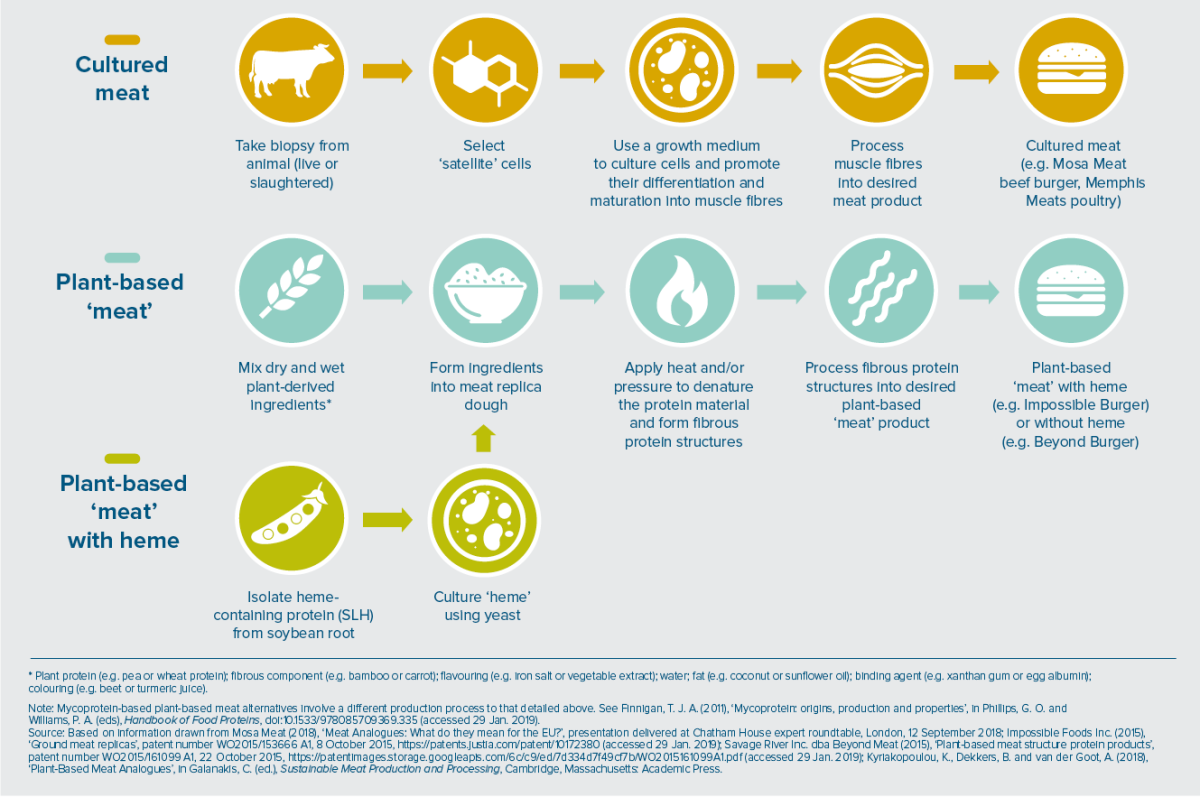
Advanced plant-based ‘meat’ products are those that use plant-derived ingredients to directly mimic animal-derived meat and which are designed to be indistinguishable from their animal-based equivalents. Drawing a clear line between plant-based ‘meat’ and the plant-based meat alternatives that have come before is not straightforward. The distinction on which plant-based ‘meat’ innovators have patented – or sought to patent – their products and processes lies in the versatility and sensory experience of cooking and eating. They are marketed predominantly as processed meat products – burgers, sausages, meatballs – but are distinct from more mainstream plant-based meat alternatives in that they contain novel ingredients or use innovative processes intended to achieve an unprecedented degree of mimicry in taste, texture, look and cooking qualities. Advanced plant-based ‘beef’ burgers, for example, developed by companies such as Beyond Meat, Impossible Foods and Moving Mountains, comprise a unique set of ingredients that, in combination, produce a patty whose texture resembles that of minced beef, has a pink hue that turns brown on cooking, and exudes liquid on eating (see Figure 1).
For the most part, these products use non-genetically engineered ingredients such as beetroot juice to achieve these qualities, while Impossible Foods’ ‘Impossible Burger’ contains soy leghemoglobin (SLH), a plant protein. SLH is isolated from the root of the soybean plant and, like haemoglobin in blood and myoglobin in muscles, it is a molecule that carries oxygen, storing it in the roots of legumes. When the ‘Impossible Burger’ is cooked and eaten, SLH is exuded as a red-tinted liquid – comparable to myoglobin, the substance that ‘bleeds’ from minced beef – and gives a metallic iron-like (and thus meat-like) flavour to this product.
Cultured meat
Cultured meat is grown in vitro from animal-derived stem cells using a growth medium (Figure 1). It is ‘biologically equivalent’ to meat but is not harvested from a living animal. Culturing meat involves biotechnological processes borrowed from regenerative medicine (the branch of medicine that aims to develop ways to regenerate cells, tissues or organs) and aims to scale up these approaches to manufacture meat through cellular and tissue culture, termed ‘cellular agriculture’. Although no agreement has yet been reached on the definition for this process, cellular agriculture entails using a ‘set of technologies to manufacture products typically obtained from livestock farming, using culturing techniques to manufacture the individual product’.
The cells used to initiate the cell culture can be sourced from primary animal tissue through a biopsy procedure; alternatively, cell lines (stem cells) that can replicate indefinitely can be produced via genetic engineering, gene editing or through induced or spontaneous mutations. Cells are cultured within specific liquid media, which provide the conditions needed for tissue growth. The exact media used will depend on the cell species and tissue type, but the process requires nutrients (supplied by foetal calf or horse serum, chicken embryo extract, collagen, serum-free media, etc.). Other inorganic and organic components (antibiotic/antimitotics or carbohydrates, amino acids and vitamins) can be added to the media to enable cell growth. A scaffold is required for cells to proliferate and develop the structure required for producing a tissue (for example, a muscle) instead of an unorganized collection of muscle cells. The components used in these processes are dependent on their stages of development, and research in this area is still in its infancy. For example, even though a few companies, such as Higher Steaks and Aleph Farms, already use only animal-free growing media, more research is needed for lowering the costs of serum-free processes.