Ukraine is a unitary state with three tiers of administrative-territorial division. At the regional level, there are 24 oblasts, the Autonomous Republic of Crimea, and two cities with special status – Kyiv and Sevastopol (in Crimea). These regions are subdivided into 490 districts (rayony). Prior to the start of the decentralization reforms, there were approximately 10,900 municipalities at the local level, i.e. communities of cities, towns, villages, etc.
Voters in Ukraine directly elect regional, upper subregional and local councils. Currently, the regional and upper subregional councils of the oblasts and rayony have no constitutional right to establish their own executive committees. They delegate implementation of their decisions to centrally staffed executive organs, i.e. the regional and upper subregional state administrations, whose heads are appointed by the president. This institutional framework severely limits the self-governance of oblasts and rayony. In contrast, lower-level municipalities enjoy a constitutional right to establish their own executive organs (vykonavchi orhany). However, except for larger cities, Ukraine’s self-governing basic political units used to be too small and too poor to provide proper public services to their residents.
The post-Euromaidan government initially sought the simultaneous reform of regional, subregional and local self-governance. In addition to promoting the amalgamation of territorial communities and granting the new ATCs additional tax-raising powers, the idea was to allow regional and upper subregional councils to establish their own executive committees. So far, however, the post-Euromaidan parliament has managed to approve legislation only on municipal self-governance, territorial consolidation and the voluntary merger of basic communities. Empowerment of regional and upper subregional self-governance, as initially envisaged by its advocates, has yet to occur.
In April 2014, the post-Euromaidan national government adopted the so-called ‘Concept of the Reform of Local Self-Government and Territorial Organization of the Government of Ukraine’. This agenda set out how the government intended to meet its ambitious objectives: empowering local government, improving the state’s capacity to deliver public services, and fundamentally redesigning the country’s administrative structure and territorial divisions.
An unprecedented degree of international technical and financial assistance helped to jump-start the agenda’s implementation within the following year. The multi-donor ‘U-LEAD with Europe’ initiative has played a key role in supporting this reform, establishing a ‘House of Decentralization’ in Kyiv and drawing on extensive, mainly EU-provided funds (approximately €100 million). Regional U-LEAD bureaus in the country’s 24 oblasts have also featured prominently in the process.
Countries particularly supportive of Ukraine’s decentralization include Germany, Sweden, Canada, Poland and Switzerland. The United States launched two multi-million-dollar programmes of its own in support of the reforms: PULSE (Policy for Ukraine Local Self-Governance) and DOBRE (Decentralization Offering Better Results and Efficiency). The Recovery and Peacebuilding Programme in Ukraine, run by the United Nations Development Programme (UNDP), also has a special focus on administrative decentralization. Altogether, Western donors have provided more than €250 million to date for Ukrainian decentralization and closely related reforms.
Since 2017, Ukraine has received additional specialized advice on decentralization from Germany via the latter’s G7 envoy, Professor Georg Milbradt. Ukraine also benefits from legal expertise provided through Council of Europe programmes, including through the ‘Decentralization and Local Government Reform in Ukraine’ project.
Unlike in some earlier cases, the current decentralization process benefits from exceptionally close coordination between international partners. There has also been strong coordination between these partners and the Ukrainian government ministry, principally responsible for the reforms, known until recently as the Ministry of Regional Development, Construction, Housing and Communal Services. Cooperation is institutionalized via the Donor Board on Decentralization Reform in Ukraine, which includes thematic working groups and assesses implementation. The Donor Board was co-chaired until 2019 by a designated vice-prime minister, until recently Hennadiy Zubko (who was simultaneously the minister for regional development, construction, housing and communal services), and by a representative of the donors.
Some of the most important early decentralization initiatives concerned the reorganization of the country’s territory and finances. Since 2015, parliament has passed several laws regulating the voluntary amalgamation of communities into bigger ones. These new, larger ATCs are now almost entirely responsible for local development and the provision of basic public services. According to the above-mentioned Concept of the Reform of Local Self-Government and Territorial Organization of the Government of Ukraine, the country’s approximately 10,900 (mostly very small) local communities were to be merged into about 1,200 ATCs. In late 2018, however, the then prime minister, Volodymyr Hroysman, mentioned a new number of 1,600–1,800 ATCs that would eventually be established.
Using the currently voluntary procedure, local self-government bodies and residents of neighbouring communities are starting and directing the amalgamation process themselves. The central government provides official guidelines on establishing sustainable ATCs capable of adequately delivering basic services such as healthcare, schooling, etc. Simultaneously, the central and regional bureaucracies are involved. Oblast administrations design ‘perspective plans’ for the formation of amalgamated communities for each region, in accordance with criteria set by the central government. Elected regional councils approve such plans, which in turn need approval from the central government.
The local self-governance bodies that initiate voluntary amalgamation can consult the perspective plans, yet can also choose not to do so. After the smaller constituent municipalities have drafted their decisions to amalgamate with each other, they inform the relevant regional state administration of their intentions. They need to obtain consent and confirmation that a given draft decision does not violate the constitution and laws of Ukraine. Once consent is obtained, the local initiators finalize the amalgamation and the relevant regional state administration asks the Central Electoral Commission to announce elections for the new ATC.
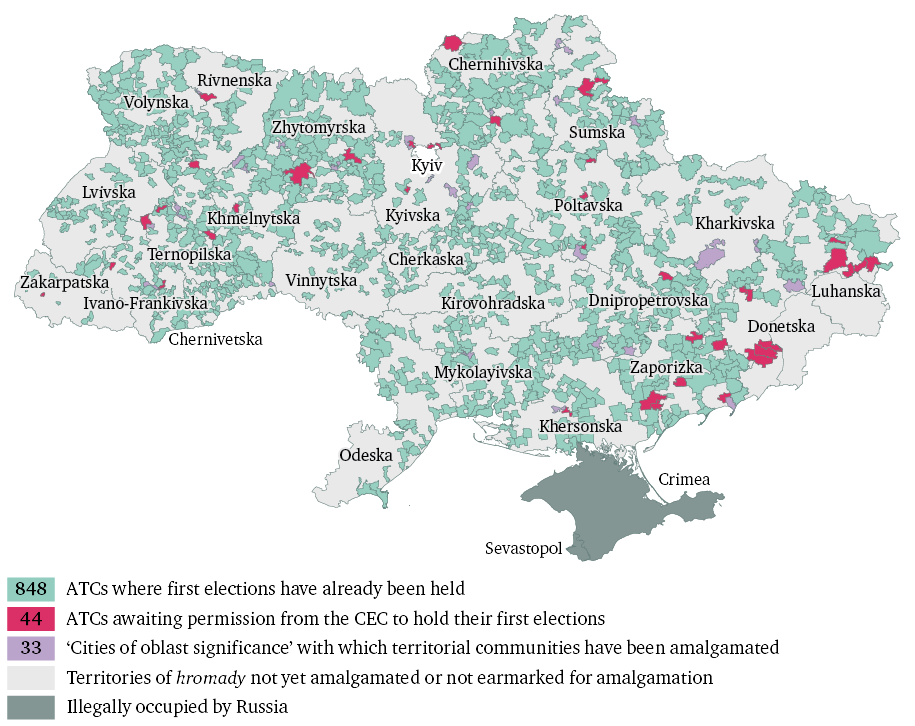
The first local elections in newly established ATCs mark the final step in the voluntary amalgamation of territorial communities. By July 2019, 881 ATCs had already held their first elections. These ATCs included 66 that had been waiting since late 2018 to hold elections; the polls eventually took place on 30 June 2019. As of July 2019, another 44 ATCs were waiting for a decree from the Central Electoral Commission allowing them to hold their first local elections, likely to take place in October or December 2019.
Substantial fiscal decentralization also got under way in late 2014 when parliament amended the budget and tax codes. These changes provided the new ATCs with budgetary privileges similar to those of ‘cities of oblast significance’, which previously had been the only municipalities with meaningful self-government.
During 2015–19, the amalgamation of communities into ATCs was initiated voluntarily, most often by local councils. In 2020, the government intends to switch to administratively initiated mergers, i.e. to force the amalgamation of those territorial hromady not yet involved in the earlier voluntary procedure. This is to speed up the establishment of ATCs, and to ensure that no municipalities remain unamalgamated before nationwide local elections scheduled for October 2020.
Substantial fiscal decentralization also got under way in late 2014 when parliament amended the budget and tax codes. These changes provided the new ATCs with budgetary privileges similar to those of ‘cities of oblast significance’, which previously had been the only municipalities with meaningful self-government. ATCs are now allowed to maintain direct budgetary links with the central government, and to keep a substantial portion of their local tax revenues (including 60 per cent of personal income tax collected).
The ATCs also receive subsidies from the central government – including, until 2020, funds for establishing their newly merged institutional and social infrastructure. Special ‘equalization’ grants are available for correcting disparities in local development between communities. Block grants for healthcare (until July 2018) and education have further improved the financial capacities of the ATCs, allowing them to take on more responsibility for public services. The ATCs are, for instance, responsible for managing primary and secondary education in their territories. This is in contrast to the situation in non-amalgamated communities, where self-government remains weak and where the local bureaucracy is still dependent on guidance from centrally appointed regional and upper subregional executives – i.e. the heads of state administrations at the oblast and rayon levels.
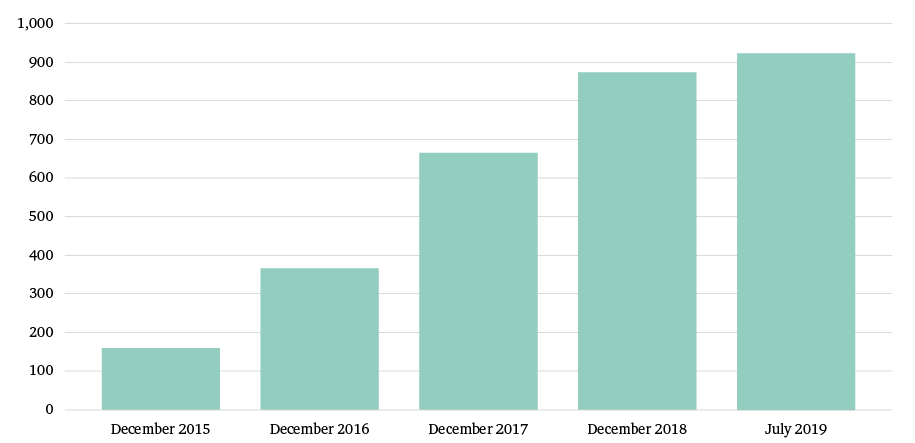
Amalgamation in Ukraine has been relatively rapid in comparison to similar reforms in other European states. Ukraine’s first 159 ATCs were created in 2015, their number rising to 366 the following year, 665 by end-2017 and 874 by end-2018. As of July 2019, there were 925 ATCs (see Figure 1).