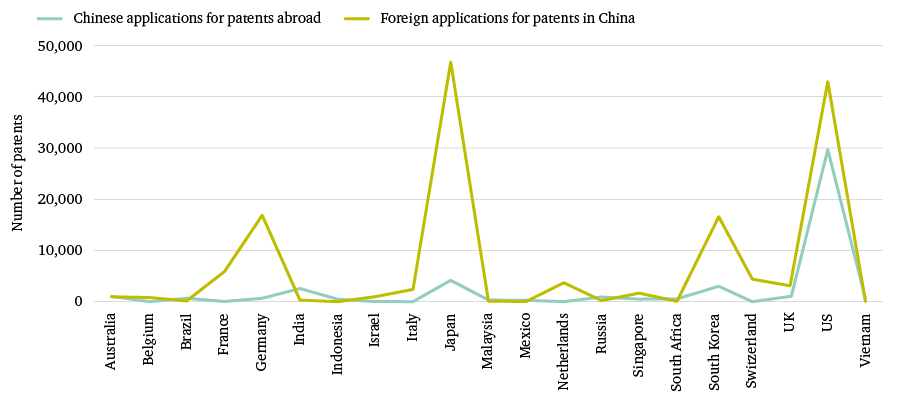
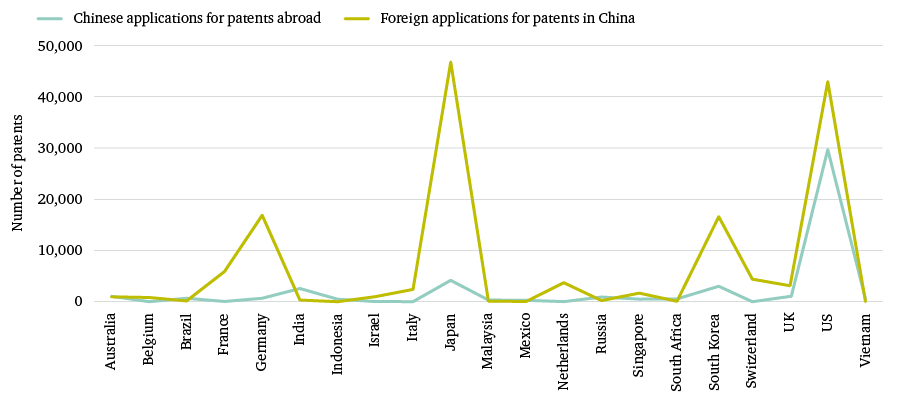
Chinese companies also enthusiastically seek to invest in high-tech R&D abroad, aiming to benefit from more advanced financial and human capital and a more consistent business and policy environment. So far, most of the R&D investment has flown to Europe, North America and China’s rich Asian neighbours, but an increasing amount is now going towards emerging and developing economies, especially those involved in Belt and Road Initiative (BRI) projects, for example, Israel, Russia, Turkey, Pakistan, Thailand and Nigeria. The most popular sectors are semiconductors, AI, aerospace, pharmaceutical and biotech, telecommunications and data science.
Among the top 2,500 R&D firms worldwide, 438 are Chinese. Although most of their R&D expenditure stays in China, many Chinese firms have set up R&D centres abroad. Huawei recently ranked fifth in terms of global R&D investment and has offices in Europe that boost the company’s technological innovation. However, a 2012 study showed that Chinese overseas R&D investment was mainly engaged in superficial exploration of existing technologies rather than facilitating radical technological innovation.
Another method of accessing technological innovation is through mergers and acquisitions (M&A), which are popular with Chinese companies. At present, there are numerous proposed deals under scrutiny by national authorities. The Chinese government is supportive of both these forms of overseas investment in the HTS. Almost all Chinese overseas M&As aiming to acquire technology have taken place in western developed economies, and the number of these deals peaked in 2016. In particular, deals in the ‘technology, media and telecommunication’ (TMT) sector surged between 2012 and early 2018.
The tide of Chinese buy-ups caused major concern among European and US politicians and business communities. They are worried that China would soon control a substantial part of their HTS, a fundamental driving force of their economies, despite the investment in high-tech companies being a relatively small part of China’s total overseas FDI. Moreover, some Chinese companies invested in or approached western companies whose technology or complete products have both civilian and military applications or whose products are sold to other production lines with a military application. These actions have made the US government particularly vigilant, as it is concerned about the possibility of military conflict with China.
China’s outbound M&A in the HTS met strong resistance from the US and Europe in 2017, and President Trump’s ‘trade war’ in 2018 has particularly targeted China’s HTS. In response the Committee on Foreign Investment in the United States (CFIUS), the main foreign investment screening institution of the country, strengthened its rules and practices for screening and investigating foreign investment in key strategic sectors, including technology. Prior to the ‘trade war’, China was already CFIUS’s main target; there is now little doubt that a stronger CFIUS will make Chinese FDI in US HTS even more difficult. This has also encouraged EU lawmakers to strengthen their own screening mechanism for foreign investment in sectors with important security influences. The new EU foreign investment framework aims to safeguard ‘Europe’s security and public order in relation to foreign direct investments into the Union’. The political implication of China’s cross-border technology investment has escalated.
Chinese firms also organize and participate in cross-border R&D collaboration, which is strongly encouraged and supported by the Chinese government. The ‘13th Five-Year National Plan for the Development of Strategic Emerging Industries’, issued by the Chinese State Council in 2016, explicitly encouraged building ‘new platforms’ for international collaboration in R&D, including ‘international innovation collaboration centres’, ‘innovation parks’, and ‘overseas R&D centres’ that bring together firms, industry associations, governments, investors, researchers, and legal and other service institutes from various countries. In fact, the Chinese government has encouraged and facilitated such collaboration since the announcement of the ‘going global’ strategy in the early 2000s, which drove the establishment of numerous ‘China overseas technology parks’ abroad, and ‘international science and technology collaboration bases’ in China, but these projects only started to proliferate and generate research products in recent years.
Chinese overseas technology parks were initially built with Chinese government funding in developed economies and tended to be co-managed by both Chinese and host governments, though occasionally private enterprises managed these parks. As the Chinese economy expanded, more and more Chinese and foreign enterprises took the initiative to build and manage such parks. Recent examples include Hanhai Investment Inc. (the first Sino–US high tech business incubator in Silicon Valley); the Cambridge Innovation Park China Centre; China Belgium Technology Centre; China–Germany Innovation and Technology Exchange Centre in Hamburg; and the forthcoming Sino–German Scientific and Technological Innovation Park, in Heidelberg.
Meanwhile, operational matters for international science and technology collaboration bases are all organized at the local level, apart from the initial certification by the Chinese Ministry of Science and Technology. Until March 2017, there were 642 certified international science and technology collaboration bases in China, engaging in various R&D activities and generating diverse research products.
Cross-border R&D collaboration allows Chinese innovators to be a more constructive part of the global technology network and appear less threatening in Europe and North America. For example, Yili, China’s largest dairy producer, together with Wageningen University, a Dutch university with strong agricultural research, founded an innovation centre in 2014 on the university campus. The centre aims to explore new technologies for food processing and packaging as well as new scientific insights in food safety and nutrition. In January 2018, US pharmaceutical company Pfizer signed an agreement with a Chinese partner, Kintor, to develop medicine for cancer treatment together. Daimler and Chinese automobile company BYD founded a joint venture in 2010 in order to develop an electric car together, Denza, which was eventually launched in December 2014. China’s NIO automobile company has recently signed a strategic cooperation agreement with German manufacturer Continental AG, aiming to collaborate on developing self-driving technology.
International techno-scientific research collaboration
This is a type of collaboration operated by academic researchers in techno-scientific fields, often initiated by governments, universities and/or other research institutes. The Chinese government has been actively pursuing opportunities for international techno-scientific research collaboration that involves Chinese scientists. President Xi Jinping advocated collaboration with foreign academic and research institutes and endorsed the concept of ‘science with no borders’ in a recent speech. A large number of the international science and technology collaboration bases mentioned above are led by universities and other research institutes and granted large autonomy and financial resources. The ‘13th Five-Year National Plan for the Development of Strategic Emerging Industries’ explicitly encourages Chinese institutes to participate in international ‘large-scale science’ research plans and projects. Less than two years later, in March 2018, the Chinese State Council issued a set of guidelines to assist Chinese researchers to take the lead in launching international ‘large-scale science research’ plans and projects and use both domestic and overseas scientific resources. This shows the Chinese government’s confidence and ambition in making original breakthroughs to solve key scientific problems and in becoming a leader in the global technology network.
Apart from the traditional method of providing funding, the Chinese government has also played a direct role in recruiting scientists from abroad through a series of incentive schemes, such as the ‘Thousand Talents Plan’, ‘Thousand Youth Talents Plan’, ‘Thousand Foreign Experts Plan’, ‘Special Talent Zone’, and ‘Ten Thousand Talents Plan’. These schemes promise talented researchers good salaries, research funds and accommodation. Through these scientists, their new employers, namely top Chinese universities and research institutes, aim to integrate further with international academic communities that are committed to the most advanced techno-scientific research. These schemes have successfully attracted some scientists, mostly of Chinese origin, to return to China. Many of them retain affiliations with various institutes abroad, and thus play the desired ‘bridging’ role.
The ‘13th Five-Year National Plan for the Development of Strategic Emerging Industries’ explicitly encourages Chinese institutes to participate in international ‘large-scale science’ research plans and projects.
However, some of the scientists were caught in the crossfire of the US–China trade war and accused of illegally transferring key technologies from the US to China. In August 2018, the US National Institutes of Health sent a letter to more than 10,000 institutions warning about some ‘foreign entities’ interfering in biomedical research in the US. In April 2019, three ethnically Chinese scientists were ousted by MC Anderson Cancer Center because of their undisclosed links with China; soon after, two Chinese-American geneticists were fired by Emory University for not disclosing funding from China. In January 2019, the US Department of Energy banned its employees and grant recipients from participating in talent-recruitment programmes run by ‘sensitive’ countries, a decision clearly targeting China. The US–China conflicts have spread to other parts of knowledge and academic exchanges. In June 2018, the US government reduced the duration of visas for Chinese students who study robotics, aviation and high-tech manufacturing in the US, from five years to one year. Meanwhile, the US government has cancelled the 10-year US visa of several Chinese intellectuals because of their connections with the Chinese government. In return, China did not grant a visa to the White House adviser Michael Pillsbury who, as a result, could not attend a forum in Beijing in April 2019. These events have made the future for China–US techno-scientific research collaboration more uncertain.
Political implications of China’s rise in global technological innovation
China’s engagement in global technological innovation has important political implications. First, it is revising the state’s role in the globalization of technological innovation. When technology was not dominating daily life as it is now, scholars had already argued that as technology, especially information technology, continued to develop and diffuse, the scope and structure of both domestic and international governance would change. The state’s role would weaken, and new actors and networks would emerge to fill the governance role. This reflects the general trend of globalization of technological innovation, but it does not entirely apply to China.
The Chinese state remains powerful in making national-level technology policies and technology-oriented industrial policies. Instead of losing authority to the informed masses, the Chinese state uses technology to strengthen its own executive power. The state–technology relationship in China is complex. On the one hand, the Chinese government’s strong political and financial support has allowed a number of tech giants to rise and expand. It has facilitated Chinese companies’ R&D activities, both at home and abroad. It has strongly pushed foreign companies to collaborate with Chinese companies in R&D and to transfer their technology to China. Moreover, Chinese companies’ outbound M&A in foreign HTS are often backed by Chinese state-owned banks, without which many deals would not be possible.
There exists different degrees of scepticism and distrust of China’s political regime among western governments, in particular, the US government is concerned about potential military conflict with China and the EU sees China as a ‘systemic rival’.
On the other hand, China’s strong push for domestic technological progress and outward technological expansion has caused uneasiness in the US and Europe. First, European and US companies are frustrated with the Chinese government’s strict control over their business in China, especially regarding technology transfer, information sharing and operational prohibitions. Second, foreign companies are concerned about the Chinese state’s financial assistance for Chinese companies’ overseas M&As, which may cause unfair competition. Third, Western governments’ objection to letting Chinese companies build telecommunication infrastructure or provide internet and communication services in their countries is mostly to do with concerns about the Chinese state’s interference in these companies. There exists different degrees of scepticism and distrust of China’s political regime among western governments, in particular, the US government is concerned about potential military conflict with China and the EU sees China as a ‘systemic rival’. Hence, they are deeply worried that the Chinese government may access crucial data of western economies and societies through Chinese telecommunication and information companies that operate in the west and use these data against their governments. Although there is no concrete evidence showing the Chinese government manipulating foreign data, the scepticism and distrust mentioned above is strong enough to persuade some Western governments to ban Chinese telecommunication and information companies.
An additional political implication refers to the prominence of having a comprehensive mechanism in the concerned country/region that measures the risks of engaging with foreign tech companies and academic and research institutes. The EU is currently trying to build one. An effective mechanism must involve technicians and scientists who can accurately detect technical problems and assess the possible risks of cross-border technological collaboration from a technical perspective. This would help to ensure that normal cross-border collaboration in technological innovation is not hijacked by geopolitical competition and rivalries between superpowers.
As mentioned above, the globalization trend of technological innovation is irreversible. With appropriate regulations, cross-border collaboration significantly increases the efficiency and productivity of technological innovation. The rapid growth in the Chinese HTS would not be possible without an open environment for collaboration. Even after Huawei was heavily criticized by the US government, its director Ren Zhengfei still expressed the company’s appreciation to the US companies that provided Huawei with equipment, technology and consultancy and ‘taught Huawei how to walk’ in the past 30 years. He was particularly grateful for those US companies that strived to negotiate with the US government about continuing to cooperate with Huawei after it was blacklisted. Meanwhile, western tech companies also benefit from collaborating with their Chinese peers, presumably in a fair and transparent policy environment. Especially in the field of AI technology, no company would like to lose access to a database as large as China’s given its huge population and market circulation. Therefore, state and regional governments need a way to accurately measure the risks of engaging with foreign tech companies and academic and research institutes, so that conducive collaboration is not affected by shifts in political environments.
In addition, an important condition for conducive cross-border collaboration of technological innovation is effective regulations on development, transfer, utilization, and commercialization of technology, both at the domestic and international levels. This demonstrates a further political implication of China’s globalization of technological innovation: governance of technology. Many conflicts between China and the US that are fuelling the trade war refer to inadequate IP protection in China. The US is concerned about China’s efforts in technological innovation threatening the rule-based global technological order that respects IP. In contrast, the Chinese government thinks the US-led international technology standard-setting system is not suitable for late developers like China. As a result, the Chinese government has established national technology standards that satisfy China’s interests better and sought to promote some of them as alternative global standards.