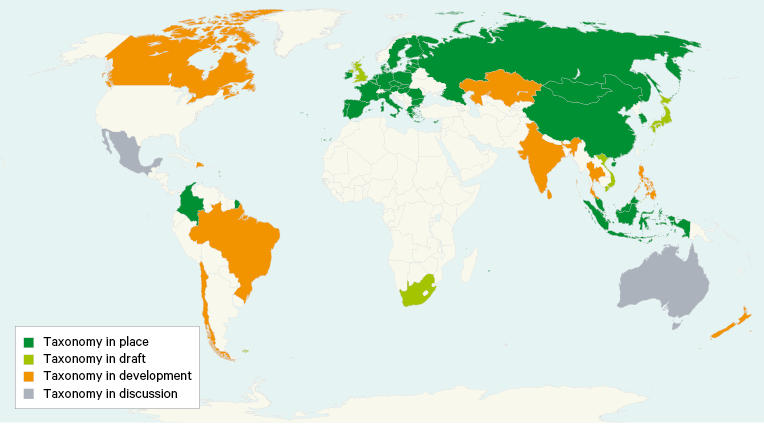
Despite the importance of the circular economy for economic resilience, social prosperity and environmental regeneration, investment in circular activities remains severely limited. Sustainable finance taxonomies could help close the circular finance gap.
The transition to a circular economy is a vital industrial strategy to mitigate the impacts of the production and consumption of materials by intentionally designing out waste and pollution, recirculating products and materials (at their highest value) and regenerating nature. Yet, the circular economy faces a significant gap in the availability of finance.
A key question therefore is how can additional finance and investment be leveraged to accelerate the transition. The introduction of sustainable finance taxonomies holds promise in this respect. Sustainable finance taxonomies classify and categorize criteria for identifying sustainable economic activities and investments.
The EU is in the process of launching one of the world’s most ambitious sustainable finance taxonomies, and has made the transition to a circular economy a key objective. The EU Taxonomy seeks to classify a set of economic activities that may substantially contribute, or cause significant harm, to the circular economy transition, judging them against specific criteria. It therefore provides lessons for policymakers and taxonomy designers elsewhere on the opportunities and unique challenges they may face when attempting to leverage taxonomies to accelerate the circular economy transition.
1.1 The importance of the circular economy for economic prosperity and resilience
Natural resource extraction, processing, use and the dumping of resultant waste are responsible for around one-half of global greenhouse gas emissions, 90 per cent of territorial biodiversity loss and water stress, and one-third of pollution. The transition to a circular economy is a vital industrial strategy to mitigate the impacts of the production and consumption of materials by intentionally designing out waste and pollution, recirculating products and materials (at their highest value) and regenerating nature.
In addition to offering environmental benefits, the circular economy offers an alternative strategy for economic prosperity amid supply-chain volatility, growing geopolitical tension and looming recession. Circular solutions have been predicted to generate global growth opportunities approaching $4.5 trillion by 2030. Research in 2021 by Bocconi University, the Ellen MacArthur Foundation and Intesa Sanpaolo (based on a sample of 222 companies) showed that companies can deliver superior risk-adjusted returns by implementing circular approaches. Circularity can also help improve countries’ financial resilience and reduce environmental damage.
During the past 10 years, the circular economy transition has progressed from being merely a concept to operationalization in national and regional economic strategies – a prime example being the launch of the EU’s Circular Economy Action Plan (CEAP) 2.0 in 2020. Further, more than 450 circular-economy-targeted policies and legislation and 54 national roadmaps or strategies have been introduced in over 100 countries, while development of a wide range of standards is ongoing.
Despite such developments, overall circularity of the global economy has decreased in the last five years, from 9.1 per cent in 2018 to 7.2 per cent in 2023.
1.2 The circular economy finance gap
In most sectors, circular models still represent a small share of the overall market. Finance for circular economy initiatives has thus been scarce. While billions of dollars are being invested in circular solutions by both the private and public sectors, trillions are still invested each year in existing ‘linear’ models, inhibiting a systemic shift in the economy. Initial estimates by Chatham House and Just Economics show that worldwide public sector spending on the circular economy totalled between $500 billion and $600 billion in 2020, compared with overall government spending of about $13 trillion. Meanwhile, the value of annual circular economy spending by the corporate sector is estimated at around $850 billion, compared with $35 trillion in linear spending, suggesting that the circular economy’s share of total global investment is only about 3 per cent each year.
Worldwide public sector spending on the circular economy totalled between $500 billion and $600 billion in 2020, compared with overall government spending of about $13 trillion.
In addition to this lack of investment, the circular economy faces a significant gap in the availability of finance. The circular finance sector and existing circular investment funds account for an estimated $50 billion, compared with $100 trillion of financial assets under the management of the 500 largest asset managers worldwide. This is due, in part, to the circular economy being a relatively new topic for investors and the financial sector generally. Awareness of the circular economy is still low and there is a lack of tools available to assess which activities substantially contribute to a circular economy, as well as the investment opportunities and risks associated with these activities.
Nevertheless, sustainable finance frameworks, tools and standards have recently proliferated at the national and regional levels. The launch of the International Sustainability Standards Board (ISSB), under the International Financial Reporting Standards Foundation (IFRS Foundation), at COP26 in 2021 was a pivotal moment for sustainability finance. The ISSB will develop a global baseline of high-quality sustainability disclosure standards to meet investors’ information needs.
1.3 Unlocking investment via sustainable finance taxonomies
Given the rapid conceptual and operational development and uptake of the circular economy in both the public and private sector, a key question is how can these new sustainable finance frameworks and tools be leveraged to accelerate the circular economy transition? One of the most important of these developments is the emergence of sustainable finance taxonomies.
A taxonomy, put simply, is a shared framework and classification system for defining environmentally sustainable investments. It ensures all stakeholders share an understanding of what sustainable economic activities are and helps prevent ‘greenwashing’ by providing transparency. More than 20 sustainable finance taxonomies have now been launched or are at various stages of development worldwide. The circular economy is largely missing from most of the existing taxonomies but is being incorporated to varying degrees within several of those under development (for example, those being developed by the EU, South Africa, the UK and the ASEAN region).