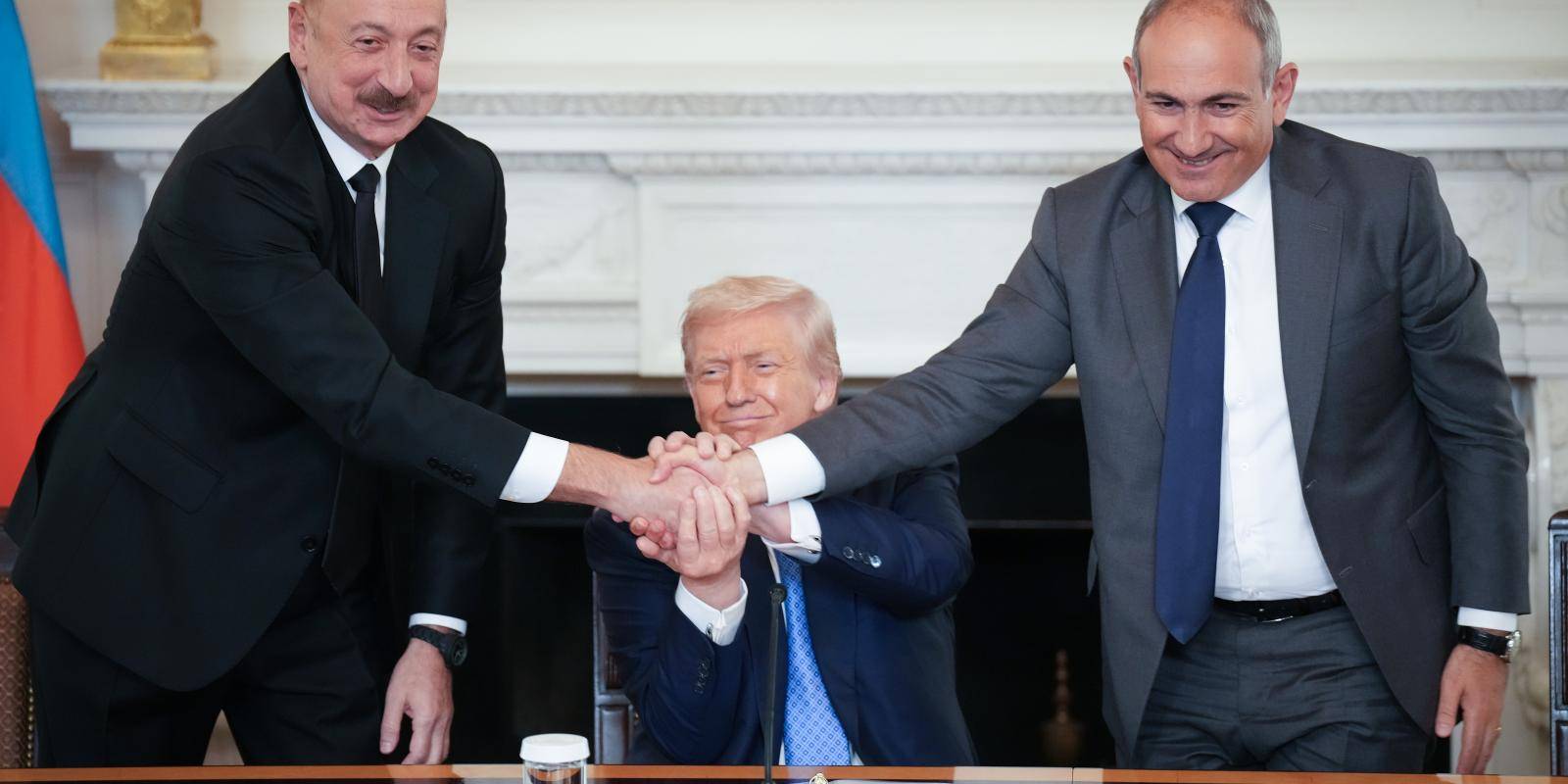

The Armenia–Azerbaijan peace process has turned a new page following a trilateral summit between Azerbaijani President Ilham Aliyev, Armenian Prime Minister Nikol Pashinyan and US President Donald Trump on 8 August.
Several documents – although not an actual peace treaty – were signed during the meeting in the Oval Office, hailed as a landmark in the convoluted negotiations between the two states. Their last war ended in an incomplete Azerbaijani victory in 2020, followed by a series of escalations culminating in Azerbaijan’s military takeover of Mountainous Karabakh in 2023 and the mass displacement of its entire Armenian population.
Geo-strategic optics dominate discussions of the White House summit and its implications. Yet ultimately the de-securitization of Armenia–Azerbaijan relations will depend more on domestic political shifts away from ingrained conflict narratives.
Initialling normalization
The summit resulted in two important, yet provisional, outcomes for the peace process.
The first is the initialling of a 17-article treaty text governing the normalization of relations. This is not a new or American-brokered text, but the product of bilateral negotiations between Baku and Yerevan ongoing since 2023 and completed in March of this year. Following the Oval Office meeting, the treaty text was published on 11 August, itself an important outcome that ‘locks in’ its contents and permits a public discussion.

The treaty text does not, in itself, contain many surprises. It is largely a technical document governing normalization on the basis of republican borders inherited from the Soviet Union, affirming the absence of territorial claims on each other and precluding the raising of any such claims in the future (Article 2).
The treaty is also yet to be signed. At the White House, one Azerbaijani precondition for signature was resolved – a joint request for the dissolution of the mediation architecture set up in the 1990s by the Organization for Security and Co-operation in Europe (OSCE), known as the ‘Minsk Group’.
But another – Azerbaijan’s insistence that Armenia’s constitution be revised to remove indirect references to the 1980s campaign for unification with Mountainous Karabakh – remains. Fulfilling this precondition is mired in Armenia’s unpredictable domestic politics, and ultimately, indirect public consent to this treaty through a referendum on a new constitution in 2026.
The Trump Route for International Peace and & Prosperity (TRIPP)
American input is more central to the second outcome, which is agreement on an approach to resolving thorny disagreements on connectivity.
Since 2020, Azerbaijani perspectives have centred on the 27-mile southern route connecting mainland Azerbaijan and its exclave Nakhchivan running along the border between Armenia and Iran. Baku refers to this route as the ‘Zangezur Corridor’, and stipulates exemption from Armenian customs checks and security clearance. Armenia has countered with the ‘Crossroads of Peace’, a concept advocating principles of national sovereign control and reciprocity for all connectivity.
US intervention now reconfigures the southern route as the ‘Trump Route for International Peace and Prosperity’ (TRIPP) as a joint venture between the US and Armenia. Under a long-term leasing arrangement to US private enterprises, the TRIPP purports to both preserve Armenian sovereignty and provide for ‘unimpeded’ connectivity between mainland Azerbaijan and Nakhchivan. The three leaders agreed on ‘reciprocal benefits’ for Armenian transit through Azerbaijani territory, though what this means is still unclear.
The TRIPP agreement is provisional, since the modalities of how the TRIPP will function in practice are still to be worked out. Much will depend on the consistency of US focus and the sustained commitment of future administrations which cannot be taken for granted.
In its favour, the TRIPP embodies the one common position that Armenia and Azerbaijan have shared over the last 35 years: reluctance to see a Russian monopoly on managing the conflict between them. The TRIPP agreement renders obsolete Russian supervision of the southern route as agreed in the 2020 Russian-brokered ceasefire.
Pax Americana?
Emphasizing the provisional nature of these outcomes is to acknowledge the risks facing their fulfilment. Externally, perceptions of a ‘Pax Americana’ in the fiercely competitive geopolitics of the South Caucasus are likely to induce reactions from those seen as losing out.
This risk most obviously concerns Russia, given Moscow’s historical dominance of mediation between Armenia and Azerbaijan. Moscow has already signalled its displeasure at ‘extra-regional’ involvement. Sustained Russian hostility to the TRIPP can be expected, possibly including through pressure on Azerbaijani energy infrastructure, Armenia’s trade in the Eurasian Union and the communities of both nationalities in Russia.
With significantly fewer levers, Iran has also indicated its concern at the embedding of American presence along its border, even if the solution proposed addresses Iranian concerns to see international borders respected.
A second risk is posed by any decline of American interest over time. Geopolitical branding of the TRIPP risks perceptions of a conjunctural solution that may not last long enough to complete the route. The initiative will be more likely to succeed if backed up first with support from Turkey, namely with progress on Ankara’s own normalization process with Armenia, and the European Union. Sustained commitment from a broad-based coalition of powers inside and beyond the region will be needed to keep momentum going as and when problems inevitably pile up.
Strategic amnesia
Domestically, efforts to transform ingrained conflict narratives will come up against an apparent willingness on the part of Armenian and Azerbaijani leaderships to enter a ‘pact of forgetting’, a political strategy to avoid accountability in order to facilitate a transition to peace. Article 15 of the treaty text forecloses, within a month of signature, any legal recourse for either party to mechanisms of international justice for claims related to the conflict.
