China’s economic performance has been looking grim in recent months. The growth rates of retail sales and investment spending have been falling; property prices continue to decline; and credit demand is subdued. Against a background of very weak household confidence, China’s inflation rate has been below zero in each of the past eight months, something the economy hasn’t seen since the immediate aftermath of the 2008 global financial crisis.
Last week’s Fourth Plenum of the Communist Party’s 20th Central Committee could have been an opportunity to arrest this decline, as it set the framework for the authorities’ 15th Five-Year Plan to be laid out next March.

Yet the plenum communiqué suggests a business-as-usual attitude to the economy, promising two objectives overall, neither of them new. The first is the pursuit of manufacturing self-reliance and industrial independence, achieved through technological innovation. The second is a long-standing promise to boost domestic consumption.
Of these two objectives, the one that is by far the more cherished of the authorities is to enhance China’s status as a manufacturing superpower. Beijing’s commitment to ‘rebalance’ the economy towards the consumer is a theme that has been a feature of Chinese policymaking for two decades now. But in reality, it has had little impact: in 2024, consumption still accounted for the same 56 per cent of GDP (low by global standards) that it did in 2004.
Pessimistic outlook
As we head towards formal adoption of the next Five-Year Plan early next year, it is difficult to be optimistic about near-term prospects for the economy, thanks to a few factors.
First, fiscal support was front-loaded during the early part of 2025, leaving the economy more vulnerable now as government stimulus fades. One highly visible element of the authorities’ fiscal support in the past year has been the ‘trade-in programmes’ that subsidise households’ purchases of new appliances, electronic goods and the like. Since these subsidies – which in any case merely borrow consumption from the future – are running low, China’s retail sales growth rate is now weaker than in the US.
In any case, the efficiency of government support for the economy – the impact that government spending has on GDP, known as the ‘fiscal multiplier’ – seems to be falling fast. Although this year’s budget deficit is set to reach 9 per cent of GDP – 3 percentage points higher than it was in 2024 – GDP growth will almost certainly end up lower than last year’s 5 per cent.
Economic activity is being subdued by other forces too. One is a form of self-induced stagflation known as the ‘anti-involution’ campaign, aimed at restricting the output of goods, like EVs, solar panels and cement, that are in obvious over-supply. Another is the latest iteration of President Xi Jinping’s anti-corruption campaigns, which has generated a reluctance to spend throughout the public sector by creating a climate of fear around expenditure. Meanwhile, Chinese export growth is showing signs of decline, and that will also put downward pressure on GDP growth in the final part of 2025.
It’s not that nothing is being done to support the economy. The People’s Bank of China, for example, recently announced a facility that will channel RMB 500 billion (around $70.4 billion, or 0.3 per cent of China’s GDP) of new lending to government-approved projects. Meanwhile, the authorities have announced other new spending schemes: for example, offering child benefits to families with children under the age of three. Another government initiative provides new subsidies for interest payments on loans taken out by companies and by individuals.
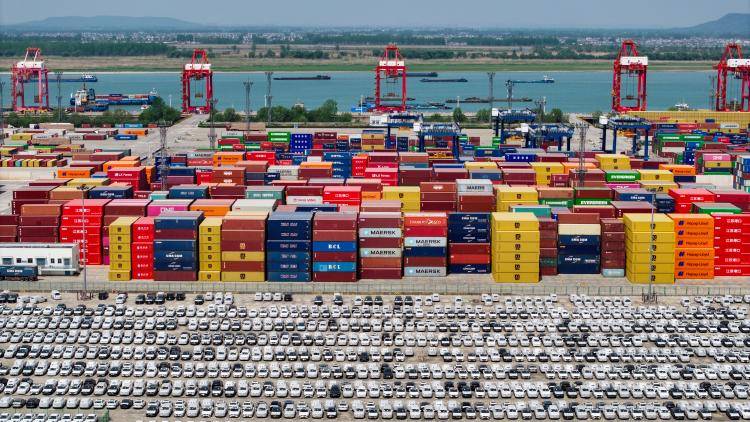
Yet these initiatives, however well-intentioned, seem unlikely to confront the basic challenge in the Chinese economy, which can be summarised as too little demand and too much supply. That combination not only drives declining prices in China, but is also what sustains its very large trade surpluses.
And if the authorities do indeed end up prioritizing manufacturing over the consumer in the Five-Year Plan, the imbalance between supply and demand will remain entrenched.
Structural imbalances
One basic reason why it is so difficult to be optimistic about the Chinese economy is that this imbalance is sewn into the entire structure of the relationship between central and local governments.