Box 2. A note on terminology
‘Blue’, ‘green’ and ‘grey’ water
Discussion of the hydrologicala cycle and freshwater use typically categorizes freshwater according to source or pollution, with each category assigned a colour:
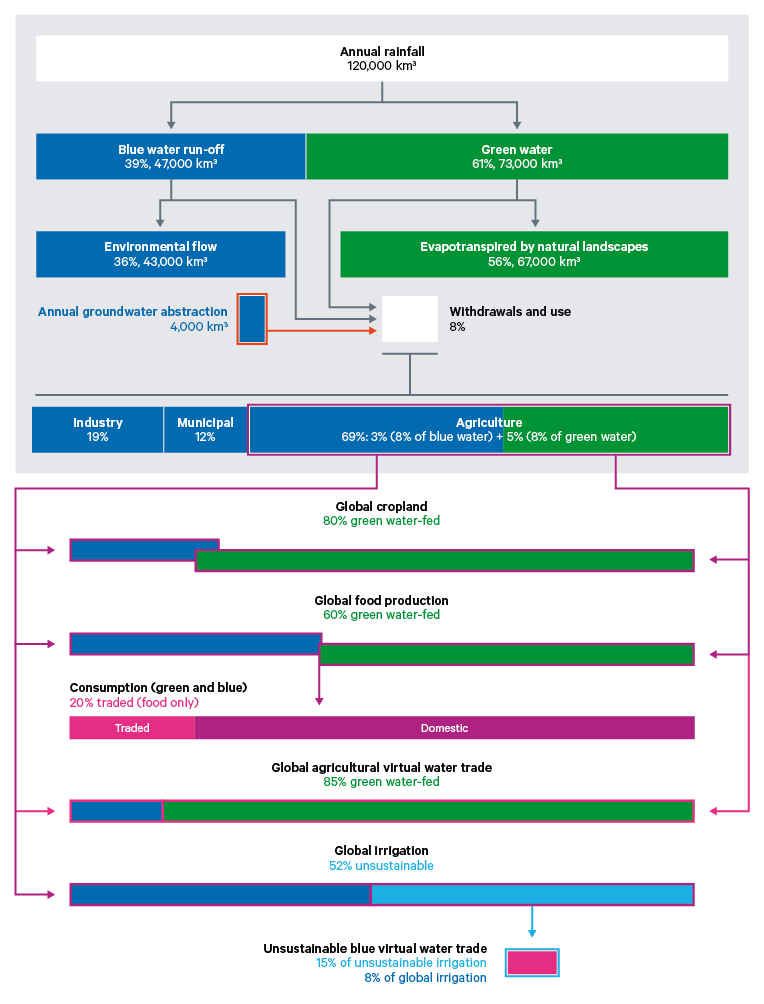
Blue water refers to surface and groundwater stores and flows (springs, rivers, lakes, reservoirs, aquifers). Groundwater includes both renewable and fossil resources, the latter of which are not replenished by the hydrological cycle; this means that fossil water extraction results in a permanent depletion of that resource.
- Withdrawal of blue water includes both ‘consumptive’ and ‘non-consumptive’ uses:
- Consumptive water use is defined as use that results in the water not returning to its source. This includes evaporation, the incorporation of water into products, and the return of water to another catchment or sea. Only consumptive use is measured in water footprints.
- Non-consumptive water use results in water being removed but later returned to its source. This is also known as ‘return flow’ and is not measured in water footprints.
- The sustainability of blue water footprints is measured with reference to water depletion. The measurement reflects the ratio between the blue water footprint (see definition of ‘footprints’ below) in an area/period and the total available volume of blue water in the same area/period.
Green water refers to soil moisture, which forms the evaporative flow for crop growth or for maintaining natural ecosystems.
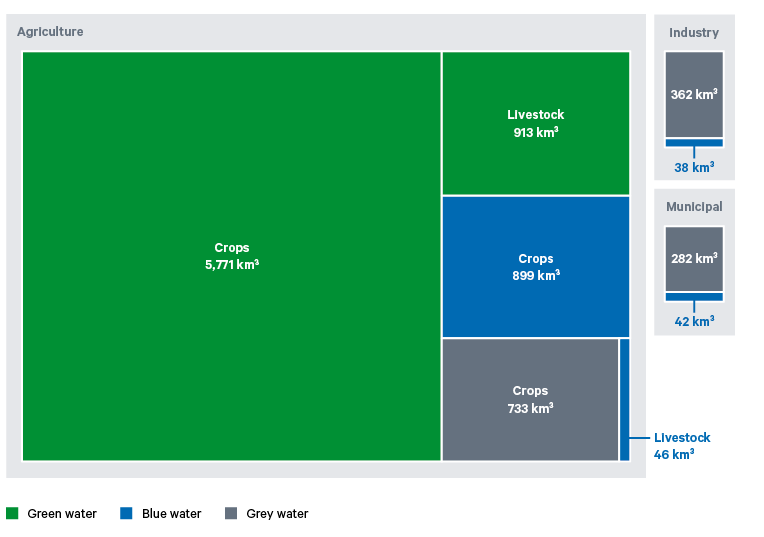
Grey water refers to the volume of freshwater required to dilute pollutants or to meet water quality standards for a specific pollutant load. If that volume of water is not available (and in the in the absence of other treatment), then water quality standards
are violated.
Water footprints
Water footprints are an indicator of freshwater use. They consider both direct and indirect water use by consumers and producers of goods or services. The water footprint of a consumer of specific goods or services is defined as the total volume of freshwater used to provide the goods or services consumed; the water footprint of a producer of goods and services is defined as the total volume of freshwater used to provide those goods or services. Water use is measured in terms of water volumes consumed (i.e. evaporated or incorporated into a product) and/or polluted per unit of time.
A water footprint can be calculated for a particular product (e.g. for a type of food, textile or critical material, etc.) in relation to any well-defined category of consumer of that product (e.g. an individual, family, village, business, city, province, state or nation), as well as in relation to any producer of that product (e.g. a public organization, private enterprise or economic sector).
Where direct and indirect water footprints are distinguished from one another, the direct water footprint is the water consumed or polluted by the specific actor or in the specific activity in question, whereas the indirect water footprint is the water consumed or polluted in the inputs or supply-chain activities prior to the relevant actor or activity.
A water footprint is a geographically explicit indicator and can be used to understand the water interdependencies that arise between countries through the export and import of goods. However, because it is a purely volumetric measurement, it does not directly convey the sustainability or impacts on water scarcity of water consumption. But the water footprint can be used alongside other measures to ascertain whether water use in a specific location – whether affecting an aquifer, river basin or entire nation – is sustainable. In this way, the impacts of water use on environmental water requirements and water quality can be assessed.
Virtual water
‘Virtual water’ is the amount of water (blue and/or green) required to produce a good or service, including all the production steps. This is also referred to as the water ‘embedded’ within a product. For a given product, its blue/green virtual water content is the same as its blue/green water footprint, but the concept of virtual water applies only at the product level whereas a water footprint can also measure water consumption by a company, region or country, etc. A water footprint can also quantify water pollution impacts. This is known as the ‘grey water’ footprint. The concept of virtual water is often used in trade contexts, with ‘virtual water trade’ referring to the exchange of goods and services based on their virtual water content.