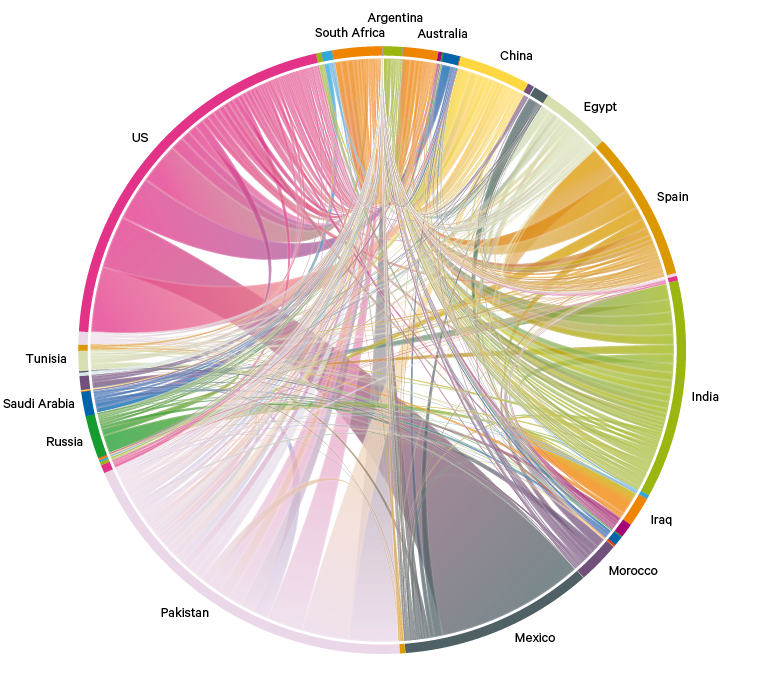
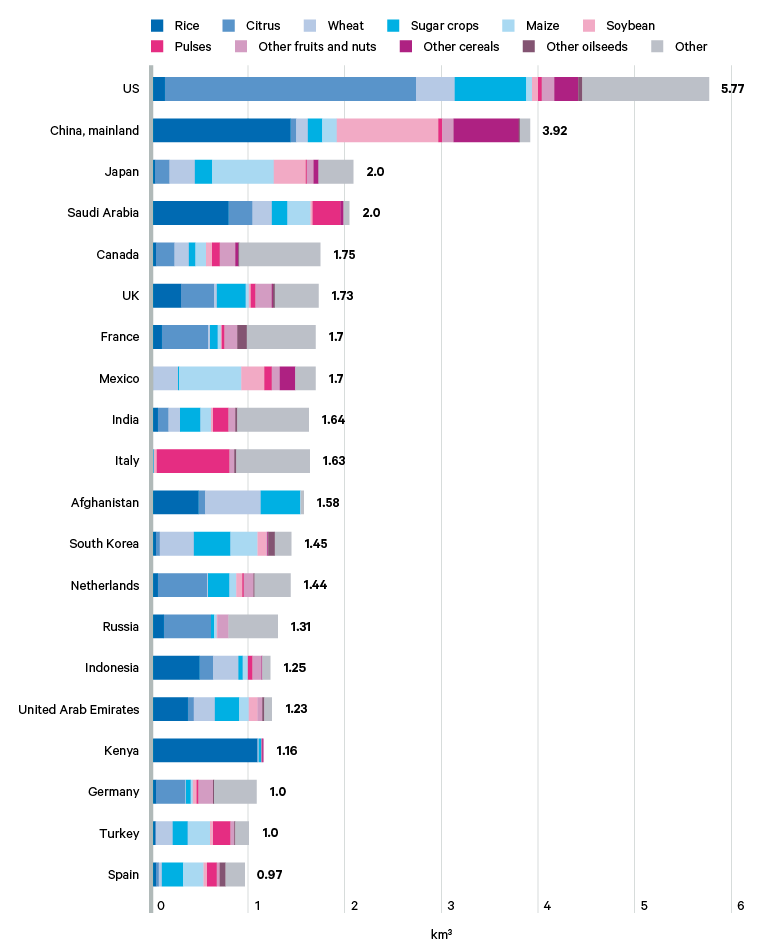
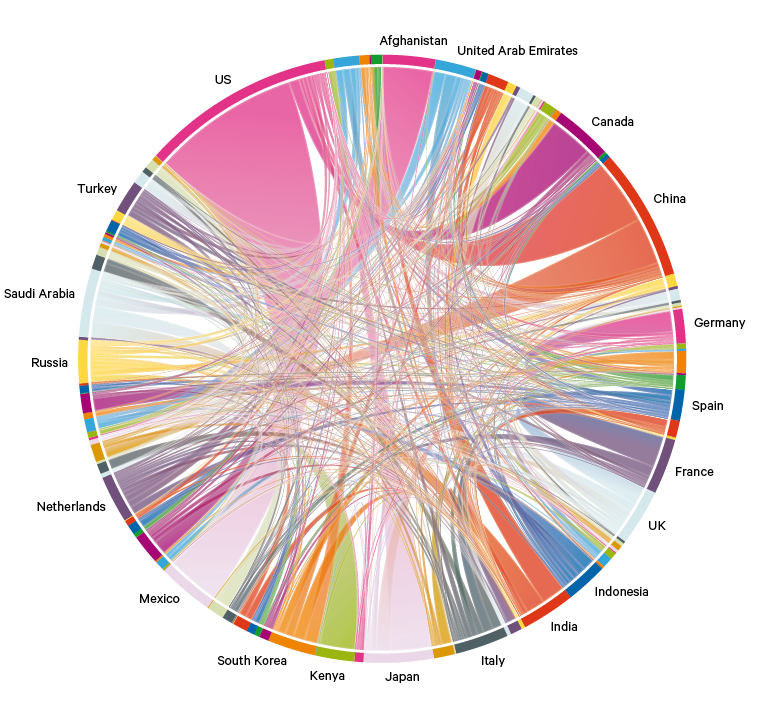
The world’s vast geographic variations in soil and water resources provide a natural incentive to trade. Individual countries are motivated to trade food – and, with it, virtual water – either because they do not produce certain foods and agricultural goods themselves (and need to import them) or because they seek economic advantage in exporting goods that other countries lack or cannot produce as efficiently.
At best, such trade maximizes the redistributive potential from resource discrepancies between countries and regions, so that those with abundant natural capital can sustainably provide goods to countries and regions with lands less suited to producing particular foods, and can be appropriately remunerated for doing so. Arid countries typically use food imports as a means of circumventing local water scarcity, while low-income countries’ participation in food trade – both exporting and importing – typically improves the affordability of nutrients available to their own populations.
But at worst, food trade can result in unsustainable exploitation and expropriation of water resources, driven by consumption that is physically dislocated from the site of impact. In such instances, it is all too easy for market participants to be unaware of, or unconcerned with, the harmful (but geographically distant) environmental and social impacts of their consumption.
In today’s global context of pronounced geopolitical, economic and environmental turbulence with greater multipolarity, contestation and securitization, there is a troubling risk of a new scramble for resources, in which countries with significant geopolitical heft may wield their soft (or even hard) power and economic influence to exploit other countries’ natural resources, including water. Given their differences in natural, economic and political resources, countries have very uneven susceptibilities to the pressures and water scarcity issues increasingly being witnessed. Their responses, quite naturally, are likely to prioritize protecting their own national interests such as food security and critical resource supplies. As such, the resilience of food supply chains and trading relationships is increasingly a core security concern, especially for countries with significant food-import dependencies. In the UK, for example, the government’s UK Food Security Report 2024 and the 2025 food strategy for England acknowledged increasing risks from climate change and geopolitical tensions. Both documents identified the need for coordinated action to manage risks and strengthen resilience across the food system.
Signifying the growing importance of beyond-military national resilience, in the summer of 2025 NATO members committed to spending up to 1.5 per cent of GDP annually by 2035, on top of core defence spending, to ‘protect our critical infrastructure, defend our networks, ensure our civil preparedness and resilience, unleash innovation, and strengthen our defence industrial base’. This spending will extend far beyond food security and water security, but securitization of trade is an increasingly important frame for governing virtual water flows.
Trade growth
The globalization of water resources through the international trade of food and agricultural goods has increased dramatically over the past 40 years. Virtual water trade in this sector roughly trebled in volume, to around 2,800 km³, between 1986 and 2022. Agriculture accounted for around 65 per cent of the volume of all virtual green and blue water trade in all economic sectors in this period.
The globalization of water resources through the international trade of food and agricultural goods has increased dramatically over the past 40 years. Virtual water trade in this sector roughly trebled between 1986 and 2022.
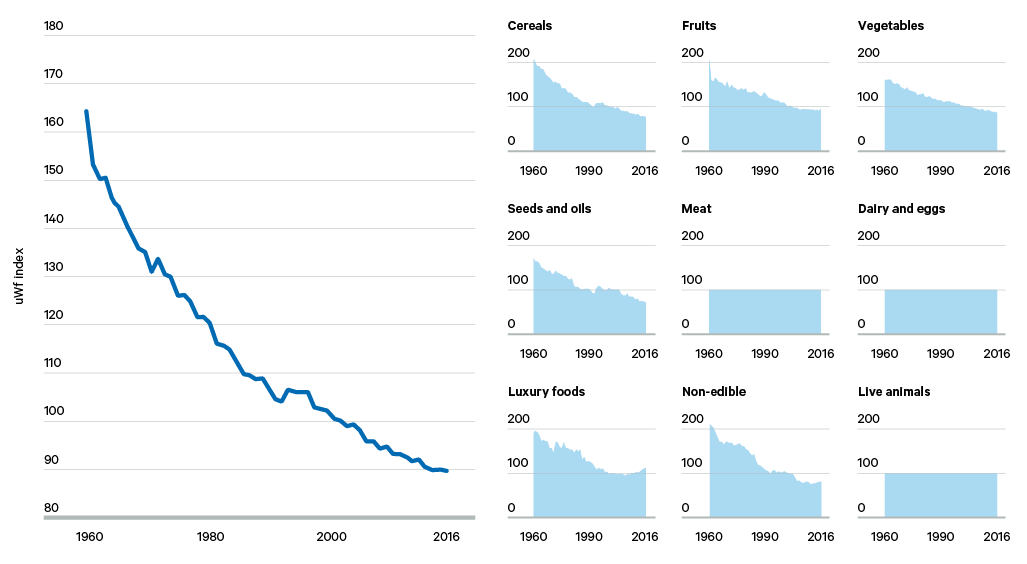
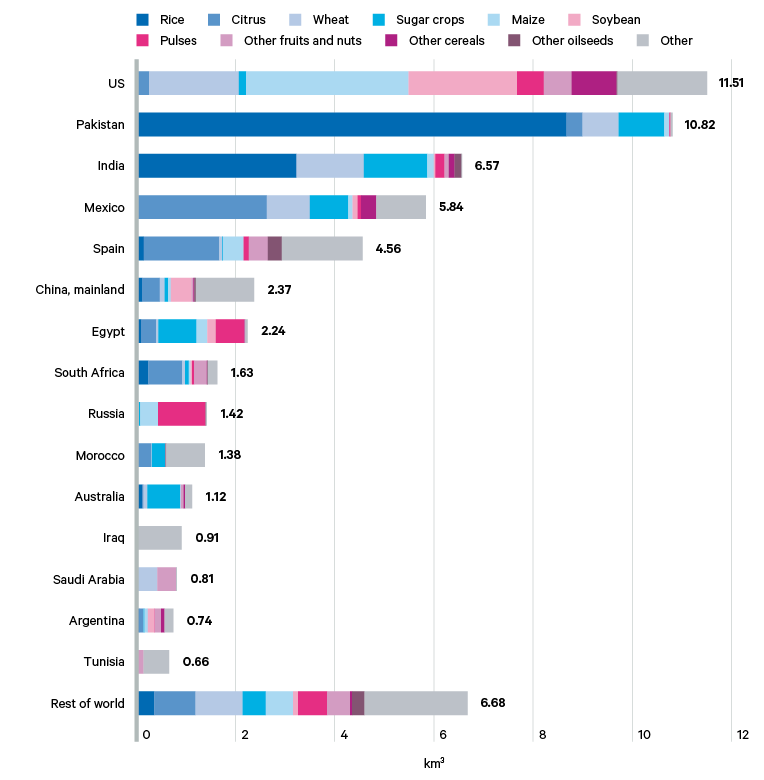
In theory, increased virtual water trade can contribute to more sustainable water use in the sector by concentrating production in areas of relative abundance and more favourable farming conditions, and by exporting food and agriculture products to more water-stressed areas where production is unsustainable. International trade can also promote global water savings, especially when areas of higher water productivity export to areas of lower water productivity (i.e. where the amount produced per unit of water is less). Every year around 240–450 km³ of water (equivalent to 96–180 million Olympic-sized swimming pools) are saved globally due to international trade. Much of these efficiency savings are due to trade in cereal crops, oil crops and livestock products.
Of course, increased water savings at an aggregate level may still translate into more or less sustainable water uses in different places, depending on how the volumetric efficiency of global water use impacts water stress in particular basins. Critically, where the value and scarcity of water are not reflected in its pricing, trade can exacerbate water depletion.
As the impacts of climate change intensify and geographic imbalances in water availability increase, there could be significant disruptions to global trade in virtual water. Modelling by the Global Commission on the Economics of Water suggests there could be a global decline in the volume of agricultural commodities traded if prices for water-intensive goods rise. Conversely, other analysts and observers expect that the water savings achieved through trade will increase, primarily due to reconfigurations in global wheat trade, with exports from water-efficient regions to less water-efficient regions expected to rise substantially. Under either circumstance, nonetheless, it is possible to envisage significant impacts on countries’ economic resilience and people’s livelihoods and food security, requiring potentially important and wide-ranging adaptations.
Many other factors beyond water availability and its impact on sourcing decisions contribute to dietary demand pressures. Differences in social, economic and environmental conditions determine countries’ comparative advantages in food and agricultural production, as well as the degree to which each country can pursue and realize these advantages. Consequently, in some cases food and agricultural trade can contribute to unsustainable demand and inefficient or inequitable water footprints.
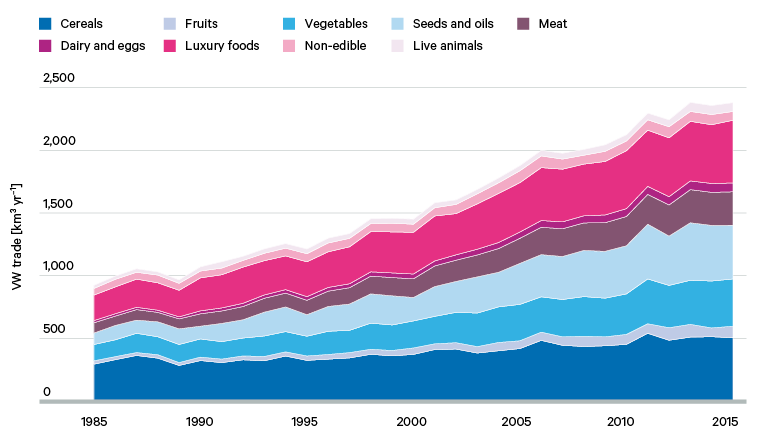
Virtual water trade increased in all categories of agricultural commodities over the period 1986–2016, with the smallest increase seen in the non-edible goods category (32 per cent) and the largest in the seeds/oils category (where virtual water trade more than trebled) (Figure 4). The relative contribution of each category has also changed over time: most noticeably, cereals’ share of virtual water trade among agricultural commodities decreased, falling from 32 per cent in 1986 to 21 per cent in 2016. By the end of that period, over half of agricultural virtual water trade occurred in the trade of livestock products, oil crops and cocoa.