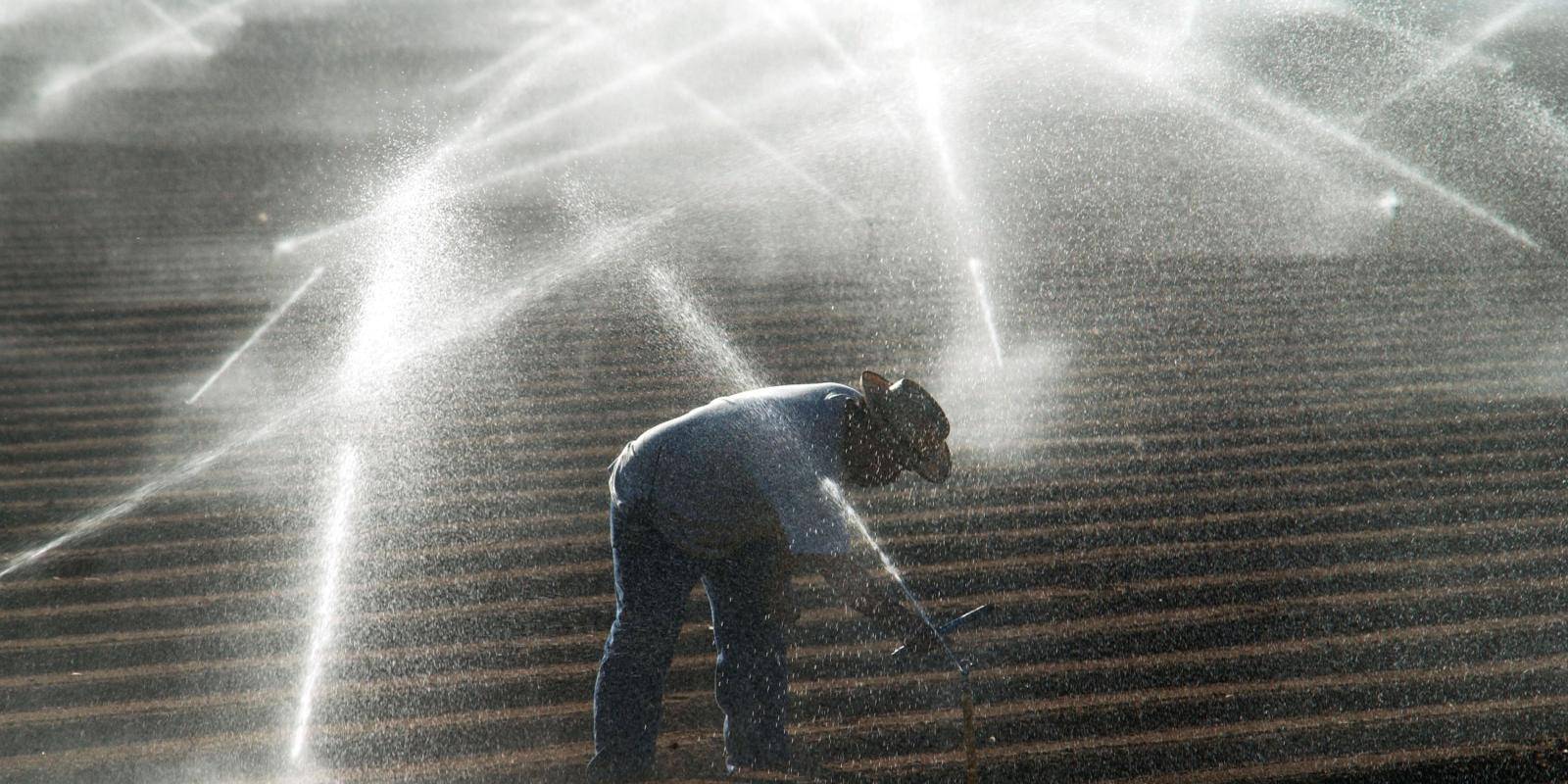
Globally, both chronic and acute lack of water availability pose significant challenges to agricultural production. Around 11 per cent of rainfed croplands (this share covering an area approximately equivalent to the size of Chad or Niger) and 14 per cent of pasturelands (a share covering roughly twice the size of India) face severe recurring droughts. Of the world’s total area of irrigated croplands, over 60 per cent – covering an area similar in size to Iran – faces high or very high water stress.
While this challenges food security on a global aggregate basis, it also has direct implications for local communities living in the most affected regions: around one in six people on the planet (1.2 billion people) live in severely water-constrained agricultural areas. In Central Asia, Western Asia and Northern Africa (UN geographical definitions), around 20 per cent of the population lives under such threats, whereas in regions beyond Asia and Northern Africa less than 5 per cent of the population faces these direct risks.
Climate change is expected to increase water shortages and water scarcity, with negative effects on agricultural production, particularly in low-latitude and tropical regions. Nonetheless, the location and magnitude of these impacts over the remainder of the century are still somewhat uncertain, and climate models do not provide a reliable picture of likely disruptions to rainfall. As illustrated in Annex 2, the effects of water shortages are not purely a function of the incidence of climatic and weather events, but also reflect the degree of exposure and vulnerability of people and agricultural assets to droughts, as well as their more general vulnerability and readiness to adapt to all negative effects of climate change.
Given that approximately 80 per cent of total cropland is under rainfed production, the majority of the world’s farmers have limited ability to adapt to weather variability. As a result, by and large they cannot influence the volumes and timings of water availability for plant growth. This is particularly a problem for small-scale farmers engaging in low-input rainfed production, who often have limited capacity to invest in water management techniques such as rainwater harvesting or water conservation. However, with improved agricultural ‘extension’ services – defined as services to train, educate and advise farmers – some basic methods of conserving green water can be implemented at little expense. For example, digging deeper furrows and improving tilling techniques can maintain soil moisture, boost infiltration rates and reduce surface run-off from fields.
As the climate changes, it is not only the quantity of water available to agriculture that will be affected but the water requirements of agriculture itself. Under hotter conditions, more soil moisture evaporates and plants transpire more rapidly as they photosynthesize. If conditions are too dry, then plants will conserve their water use, but this often results in failed or stunted growth and death. Although rising atmospheric carbon dioxide levels, in principle, can accelerate plant growth, increased water stress in the future is likely to negate any such ‘CO₂ fertilization’ benefits. This is why virtual water trade could become an even more important mechanism over the coming decades for conserving and redistributing food production to areas with higher availability of sustainable water. Whether this actually happens or not will, however, depend predominantly on other factors also influencing production decisions, such as how demand evolves and the policy choices countries make around economic development.