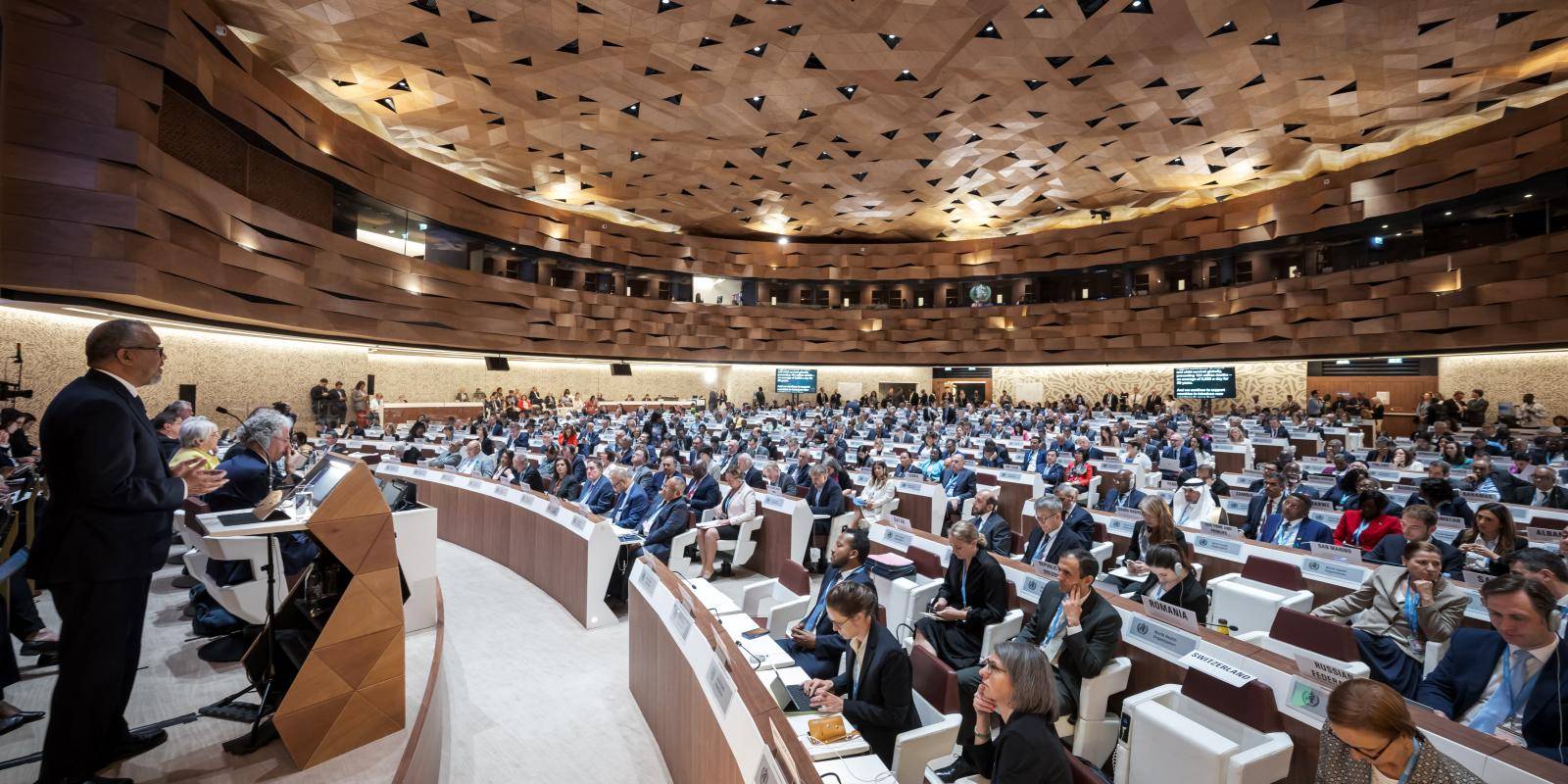

The 79th World Health Assembly (WHA) – the decision-making body of the World Health Organization (WHO) – will take place in Geneva on 18–23 May amid major challenges to global health cooperation. The United States has withdrawn from WHO, leaving a $600 million funding gap and forcing WHO to cut its budget for 2026-27 by 20 per cent. Bilateral health deals under the America First Global Health Strategy are being signed across Africa and Asia, bypassing multilateral frameworks and transferring costs onto the partner countries without commensurate power. In February, WHO Director General Dr Tedros Adhanom Ghebreyesus described 2025 as potentially the most difficult in the organization’s history.
Two recent speeches provide the clearest political diagnosis of the current international moment. On 5 March, Canada’s Prime Minister Mark Carney told the Australian parliament that the rules-based order is not in transition – it is in rupture. That same day – and building on Carney’s speech – Finland’s President Alexander Stubb opened the Raisina Dialogue by arguing that the Global South will decide what the next world order looks like, and that the West has one last chance to prove it is capable of dialogue rather than monologue. Although neither mentioned global health explicitly, both were talking about it.
As global health diplomats head to Geneva, the question WHA79 must answer is not whether WHO needs reforming, but who will drive that reform, in whose interests and on what political basis. Although Carney and Stubb approach the issue from very different angles, they converge on a clear answer: middle powers must act with urgency – and Western middle powers must act in genuine partnership with the Global South.
Carney’s argument is strategic: great powers can compel; middle powers can convene. But not every country can convene because convening power flows from trust, which is earned through consistency between stated values and demonstrated actions. In the global health context, this matters enormously. WHO has never had enforcement powers; its authority has always rested on the legitimacy conferred by member states who believe it acts in their collective interest. That legitimacy is now under structural pressure. A WHO seen as a residual institution – one that the powerful use when convenient and abandon when not – cannot perform its core functions of surveillance, standard-setting and emergency coordination. The middle powers who remain committed to it must therefore act not merely as supporters but as active co-architects of its renewal.
Carney’s concept of ‘variable geometry’ is equally important for global health. Rather than waiting for a comprehensive multilateral settlement that may take years, middle powers should build different coalitions for different issues, based on shared values and common interests. This is not a retreat from multilateralism, Carney argues, but its evolution. For global health, the implication is direct. Issues such as pandemic preparedness, antimicrobial resistance, digital health governance and climate-health linkages each require a different coalition, moving at different speeds. The WHO reform process is necessary but slow. Variable-geometry coalitions can build the normative and financial infrastructure that a reformed global health architecture will eventually need to incorporate. The Framework Convention on Tobacco Control showed what is possible. Similar courageous steps must now be taken in other areas, such as negotiations on a pandemic agreement or possibly in relation to digital health.
Stubb’s argument adds a political dimension to Carney’s intervention: the Global South cannot be a passive recipient of whatever order emerges – it is the decisive actor. The triangular contest he describes between a Global West, Global East and Global South is directly visible in WHO’s governing bodies. How Brazil, India, Indonesia, Nigeria, and South Africa engage at WHA79 – whether they drive the reform process or treat it as a Northern preoccupation – will shape the outcome far more than any European position paper. Stubb’s challenge to the West is blunt: stop treating engagement with the Global South as a communications exercise and start treating it as a power-sharing negotiation. The global health corollary is equally blunt: a reformed WHO governance structure that still reflects 1948 power distributions, rather than today’s distribution of disease burden and health capacity, will not be legitimate in the world that is now emerging.
In his speech, Stubb called for concrete structural reform of global multilateral institutions: new permanent representation for Asia, Africa and Latin America in global institutions, not as a rhetorical concession but as a condition of legitimacy. Passivity is not a strategy, he said – a charge directed at Europe as much as anywhere. For the European and other Western middle powers who dominate WHO’s financing and governing bodies, this is uncomfortable but necessary. Being present is not the same as exercising leadership and showing willingness to cede structural power. Professing commitment to multilateralism while resisting the governance reforms that would make multilateral institutions genuinely representative is precisely the double standard that Stubb warns will cost the West its last chance.