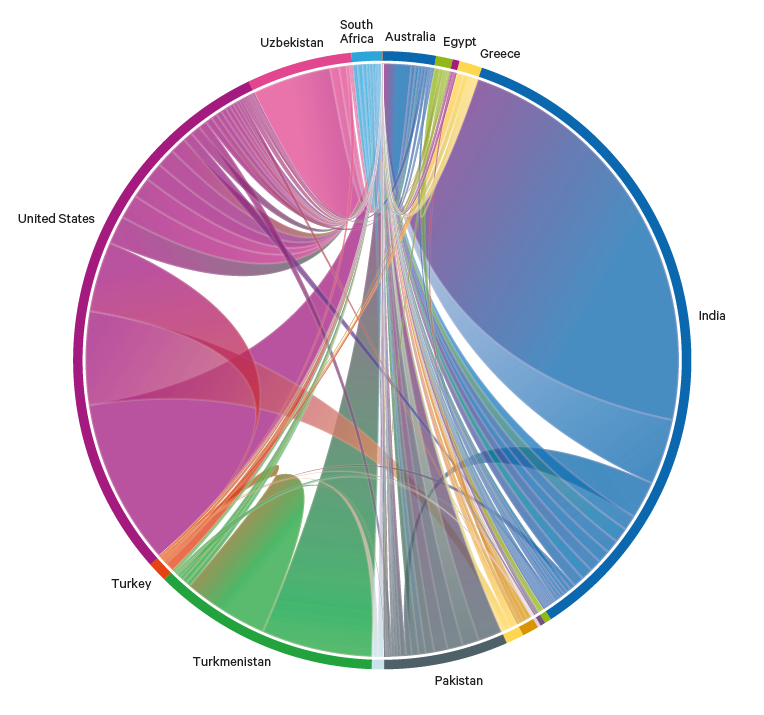
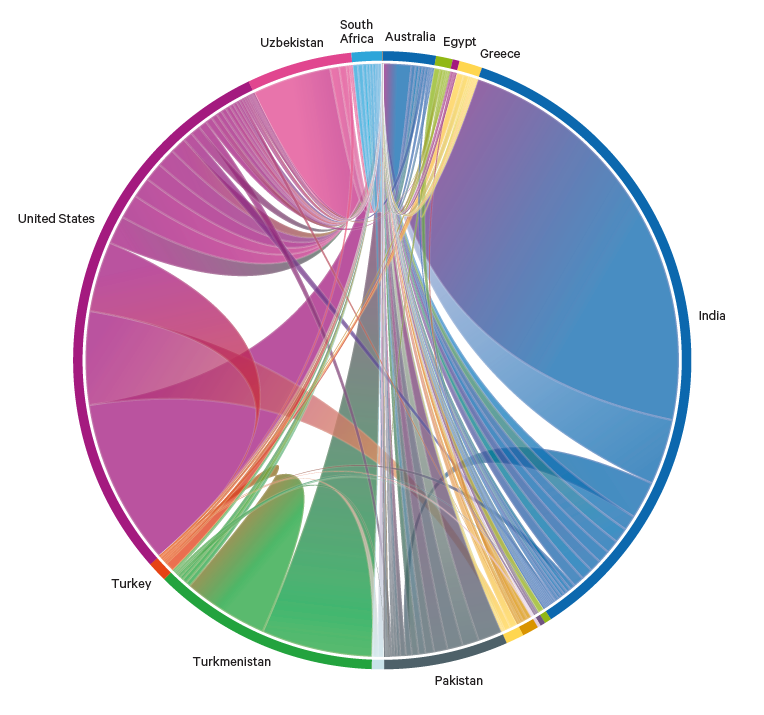
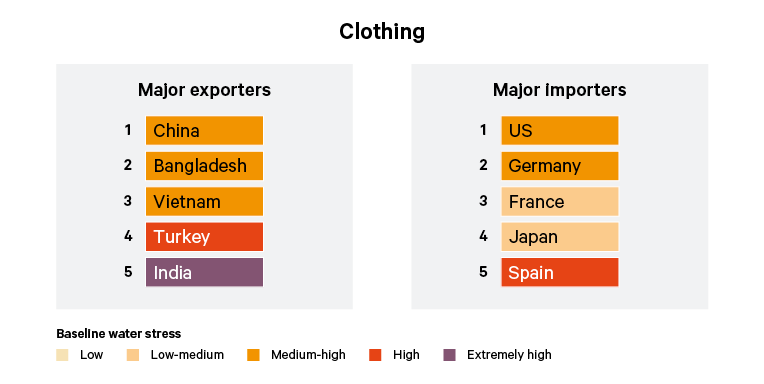
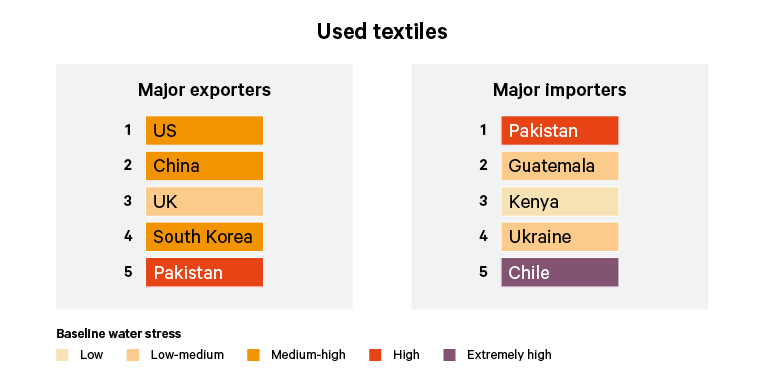
Many imported used textiles cannot be resold because of poor quality
and/or sheer volume, often leading to disposal by open burning or dumping at unmanaged sites. High and growing volumes of synthetic textiles – fossil fuel-based and non-biodegradable – also pose increasing end-of-life pollution risks to water, air and soil.
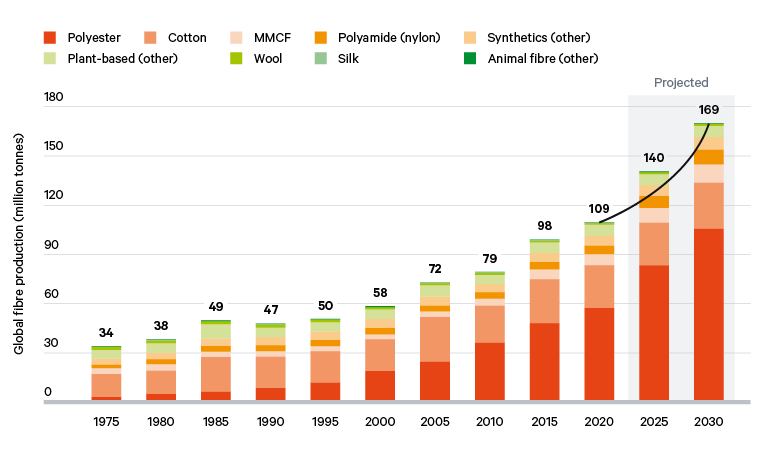
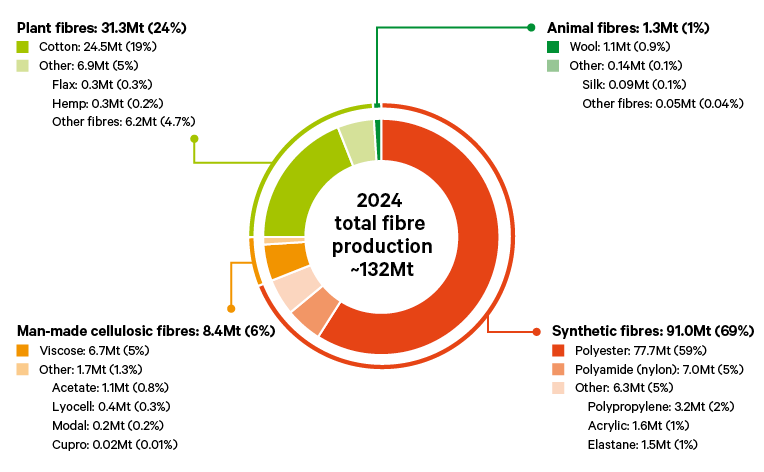
Low recycling rates further compound this challenge. The overall demand for recycled fibres was 7.6 per cent in 2024, having peaked at 8.5 per cent in 2021. Output is dominated by recycled polyester, which accounted for 6.9 per cent of global fibre production in 2024 – 98 per cent of this being derived from PET plastic bottles. With recycling infrastructure not keeping pace with demand, and given poor uptake in fibre-to-fibre recycling, most synthetic waste ends up in landfill rather than being used as feedstock for new products. Less than 1 per cent of global fibre production was from the recycling of pre- and post-consumer textile waste in 2024. True fibre-to-fibre recycling, to turn used textiles into new fibres, remains negligible.
Despite initial investments in using recycled PET bottles in fibre production as a viable alternative to virgin fossil-based synthetics, turning high-grade PET bottles into low-grade synthetic textiles – which are prone to microplastic shedding and unlikely to be further recycled – does not truly address the broader plastic waste problem. Greater recognition of closed-loop recycling as a means of strengthening circularity has prompted some clothing brands to move away from recycled polyester made from PET bottles. Instead, they are investing in closed-loop recycling and committing to a 30 per cent fibre-to-fibre polyester goal from recycled textile waste by 2030.
Existing customs codes categorize worn clothing broadly, stopping short of differentiating between reusable material of good quality and degraded materials. (See Box 5 for a fuller discussion of the dynamics of the used textiles trade and shifting of responsibilities.) With inadequate regulatory enforcement and underinvestment in recycling and reuse, importing countries can struggle to direct the high volumes of used textiles they receive to profitable uses.
Water footprint of pre- and post-consumer textile waste
Robust and standardized quantitative data on water footprints for pre- and post-consumer textiles waste are limited. While some methodologies do exist to estimate water use at this stage, they are normally embedded in life cycle assessments of specific products and case-specific assumptions around garment care and end-of-life processes. Therefore, water-related impacts are qualitatively discussed here for pre- and post-consumer textiles.
The rising consumption of textiles not only drives high water use and pollution levels during production and processing; it also amplifies downstream risks. From the limited data that are available on the scale of pre-consumer textile waste, it is estimated that as much as 25 per cent of the fabric used in manufacturing is discarded during the garment production process; and industry estimates suggest that excess stock represented a loss, in terms of sales value, of between $70 billion and $140 billion in 2023. Of the expected 15.2 million tonnes of textile waste generated in the EU in 2025, around 13.3 million tonnes was post-consumer textiles, equivalent to roughly 26 kg per person.
After consumer use, improper disposal of discarded textiles contributes to multiple water-related challenges. For example, in many low- and middle-income countries, poor waste collection and recycling systems mean that discarded textiles frequently end up in uncontrolled landfills, burning sites or unauthorized dumps. Such environments facilitate the leaching of dyes, microfibres and hazardous chemicals into soils and water bodies, and contribute to air pollution when discarded textiles are burned.
The recycling of textiles, though a potential avenue for reducing reliance on virgin materials, still presents challenges for freshwater use and requires accelerated technological innovation. Chemical recycling, which dissolves fibres into their original components for repurposing, is more effective in maintaining fibre quality, but often requires significant water usage. Pre-processing and chemical recycling of synthetic fibres and dissolution of MMCFs are particularly water-intensive processes. Additionally, the wastewater generated from chemical recycling processes contains dyes, synthetic polymers and chemical residues that require specialized treatment to be safely discharged. Mechanical recycling, which involves shredding old textiles into fibres, is less water-intensive but has limitations in fibre quality and durability unless accompanied by better product design. Recycling is one component of circularity, and when combined with reuse, repair and resale, it reduces reliance on much more water-intensive virgin fibres and lowers total freshwater demand over the full life cycle.
Recycling is one component of circularity, and when combined with reuse, repair and resale, it reduces reliance on much more water-intensive virgin fibres and lowers total freshwater demand over the full life cycle.
The sheer volume of end-of-life textiles exported for recycling often means that importing countries receive quantities of used textiles beyond their capacity to reuse or recycle, resulting in excessive uncontrolled waste. In Ghana, for instance, textile waste dumped on the banks of the Korle Lagoon has clogged waterways and leached contaminants into the marine environment; while in Chile’s Atacama Desert, more than 39,000 tonnes of clothing are dumped annually, contaminating soil and water and releasing toxins when burned. Within Europe, an investigation into one used textiles supply chain found that second-hand clothing entering Romania under the banner of ‘reuse’ was, in some cases, dirty, stained or unsorted waste. Local communities reported illegal dumping in fields and rivers; while in some of the poorest areas, households burned jeans and shoes for heating, releasing toxic fumes into the air.
There are emerging policy responses. The EU’s Strategy for Sustainable and Circular Textiles introduced binding ecodesign requirements to ensure garments are durable, repairable and recyclable. It mandates extended producer responsibility (EPR) schemes, requiring producers to finance collection and recycling, and proposes a Digital Product Passport to improve traceability. Crucially, it also seeks to deter burden-shifting by restricting exports of textile waste outside the EU. UNEP’s global roadmap echoes these calls, urging reforms to customs coding, quality standards for exports, and investment in domestic reuse and recycling infrastructure. To ensure that exported textiles enter the circular economy, trade policy itself must be aligned with circular economy goals, ensuring that exports support – rather than undermine – domestic circularity in importing countries.
The story of trade in used clothing is thus not one of simple reuse, but of global inequalities, regulatory blind spots and unclear definitions. Without reform, it risks continuing as a waste export system in disguise, with attendant water impacts. However, with harmonized legal definitions, robust enforcement and EPR requirements, along with investment in local circular economies, importing countries could shift from being dumping grounds to hubs of repair, upcycling and recycling. The challenge is to ensure that circularity is not only about closing material loops, but also about accountability, fairness – including gender equity and empowerment of marginalized peoples – and shared responsibility across borders.