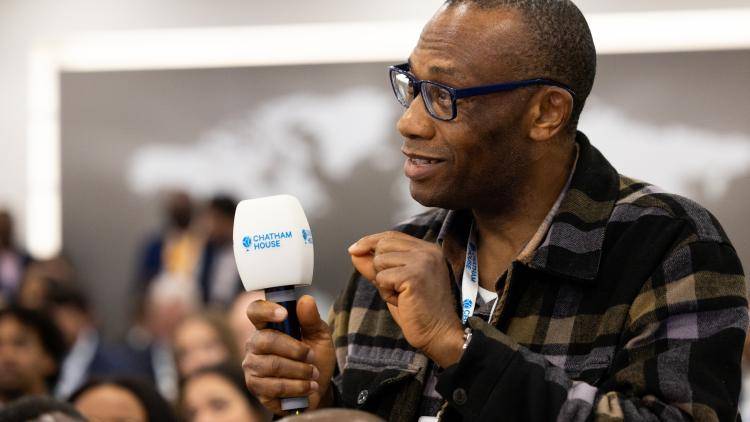
Sanam Vakil
Alright, well, good evening, everyone, thank you for being with us today. My name is Sanam Vakil. I am the Director of Chatham House’s Middle East and North Africa Programme, and it’s a great pleasure to welcome you for a live discussion about the conflict in the Middle East, initialled originally, ‘What comes next?’ Seems like we’re living through what comes next. So, we’re going to be talking about live events with a fantastic panel that I am going to introduce momentarily.
I just want to give you a tiny bit of administration and update you that we are online, as well, and this event is being held on the record and livestreamed and we will have a recording available for you to watch on demand after the event. Those of you who are joining us online, thank you for being with us, as well. I will be taking questions using the Q&A function on Zoom and also, to you in the audience, I will be trying to make this as dynamic and interactive as possible, so please raise your hand and introduce yourself when we get to the Q&A session. You’re also very welcome to tweet about the event, as well. So, we would welcome that. So, I think that’s all of my administration guidelines.
I want to take a moment to briefly introduce the panel. They are all very well-known and have very long and lengthy biographies. They’re all colleagues of mine. I think that’s the best people I respect greatly. So, I’m very excited that they have given us some of our time. I’m going to start all the way on the far end, introducing Ali Alfoneh, who is a Senior Researcher at the Arab Gulf States Institute, a Political Scientist, but really well-known for his work and writing on the transformation of the Islamic Republic, in what he argues will be a ‘military dictatorship’. Ali is very well published, and he is the author of ‘Political Succession in the Islamic Republic,’ written way back when in 2020. He also publishes frequently in other outlets, as well. So, welcome, Ali.
Next, I have Mohammed Baharoon, Director of the Dubai Public Policy Reach – Research Center, also known as b’huth, which was founded in 2002. Mohammed has also worked as an Editor for the Gulf Defence Magazine. He focuses on the interplay of geostrategy and policymaking in governance, stability, capacity building and futureproofing. He also worked as Deputy Director of Watani, the UAE’s first initiative on national identity, and was on the board of the Bussola Institute in Brussels. Mohammed is also a deep thinker on Gulf politics, Emirati politics, very well-placed to explain Gulf security, which is certainly not monolithic or homogenous.
Next, I have Sima Shine, a Senior Researcher at the Institute for National Security Studies in Israel. Sima was the former Director of the research programme, ‘Iran and the Shiite Axis.’ Sima has served in the intelligence community and since her retirement, has served as a Deputy Head of Strategic Affairs, also in Israel’s National Security Council. She is certainly one of the go-to Analysts for me in Israel, so very grateful to benefit from your analysis and thinking.
And last but certainly not least, Nate Swanson, who I’ve known for quite some time now, maybe two decades, which dates us both, Nate.
Nate Swanson
Hmmm hmm.
Sanam Vakil
Resident Senior Fellow and Director from the Iran Strategy Project at the Atlantic Council. Prior to joining the Atlantic Council, which was just recently, Nate spent over 20 years as a career US Official, primarily focused on Iran and was a Senior Advisor on Iran policy to successive administrations, including on the Biden and Trump Iran negotiating teams.
So, we have assembled a, what I think is an all-star lineup, to maybe take us through events in the region, reflect on the two wars between Iran, the United States and Israel, also reflecting on the impact for the region more broadly and the Gulf states more specifically. As I said initially, I wanted this to be a bit of a think discussion and perhaps it’s going to be a bit more reactive. Of course, we’ve seen the MoU signed almost a month ago, end of war formally declared and since that day, the slow unravelling of the terms and conditions of the MoU through kinetic action in the Gulf. And of course, today, I think there’s been a few inflammatory messages on social media, where it’s not just Iran that might want to toll the Strait of Hormuz. We have a new Sheriff or Captain or angel, depending on how you want to look at him, in town, who maybe has his own ideas.
So, let’s try to make sense of where we are where we’re going. I should say that we just had a all-day discussion on these dynamics, so we’re, sort of, fresh and buzzing from the ideas that we exchanged amongst each other. And so, I’m going to start by asking Ali a question for you, because I cannot tell you how many times we, sort of, debate back and forth cohesion within the Islamic Republic. Certainly, it – we are witnessing, or perhaps living through, a profound transformation in Iran. Its leadership has certainly changed, not necessarily regime change, as argued by President Trump, but how do you see Iranian politics evolving? You’ve certainly laid out a case for militarisation of Iranian politics, but where are we?
The, you know, the US and maybe many other interlocutors or observers suggest that Iranian politics are in flux, there’s a lot of tension and back and forth and thereby, Iran can’t make a deal. Iran is to blame for where we. So, maybe set us out with how you see things in Iran and also, you know, what Iran is trying to achieve. I know I’ve given you a lot there.
Ali Alfoneh
Dr Vakil, thank you so much for your kind invitation. I thank you for providing me with this opportunity to share my analysis with the very, very sophisticated British public, in the company of my esteemed friends and colleagues.
As for the question you asked, ever since the assassination of Ayatollah Ali Khamenei, what we have seen in Iran is emergence of a collective leadership. This collective leadership is comprised of the heads of the three powers of the government, meaning the President of the Republic, the Speaker of the Parliament, the Head of the Judiciary, one representative from the Revolutionary Guard, whom I believe is Major General Ahmad Vahidi, the Chief of the organisation and one representative from the regular military, whose name I am not still familiar with. That person could be anyone. I have not identified that individual.
What we also have seen is that in spite of all their differences and these individuals have a different view of the world, some of them are elected officials, others were appointees, they are co-operating with each other and sticking together because of the existential threat that the regime in its entirety is facing from Israel and the United States. What I also need to share with you is how they are trying to survive, and these are the few words that I can share with you in the short time that I have at my disposal.
When it comes to the Government of Israel, this collective leadership does not believe that it can reach any kind of peaceful co-existence with Israel under Prime Minister Netanyahu. What happens after Prime Minister Netanyahu is a different study, but as long as Prime Minister Netanyahu is in power, they do not believe that they can reach peace with Israel. When it comes to the United States, they have great doubts, because they believe that they cannot count on President Trump. President Trump shifts his opinion, and he has bombed Iran twice when Iran and the United States were engaged in negotiations.
So, their approach currently appears to be to survive at least until the November mid-term elections and see to it that the Republican Party loses these elections. They want to see the Republican Party lose the House of Representatives and preferally – preferably also the Senate. This, they believe, will put the United States in a very difficult position. If the President recognises the election result, the Democratic Party will be engaged in impeachment of the President day and night, and if he refuses to recognise the election result, the United States will find itself in a constitutional crisis. In both scenarios, the United States of America will most likely not continue the war against Iran, and that is one survival strategy.
As for the Arab states and my friend, Mohammed, and all other Arab friends that I have, you find yourselves in a terrible and very unfortunate situation in a war that you never called for, that you were opposed to and now you’re taken hostage by Iran. Iran’s attacks against Israel are ineffective because of the simple fact that the Iranian missiles cannot penetrate the multilayered air defence systems of the Government of Israel. But you are there, very close to Iran and Iran has taken you and by proxy, also the global economy, as hostage, and I’m very sorry for this situation that you find yourself in, but what is the way out?
One way out is that the regime in Tehran collapses, there is a civil war and Iran, as a country, breaks up. You see the repetition of the breakup Yugoslavia, that is one scenario. I do not believe it is likely, but that’s one scenario. Another scenario is that Iran manages to produce at least two nuclear bombs, one for testing to telegraph to the world that they have it and another one in order to deter Israel. This, I believe, may be likely, depending on technicalities, and the third one is that President Trump loses the elections, will be impeached and there will be a totally new dynamic.
Sanam Vakil
Thank you. There is a lot there to unpack and quite – some provocative or ambitious objectives for Iran. It seems like making – or trying to facilitate conditions to help Trump lose November might help it – Bibi Netanyahu, but we’ll come back to that, and keen to get Sima’s view on that, and I’m keen to also ask you, Ali, before I move on, about Iranian domestic politics. I mean, what’s the balance of power in Iran like today, how are you seeing things and how important is Mojtaba Khamenei, the new Supreme Leader, who has been absent since he succeeded his father? He’s certainly been injured. There are worries about his safety or his security, but, you know, what is this balance of power look like?
Ali Alfoneh
From, you know, the viewpoint of the Revolutionary Guard, it is not such a big problem that Mr Mostafa Khamenei has gone into occultation. He has become the Shia messiah. He has also been in occultation for 1,000 years. Has it prevented the Shia clergy to demand taxes from the devout Shia for an Imam who has not been seen for the past 1,000 years? No, nor should it constitute a problem for the Revolutionary Guard that the Commander-in-Chief has not been seen by anyone since February 20th. On the contrary, I actually think it helps them. The existence, somehow, in occultation, of a Supreme Leader who is not giving them orders, who is not bothering them, who is not restricting their actions, but at the same time, also legitimises what they are doing, is a good thing from their point of view.
However, they do not want to assume direct political responsibility and that’s why they are co-operating with the civilian Politicians, in our books. If the Revolutionary Guard has to see to it that the Iranians are well fed, can receive hospital treatment and all those things that every responsible government has to provide for the population, they will be hated by the population. So, what they prefer is to allocate the scarce resources of the state and to take the strategic decisions, but not to be politically accountable. Who is politically accountable? Poor Dr Pezeshkian, who is the President of the Republic, and that division of labour is not such a bad thing from their viewpoint.
But, you know, on, you know, one optimistic note, what I have seen is that many Revolutionary Guard Officers and Analysts consistently talk about Vice President Vance as the person capable of bringing about a deal between the Islamic Republic and the US and also restricting the actions of the Israeli Government, and therefore, I am not totally pessimistic. I do believe that there are political ways of coming out of the crisis that they are – everybody’s finding themself.
Sanam Vakil
Okay, thank you very much. Let me turn to Nate, to maybe reflect on how you see the US side of things. You know, obviously, two wars happened, you know, President Trump had a whole slew of objectives, but very clearly, he was focused above all, on preventing Iran from obtaining a nuclear weapon. We’ll put, sort of, mismanagement and all of the things that have gone wrong since February 28th to the side, unless you want to bring them up, but, you know, it became somewhat clear along the way that President Trump was looking for an exit strategy and the war was becoming a bit unsustainable because of the Strait of Hormuz, the costs, the hostage crisis that Iran has imposed, not just on the Gulf but on the international economy. But yet, you know, we all, by all, you know, uncertain purposes, in this nor – war, no, peace dynamic or maybe creeping back to war. You know, how does Trump play this? How do you see the US position right now?
Nate Swanson
Yeah, thanks. I wish I could answer with certainty, but I can’t, so I’ll do my best job to guess. So, look, I think really, fundamentally, what led the US into this war wasn’t a clear objective to constrain Iran’s nuclear programme. It was just the idea that it’d be easy, right? They’re coming off the successes in Venezuela, you know, just – less than a month before, a month before the Twelve-Day War before and just, you know, this – there was just this pattern of being told you couldn’t do something, then doing it and basically, having no repercussions. So, you know, we came in with the idea that initially, you know, this was going to be to support the Iranian people and then, you know, take to the streets, the institutions will be yours, and then it was military degradation and then finally, it’s come to, you know, Iran’s nuclear programme. So, I think the reality is now, it’s really just about energy prices, right?
Sanam Vakil
Right.
Nate Swanson
And so, I think now, like, the objectives has shifted so much, so basically, Trump would like to exit the war, but needs to be able to do it where, you know, he can save face and ideally, get energy down. So, you know, he’s doing this through a very muscular approach, right? And so, today’s, you know, announcement that we are taking control of the Strait of Hormuz and putting in our own service fee?
Sanam Vakil
Hmmm hmm.
Nate Swanson
I don’t know what we want to call that. ‘Fairness fee’ I think he called it. You know, is really, I think, just a continuation of the tactic which has been there since April, which is, you know, he doesn’t want this war to go on, but he wants it to end on his terms.
Sanam Vakil
Hmmm.
Nate Swanson
Now – and so, I think that’s what today is. I don’t think we’re headed back to a full-blown war. I think this is the exact same conditions that have been there since the first ceasefire after the first 40 days, but he is trying to do it in a way, for the same reasons he did the blockade and all these other things, to make the terms more favourable to him. I just think the problem with that is the longest it’s gone on and has not become more favourable to us and I don’t – can’t predict exactly how Iran will respond, but I’m not sure this actually gets us any closer to a better deal or an enforceable MoU.
Sanam Vakil
Okay, so let me ask you a follow-up. This memorandum of understanding, you know, that’s all on one page, has been, you know, criticised for being very favourable to Iran.
Nate Swanson
Hmmm hmm.
Sanam Vakil
But of course, the US over the past month has been trying to whittle away, perhaps, at Iran’s leverage over the Strait of Hormuz, also trying to segregate Lebanon from the broader picture, and Iran, you know, very clearly continues to say that they don’t trust President Trump. Are they right not to trust President Trump? Is this memorandum one that we should try to preserve as a structure to get back to negotiations?
Nate Swanson
So, I’ll take the second question here, first, because a think that’s easier, right? So, I actually – I think we should just keep the MoU, because why do we need to recreate the wheel? I think it would just add another obstacle. So, while the MoU didn’t actually solve anything, right, it’s – the structure that’s in place now, you know, you should – we should try to work off it, because if we’re starting from anew, I think it just pushes this whole thing off further. And to me, I mean, that is the – primarily value of the MoU was, it was that it was supposed to end the war, right? It doesn’t actually do anything, doesn’t codify anything. It’s aspirational about what you want to talk about, and so, ending the war I think was a good objective, because it beats – I mean, the terms are definitely favourable all round, but it beat, I think, continuing war.
My view on this is, you know, unless the US is willing to commit, you know, hundreds of thousands of people, ground troops to, basically, occupy Iran, you weren’t going to achieve a military victory, certainly not, you know, regime change or anything along those lines. So, if we’re not willing to do that, which I don’t really think is on the table for Iran, it’s best to seek a diplomatic outcome and sooner than later. So, to me, the MoU makes sense. What was your first question that I forgot, again?
Sanam Vakil
Ca – you know, can a deal with – you know, the Iranians see Trump as not trustworthy.
Nate Swanson
Oh, yeah.
Sanam Vakil
Is that right?
Nate Swanson
I mean, probably. I mean, I think he – that, you know, in his defence, I think he goes well beyond, him, right? I mean, obviously, he’s pulled out of JCPOA, and he’s attacked them twice during negotiations and now, whatever with the MoU. But look, I mean, this is a longstanding distrust that goes well beyond President Trump, and I think, you know, the Iranians would rightfully point out that, you know, like, the last administration didn’t follow through on the consular hostages, you know, really to cut our funds. So, I mean, I think this is deep levels of mistrust that go well beyond Trump. It’s just been exacerbated under him. So, no, I don’t think there’s any trust and it hasn’t been there. It’s just worse now.
Sanam Vakil
Okay, lots to pick apart, but I’m going to park it – park my own questions and turn to Sima. We’re thrilled to have your perspective. Maybe you can tell us, I mean, Israel embarked on not one, but two wars, sort of, altering the balance of power in the region. By many people’s accounts, Iran has been weakened, by many people’s accounts, and I think it would be good to hear how you see things. I mean, at the same time, obviously, there have been tensions between Israel and regional states…
Sima Shine
Hmmm hmm.
Sanam Vakil
…very actively but also tensions between Prime Minister Netanyahu and President Trump out of this war. So, has this war been good for Israel, or, you know – maybe I’ll let you take this wherever you want to take it.
Sima Shine
Okay, thank you. Of course, I don’t represent the government of Israel.
Sanam Vakil
Yes.
Sima Shine
I represent…
Sanam Vakil
You’re an Analyst.
Sima Shine
…myself, but I can understand the government, the – what they – what is the policy. Here, I want to say you have mentioned several levels, at the regional relations, the relations vis-à-vis the war and vis-à-vis Iran and the US-Israel. So, let me say two things, one is – several things. One is that Israel initiated the first war, the Twelve-Day War, a year ago. It was not the one who initiated the second war, and it is important to mention even because I hear a lot of different sections in different places using the slogan that Israel tripped [means tricked] and they pushed Trump into this war.
So, I just want to remind everyone that President Trump was the one who decided in his first term to eliminate Soleimani. In the second term, he decided that he will support Israel when Israel started the war. It wasn’t a precondition for Israel at that time, and he supported by attacking the Fordow site, the nuclear Fordow site, and there – then, on January, when the Iranian’s demonstrators came to the streets and were killed by their own, the government in thousands, he said, ‘Help is on the way.’ No-one in Israel told him to say it and he – I think he meant it when he say it. So, therefore, I just, first of all, want to put things in proportion, where – and of course, once he decided if he wants to attack and to go for a war, of course, is – it served Israel interest that they understood it after the Twelve-Day, not everything that Israel was planning to attack was – it was attacked. Because the – Trump, actually, was the one who decided when to stop the war, without consulting Israel, of course.
Now, so that’s one element. The other one is, of course, the issue, as you mentioned be – Israel in the region. Israel in the region has two different dimensions. On one hand, there are a lot of – this notion that Israel was the one who motivated, who pushed, who influenced President Trump, is quite deep in the region and I think the region feels, in a way, different states, of course, not everyone the same, but they generally saying – felt that as if they were to – they were trapped in a war that was not for their interest, they didn’t initiate and they are paying the price. And of course, that’s correct, but they are paying the price because they – because Iran decided to attack the Gulf states.
So, it is a mixed feeling, I would say, in the region. On one hand, no love for Iran, on the country. On the other hand, this uncomfort situation where they feel that they are paying do – paying a lot for something that they didn’t initiate. Not only they didn’t initiate it, they even tried to persuade President Trump not to go for this war. So, that’s in the region. Of course, there are – after the 7th of October, that Israel deterrence and the posture in the region was the lowest that could be. I think after the war, when it started by the – by Hamas at 7th of October and after the wars with Iran, I think the deterrence of Israel in the region is much higher than it was before.
The – I think the acknowledgement of its capabilities, military capability, technological, intelligence and all these combined together to quite a success, but not a full success. Of course, no-one of the front that Israel has fought is closed and there is no agreement an – on any of the fronts, neither with Hamas in Gaza, no in Lebanon, no in Syria, no in Iran, with no-one, which is a very unfortunate, I would say, outcome. So, there is always a – we – as we know, always the picture is a mixed one. There are achievements and I think Israel understands that there are achievements. On the other hand, no full solution to any of the problems that Israel is facing and from that point of view, it’s a huge problem for the coming years. And part of it depends on the Government of Israel, but part of it depends on the other side that doesn’t want to be – to stop and to arm itself and to be – to continue to be a threat – a potential threat for Israel.
So, as always, the picture is mixed, as I said. I do think that Israel is be – as all – everybody knows, we are before elections. It’s not only mid-term elections, it’s a real elections, full elections of Parliament and the government that will be established after that. And the question of who will be the next government, because there is – there are good chances that the current government will not continue, but, you know, in a democratic system you never know what will be the result, and we have three months, which is, in the Middle East, long-term. And – but I do think that there are developments in the future, in the near future, that might change the environment and also perhaps contribute to different developments. But at the end of the day, not only Israel didn’t solve any of its problems on any of its fronts. Also, the Americans didn’t solve the issue with Iran and it’s open, and therefore, we are in a situation, in a very unstable situation, where all fronts are open.
Sanam Vakil
Okay, thank you, Sima. I mean, certainly, yes, it’s clear all fronts are open, but obviously, Israelis have a, sort of, hierarchy of priorities and perceptions about all of these fronts, right? The near abroad or perhaps Hezbollah is clearly a more urgent national interest concern than maybe that of Iran, but yet, pulling in in Israel indicates what with regards to the war? Has it been seen as successful? Has it been seen as, you know, maybe not delivering what the ambitions are? Do you think Israelis still view Iran as the existential threat go – and do they want this war to continue, or is there a third round for Israel?
Sima Shine
Actually, we in the institute have – are conducting every month a poll and there, we can compare for – from time to time. I can say openly that there is a higher number of people that think that Israel didn’t win the war with Iran. There is a complexity in whether to continue with the war. I think most of the big numbers are against, but what is – as you’ve said, Hezbollah and Lebanon is much more closer to our front and to our borders and to our – to the, you know, cities and the villages and everything. And therefore, you see there different results, a big nu – a high number of people, support continuation of war, if it’s needed, vis-à-vis Hezbollah, in order to make sure that life is possible on the northern border of Israel. And even though there is a understanding that it’s very difficult to do it and there is also support for a, kind of, an agreement with the Government of Lebanon that Israel has just had there months ago, but huge, huge, huge numbers of people that don’t believe that this government is able to disarm Hezbollah and to bring peace to our relations.
Sanam Vakil
Okay, thank you. I think, well, there’s lots to come back to, including on Hezbollah and stability in Lebanon, but I’m going to park it and maybe leave it to someone in the audience intend to ask. So, Mohammed, thanks for your patience and I know you have a lot to add. You know, how – this has been a very, you know, existential moment in the Gulf, certainly. Of course, at the same time, Gulf states have collectively, but really individually, you know, marshalled a good defence for a war that they lobbied against, you know. I think we have talked about and agree that this wasn’t, sort of, a behind the scenes get the job done kind of scenario that is oftentimes, misreported in the newspaper.
But that – you know, that said, you know, what strikes me is that this war, you know, has led to real, you know, challenges among – for the Gulf states going forward. Geography, you know, is not something that you can really acutely deal with, and there still remains contact and, sort of, a pragmatic pathway for the Gulf states. On the one hand, there’s still engagement, there’s still dialogue, there hasn’t been a, sort of, formal downgrading of diplomatic ties or severing, as we saw in the decades of the past. So, maybe talk us through – and you don’t need to speak on behalf of the whole Gulf. If you want to just focus on the UAE, I will be – I will welcome that, but, you know, express the, sort of, the challenges as a result of this war, but also, you know, the pathway forward, because you’ll – you do tend to have a very sober, but very rational, approach to how to handle this.
Mohammed Baharoon
Thank you, Sanam, first for having me here, also for having me speak last, after the parties of the war, and also, many thanks to the audience who prefer to stay in this air-conditioned basement instead of enjoying sunny London outside.
Now, is this an existential moment for the GCC? I think it was a testing moment, but not an existential, and I think that the war did not really change our DNA. It – there was a risk it could, but it didn’t really change totally how we think about things, how do we see the world? We haven’t seen that change. Yes, thank you for your, sort of, sympathy, but 97% of those projectiles have been, you know, fended in the UAE. That’s not 97% of ten, that’s 90% of 3,000 plus projectiles. That means we have really been ready for this. Yes, we’ve built a lot of high-rise building, but we have really fortified our defences. And the rationale why we had so many attacks, rather than, let’s say, Israel, for instance, is that the first wave of attack dealt with the medium-range missiles and left the shorter-range missiles at the drones, and that were weapons that Israel could most effectively use against GCC countries.
But again, the UAE alone had got almost half of the total attacks and that’s not because, again, you know, Israel and so U – Iran hates the UAE more than Israel or see that the UAE is the, you know, the one that started the war. I think it has to do with the conceptual idea that this is a regional place, we need to bring it back to become a regional place and where geography, size, number of people really matters. Because what we’ve done over the years is that this became a hub and the hub means that the whole world is interested. In the eyes of Iran, or the IRGC, the leadership, that is against their own power. It takes away from their power as the biggest, you know, geography in the region, and the – as long as this continues, they will become less and less relevant, if you want.
And I think they possibly have got it all wrong, because everything we’ve been doing is try to make Iran understand that hard power alone is not enough. Now, the war have proved this. Neither the US, with all of its might, could destroy Iran, you know, Israel with all of its intelligence and – could not change the regime. Iran could not wipe out Israel off the map. No-one really can – could use that power in our coun – but on the contrary, the type of ideas of connectivity that the whole GCC was pushing, the idea of geoeconomics versus geopolitics, which is what Vision 2030 is all about, you know, have made the GCC countries small as they are comparing to Iran, far more relevant to the world than Iran is. And that could have paved a way for them, but right now, we haven’t seen that happening.
I mean, I might push back on – for – on Sima’s idea of success, ‘cause it reminded me of a line from Egyptian movies, when they say, ‘The operation succeeded, but the patient died.’ I mean, I think this is where we are right now, you know. Militarily, maybe the attack has, you know, achieved objectives. Strategic outcomes have not been yielded. Now, is there a way, is there a world where this strategic outcome can actually come out? I think, yes, there might be, but it’s, as we’ve said this morning, it’s one outcome out of 14 million 605 outcomes that could be possibly, and that is where the polarity of Iran versus the greatest Satan, which is the US, can be reversed.
If their MoU, good or bad as it is, actually happens, leads to an agreement where there is a reconstruction in Iran and that reconstruction is being done by the US and others, it opens up a different time, because the US is not a Great Satan anymore. And that could reverse a lot of the dynamics that we’ve seen in the Gulf, including the kind of discussions on the basis, because the basis then would not be against Iran. Actually, the US can prove that it could be, you know, a guarantor of security against Iranian attacks and that has actually happened during the Twelve-Days War. Despite the talk about the US participation in the Twelve-Days War, it was a diplomatic strike, ‘cause it was one strike that ended the war rather than one that’s opened it up.
Sanam Vakil
Wow. I mean, I think that’s wholly positive and yeah, I’m – when you discuss that, which I hope you do, with let’s say American policymakers, or maybe engage across the Gulf that has maybe not come out fully aligned, or even maybe with Iranians, how is that prognosis received? I mean, is economic integration of the Middle East possible after this war? I hear you, hard power clearly doesn’t work on its own.
Mohammed Baharoon
I – look, I mean, I – as I said, it’s one out of 14 millions in Iran. That’s not very positive…
Sanam Vakil
Yes, yeah.
Mohammed Baharoon
…you know, in comparison, but it is a possible outcome, and I think it’s possible if, and particularly if, Iran chooses to. And I’m not quite sure – I mean, you talked about this collective leadership, but we, actually, from our side of the Gulf, we see a lot of divergence. You have a meeting on a day, Iraqshi with the Qataris and the Omanis, and after a few hours, Iran attacks Qatar and Oman. So, it tells you that there is a lot of commotion inside, it’s not as unified as possible, and maybe it’s still because of the war going on.
However, there is – I mean, yes, I – we do discuss it quite often, not only with the – you know, within the Gulf, but also across your – that is a possible outcome. It will have to depend on what type of view Iran sees when they look in the mirror. If the Iranian leadership looks in the mirror and see a martyr, then none of this will make any sense. If they look at the mirror and see a state, a big state, an important state, then they will have to think about money, they will have to think about education, they have to think about health, like any government in the world. And once they start doing this, they will realise they cannot do it alone, and by saying alone, I don’t mean just Russia and China, or Korea and North Korea. They will have to rely on the world, and there is a lot to – I mean, just look at the number of borders and countries bordering Iran. It will make it a mega connector in the way that we see it, except that I don’t see that this vision yet is seen.
Sanam Vakil
Hmmm. I mean, it sounds like we’re at a fork in the road where that old, you know, Kissingerian adage could mi – maybe finally stop being used, but revolutionary or state, is it going stop being a cause and actually become functional? But I have to ask you one more thing and then I’m going to open it up for questions, so get your questions ready. What does the Gulf want? Is the status quo anti the baseline for Gulf states? Is February 27th where we need to be, or doe – has this war opened up a basket of desired objectives? Is it about the Strait of Hormuz, or is it now about all of the, you know, issues, nuclear missiles, proxies and the Strait of Hormuz?
Mohammed Baharoon
Okay, this might sound a little bit, you know, haughty in a way, but I think we really need rules for this world, and I think the rules of the world has been, you know, shattered. Need to put them back again, because regardless where we want to go, we need a map of some sort. We need a compass, a north – our north right now is been, you know, shattered, in a way, and I think it is not the Gulf that wants this, I think the whole world. And as I was mentioning, I mean, I was in discussions in Korea about Hormuz and I say Hormuz, but they see something else. They see the Strait of Taiwan, they see Malacca, they see the South China Sea. This is contagious and I’m afraid right now, not Iran, but maybe the IRGC, which I think behind this, see themself as the custodian of the two holy straits, Bab el-Mandeb and Hormuz. That’s how they see themself right now.
It might be positive because it’s, you know, it’s not about, you know, religion or ideology. It’s about economy, end of the day, but it is hegemony, and that’s the difference. In the same way I was critical of the Trump administration when they said, ‘We want to annex,’ you know, ‘Greenland,’ they could’ve done the same thing, achieved the same objective, with a CEPA. It’s a different tool for a different world…
Sanam Vakil
Right.
Mohammed Baharoon
…and I don’t think Iran now is equipped with that tools. They’re trying to fix a computer with a spanner.
Sanam Vakil
We’re certainly in a revisionist world, at least in the Middle East, but it’s certainly spilling over into the order and if we could only get order, that would be great. These are the things we talk about here at Chatham House. So, now it’s over to you, questions. Please keep them as questions, not long statements and please introduce yourself, and I’m going to take three questions from the floor and one online and toggle back and forth. So, one here.
Jonathan Paris
You want to…?
Member
No, go…
Jonathan Paris
You want to go first?
Sanam Vakil
Oh, no, Jonathan, sorry.
Jonathan Paris
Oh, so – hi, I’m Jonathan Paris, a member of Chatham House. I have a question for Sima and Nate. It’s – what’s depressing about the Iran is that the nuclear project is still not resolved and it’s getting further and further away. It’s even – it’s not even on – in discussion anymore. Hormuz has taken over it. Do you see any chance that either Israel, in another round, will try to diminish the nuclear capabilities a little bit more, particularly the new ones that have arisen in the news lately, and also, why didn’t they do that in the first 60 days of kinetic activity? Why were they focused on other things and not focused on further degrading the nuclear?
And the other question I have is, even if you get Iran under control, the region is now going to be facing with a new Sheriff of town and that’s this Turkey, ahead of this new quad of Pakistan, Qatar and Saudi Arabia, and where is Saudi Arabia going since this war started? So, it’s – it looks to me like a very depressing situation, from my point of view.
Sanam Vakil
Thank you. The gentleman behind.
Member
Thank you. [Inaudible – 43:06] member of Chatham House and this is a question for the three of you. Hypothetically speaking, this is strictly hypothetical, if the peace agreement is signed, the sanctions are removed, Strait of Hormuz is active as usual, would Iran eventually emerge as a more progressive, culturally progressive, politically progressive society, or do you see IRGC assembly of expert and clerics gre – further hardlining – further coming out as a more hardline state? And one particular question for you, again hypothetically speaking, minus US or Israeli support, do you think UAE could really survive a military conflict against Iran?
Sanam Vakil
Thank you, and some…
Ali Alfoneh
Sorry, can you…?
Member
Well, do you think UAE could really survive a military conflict against Iran minus Israel or US support?
Sanam Vakil
And yes, thank you. Yes.
Sophie Davies
Hi there, good afternoon. My name is Sophie Davies. I’m an Analyst at SC Strategy. My first question – I have two, I hope that’s okay, Dr Vakil, I’ll be speedy – is for Sima. I was going to ask about the prospect of unilateral U – Israeli action, given the pressures in line with the elections that are upcoming and whether Bibi will be pushed, in light of the existential threat and pasitas being faced. And I wanted to also ask, kind of, a broad question, hopefully not reductive, given the gravity of the issue. There’s such a huge gap to be bridged when it comes to the MoU and the prospects for the Strait. I was just wondering if anyone had any, yes, thoughts around how we bridge the gaps between the different positions and Iranian hopes for generating revenue from the Strait compared with deterring the US, as well. Thank you.
Sanam Vakil
Okay, I think that was a lot of questions, so I’m going to come to the online group next. I’ll start with you, Ali, pick up what you want.
Ali Alfoneh
Right, so the – I mean, who is the IRGC? It’s recruits, it’s young Iranians serving in the military and therefore, the Revolutionary Guard, to some extent, represents a – the majority of the Iranian public. If there is an ideological change in society, it is reflected, sometimes with some delay, among the ranks of the Revolutionary Guard. What are we seeing? We are seeing gradual shift, ideologically, in the Iranian state and in particular, in the Revolutionary Guard, from Shia Islamism to a mixture of nationalism and Shia Islamism. That – it’s a big difference, you know, that’s a really big difference.
Then there is also the changing attitudes concerning personal freedoms, not political freedoms, but personal freedoms, for example, matter of hijab. The Iranian Government alienated half of the population, the women, by imposing hijab on them. Even progressive Clerics, they were saying, ‘You are giving a bad name to Islam. If people want to wear hijab, they will wear it. If they do not want it, they will not do it. You, as a man, it is your duty as a Muslim man to avert your eyes if you believe that it is provocative to see hair of a woman. Why do you insist on looking at this lady if do you believe that this is such a provocation?’
So, the values in society are changing. Those changes are also visible in the Revolutionary Guard, and I think it’s a good development. What I’m not expecting is, you know, democratisation, because if there’s democracy, this regime will obviously collapse. So, what they’re, you know, trying to allow is first step, personal freedoms, next step, hopefully, hopefully learning from the experiences or – of the Arab neighbours of Iran who have managed to prosper by economic liberalisation that Iran tried in the 1990s, but failed. But as for political liberalisation, I think it’s different story.
Sanam Vakil
Okay. Hammed.
Mohammed Baharoon
The hypothetical question, maybe a hypothetical answer.
Member
Yeah.
Mohammed Baharoon
There wouldn’t be a war to defend. I mean, look at it, since the inception of the Iranian Repub – you know, Islamic Republic, there hasn’t been any direct war between GCC and Iran, not even a direct attack to Israel. It all happened after the first message of assassination that went to Haniyeh. That was when things started to shift and actual capabilities, I think there was a lot of capacity built by the US, but it was not US pret – you know, defending. We were operating. It was our purchased missiles but was not only US. We’ve got Italian systems, Korean systems, later an Israel system came in. We’ve got French Mirages defending and we’ve got Egyptian Mirages defending. And for me personally, someone who has been talking about connectivity for a long time, it was a gratifying moment, because the people who came to help the UAE were people who geographically very far from the UAE, all the way up to Korea. So, connectivity actually works even when it comes to security.
Sanam Vakil
Sima.
Sima Shine
There was one question about the Nuclear Agreement. I want to say things, I don’t have long to – time to explain, to say it very bluntly. I don’t see high chances for a nuclear agreement in the coming months, even at all. Now, why is it? Because I think the – first of all, we are not – we didn’t achieve yet the first stage of the MoU, which is Hormuz. As you all know, today Trump has announced new sanctions on Iran and new closure of the Hormuz, and so, I think we are so far away from going to the second stage, which is the – talking on the nuclear project. So, that’s one thing.
The other one is I don’t think the Iranians are able – are willing to withheld to the demands of the Americans related to the taking out of the enriched uranium, the stopping of enrichment for a long period of time, the issue of inspection and all other issues that are on the table. I don’t think them willing to do it. They don’t believe, they don’t trust Trump. They don’t trust any Americans, not only Trump. They say it openly, ‘We don’t care if it’s Democrats or Republican, we don’t trust anyone,’ and they – and therefore, it’s very difficult to see.
It’s not impossible from the point of view of the proxi – of the ideas of both sides. It’s possible to write and to put a suggestion that both sides can live with that. I don’t see it happening in the coming ti – months and as already they belie – didn’t believe it will happen in 60 days, they – in the MoU they have the possibility to poss – to prolong the period of time of negotiations for more if both sides decide. I’m sure that both sides will decide. So, I think we might finish he term of President Trump without any nuclear agreement. It might be even that the Iranians are willing to see this scenario more than the scenario of any kind of agreement.
And one more issue that was – just to remind you that the Iranians have attacked Saudi Arabia in September 2019.
Mohammed Baharoon
Via Houthi indirectly.
Sima Shine
Via Houthi. Well, yeah, we know they…
Mohammed Baharoon
Well…
Sima Shine
Is they are taking Israel via Hezbollah.
Mohammed Baharoon
Exactly, exactly, so it’s…
Sima Shine
Yeah.
Mohammed Baharoon
…always been the proxies, not the…
Sima Shine
Yeah, that’s right, and I think what should be said about Iran’s security strategy is that actually, it failed, it failed dramatically. They succeeded not to continue with the war and to continue with demands to the Americans, but the whole strategy or – on – that was based on two pillars, one is the nuclear programme and the other is the proxies, both of them have collapsed, not completely, not totally, but they have – the strategy, a security strategy, they have collapsed. And the question is whether Iran will invent a new strategy, whether it has the capabilities to do it and – or it will continue, as it looks for the time being, continue the – to the same – in the same pattern by trying to preserve the nuclear programme and trying to preserve the proxies. We’ll see.
Sanam Vakil
Yeah, thanks, Sima. I might come back to you on Turkey, but Nate.
Nate Swanson
Yeah, definitely wasn’t answering Turkey. So, okay, so I agree with everything you just said, but I’m going to start with, like, a big but. So, we spent a lot of time this morning talking about what does Iranian pragmatism look like or not look like, and, you know, who knows what the answer to that is? But one thing we’ve said I thought was – made sense is, do you define Iranian pragmatism by the idea they don’t want – you know, the regime doesn’t want regime change, and they also don’t want to get attacked again? So, I think that’s a pretty good definition, right?
So, the problem with what Iran’s doing now is that if there is no clarity on the Strait of Hormuz or the nuclear programme, they’re inevitably asking for anther attack on them again. So, to me, like, yes, I don’t think there’s going to be a short-term view, but the best part about the MoU was probably, like, Paragraph Nine, Section Nine, which said, like, okay, like, in the interim, like, status quo needs to be sustained. And so, like, look, if that’s there, that bides us a little time. It doesn’t answer the long-term thing, and I think they probably aren’t going to do a deal with Trump, but it buys you two years and, like – then it absolutely has to be addressed, because otherwise, without it, I think there is, you know, an inevitable attack.
Okay, so on the questions of, like, how do you bridge the gaps on the Strait of Hormuz? Like, I would say two things. So, one is, like, right now, the US proposal to Iran is, like, let’s do a grand bargain, let’s do everything. You know, like, this has been in the press, you know. They actually haven’t tried to focus on, like, what actually is an agreement on the Strait of Hormuz? So, I would say, like, for the short-term, like, focus small, get that done, ‘cause absent that, you have no stability and an MoU’s totally volatile. So, I mean, that would be, like, one area to bridge the gap. It’s just, like, focus on the MoU, or focus on the Strait of Hormuz first.
And then I guess, on the second thing is, like, you know, the groundwork’s, is, kind of, laid out, right? I mean, like, the General Licen – the MoU gives Iran, like, General Licence X, which the President took away already, but, you know, this is, like, a pretty – extremely significant gift to Iran, which we gave them for nothing. But, you know, this is, you know, Iran’s ability to sell oil, which is a big deal, and including to the US, hypothetically, which hadn’t happened since 1996. So, like, this is, like, a big deal. You know, the math varies, but, you know, it’s like a million a billion dollars a month in revenue and hypothetically, I mean, if they were to up their production, you know, like, multiple billions a month.
So, I mean, to me, this is a significant thing and to me this is also – I mean, I wouldn’t have traded this for nothing, certainly and I, you know, in an ideal world, wouldn’t have traded it for the Strait of Hormuz, but it seems like now that we’ve broached this territory, that’s there to be utilised for the Strait. So, to me, I think that’s a way to think about how it can be handled on the Strait, but, you know, well, I guess I’ll just leave it at that.
Oh, sorry, and just on the last thing, on the IRGC point. So, I think, you know, from an American perspective, I don’t know – have nearly the insight you do, Ali, on the ins and outs, but it seems like to me, like, we know the IRGC is going to be more involved, but we don’t know what that is, right? I mean, if you look at the Iranians making decision right now, you have, you know, Ghalibaf, who is, like, IRGC but very opportunistic. You know, you have, like, Araghchi spent time in the IRGC, but you also have, like, ‘scorched earth’ Vahidi and, like, Mostafa. I mean, so, IRGC is many different things right now. We have, like, no idea how this will play out, and I think the only thing the US can do, and the West can do right now is try to, at least, outline, like, what the vision of what we want, what the West wants out of this. And then, Iran will either do it, or they won’t, but if they don’t, then the, you know, the consequences come with it.
Sanam Vakil
Okay, thank you. I’m going to take some questions online, but I’m going to try to come back to the audience. [Inaudible – 55:34] asks, and this is for you, Hammed, ‘Is what Trump is proposing for safeguarding the Strait acceptable to other Gulf states?’ I mean, a toll and serving as the new saviour of the Strait? Here’s another one, I guess this for you, Nate, if you want to answer it, but I’m going to add to it, from Clement. ‘To what extent could the Iranian war be seen as a Suez moment for the United States?’ And from me adding onto that, forget if – you know, the Suez analogy. I mean, you seem to be recommending a way forward, right, ish? I’m hearing that, or I feel that that’s where you’re going, but how are we climbing down from this escalation? What is the mechanism to get back to the memorandum of understanding in the context of deep mistrust? And maybe you can all pick this up, actually, ‘cause it’s practical. What is the way to get back to the ceasefire, the MoU and the negotiating table? Because we seem to be acknowledging or accepting that this is the new normal and the new normal is creeping us back, actually, into the war that none of us thinks anybody wants, but that’s where we’re going. So, what are the decisive steps that need to be taken quickly before this gets out of hand, or is it just going to be like we’re escalating to gain leverage and then we’re going to negotiate to come down?
Nate Swanson
Hmmm hmm, this is – so, I do think this new normal is totally unacceptable, unsustainable, so it can’t be it, and I think ultimately, you need, like, a grown-up to step up and unfortunately, I think…
Sanam Vakil
Where’s the grown-up?
Nate Swanson
I think it’s not coming from necessarily my country and it’s not coming from within Iran. So, unfortunately, this is why you have to have mediators push this, as well. So, I think this is where the Qataris come in, but also everyone the Qataris talk to and where Europe comes with, and I think it’s really focusing on – not on what a grand vision should be, but, like, how do we address this immediate and near-term crisis on the Strait? And so, I think this is the most important thing for the Gulf, correct me if I’m wrong, but this is where the focus should be. How do we figure out this in a way that’s sustainable? And if that means, like, tolls going in and out for the US or for Iran, that’s not sustainable for the Gulf, right, or it’s not sustainable for globing shipping to have 20% tolls or any tolls going back and forth. So, figuring out something that works here is to me, the priority and where the mediator should be focusing and one – everyone who has connections and influence with the media should be focusing.
And whether it’s a Suez moment, I mean, like, the world’s changing, you know, and I think we’re going to have to grapple with this, and – oh, but who knows?
Sanam Vakil
Okay, quick from you, one minute, Sima on, you know, where are we going? How do we de-escalate? I mean, does Israel even want to de-escalate and can you keep Lebanon segregated from this?
Sima Shine
I think Israel prefers – if there’s three options, agreement, war or, kind of, a…
Sanam Vakil
Attrition.
Sima Shine
…status quo, like it is now, I think Israel would prefer the status quo, because Israel doesn’t belie – Israel – the formal Israel doesn’t believe in a good agreement, that it is achievable, doesn’t want to go to a war and therefore, the situation where you don’t have an agreement and you don’t have war is a better – I don’t think it’s sustainable for a long time. But I think this is the preferable solution on the side of the Israeli Government, especially in this period of three months before elections.
Where we’re – where are we going? I really think we are going to a collision, because both sides believe – the US and Iran believe that by crimping higher and higher, they will come to the negotiating table for – from a strength and not from a weakness. And therefore, you know, once you want to accelerate, probably there will be a clash.
Sanam Vakil
Okay, thank you. Mohammed.
Mohammed Baharoon
Well, on the new Sheriff in town, as you said it…
Sanam Vakil
Yes.
Mohammed Baharoon
…if President Trump is actually thinking about a Council of Straits where this would be managed, collected from all the straits in the world, dealing only with Hormuz would be, you know, playing…
Sanam Vakil
A precedent.
Mohammed Baharoon
…Whac-a-Mole, ‘cause you keep hitting one place and then, something else will bubble, and that will appear and others. So, what is the solution? I think the solution is to go back, I mean, International Court of Justice, to decide whether this is an international waterway or is it a territorial waters? And if it’s established as territorial waters, then this will go to all of the other states around the world and then we will ha – if it is an international waterway, then this will have to be respected as such.
Sanam Vakil
But the US administration doesn’t even acknowledge the ICJ, correct, and…?
Mohammed Baharoon
No, this is why we…
Sanam Vakil
Minor problem.
Mohammed Baharoon
…need to catch up with a global. But again, very quickly, as where do we want to go from here? I think there are many places we can end up in and a lot of them are not very good. If we want to maintain one thing, is we will want to maintain a nation state, sovereignty, ‘cause it’s the basis of the world order as it is. We cannot maintain that if countries keep attacking other countries, not Iran-GCC, but also Israel, Iran and others. So, we need to re-establish this again that this idea of non-aggression, it sounds, like, ethereal, but I think we need to find way of establishing on the ground.
And I would go even for something similar to what Jordan did, even call it, you know, Amman declaration, where they say that we will shut down any missile going from Iran to Israel, from Israel to Iran. If this happens within the entire Arabian Peninsula, then the arc of instability in our region, which is Iran-Israel, would, you know, would be limited to a certain degree. I’m sure that the US can help with that, I’m sure that Europe can help with that, but I don’t see people actually moving that way.
Sanam Vakil
Hmmm hmm. I would add in addition to non-aggression, non-interference.
Mohammed Baharoon
Yeah.
Sanam Vakil
I think the two go hand-in-hand and everyone is guilty of it.
Mohammed Baharoon
They’ve been written – there’s so much in…
Sanam Vakil
Yes.
Mohammed Baharoon
…written on this, but…
Sanam Vakil
Every think tank all around the world. Ali, over to you, how do we climb down, or is that even possible?
Ali Alfoneh
In – yeah, in the short-term, I’m afraid it’s very, very difficult. As long as Prime Minister Netanyahu fundamentally believes it’s possible to overthrow the regime in Tehran, what he will do is that even when the United States and Iran agree on the memorandum of misunderstanding and interpret it in a similar way, you will see Israel sabotaging by bombing someone or something in Lebanon or in Iran or elsewhere, and the problem is not solved. And what I am hoping for is that on the other side of Prime Minister Netanyahu, the successor may have a different position, not the least because they also do understand that there is a widening gap between Israel and the United States. We heard it from Vice President Vance. We hear the irritation in the voice of President Trump whenever he talks about Prime Minister Netanyahu.
These things cannot be ignored by the political elites of Israel. This is an existential issue for them. So, what I’m hoping for is that on the other side of Prime Minister Netanyahu, there will be, as there has been before, between Islamic Republic and Israel, some kind of contacts. You would have individuals, like Major General Ahmad Vahidi, the current Chief Commander of the Revolutionary Guard, who in the 1980s was working very, very closely with the Mossad to import, to purchase US arms and US spare parts for Iran. So, these people are sophisticated, they are…
Sima Shine
And then he bombed the Israeli Embassy in Algi – Argentina and…
Sanam Vakil
Buenos Aires.
Sima Shine
…Israel…
Sanam Vakil
Okay, okay.
Ali Alfoneh
And Israel answered, you know, in a different way. But the thing is that I do believe that these types are sophisticated and it’s quite possible to achieve something, but in the shorter-term, probably not.
Sanam Vakil
Okay, and Nate wanted to say one last…
Nate Swanson
I don’t…
Sanam Vakil
…quick point.
Nate Swanson
I don’t think the MoU fell apart because of Israel. I think it ultimately fell apart because of the lack of clarity in it because of Iran and because of the United States.
Sanam Vakil
Okay, so where we do go from here? Well, we’re going to release you to the sunshine and out of the AC and hopefully, you will have better short-term evenings but let me thank the panel. This was very rich, sadly not optimistic, but realistic [applause].