Bronwen Maddox
Thank you very much, welcome, everyone. I have to tell you, Mr President, not every speaker here gets a stand – a standing and I’m not going to – ovation, but anyway, an audience rising to its feet simply on your entry.
HE John Dramani Mahama
Thank you.
Bronwen Maddox
Everyone, I am delighted that you’re here. I’m Bronwen Maddox, the Director and CEO of Chatham House, and that you’ve joined us for this conversation with President John Mahama of Ghana. There are many, many things we can discuss and we began to, tantalisingly yesterday, reaching back both into his first term as President, when he spoke here at Chatham House, and even beginning to get into the issues of his current term, the economy, security, many things within Ghana and internationally.
But he is going to talk to us today, give a short talk for about 15 minutes, particularly about Ghana’s role in global order. And as I was saying on our podcast, Independent Thinking, last week, talking to Tighisti Amare, Head of our – Director of our Africa Programme, one of the reasons I’m particularly interested in this conversation is the leading role that John Mahama has taken in his presidency in trying to bring together a degree of international order, of global order, on questions like security in West Africa, on questions like aid, given the removal of USAID for much of the picture.
So, those are the kind of things we might be asking, but I do not know what he is going to say. So, we can all together, start forming our questions as he speaks. Mr President, a very warm welcome to Chatham House.
HE John Dramani Mahama
Thank you [applause] [pause]. Thank you very much, distinguished guests, ladies and gentlemen. It’s a privilege to address this distinguished gathering at Chatham House. For more than a century this institution has shaped critical conversations on international affairs, diplomacy, governance and the global order. At moments of profound global transition, institutions such as this become even more important. They provide the intellectual space not merely to interpret change, but to interrogate its consequences and help shape its direction.
We meet today at a time of growing global uncertainty. As the post-war multilateral system we adopted is under severe strain, the ‘global order’ as we have known it since the end of the Second World War, is undergoing significant transformation. Geopolitical competition is intensifying, economic nationalism is resurging, multilateral institutions are under growing strain, technological disruption is reshaping power and production. Climate change continues to deepen global vulnerabilities. Conflicts across regions increasingly challenge the norms and guardrails that have underpinned international stability for decades.
But history reminds us that no global order is permanent. The rise and decline of dominant powers has become a recurring feature of human civilisation, from the ancient empires of Babylon, Persia, Rome and Mongolia to the European colonial powers and the post-war Atlantic order that emerged after 1945. London itself holds a unique place within that history. It was a time when the British Empire exerted influence across vast regions of the world, including my own country, Ghana. The British Empire was once described as ‘the empire upon which the sun never sets,’ yet history evolved, power shifted, new centres of influence emerged, and the global system adjusted accordingly. This is not an aberration in history. It is history itself.
What matters, however, is not simply that change occurs, but now nations respond to it. The post-1945 international order, despite its imperfections and inequalities, established important norms and institutions that help provide relative global stability. The Charter of the United Nations advanced principles intended to regulate relations amongst states, sovereign equality, territorial integrity, peaceful settlement of disputes, non-interference and the collective pursuit of peace and development. These principles laid the normative foundations upon which many formally colonised nations, including Ghana, secured independence and asserted our sovereignty.
Today, however, many of these norms are under strain. We increasingly witness a selective application of international law, the erosion of multilateral consensus and the growing tendency for strategic competition to take precedence over collective responsibility. Conflicts across regions continue to test the credibility of the international system and expose the fragility of the institutions designed to uphold peace and stability. At the same time, global co-operation to address shared challenges is weakening. Climate finance and commitments remain unmet. Development assistance is contracting across many regions. Global public health inequities persist. Sustainable Development Goals financing gaps continue to widen. The world is becoming increasingly technologically interconnected and yet, politically fragmented.
For countries in the Global South, the central question is no longer whether the international order is changing. The question is how to navigate this transition with resilience, strategic clarity and sovereign confidence. For Ghana, this moment demands neither retreat nor passivity. It demands for possible engagement. Ghana’s response to this change in global environment is anchored in four broad strategic priorities. One, reforming global governance, two, deepening African integration, three, building balanced and mutually beneficial partnerships and four, strengthening sovereign agency over a national development trajectory.
First, Ghana believes that the institutions of global governance must evolve to reflect contemporary geopolitical realities, rather than the power structures of 1945. The international system cannot sustainably preserve its legitimacy while significant portions of humanity remain structurally under-represented in global decision-making. Africa, with 54 member states at the United Nations and a population projected to constitute nearly one quarter of humanity by 2015, continues to be excluded from permanent representation on the United Nations Security Council. This is not merely a procedural anomaly. It’s a historical injustice and a structural imbalance that undermines the credibility of the multilateral system itself. Ghana, therefore, continues to support comprehensive reform of the United Nations system, including equitable representation for Africa on the Security Council.
Similarly, the international financial architecture has become more responsive to the realities facing developing countries. The debt vulnerabilities facing many countries in the Global South are not merely fiscal challenges. They constitute development constraints that limit investments in health, in education, infrastructure, climate adaptation and industrial transformation. The international debt system has therefore become fairer, more flexible and more development focused.
Equally important is the need to reform global taxation frameworks to ensure that developing economies derive equitable value from economic activity generated within their jurisdictions. A stable international order cannot be sustained if prosperity remains structurally unequal. The COVID-19 pandemic revealed profound inequalities within the global system. For many African countries, access to vaccines, therapeutics, diagnostics and essential medical supplies became dependent not on the urgency of the need, but on their position within the global supply hierarchy. The pandemic revealed that over-reliance on external systems and critical sectors and quickly become a national security vulnerability.
It was against this backdrop that Ghana launched the Accra research Initiative. The research reflects a broader philosophical and strategic repositioning, one that seeks to move Africa and the Global South from dependency towards resilience, from vulnerability towards capability and from passive participation towards active agenda setting within the global governance system. The Accra research Initiative advocates strengthening sovereign capacity across public health systems, pharmaceutical manufacturing, vaccine production, digital infrastructure, food security, industrialisation and strategic financing. Importantly, the Accra research is not an argument against international co-operation, rather a course for the new architecture of partnership, grounded in mutual respect, co-creation, equity and shared responsibility. The future of the multilateral itse – system itself cannot be built on dependency. It must be built on dignity.
Secondly, Ghana views African integration not merely as an aspiration, but as an economic and geopolitical necessity. In a world marked by supply chain fragmentation, shifting trade blocs and rising economic nationalism, Africa must strengthen its internal economic resilience. The African Continental Free Trade Area headquartered in Accra, is one of the most consequential economic transformation projects of our generation. If implemented successfully, the African Continental Free Trade Area has the potential to unlock intra-African trade, expand industrial production, strengthen regional value chains and reduce Africa’s excessive exposure to external shocks.
For too long, African economies have remained overly dependent on exporting raw commodities while importing finished products at significantly higher value. That model is neither sustainable nor strategically viable. Ghana, therefore, remains committed to industrial transformation, value, addition, export diversification and regional economic integration. In today’s global environment, no African country, regardless of size or resource, can effectively navigate geopolitical and economic complexities in isolation. African unity is therefore no longer simply a political aspiration. Like I said, it’s a strategic imperative.
Again, Ghana believes that partnerships remain indispensable, but they must be increasingly balance, pragmatic and mutually beneficial. We continue to value our longstanding relationship with our traditional partners, while expanding co-operation with emerging economies and new centres of global influence. Our foreign policy approach is guided neither by ideological rigidity, nor by dependence, but by strategic pragmatism rooted in Ghana’s national interest. In a fragmental – fragmented world, countries that can build bridges across geopolitical divides will be more strategically relevant. Ghana, therefore, seeks partnerships that expand markets, that facilitate technology transfer, creates opportunities for our young people, support industrialisation and strengthening economic transformation.
At the same time, we remain committed to international co-operation, peaceful co-existence and multilateral engagement. The preservation of global stability cannot depend solely on the actions of major powers. Middle powers and developing nations also bear a responsibility for upholding the principles of co-operation, restraint and international legality.
Fourth and perhaps most fundamentally, Ghana recognises that credible international influence ultimately depends on domestic resilience. Our ability to navigate a changing global order is inextricably linked to the strength of our democratic institutions, economic governance, productive capacity and human capital. Ghana’s democratic tradition remains one of our stra – greatest strategic assets. At a time when democratic systems are under pressure across regions, Ghana continues to demonstrate that constitutional governance, political pluralism, the rule of law and peaceful transfer of power remains essential foundations for long-term stability and sustainable development.
Democracy is not merely a political ideal. For us, it is also an economic asset. It strengthens investor confidence, enhances institutional credibility, supports social cohesion and creates the predictability necessary for long-term investment and development. And so, as part of our national Reset agenda, we’re pursuing reforms to restore macroeconomic stability, strengthen domestic resource mobilisation, improve public financial management and rebuild investor confidence in our economy. Essential to this transformation agenda is our 24-Hour Economy initiative and Accelerated Export Development Programme, our strategy for repositioning Ghana as a productive industrial and export-oriented economy. In an increasingly competitive world, nations that produce, innovate, industrialise and export will have greater strategic relevance, and Ghana intends to be amongst them.
We’re also prioritising the responsible management of our natural resources. As global demand for critical minerals and strategic commodities rises, Ghana is determined to ensure that our natural wealth translates into long-term national value creation, rather than perpetual extraction without transformation. Recent measures, including the creation of the Ghana Gold Board, reflect our broader commitment to resource governance, transparency and economic sovereignty.
At the heart of Ghana’s strategic priorities is investment in our people, particularly our young people. Africa has the youngest population in the world. This demographic reality can be either a historic advantage or a profound vulnerability, depending on the choices we make today. My government is therefore prioritising education, digital transformation skills development, entrepreneurship, innovation, ecosystems and youth empowerment. We recognise that the global economy of the future will increasingly be shaped by artificial intelligence, advanced manufacturing, renewable energy, biotechnology and digital finance. Our objective is not merely for Ghanaian youth to participate in that future, but to help shape it.
Ladies and gentlemen, a more just and inclusive global order must also be prepared to confront historical injustice honestly and courageously. The transatlantic slave trade remains one of the gravest crimes against humanity. Its consequences continue to shape our current global inequalities, racial disparity and structural underdevelopment across the world. Ghana therefore believes that historical memory, restorative justice and moral accountability must be part of any credible conversation about inclusive multilateralism. It is in this way that Ghana took a leading role in advancing the 2026 United Nations Resolution recognising the transatlantic slave trade as one of the gravest crimes against humanity. This effort is not about reopening historical wounds. It’s about affirming historical truth and reinforcing the principle that justice must remain universal in its application. A rules-based international order cannot selectively recall history. Justice must be principled, consistent and inclusive.
Distinguished ladies and gentlemen, the changing global order undoubtedly presents uncertainty, but it also presents an opportunity. Periods of transitions in international affairs often create space for renewal, innovation and the emergence of new voices and ideas. Ghana does not regard itself as a passive observer of these changes. We see ourselves as active participants in shaping a more balanced, equitable and co-operative international system. Our approach is guided by realism, anchored in democratic values and informed by an enduring belief that multilateralism, despite its imperfections, remains indispensable to humanity’s collective future.
The future international order will not be shaped solely by military power or by economic scale. The quality of leadership would also shape it. The credibility of institutions, the fairness of partnerships and the ability of nations to build trust across divides is going to be very essential. And so, for Ghana, our path remains clear, to defend democratic governance, to pursue inclusive and sustainable development, to strengthen African co-operation, to deepen sovereign resilience and to engage the world with confidence, pragmatism and principle. In the end, the future of the international system will not be determined by any single nation alone. Our collective choices will shape it and determine whether we possess the wisdom to build a world order that is not only more stable, but also more just. I thank you for your kind attention [applause].
Bronwen Maddox
Mr President, thank you very much.
HE John Dramani Mahama
Thank you.
Bronwen Maddox
We welcome all kinds of speeches about global order at the moment and what can be done to improve it, given that it is not in the best shape ever. Let me ask a question that starts very near to home, and I’m just going to ask about ten/15 minutes of questions and then I will come to your questions. So, please do get them ready, and I have got quite a lot online, as well, flooding it. What would you like to gain from your trip this week to Britain?
HE John Dramani Mahama
The principal event of this trip was held this morning, actually it’s a two-day event, and that is the Ghana-UK Investment Summit. It’s a summit that brings together Senior Government Officials and businesspeople from Ghana to network and discuss with their UK counterparts what areas of opportunity and investment we can work together on, and it was a very good opening event. Our High Commissioner here gave their score card on Ghana-UK investments. I had the opportunity to give a keynote address, and the Deputy Prime Minister also joined us.
And so, it runs today and tomorrow. There are panel discussions and our Minister for Finance and our Governor of the Bank had the first panel discussion, very interesting, about monetary policy, fiscal policy and how Ghana has managed to make the turnaround, coming from economic crisis to an economy that is growing. Inflation is down; interest rates are down. The second part of the visit is official, bilateral. We have a meeting with the Prime Minister tomorrow to discuss bilateral partnerships between Ghana and the UK, and then on Wednesday, before we leave, we have a private visit with King Charles.
Bronwen Maddox
Well, I won’t ask you – because those visits are private, I won’t ask you what you intend to get out of it. When we were chatting, you said the economy, not surprisingly, is one of the main things on your mind, but you were also talking in your remarks just now about security and security in Western Africa. And you’ve – Ghana has recently signed a defence-security deal with the European Union. I was wondering what you thought the European Union and the UK could do to help the question of security in Western Africa.
HE John Dramani Mahama
Actually, the partnership we’ve signed just formalises a very excellent co-operation that we’ve had with the European Union and other countries. As you know, the Sahel region of West Africa has become the epicentre of terrorist activity and three of our neighbours, which are the Sahelian nations, are bearing the full brunt of terrorist activity. The situation is particularly difficult in Mali, but it also affects Burkina Faso and Niger. We had previously a framework for co-operation in the fight against terrorism, which was called the Accra Initiative. Unfortunately, with the souring of relations between the Sahelian states and the ECOWAS, which led to the formation of the Alliance of Sahelian States, the Accra Initiative has virtually been abandoned.
And so, what I have done since I became President was to seek new pathways and build new bridges for co-operation between ECOWAS and the AES states, because after all, terrorism is not a threat to only one nation, it’s a threat to all of us and so, we need to work…
Bronwen Maddox
Move…
HE John Dramani Mahama
…together.
Bronwen Maddox
It moves right across borders.
HE John Dramani Mahama
Exactly and so, it needs international co-operation to deal with it, and so, for Ghana, our attitude has been to co-operate with everybody who is interested in the fight against terrorism. So, we have relations with the United Kingdom. We have – we share intelligence in terms of terrorism. We do joint exercises, training programmes with the UK, with Germany, with France, with the United States, yeah and I think that’s the way to go.
Bronwen Maddox
Hmmm, and I’m really interested in this, which has got a lot of media coverage, of you putting Ghana as a, kind of, bridge between ECOWAS and Burkina, Mali and Niger. How, in practice, does that work? How can you get some kind of dialogue with those three?
HE John Dramani Mahama
When I came to the presidency, I met an atmosphere of distrust. The Sahelian states had just broken off from the ECOWAS and declared their fed – confederation, and ECOWAS was – there was no talking with each other. Indeed, the atmosphere was adversarial. It was like, okay, you’ve broken away, you know, and it’s like, everybody wanted their pound of flesh. And so, the first thing to do was to convince ECOWAS that it was not the way to go and that we should reach out to them.
And so, I paid a first visit to all three states, because I had invited them to my inauguration and they very graciously attended at a very high level. Ibrahim Traoré was there personally and then the other two nations were represented by their Prime Ministers, and by Africa tradition, you go and say thank you for that, and so, I visited all the three countries. But it gave me the opportunity to begin to sound out, you know, how we can create a rapprochement with them. Happily, the relation has thawed, and I think that there’s more, you know, discussion and contact about a common future between ECOWAS and the AES states.
Bronwen Maddox
Hmmm. Is it your view that countries outside the region are helping fuel that terrorism?
HE John Dramani Mahama
Yes, I believe that the solution is multinational, it goes beyond just the region. There are many countries with an interest in what is happening there. One, the collapse of Libya contributed. Gaddafi and Libya contributed to what is happening there, because it became a conduit route into the Sahel, especially when a lot of terrorist groups were eliminated in the Middle East, in Syria, in other places, they found a safe haven coming through Libya into the Sahel.
Now, what happened was the Tuaregs in Mali had a grievance about marginalisation and they had started asking for an autonomous region that they call Azawad, and so that discussion had been going on and the tensions existed. Now, what has happened is these are the groups, Al-Qaeda groups and all of them, ISIS, have come and exploited the legitimate grievances of the Tuaregs and that has been the point of entry. But you cannot have – we cannot have peace in the Sahel without involving Algeria, we cannot have peace in the Sahel without involving Mauritania, and so, I think that it must be a larger discussion than just ECOWAS.
Bronwen Maddox
Hmmm. Let me take you onto a different area of larger discussion, again, very much the theme of your remarks here, and that is about how African countries can work together on development and indeed, on mutual aid. I’m going to ask you first what the impact of the US removing USAID from much of the region has been, and then a bit about your plans for, you know, what countries can do together, which has been very striking.
HE John Dramani Mahama
It was abrupt.
Bronwen Maddox
Yes.
HE John Dramani Mahama
Happened out of the blue. We had factored over the years our co-operation with USAID into our budget and it went to quite essential things, especially with healthcare. A total of $154 million averagely a year, and out of this about $75 million went into critical areas of our healthcare. It included PEPFAR, it included critical HIV testing, and it included a supply antiretrovirals. It included the fight against malaria and the support to several research institutions. And so, the withdrawal was quite abrupt, and we had to find a way of making up for it.
And so, what we did – and Ghana has come out quite well from the withdrawal. What we did was the previous government had capped national insurance. They called it the Capping and Alignment [means Realignment] law. And so, every statutory fund had to be a certain proportion of the national budget and if the fund exceeded that amount, then the extra funds went into the Consolidated Fund, we call it. And so, one of the first things we did was to uncap that fund, the National Health Insurance fund, and you won’t believe that it freed up more than three billion cedis, equivalent to almost $300 million, you know, going back into the Health Insurance fund. And so, we asked the health insurance to make up for the shortfall in USAID funding, which they were able to do, and so, we’ve been able to fill that gap.
We’ve come out much better, but I mean, there are many other countries that really are finding it difficult to cope. In countries like Gambia, USAID was responsible for their School Feeding Programme to prevent malnutrition and all that, and for smaller countries like that, it makes it more difficult for them. There are other countries that are in debt distress. If you’re spending 40 to 50% of your total revenue to service debts, then it means what is left over for critical areas like health and education is not much. You can’t invest in that area.
So, many – several countries are really making heavy weather of what has happened, but that is why we met in Accra and decided on the Accra Reset, to let African countries realise that this is not a short-term event and that increasingly, humanitarian assistance and oversees development assistance is going to continue to dwindle. And so, it means that we must take our destinies into our own hands and provision better for our own health outcomes, not only health, but education and all the other things, and how do we do that? We must cut waste, govern better, reduce corruption and create extra resources to be able to invest in what is important to our people.
Bronwen Maddox
Hmmm. Do – we have the US, under its current administration, behaving ‘abruptly’, as you’ve said. We have China with its own agenda. Do you feel that African countries are finding a way to find their own path between these two superpowers?
HE John Dramani Mahama
I do think that African countries working together can create a better outcome for our people. It’s unfortunate that in the early days of the independence, we did not heed a lot of the advocacy to unite, you know, and we came out as 54 separate countries, some with a better viability advantage than others. And so, I think that if we work together, knowing that we’re stronger together, it will create a better outcome for our people. And that’s why I think that the African Continental Free Trade Area is one of the most transformational, you know, protocols that our leaders have signed and if we work at it, I’m sure that our relative strengths will reinforce each other and create a better outcome for our people.
It’s not easy, because even though we can see that we’re beginning to trade more amongst ourselves, the pace at which it is expanding needs to be increased, but there are constraints in terms of infrastructure, in terms of logistics, you know. It’s been easier to ship items from Ghana to Liverpool than it is to ship the same items from Ghana to Kenya, and so, those are constraints that exist that we must overcome. We must put in the railway infrastructure to be able to move goods from Cape to Cairo. We must improve the road network between our countries. We must build bridges. We must create a network for sharing power.
I mean, there’s a lot that we can do, but I believe that little by little, we’ll put this infrastructure in place and then, if we trade more amongst ourselves, we allow freer movement of our people between our countries. And unfortunately, just recently, some xenophobic, you know, issues have arisen. I think that it defeats the purpose of African integration and it goes against the principles of Pan-Africanism.
Bronwen Maddox
Hmmm. You’ve made a powerful call for United Nations Security Council reform on grounds of justice, representation and so, it’s one that Britain supports. What do you think, though, the chances are of African countries of really bringing pressure to bear? There are a lot of countries now lined up demanding reform, but we all know the obstacles, which are the vetoes, depending on how it’s framed, of different members of the Permanent Five. What do you think the chances are?
HE John Dramani Mahama
I believe it’s a thing whose time has come. Like I said in my speech, we cannot have a multilateral order that is unequal. These are inequalities that have existed in the power structure from the post-war era and I think that with the shift in geopolitics, one of the things we must address is equality in the global order. And any new system that takes over from whatever we’re used to must factor in equality of nations and that’s how come we demand that Africa should have better representation on the Security Council.
We met in Ezulwini and came to a consensus, that was the Ezulwini Consensus, that we should not only increase the number of Africa’s representation on the Security Council, but also give a veto. It’s been years and the calls have continued to fall on deaf ears. I believe that there were some mistakes in Ezulwini. We can tackle it in a two-step process. First, let’s sort the issue of representation and then secondly, we can discuss the veto. Unfortunately, because the two have been bundled into one, it makes the Five Permanent Members a bit more reluctant to take the step of increasing representation. So, I will advocate that the African Union separate the two things. First, let’s solve the issue of representation and then, after that, we can discuss the issue of veto.
Bronwen Maddox
Very interesting. For what it’s worth, I agree with you that the time has come. Some years ago, I would say to my colleagues, ‘Look, let’s not spend too much time on this because nothing is moving.’ But my sense is actually things – a critical mass of pressure is beginning to build. I must ask you one thing about internal Ghanaian politics, and I’ve got a lot of questions already in it, thank you, Samuel Badu and others, which is whether you will sign the Human Sexual Rights and Family Values Bill…
HE John Dramani Mahama
Oh, wow.
Bronwen Maddox
…that your Parliament has passed. We’re speaking on the first day of Pride and the month of Pride here and there is a lot of interest in Ghana, as well as here in the UK and in Europe of what you will do on this.
HE John Dramani Mahama
The Human Sexual Rights and Family Values Bill has been a bill that has probably evoked the most interest in Ghana. It shows how, you know, important issues of family values are.
Bronwen Maddox
But it’s not the only reason Ghana’s in the news, but it has been one.
HE John Dramani Mahama
Yeah. Parliament has been considering it, and it was supposed to have been passed last week. There have been a few issues raised. One, that there wasn’t quorum when it was passed and that’s an issue that has come up, and then, two, there were some procedural lapses in terms of its passage. I just got some communication that the speaker was reading a statement to address the issue of the lapses in the passage of the bill and so, like I said when I was the opposition leader, the President has a number of options in this matter. It must come for ascent and so, once the President gets it, you go through it, because you are not part of the discussion in Parliament. And so, the legal representative, the Legal Counsel in the presidency and the Attorney-General would sit on it, because it was a private members motion. This was not a government bill, and so, will look at it and make sure that everything is in order before the President is advised to ascent.
The President has another option. If there are some things that he thinks are a problem, he can refer it to the Council of State for advice. The Council of State is an advisory body to the President and so, they will take a look at it and then they will advise the President. And if there are issues, substantial issues that are raised, the President would return the bill to Parliament indicating exactly what the issue are, and so, there’s still quite a while to go before that bill becomes law.
Bronwen Maddox
Thank you for certainly settling – setting that out so clearly. Let me ask you one final one, which is about the Commonwealth. We now have Shirley Botchwey of Ghana, as the Secretary-General of the Commonwealth. What does – what role is the Commonwealth for Ghana? What value is it to you?
HE John Dramani Mahama
Yeah, for us, we continue to be a proud member of the Commonwealth. We value our historic relations with the UK. Indeed, a lot of our institutions are founded on UK traditions, our experience from colonialism and so, our justice system is based on common law, you know. Legal traditions are similar. Our curriculum in school is virtually based on what we inherited from the colonial period. And so, a lot of things are very common to us with our historic relations with the UK and we continue to be a proud member of the Commonwealth. I do think that the Commonwealth is still relevant. We’re gathering in Cambodia in November, I guess, and there are many similarities between our nations, and I think it creates the platform for us to collaborate in another setting.
Bronwen Maddox
Hmmm hmm, great, thank you very much. Let’s have the lights up and hands up for questions. Right, you were first. I’m going to take – well, I’m – I’ll take one or two at a time, but let’s start here, yeah.
Esther Anato-Dumelo
Thank you.
Bronwen Maddox
Please could you say who you are, as well, please?
Esther Anato-Dumelo
Thank you. Mr President, thank you so much for all your speeches last night, this morning and this afternoon. My name is Esther Anato-Dumelo. I am a Commercial Law Barrister, and I also do human rights work, and I’m part of the Ghana Lawyers UK…
HE John Dramani Mahama
Okay.
Esther Anato-Dumelo
…which is a group of Ghanaian Lawyers which hope to assist the Ghanaian community and work with the Ghana High Commission and in helping the Ghanaian diaspora here. And we were kindly hosted by Her Excellency some time ago, which – for which we were very grateful for.
My question relates to the Ghana economy and given all the recent developments with the AfCFTA bill, what is your view on establishing a Ghana free economic zone, much like has been done in Dubai, where there’s an international free economic zone which is not subject to the laws of Dubai or Saudi Arabia, but a zone where there can be free trade, borderless trade and certainly, which can increase the work in Ghana? Something that I’m very passionate about…
HE John Dramani Mahama
Hmmm.
Esther Anato-Dumelo
…and it’s very much, I believe, if all the different African states can each have their own free economic trade zone, which will help to facilitate borderless trade, we will soon, hopefully, reach that vision that our President, Kwame Nkrumah, had, in terms of the United States of Africa.
HE John Dramani Mahama
Hmmm.
Esther Anato-Dumelo
Thank you.
HE John Dramani Mahama
Okay.
Bronwen Maddox
You can answer that, yeah.
HE John Dramani Mahama
Well, I’ll say that we – do we take some more questions, I guess?
Bronwen Maddox
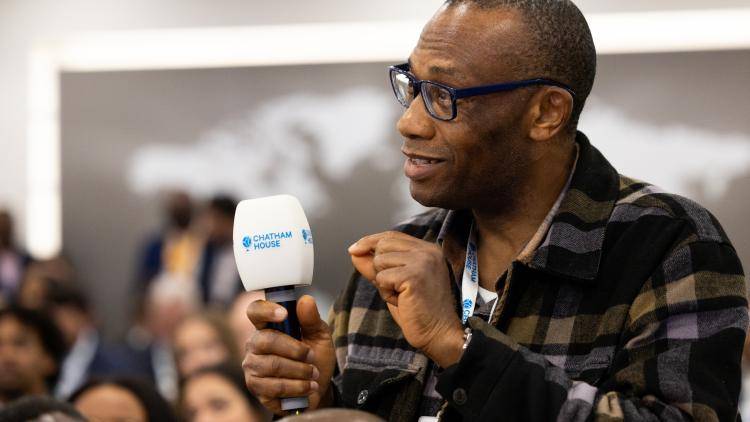
Maybe, as that one’s – alright, let’s take one more here on – gentleman here on the aisle. Let’s take – so that one on economy and trade. Yeah.
Kobina Hughes
Your Excellency, I’m afraid it’s another Lawyer.
Bronwen Maddox
Well…
Kobina Hughes
My name is Kobina Hughes. I am a Solicitor, dual-national, UK-Ghana. I’ve worked with the VRA and in the power sector in Ghana and I work in the power sector here, but my question is more about the reparations resolution. I’m really glad that you turned towards it at the end of your speech. I thought you weren’t going to mention it. I think it was a landmark victory and I’m really proud of Ghana for championing that and for you, in particular, sir. What I really want to know is, it’s just the beginning, the resolution has to be the beginning of something.
HE John Dramani Mahama
Yeah.
Kobina Hughes
And if you take the Holocaust, for example, the Lawyers who followed, the Nuremburg Trials, they created a lot of new international novel principles in international human rights law, including crimes against humanity, issues of sovereignty and individual responsibility. And I want to know whether you have any plans, because the resolution could just wither unless you have plans for getting Lawyers, African Lawyers – you talked about justice being, I think, principled, consistent and inclusive. We have to make it that. It doesn’t just happen and I wanted to know what you’re doing to make the resolution…
HE John Dramani Mahama
Hmmm.
Kobina Hughes
…buildable on, rather than just the end of the story. Thank you.
HE John Dramani Mahama
Yeah, okay, yeah.
Bronwen Maddox
Let’s take those two Lawyers putting out their case at some…
HE John Dramani Mahama
Yeah, okay.
Bronwen Maddox
…length. Let’s take those two.
HE John Dramani Mahama
Let me be – correct something I – the Commonwealth Summit is [inaudible – 45:42] Antigua and Barbuda. Yeah, I said Cambodia. I think that’s the Francophonie, I mixed the two up. Well, let me start with the issue of reparations. The UN General Assembly Resolution was the first step. I think that for many decades, we have been struggling with the issue of reparations. Things took a faster turn when Ghana was made champion of reparations and restorative justice for the African Union. And when I came into the presidency, I served notice in September last year that Ghana was going to move this notion – motion, we gave notice of the motion. And it took quite a lot of work building the coalition around it, because work on reparations had been very fragmented. Different parts of the Black diaspora were pulling in different directions.
So, one of the first things we needed to do was to bring everybody together and start looking at it with one lens, and we managed to do that. It took a lot of legwork by my Foreign Minister travelling the length and breadth of the Black diaspora. Eventually, we got some traction going. Then there was the motion and what should be in the motion. Everybody had the ideas there, Congressional Black Caucus, the Caribbean CARICOM nations and all, but eventually we agreed on a text that everybody was happy with and then, we moved that historic motion in the UN and got 123 members supporting it.
I don’t want to shoot ahead of everybody else, but we have a conference coming up in Accra in June and it is appropriately titled, ‘The Next Steps,’ and so, that conference is going to discuss, you know, legal options, return of looted artefacts, I mean, so many things. But I must say that even after the passage of the resolution, several countries have been proactive in coming back and saying that ‘Look, let’s have a discussion on this.’ And if you notice recently, France took some action about slavery, the Catholic Church apologised for slavery. Several countries have taken the step of returning artefacts that were taking and actually supporting the countries from where those artefacts were taking, to be able to preserve them and create the conditions for the artefacts to be returned and be able to be preserved for history. So, I think it’s been a positive step and at the summit that we hold in June, we’re going to come together. We already have – the CARICOM have a ten-point plan and so, it’s going to be one of the source documents that we’re looking at in terms of what the next steps should be.
With regards to free trade, we’ve always had free trade. I mean, we didn’t recognise borders before. I mean, you carried your cassava across the border and sold it freely. Nobody harassed you. It was only the colonial experience that created those borders, but still, our people don’t really respect the borders. I mean, aunties and aunties live across the borders, they just walk across it and trade amongst themselves, but I understand what you’re trying to say.
We have approached the issue of free zones mainly in the direction of manufacturing and industrialisation and so, for example, in Ghana, we have the Free Zones Board that allow visitors to – investors to come, establish industries and sell 30% of the product into the local market and export 70%. But yes, it would help if we had free trade zones amongst each other. It would improve the exchange of commodities in Zimbabwe. That is what the African Continental Free Trade Area is supposed to do.
One of the major obstacles to trade amongst ourselves is the fact that we have 54 different currencies and so, you need to change those currencies into some other currency to be able to trade amongst ourselves. And that’s why we’re working on the Pan-African Payments and Settlement Systems, that would allow a producer in Ghana to export his goods and be paid in his own currency and it will allow somebody who buys those goods in Kenya to be able to pay in Kenya shillings for the goods. And so, that is work in progress and I believe that if we get that sorted out amongst ourselves, it would increase the trade amongst our countries.
Bronwen Maddox
Thanks very much, indeed, for that. Alright, let me take – there are a couple here, one in the front and then gentleman in the cap.
Ghida Fakhry
Thank you very much, indeed. My name is Ghida Fakhry. I’m a Broadcast Journalist working for TRT World, formerly with Al Jazeera English. I, in fact, I host a programme about the changing geopolitical dynamics and the emergence of new powers – new players in Africa and the Global South willing to take on the established status quo. I’m also someone who knows Ghana extremely well, having spent a lot of time there throughout my childhood.
Mr President, you spoke about the need for this new global architecture that is built on genuine partnerships, away from the dependencies of the past. You also talked about the importance of confronting historic injustices and seeking moral accountability. To build this more equipped – equitable order that you speak about, what is the single most important reform that you think wealthy Western nations, former colonial powers, global institutions, must make today to end Africa’s structural dependence, both economic and political, rather than simply managing it?
Bronwen Maddox
Okay, thank you very much. Gentleman who did have a cap on.
Mansa Musa
Yes, I did. Right, Mr President, I want to ask about…
Bronwen Maddox
Will you – forgive me, would you like to say who you are?
Mansa Musa
Sorry. The name is Mansa Musa of Voice of London Radio. Mr President, I want to ask about ECOWAS and the EU, going forward, the viability of these organisations. But before, I have to say I want to congratulate you and your crew in a nice way. The job you are doing in Ghana, so far, so very good. There’s a lot to thank you for, that is a fact. But Mr President, what I want to say is we in West Africa alone, we are sitting on trillions of pure raw wealth and so, one will have thought that whether it’s either peacetime or troubled times, we’ll have Heads of States meeting in let’s say, Abuja, in Cotonou, Accra, Yamoussoukro, elsewhere, to think, formulate, ways and means to raise hundreds of billions for development for let’s say, five/ten years.
Instead, we have individual each Heads of States, always trekking, going outside, wherever, to find help and, you know, service its help here and there. Mr President, there isn’t a single, since I was born, a single problems that are raising in Africa that either ECOWAS or the EU have been able to solve. You and I ver – remember very well talking about xenophobia, I call it Black on Black hatred.
Bronwen Maddox
Will you forgive me, sir? It’s just if you could…
Mansa Musa
I will come…
Bronwen Maddox
…get to the question.
Mansa Musa
…to the questions, I will come to the place. What I want to say is we Ghanaians drove out Nigerians. Nigerians drove out Ghanaians.
Bronwen Maddox
They did, it…
Mansa Musa
ECOWAS or EU couldn’t. So, my question to you, Mr President, can we say do you – can we say that the African contest, or the Africa concept, that Africa project, is dead?
Bronwen Maddox
Alright, what is the most important reform wealthy powers should make and is the African project dead?
HE John Dramani Mahama
Okay, I’ll start with the Africa project. I don’t believe the Africa project is dead. I still believe in continental integration. I believe that we can do more to co-operate with each other and indeed, that is the way to go, because I don’t believe that any one country can, in isolation, become an island of prosperity on the continent. We need to work together. If you take regional integration, I mean, Nigeria, it’s the largest economy in West Africa and I think the second largest in Africa and so, these are regional powerhouses that’s can help drive prosperity in the whole of the continent. South Africa is the biggest economy, and I believe that if these countries are working properly and the other countries are co-operating, we’ll have regional growth poles where we can pull each other up by our bootstraps.
And so, yes, we must think regionally, but we must now also act locally, and I gave you the conditions that would make a change in our countries. One, democracy, respect for human rights, you know, better governance, you know, better economic governance, I think that those are things that we should begin to take seriously. There must be a new crop of African leaders who are selfless, who are working for their people, who are more accountable and trustworthy. The days where African leaders, I mean, just took power for the sake of having power and for the privilege of being leaders has passed. There must be a new crop of African leader that is prepared to work and sacrifice for their people.
The African project is not dead. I believe that we must continue to work at it. Yes, we do have problems, but not all the problems are caused by African interests. In many cases, they are external interests that are responsible for the problems that we were confronting. I mean, look at what happened in Libya. US and France interfered and took Gaddafi and look at the mess that was left behind. Today, look at Sudan. There are all kinds of interests in Sudan that make it difficult to resolve the issue in Sudan. And so, yes, there’s external interference, but we mustn’t give up on Africa.
And then, with regards to what should – we should do. First, we need to recognise that we’re interconnected and that we were put on this planet together for a reason and that we must learn to work together. There are some things that however powerful a nation you are, you cannot resolve on your own. Climate change, you can’t – no one country can deal with the issues of climate change and yet, they affect all of us and so, we must work together and realise that we can create prosperity for every citizen in this world if we share the prosperity.
And so, there are some things that we need to do as developing countries. We must govern better, we must be more accountable to our people and all that, but there are some things that our partners should also do. Our relationship and our co-operation should be based on our priorities. If you take the health space, countries give money to NGOs and there’s a lot of fragmentation. Every NGO comes and sets up and starts doing something on its own, without reference to the priority that the country has set for itself, and that’s what we’re saying in the Accra Reset, that we’re not talking about isolation, we’re talking about partnership, but partnership based on our priorities. And I believe that that voice is getting even louder and many countries are buying into a new global governance system, and that system has been more equitable than the old one that we’re leaving behind.
Bronwen Maddox
Thank you, and I’m going to stir – we got two minutes. I’m going to stir in three questions online. Thank you online for the terrific questions that have come in. One, ‘Should ECOWAS have a joint army? Two, ‘Should Ghana join the BRICS?’ And three, ‘Does the violence against the Ghanaian community in South Africa affect relations between Ghana and South Africa?’
HE John Dramani Mahama
[Pause] We have the protocol for a standby force in ECOWAS, but we have not evoked it regularly. The only time that I know that we came close to evoking it is recently, when there was the attempted coup in Benin. The President of Benin evoked the standby force, and Nigeria went in and supported to quell the coup d’état. And so, yes, we do have provision for a standby force and that should be a mechanism that helps us in our common fight against terrorism and other threats to the countries in the sub-region.
Bronwen Maddox
There was an example I’ve quoted a lot of what ECOWAS did in regards to Benin at the end of last year.
HE John Dramani Mahama
Yes, and then before, also, the action of ECOWAS in Guinea Bissau, in Liberia. The ECOMOG force was a joint military force that went and restored peace in Liberia. And so, there are examples where we’ve had to make use of our joint forces to be able to resolve issues.
Should joi – Ghana join BRICS? I don’t know what the criteria for joining BRICS is, but I think that you need to develop your economy to a certain level to become a member of the BRICS. I don’t think that it’s a conversation that we’re having in Ghana about whether to join BRICS. Let’s do a better job of our regional integration, ECOWAS, you know, African Continental Free Trade Area. I think that that should be our priority for now, rather than joining a wider economic grouping.
Our relations with South Africa continue. We do not have any breach in our diplomatic relations. What happened was that it’s not the first time there have been these xenophobic attacks in South Africa. They say we shouldn’t call it xenophobia. I don’t know what else – other name you can give it, but there have been these surges in anti-foreign attacks and normally, those who bear the brunt are fellow Africans from neighbouring states, Mozambique, Malawi, Zimbabwe and before, Nigeria. Lately, Ghanaians have gotten involved. This is the first time we’ve really had Ghanaians getting part of the direction of attacks.
We had a situation where people went on rampage, locked the shops of foreigners, and many of the Ghanaians and other West Africans there come with some skills, like nail work, barbering, weaving of hair, I mean, the cosmetic and Beautician industry. And so, when the rampage took place and their shops were locked and it was dangerous to go out, because if you were identified as foreign, you could be attacked. And they were even forays into health institutions and if you were not South African, you were asked to leave the hospital, even if you were ill. It created a very, you know, toxic atmosphere and many of our citizens rushed to our Embassy because they were displaced, especially those who came from Daban and other places, they sought refuge in our Embassy.
And so, at a point we had nearly 200 of our citizens in our Embassy and I mean, it didn’t look like the South African authorities were doing anything to try to quell what was happening and also, to provide protection to those who had been displaced. And so, we had no option but to evacuate our citizens and so, we did a first evacuation flight. We’re going to do two more to take those who want to leave, it’s voluntary. We asked, ‘Do you want to stay, or you want to leave?’ And many of them say they feel threatened and so, they want to leave, but I think it’s unfortunate what is happening in South Africa.
We need to drill down to what causes these flare-ups in terms of xenophobia. I think that there might be some structural issues in the – that are a carry over of the Apartheid area. And so, all of us must empathise with South Africa or must sympathise with South Africa and we must help South Africa to be able to drill down and find out what it can do to reduce the unemployment rates amongst the Black populations and to also change the mindset that people who have come to your country are taking your jobs. You know, really, let all the Africans leave. After the last fellow African leaves, is it going to change unemployment among Blacks in South Africa? After the last shop has been closed and everybody has left, is it going to change unemployment in South Africa?
There’s something in there that the South African Government must put a finger on and start a process of reforming so that – I mean, every country benefits from migration. There are Lawyers here in the UK, there are Surgeons, there are Doctors, there are Ghanaian healthcare workers working in the NHS. In Ghana, we have fellow Africans working in Ghana. They are South Africans, they are Sudanese, they are, you know, Nigerians, and everybody brings some advantage. They either bring their knowledge or they bring investment, and I think we should get over this fear of, you know, foreigners coming into our countries.
Bronwen Maddox
Hmmm, thank you. On that note, can I thank you for coming? Terrific questions online. Thank you for viewing online. We’re getting very, very big online audiences these days. Please join me in thanking President John Mahama [applause].