

In the context of recent developments, this paper reviews US President Donald Trump’s Iran strategy and explores possible pathways to a new nuclear agreement with the Islamic Republic.
A Guide for Trump, Washington, Tehran, Europe and the Middle East
Research paper
Published 22 October 2019
Updated 14 December 2020
ISBN: 978 1 78413 366 5

In the context of recent developments, this paper reviews US President Donald Trump’s Iran strategy and explores possible pathways to a new nuclear agreement with the Islamic Republic.

President Trump made clear his opposition to the JCPOA during his election campaign, describing it as the ‘worst deal in history’. He has also made clear his willingness to strike a ‘bigger and better’ new deal that would address all outstanding issues in one process, though more recently he has given higher priority to nuclear non-proliferation. To that end, the Trump administration has supported a policy of maximalist pressure, which it believes will lead Tehran to reopen negotiations and expand the terms of the JCPOA. Of course, one should note that it was the US that withdrew from the deal and that Iran so far has remained a party to it.
The findings of this research paper suggest that, at best, the signatories to the 2015 agreement will only be able to renegotiate aspects of the deal to accommodate concerns that have arisen among all parties, including Iran, and that any successful outcome will consist of a JCPOA+ agreement rather than a so-called ‘grand bargain’.
There is little to suggest that the Trump White House’s policy on Iran will do more than follow the template established vis-à-vis North Korea, which involved Trump promising a breakthrough (which he characterized as ‘the deal of the century’) in resolving the nuclear stand-off with that country but delivering little, if anything, in the way of substance.
Very few respondents were willing to entertain the idea of a grand deal, but it was welcomed by some interviewees, notably a number from Iran and the US. A number of structural factors certainly work against a move towards a bigger and better deal, frustrating US efforts to kick-start negotiations. Nonetheless, this paper has explored potential pathways back to negotiations, and has given consideration to areas in which the parties involved can find common interests.
This chapter assesses which of the pathways to a deal is most likely to prove productive. Before making any recommendations, however, it is first necessary to reconsider some of the obstacles that must be overcome, and to re-examine some of the working assumptions that have informed the approaches of the different parties.
As mentioned, the Trump administration’s policy of maximum pressure on Iran is unlikely to succeed. Despite this, the current US administration remains steadfast in its belief that the only way to engage Tehran in a new round of negotiations is by increasing sanctions. Furthermore, the Trump White House appears to have calculated that time is on its side, and that the more it pressures Iran, the more likely it is that it will be able to extract important concessions. In other words, Trump may be prepared to ‘squeeze’ Iran throughout his current presidency, and then pursue new negotiations if he is re-elected in 2020. In the climate of current regional tensions and President Macron’s diplomatic initiatives, there could be scope for a deal before November 2020; such a deal would require Iranian nuclear compliance in exchange for sanctions relief.
While Trump has made clear that his end game is a deal, not regime change, he has yet to adjust or moderate his strategy to meet his objectives. This failure or unwillingness to adapt to changing realities will mostly likely serve as a major constraint on kick-starting negotiations. Steadfast adherence to a simple, linear strategy will frustrate efforts at building consensus between the US and its international partners.
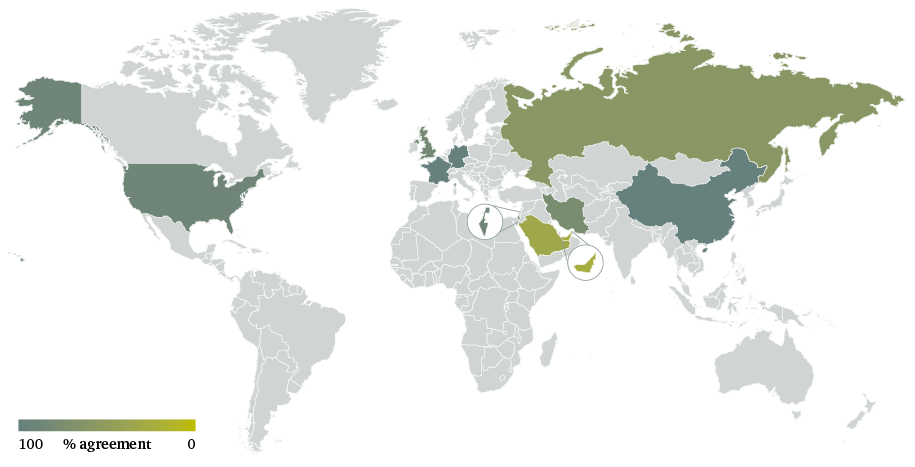
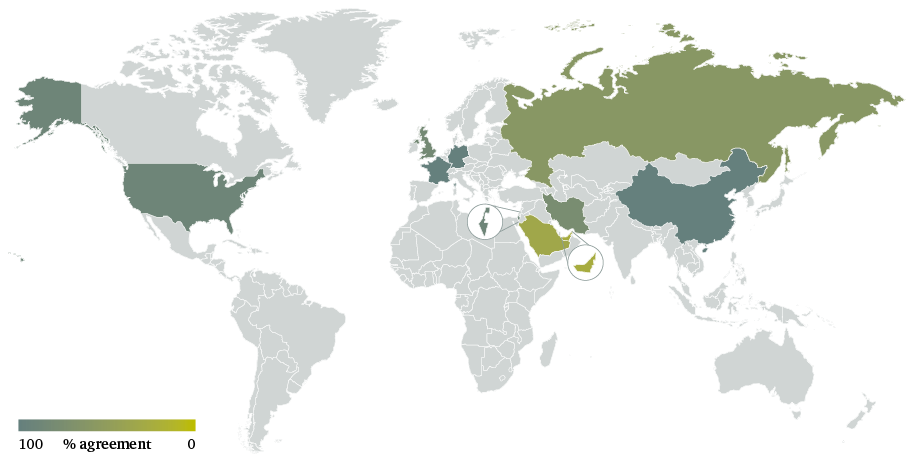
Rather than completely isolating Tehran, Trump’s unilateral policy has created openings for US allies and adversaries. The E3 countries continue, albeit limitedly, to pursue multilateral efforts to save the JCPOA. The continued efforts to operationalize INSTEX in 2019 and sustained diplomatic traffic between European capitals and Tehran confirm the validity of this agenda. Transatlantic tensions continue to frustrate wider coordination on Iran policy between Europe and Washington. Russia and China also continue to provide Tehran with strategic support and marginal economic engagement, further obstructing Washington’s goals of isolation. Israel, Saudi Arabia and the UAE – while publicly supportive of Iran’s containment – remain privately anxious that in any negotiation the US administration will sacrifice their interests, as they believe Obama did.
Iran is highly unlikely to return to negotiations simply because of maximalist pressure. One interviewee stressed that Iran’s calculations were not based on the state of the economy: ‘There was no magic number or economic statistic that would drive decision-making.’115 While sanctions played a role in pushing Iran to reach agreement in 2015, the decisive factor was the Obama administration’s willingness to agree a limited uranium enrichment programme as part of the JCPOA.
Restoring full diplomatic relations with the US government and opening up to US businesses is not the objective of the Iranian government. Tehran wants access to the US financial system, the withdrawal of US forces from the region, and above all security guarantees.
Nonetheless, Iranian leaders have said repeatedly that the removal of sanctions would constitute an inducement to reopen negotiations. Many analysts now also believe that Tehran would require the Trump administration to acknowledge Iran’s regional security concerns or defence asymmetry.
Despite sanctions that have restricted economic growth and inflicted pain on the government and population, Tehran’s regional policy has not changed since Trump was elected. Its willingness and ability to strike out, not only against regional targets but also against international players, have increased.
Restoring full diplomatic relations with the US government and opening up to US businesses is not the objective of the Iranian government. Tehran wants access to the US financial system, the withdrawal of US forces from the region, and above all security guarantees. It would consider regional agreements on security issues only if its neighbours made similar concessions. The current US administration has yet to appreciate this, and simply believes that the promise of business will be enough to persuade Iran to sign up to a new deal.
It is not clear that the US administration has considered what concessions Iran would seek in any forthcoming agreement. While the US has set out 12 challenging conditions, it appears to have done little preparation for getting beyond the current impasse. Iran, on the other hand, is already engaged in its own domestic process of coalition-building and bargaining. This means that an internal consensus will be reached over the timeline, terms and process of any future negotiations. Therefore, should negotiations begin, Iran will be better prepared than the US.
While a trust deficit between the governments of the US and Iran is not new, Trump’s decision to withdraw the US from the JCPOA may have irrevocably damaged prospects for future talks. Domestic opposition prevented President Obama from negotiating the JCPOA as a treaty – a process that would have required the support of two-thirds of the US Senate. Consequently, the Iranian leadership has lost further trust in the US system, and would therefore be unlikely to accept a deal on the promise of a president.
The lack of US government unity on Iran has also deterred Tehran from investing in negotiations with what it perceives to be a divided and disorganized administration. The Iranians have made it clear that they would prefer to wait out the current impasse until the next US presidential election in 2020.
However, it is not clear whether the JCPOA will survive the remainder of the Trump presidency. With a continued escalatory pattern of tensions between Washington and Tehran, a danger of miscalculation looms large. While nearly all respondents to our survey expected talks of some kind to begin in 2021, the interregnum presents a major challenge to the integrity of the JCPOA. Without immediate remedial care, the nuclear deal is unlikely to survive, which makes the prospect of negotiations in 2021 that much more remote. In other words, all original parties to the deal, including the US, need to keep the current nuclear agreement alive. They need to invest time now, ahead of any future negotiations, to lay the groundwork for what comes next.
Based on the findings of this paper, it is clear that a grand bargain is highly unlikely, given the nature of the challenges. In fact, seeking to address all the issues as part of a comprehensive deal would likely frustrate progress in individual areas where there remains a greater likelihood of reaching new agreements.
While Iran’s nuclear programme, ballistic missiles and regional dynamics are all issues that need addressing to satisfy the national interests of different countries, as well as to enhance regional stability, the majority of interviewees agreed that the approach most likely to achieve results is either a JCPOA+ model or individual deals on each of the three issues.
The goal of the JCPOA was to limit Iran’s breakout time to building a nuclear weapon from an estimated few months to one year. An equally important and little-discussed aspect of the JCPOA is its procurement channel, which provides a legitimate and controlled pathway for Iran to obtain needed nuclear-related goods while controlling dual-use procurement. All US interviewees pointed to nuclear issues as the most important priority for the US, with 36 per cent seeing the JCPOA+ model as the most viable scenario for protecting American interests. Therefore, strengthening the nuclear provisions of a follow-up agreement should be a priority for the Trump administration. The US objective is to guarantee that Iran will never obtain nuclear weapons. Therefore, the goal of extending Iran’s breakout time should be the primary objective of a JCPOA+ agreement. Seventy-one per cent of US respondents saw an extension of the sunset provisions as the most viable way to achieve this aim.
Drawing from the findings of this paper and recommendations from interviewees, the basic contours of an improved deal could include the following points:
To arrive at negotiated outcomes, policymakers in Washington, Tehran and Europe should consider the following recommendations as they work towards new, achievable agreements: