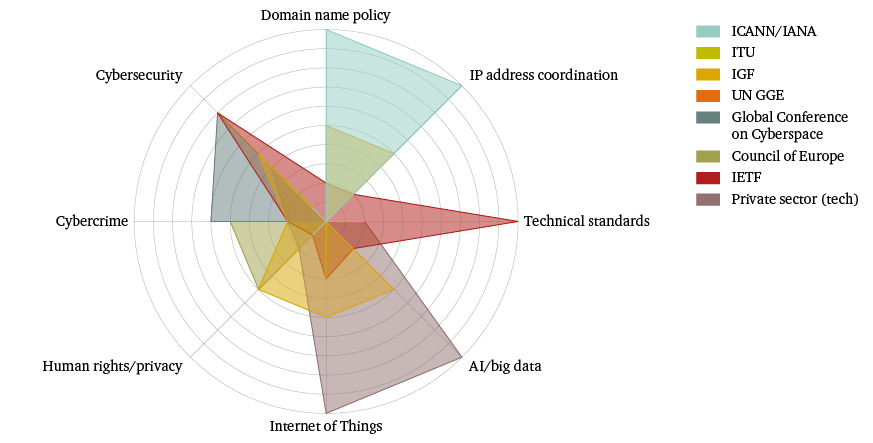
Whether or not domain names and IP addresses have as much relevance in the future, an essential component of any internet governance strategy is the continuing focus on the system’s unique identifiers. But this narrow focus is insufficient to tackle widely recognized urgent internet governance issues, which currently have no internationally agreed upon multi-stakeholder home. These issues include AI, big data, IoT and its applicable technical standards, oversight of new recursive resolvers (i.e. using DoH), as well as privacy, cybersecurity and the role of states in cyberspace.
The changing nature of internet governance and strategic risks
O’Hara and Hall’s ‘Four Internets’ paper, describes four competing visions for the future of internet governance: the ‘open internet’ favoured by the US; the ‘bourgeois’ internet of the EU ‘where trolling and bad behavior are minimized and privacy protected, possibly at the cost of innovation’; China’s ‘authoritarian’ model; and the ‘spoiler’ internet for states such as Russia and North Korea, which exploit its open standards for strategic gain. All four approaches have differences that could characterize the future shape of the internet, or even fragment it. However, there are greater commonalities between the EU and US versus Chinese and Russian approaches – accentuating a potential East–West divide.
As the field of internet governance necessarily evolves to meet the challenges of technological and societal change, ideological fault lines between the EU and US are likely to emerge.
The relevance of the four internets model to this paper is that while internet naming and addressing (the traditional core of internet governance) have not to date posed major ideological differences between the EU and US, continued agreement cannot be taken for granted. As the field of internet governance necessarily evolves to meet the challenges of technological and societal change, ideological fault lines between the EU and US are likely to emerge. The future of a free, open internet in which human rights and the rule of law are respected is not guaranteed. There is a strategic imperative for the EU and US to emphasize areas of common ground in order to prevail against the emergence of an internet whose fundamental values differ from those upon which the network was founded. It is, therefore, important for the EU and US to work together to encourage participation of moderate, like-minded stakeholders in internet governance processes. The authors recommend that the EU Delegation seek to establish a taskforce for this purpose.
The term multi-stakeholder has become ubiquitous when discussing internet governance processes over the past 20 years, particularly those originating from the US. What does multi-stakeholder mean, and why has it become a charged term in the context of the four competing visions for the future of internet governance?
What does multi-stakeholder mean?
The term ‘multi-stakeholder’ was first coined in the 1990s as a way of extending the types of actors involved in policy and corporate decision-making. The starting point is a ‘complex, controversial issue on an international scale’, not unlike climate change.
In theory, multi-stakeholder governance decentralizes and democratizes decision-making. In internet policy, it is usually associated with ‘bottom-up’, ‘rough consensus’ policies developed by all stakeholders on an equal footing. For the majority of Western commentators this is viewed as the appropriate model for governing the internet, on the basis that involving diverse stakeholders leads to better policy outcomes. Multi-stakeholder is viewed as an alternative approach to intergovernmental, multilateral processes (typified by the International Telecommunication Union (ITU) and favoured by authoritarian regimes such as Russia, China and Iran). In this sense both have become charged expressions that import their advocates’ contrasting visions for the future of the internet – divided along the East–West or ‘four internets’ axis.
ICANN is above all the poster child of multi-stakeholder internet governance. Unfortunately, gaps between theory and ICANN’s practice threaten to become a strategic risk for both the EU and US visions for the future of internet governance. As practised within ICANN, multi-stakeholder governance gives equivalency to all voices, no matter how radical or self-interested, and there are underdeveloped mechanisms for breaking a deadlock or asserting the public interest.
The role of governments remains a contentious point, illustrating that, behind EU and US support for multi-stakeholder governance, there may not be a consistent, shared understanding of what ‘multi-stakeholder’ actually means. The structure of ICANN illustrates how these divergent views can impede closer cooperation in practice.
From ICANN’s inception in 1998, it was intended by the US government that the ‘private sector… take leadership for domain name system (DNS) management’. A foundational principle for ICANN – and what marks it out as different from the multilateral ITU – is that it is not government-led. This was originally articulated as ‘private-sector led’ and, following the conclusion of the World Summit on the Information Society 2003–2015 (WSIS), morphed into ‘a bottom-up consensus-based multi-stakeholder process’. The ICANN structure has two types of stakeholder groups: the ‘supporting organizations’ – the Generic Names Supporting Organization (GNSO), the Address Supporting Organization (ASO) and the country code Names Supporting Organization (ccNSO) – which are focused on making policy for domain names and IP addresses; and the ‘advisory committees’ – the Governmental Advisory Committee (GAC), the Security and Stability Advisory Committee (SSAC), the Root Server System Advisory Committee (RSSAC), and the At Large Advisory Committee (ALAC) – which provide advice to the ICANN board. The advice of governments and other advisory committees is not binding on the ICANN directors, but over time the bylaws have strengthened the board’s obligations to provide reasons for not following GAC advice.
Throughout ICANN’s numerous transitional periods, the US government has increasingly tried to stay at arms-length from ICANN to ensure its independence from government oversight. A respected advisory committee role within the community and acknowledgment of government’s role in internet governance suited this aim. Additionally, the US is traditionally a free market-driven economy with a light regulatory touch and decentralized governance, which is both an alternative structure compared to the EU and provides private industry a strong position in internet governance. With respect to multi-stakeholderism, the US vocally supports inclusion of all stakeholders, such as academia and civil society, but the US style of multi-stakeholderism can seem from the outside to be market-led.
The US is traditionally a free market-driven economy with a light regulatory touch and decentralized governance, which is both an alternative structure compared to the EU and provides private industry a strong position in internet governance.
European policymakers would likely have set up ICANN in a different manner, for example, possibly including more accountability to the public to counterbalance corporate interests. To European policymakers, and representatives of other governments (especially authoritarian governments such as China, which would favour a multilateral solution to internet governance), it is conceptually troubling to have sovereign states in a capacity that may be perceived as lesser than or secondary to the directors of a private corporation. In reality, the board’s powers to reject the policy recommendations of supporting organizations have always been limited.
However, differences in status of the various stakeholder groups and advisory committees within ICANN are, for the most part, more problematic in concept than in practice. Over time, the powers and influence of ‘advisory committees’ has grown (for example, the SSAC is one of the most influential organs of the ICANN community), and successive changes to the bylaws have gradually strengthened the role of governments within ICANN.
A more practical way of thinking about multi-stakeholder processes is to adopt a flexible, results-orientated approach, driven by considerations of required expertise, which caters to those who are currently not being heard.
What are the key internet governance institutions?
An exhaustive review of the institutions involved in internet governance is outside the scope of this paper. Table 1 summarizes the characteristics of key institutions active in the internet governance landscape. There are others, such as technical standards bodies, the regional and national domain name registries, registrars, and the organizations that manage the distribution of IP addresses. The intention is to focus on areas of interest and possible influence for the EU Delegation.
Table 1 shows the institution’s characteristics, openness (how easy it is for stakeholder groups to participate), what the forum’s decision-making process is (if there is one), whether government plays a formal role, primary participating stakeholders, the oversight body or convener of the forum, and the type of formal and informal outputs by the forum.