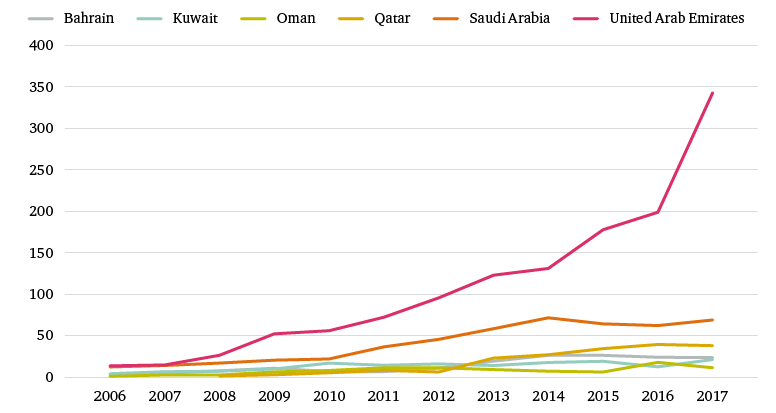
ISO also tracks the number of sites where ISO 27001 applied between 2007 and 2015 (the last year for which data is available). This data also shows an increase in this period, although with declines in the UAE, Saudi Arabia and Oman after 2013, again potentially due to the new version of the standard. Other surveys suggest that implementation of ISO cybersecurity standards is uneven in the GCC. An academic survey of ISO 27001 in Saudi Arabia in 2014 found that standards were low on security professionals’ priorities, below personnel issues like training, expertise or salary, and organizational ones such as management involvement. This suggests that, despite the impressive educational opportunities in cybersecurity in the GCC, these skills are not always translated into professional practice. Overall, the GCC has adopted international cybersecurity standards slowly and unevenly, and with many businesses focused on older versions of these standards after newer ones are available.
For data protection regulation, in media interviews some cybersecurity professionals claimed that only 30–35 per cent of UAE companies would be compliant with European data protection standards (GDPR), and around half that number were even aware of the steps necessary for compliance. A survey by a data storage solution provider, including 100 respondents in the UAE, highlighted the existence of large amounts of data in organizations that could contravene GDPR requirements. Separately, Gulf Business Machines (GBM) has conducted an annual survey of ‘IT/security managers and professionals’ in the GCC since 2014 (the last year for which data is available is 2017), with the number of respondents varying between around 600 and 1,500. The survey is presented as an independent analysis of the cybersecurity community, although the results are shown in a way clearly designed to market GBM products. Despite this bias, its sample size and repetition make it a valuable source in an area of limited data. This survey suggests that cybersecurity capacity is slowly increasing in the private sector, as 43 per cent of enterprise respondents claimed they had the capabilities to predict and prevent cyberattacks in 2015, rising to 50 per cent in 2016; similarly, 58 per cent claimed they had an effective security strategy in 2015, rising to 79 per cent in 2017.
For finance, digital financial transactions are governed by e-transaction and e-commerce laws introduced throughout the GCC between 2002 (UAE) and 2014 (Kuwait). There are several free-trade zones in the GCC that operate under different financial regulations to the rest of the state, the most notable being the Dubai International Financial Centre (DIFC), the Abu Dhabi Global Market (ADGM) and the Qatar Financial Centre (QFC). These centres also have different cybersecurity regulations, mainly focusing on data protection: DIFC is regulated by a data protection law introduced in 2005, amended in 2012; ADGM’s data protection regulation was introduced in 2015 and amended in 2018 (with an Office of Data Protection established in 2017); and the QFC has had separate data protection regulation since 2005. These regulations aim to ensure that businesses in these free-trade zones are able to work internationally, and so they explicitly claim to follow international regulations, especially that of the European Union. However, financial regulation – including on data disclosure requirements – has been insufficient to prevent the inclusion of the UAE and Oman on an EU list of 17 countries, finalized in March 2019, which either failed to comply with required financial ‘good-governance’ criteria or did not commit to doing so.
43 per cent of enterprise respondents claimed they had the capabilities to predict and prevent cyberattacks in 2015, rising to 50 per cent in 2016
For health, the UAE has introduced Federal Law no.2 2019 for healthcare data, while Dubai’s Healthcare City has had separate data protection regulation since 2013. In Saudi Arabia the transfer of financial and health information is regulated by the relevant sector bodies. The other GCC states do not have separate healthcare cybersecurity regulation.
Given the GCC ‘late rentier’ economic model, cybersecurity threats to the oil and gas sector are particularly concerning for national governments. Companies in this sector have extra cybersecurity responsibilities due to their crucial role in the functioning of the state and as a core economic foundation for both international stability and national welfare. There have been several notable cyberattacks against the oil and gas industry in the GCC, including the Shamoon incident in 2012, and more recently malware that altered the settings of industrial control safety systems in a Saudi petrochemical and refining complex in 2017, with the potential to disrupt production and harm employees. Cybersecurity provision in the energy sector, and oil and gas in particular, has three particular challenges, in addition to the wider issues above. First, there is an economic incentive for companies to adopt IP-based operational technology networks for more efficient production, creating practical problems in isolating such networks from their internet-connected business networks. Second, the cybersecurity priority for these companies is protection from espionage (corporate or state-sponsored), rather than damage, as the former is seen as a more immediate threat to their business model and reputation. Third, like other industries, the oil and gas sector has a long and complicated supply chain, with many vulnerabilities introduced early on, so transferring good practices down the supply chain is difficult.
Overall, the uneven nature of cybersecurity provision in the GCC states means that it may be difficult for these states to recover from a large-scale cyber incident. GCC states need to improve their cyber resilience as well as their cybersecurity in order to withstand and rapidly recover from cyber disruption.