Ukraine is a front-line state in the struggle between European rule-based order and Russian kleptocratic autocracy. Since the Euromaidan Revolution in 2013–14, Russia has deployed a range of measures – short of an open declaration of war – to undermine Ukraine’s aspirations to build an independent democratic system of governance and integrate into the Euro-Atlantic community.
Russia is waging a full-spectrum war against Ukraine, exploiting domestic vulnerabilities to sow chaos and challenge the state. In this sense, Ukraine can be considered a political ‘laboratory’ of Russian influence on a large scale. Because of its proximity to Russia, the widespread use of the Russian language and Russian infiltration of its security forces, Ukraine is often used by the Kremlin as a testing ground for various coercive measures.
Russian strategic intentions towards Ukraine have not changed since the start of the conflict in 2014. The Kremlin remains committed to keeping Ukraine weak, isolated and under some form of control. In his December 2019 press conference, Russian President Vladimir Putin reaffirmed threats to Ukraine’s territorial integrity beyond the Donbas region, in the east of the country, by claiming that the area north of the Black Sea (‘Prychormoriya’) is historically Russian land.
Fundamentally, the Kremlin wants Ukrainians to believe that they do not need their state and that state-building is a futile effort that only benefits corrupt, dysfunctional elites. It wants to encourage citizens to wonder whether things would not be better if Russia governed Ukraine. For this to happen, the Kremlin seeks to promote polarization and a clash between Ukraine’s people and its governing elite.
Since 2014 the Kremlin has adapted its tactics in Ukraine. These have developed from initial fermentation of civic discontent in the southeast against Kyiv, to pushing wider fragmentation, and to the use of direct military means to sustain simmering conflict along the line of contact (LoC) in Donbas. Russia exploits the current military situation in the east to further destabilize Ukraine. However, opinions in the Kremlin differ on how best to deal with Ukraine. Some advocate patience and maintaining pressure via conflict until widespread autonomy for Donbas is granted, while others argue for some form of compromise in exchange for the lifting of Ukraine-related sanctions against Russia.
From the Kremlin’s perspective, the broad menu of satisfactory choices includes: integration of the self-proclaimed ‘Donetsk people’s republic’ (DNR) and the ‘Luhansk people’s republic’ (LNR) into the Ukrainian constitution as special-status areas; annexation of these quasi-statelets via recognition; or maintaining military pressure until Ukraine compromises and the West loses interest. In short, Putin would like to have a veto over Ukraine’s future.
Russian tactics to subjugate Ukraine include disinformation warfare, cyberattacks, trade embargoes and limitation of transit to Asia, undeclared war in Donbas, interference with navigation in the Sea of Azov, energy supply blackmail, and the annexation of parts of Ukraine’s territory (e.g. Crimean Peninsula). Since April 2014, over 13,000 people have lost their lives due to the conflict in eastern Ukraine, with an additional 30,000 injured. These figures include over 3,300 civilian deaths and over 7,000 injured civilians.
Russia’s aggression has caused major disruptions in Ukraine including rising flows of internally displaced people (IDPs), difficulty in the reintegration of war veterans, the loss of coal supplies for leading Ukrainian metallurgic companies, and complications for the shipping and fishing industries due to the construction of the Kerch Bridge across the Sea of Azov. The region’s ports are critical for Ukraine’s exports of grain and metallurgical products.
In the occupied territories of the DNR and the LNR the Kremlin is creating pre-conditions to complicate the future reintegration of these territories into Ukraine. Moscow is limiting remaining voices inside the DNR and the LNR calling for these territories to become part of Russia. At the same time, in those territories, it is conducting a soft integration of existing structures in Russia’s ‘sphere of influence’, notably in the economic, cultural and education sectors, and through a passportization policy. At the start of 2020, Russian authorities reported that 200,000 Russian passports had been issued in Donbas using the fast-track procedure available for people working for the separatist ‘authorities’.
Russia has used its information channels, which also reach Kyiv-controlled parts of Donbas, to mould a separatist identity through the manipulation of fear and pre-existing grievances. The Kremlin is conducting a form of social engineering through propaganda in order to generate a pro-Russia, anti-Ukrainian electorate. This is particularly controversial since ideological brainwashing of citizens includes schoolchildren via new curricula in history and ‘citizenship classes’. In terms of ideological content, Russia’s narrative focuses on the de-legitimization of the Ukrainian state and the promotion of the idea of a special status for the separatist territories that goes beyond current Ukrainian legislation. This has resulted in the creation of a local identity shaped by war. While this local separatist identity is not well established, it has the potential to take hold as it has been formed by more than six years of conflict and against a background of rising anti-Ukraine sentiment.
Beyond Donbas, Russian destabilization tactics against Ukraine have evolved over time and are notoriously slow burning. They range from broad attempts to undermine the independent Ukrainian Orthodox Church (UOC) to specific efforts to negate a sense of pride among local volunteers. These tactics mostly aim at multiplying internal disputes in Ukraine, exploiting passive discontent and putting pressure on state structures. For instance, Russian authorities are most likely behind a series of fake bomb threats that are putting additional strain on Ukraine’s infrastructure and diverting the attention of local authorities. Other endeavours focus on undermining the central government by corrupting regional administrations, as exemplified by recent court decisions in Mariupol regarding the amnesty of DNR war fighters.
On top of continuously discrediting democratic Ukraine, Russian propaganda efforts are now concentrating on depicting President Volodymyr Zelenskyy as a ‘puppet’ of the West and a ‘clown’. Seizing the opportunity presented by the COVID-19 pandemic, Russian state media spins the story of the collapse of Western liberalism and depicts apocalyptic scenarios in Ukraine to increase panic, such as possible hunger protests, lack of cash in the economy, and the disintegration of the healthcare system. Russian-designed disinformation operations and active measures radicalized the local population in Poltava region to violently protest against the placement of Ukrainian citizens recently evacuated from China in the local hospital. This violent demonstration generated negative media coverage of Ukraine in leading international outlets and damaged the country’s image.
Fortunately, these major disruptions have not resulted in a nationwide disaster or state collapse. Despite Russia’s aggression, economic pressure and information war, Ukraine has managed to preserve its statehood, reclaim parts of territories captured by Russia-backed separatists and roll out a comprehensive programme of ambitious reforms. Ukraine is attempting the equivalent of rebuilding a ship in heavy seas.
The benefits of resilience
Ukraine has persevered as an independent state thanks to its resilience and determination to defend its own future. There are various definitions and examples of resilience. In physical sciences and psychology, resilience is viewed as the capacity to regain shape after various shocks. Among countries under duress, Bashar al-Assad’s regime in Syria is an example of such perseverance. Ukraine’s own crony capitalist economy with its strong vested interests demonstrates similar robust resilience and opposition to change. The second kind of resilience is a system’s ability to absorb shocks and make adjustments without losing its main features. For example, the US financial sector following the 2008 economic crisis, where some adjustments in policy allowed it to return to business as usual.
For the purposes of this analysis, we define resilience as the capacity of an entity – an individual, a community, an organization or a natural system – to prepare for disruption, to recover from shocks, and to adapt and grow from a disruptive experience.
In the case of Ukraine, the adaptive nature of resilience is of key importance. In addition to withstanding and absorbing shocks, there is an opportunity to generate a resilience dividend. By this, we mean an adaptation that comes out of a crisis, which develops Ukraine’s political institutions to a new higher level of operation. Much of Ukraine’s post-Soviet transformation occurred as a result of innovation from non-state actors, both private sector and civil society. This is where societal resilience comes into play and why it is so important. It has been the bedrock of Ukraine’s transition. At present, Ukraine finds itself needing to accelerate this process of adaptation if it is to emerge as a strong and viable state; it is not enough to maintain the status quo.
Ukraine is in an extremely turbulent environment. Russian military aggression and coercive actions, the domestic turmoil resulting from structural reforms and, more recently, the challenge of addressing the COVID-19 pandemic all require resilience from citizens, organizations, cities and communities. The mobilization of active parts of society often compensates for the weaknesses in Ukraine’s political institutions. In the current crisis, a new type of institution is already emerging from this interaction between political institutions and non-state actors (civil society, business sector, local communities).
Ukraine already has a certain amount of resilience capital based on the following factors, mainly stemming from its societal culture and views about the armed conflict:
- Ukrainians are accustomed to living with instability;
- Ukrainians are determined to defend the country, as reflected in the rise of patriotic sentiment. The majority of the population views Russia as an aggressor state and sees the conflict as a ‘war for independence and restoration of territorial integrity’;
- The majority of citizens are hopeful that the country can overcome difficulties;
- Nascent social cohesion among groups of active citizens;
- An active civil society and vibrant volunteer movement; and
- Horizontal social links rather than hierarchical centralized command as the main organizing feature of social interactions.
These factors should be nurtured as Ukraine remains highly exposed to Russian threats. Building the resilience of communities and institutions is an important strategy for Ukraine to achieve its developmental objectives despite the actions of a violent and disruptive neighbour. Resilience is not an inbuilt feature that is present by default in each system. It can be acquired and strengthened if the proper mindset is applied to social change, organizational development and approaches to crises.
Russia’s drivers of negative influence
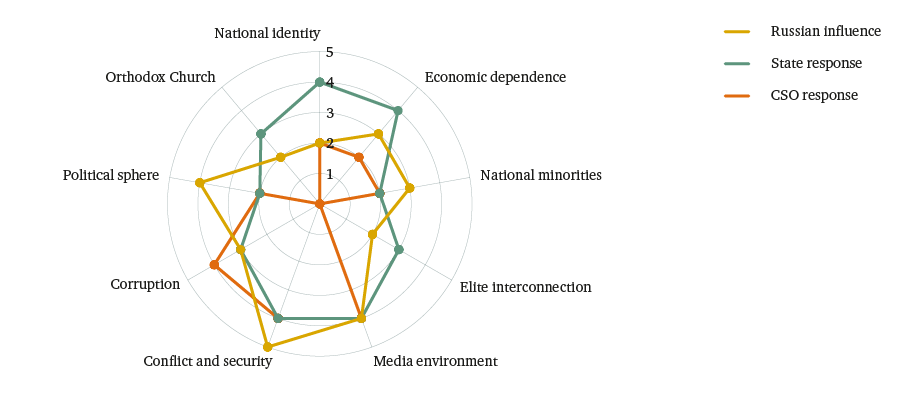
To better understand how Russia has deployed its various levers of influence in Ukraine, previous research by Chatham House proposed a set of categories to identify areas of strategic local vulnerability:
- Quality of the internal political system (political parties, government-organized NGOs, prevalence of corruption, interconnection between elites);
- Security, conflicts and Russian military presence;
- Economic dependence (energy, trade, business ties);
- Media environment (Russian disinformation, public support for pro-Russia narratives, penetration of Russian narratives into pro-Russia privately owned outlets, weak independent media); and
- Identity (history, language, minorities, culture, role of the Russian Orthodox Church).
Figures 1 and 2 map Ukraine’s vulnerabilities and responses to drivers of Russian influence, as assessed by independent experts, in 2018 and 2019.