Industry needs to be forward-looking
Services are central to the European economy where many of the companies see the potential of the energy transition rather than the risk. Large parts of industry can transition at a low cost through efficiencies and by using other forms of energy. But heavy industry – aluminium, steel, chemicals, cement – will be impacted. They are not necessarily doomed like the coal sector where there is support, labour market action and measures to help people move into other forms of activity. But heavy industry is the interesting in-between category that has a choice to make. They need to evolve. Forward-looking measures are being taken. Look at what the Swedish steel industry is doing with hydrogen. The Austrian steel industry is also investing in different pilot projects that use hydrogen.
Their survival depends on how they innovate and develop technologies. By 2050, we would certainly hope, (a) to be carbon neutral; and (b) to have a thriving steel, chemical and aluminium industry in Europe. There will be support from the EU side, and research and other measures that the public sector should take, but of course it will also depend on company decisions. Fundamentally the energy transition is a structural reform of the economy. As with all structural reforms, some companies prepare, reform and live through such transitions while others don’t take the necessary actions.
A lot of carbon reduction can be done with the current structures. But there is reform of production processes in these industries where, for instance, in terms of process-related emissions, CCS can offer a solution. The steel, cement, and perhaps even more so the chemicals sectors must prepare.
The steel sector in Europe does seem aware of this. They’re in a difficult position now because Chinese steel is being dumped on the market. Supply of steel is much higher than demand especially now that selling steel to the US has become difficult. But they are not ignoring this challenge and a part of the European steel industry is preparing.
Until a global equivalent carbon market develops from raising the ambitions in the Paris Agreement, which are revised upwards every five years, free allocation of permits will be necessary to spur innovation. It works towards reducing emissions while at the same time not putting industry at a competitive disadvantage to an extent that they can’t overcome.
CCS vital for industry and negative emissions
We do not see a big role for CCS in electricity. You might see some CCS for electricity outside Europe but there isn’t a compelling need for it inside Europe. There is, however, a need for CCS in two areas – heavy industry and industry that has process-related emissions. Emissions in industry will have to head towards net-zero by 2050.
Biogas will increasingly be used as an application for heat. Biomass is more suitable for heat than electricity as it gives more energy. Biomass, which is classified as zero emissions, combined with CCS generates negative emissions. We are committed to net-zero by 2050 but emissions will remain, in agriculture and industry. Land use, soil, and forests provide a sink, but CCS goes further in providing a route to negative emissions and therefore providing a solution for those remaining emissions. It is a very viable option.
Some geographical integration is helpful for CCS and biogas, in having heavy industry zones, but we would also envisage CO2 being shipped to Norway or elsewhere by pipelines in the future. It can also be shipped by boat. We are already financing some of these projects.
Closing the variability gap with renewables
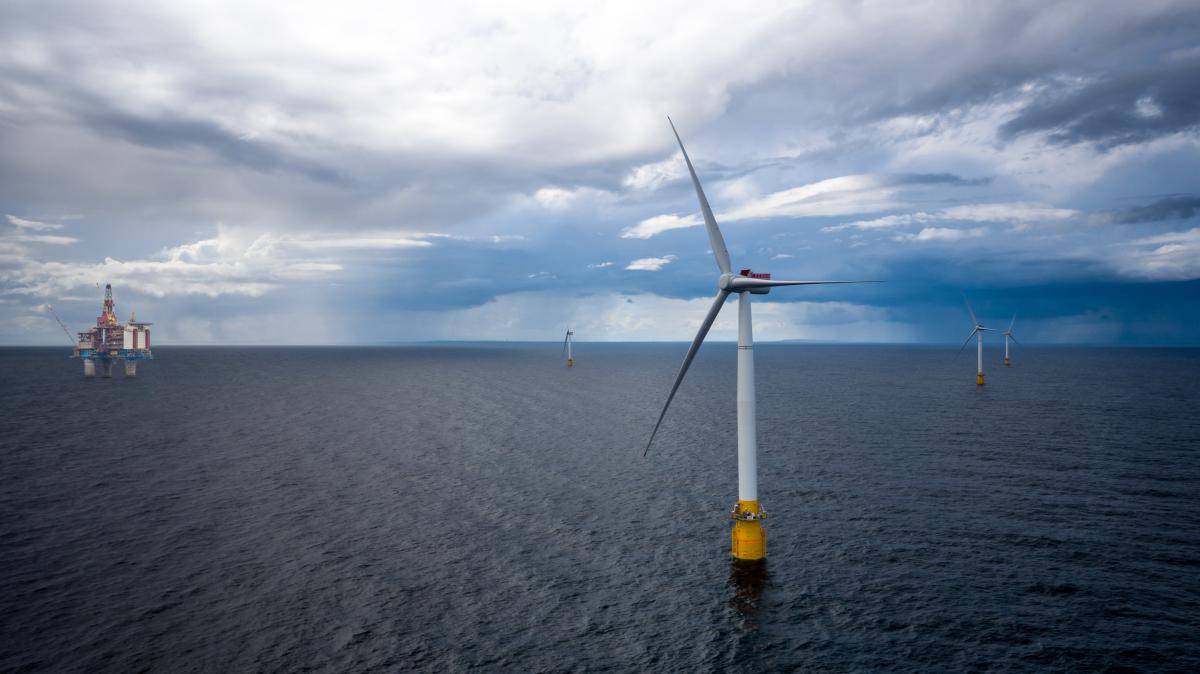
The European Commission assumes that there will be 55 per cent of renewables in the power sector by 2030, and 85 per cent by 2050. Some of the growth of renewable electricity will come from the marine environment. There will be the continued increase in offshore wind power and possibly new forms of energy such as from wave, tidal etc.
The gap not met by renewables in 2050 is likely to be provided by nuclear with zero CO2 emissions. There would be a rather small baseload, probably less than 15 per cent, provided by nuclear. As time goes on, not all renewables will be variable, there will be progress with battery storage, and so nuclear will contribute. But the fluctuation with renewables will increasingly be less of a problem. A more connected power sector is of course necessary for greater renewable deployment.
Interconnection and Norway’s position
Interconnection enables the smoothing out of variability and the EU current target of 15 per cent interconnection by 2030 would provide stability in the market. A higher target is not currently foreseen. The target for 2020 is at 10 per cent. Most member states will meet this. There will be some exceptions, such as some parts of the Iberian Peninsula and southeast and central Europe. They’re more at 7 or 8 per cent but that will increase by 2030. The 15 per cent target does create sufficient flexibility in the marketplace. It would be better if it were higher but that level is good and realistic. Some member states are far beyond that, at 30 per cent, whereas others are not near. Islands like Malta and Cyprus will have none and then will leap to 40 per cent with an interconnector, as in the case of Malta. But then there are areas where it is more complicated, for cost reasons partly, but also vested interests.
Norway is far beyond the target when you look at how much it connects to the Nordic market and through that to the European market. There are major projects between countries such as Norway’s connection to the Netherlands with the world’s longest high-voltage subsea cable, the NorNed; and the interconnector to the UK under way; and one to Germany is also planned.
Norway has an important role as an exporter of electricity to the European market, which is in both our interests. It is also CO2-free, which is why we are so interested. We would like the Finnish to do more as well but they believe that it will raise prices domestically.
In terms of electricity, Norway is essentially part of the EU market; there’s no real difference between them and Sweden and Denmark. For all practical purposes they are part of the Nordic market, and they have two options: either they leave the Nordic market or they stay in the Nordic market and apply EU rules. With the European Economic Area (EEA) agreement, through the third energy package that they did last year, EEA countries implement EU legislation where they have to adhere to the European Agency for regulation. We’ve just renegotiated the electricity market rules, concerning balancing and network codes and so on, and in turn they will have to integrate those new rules into Norwegian law.
Norway’s lead on EVs
Norway is a leader in rolling out EVs and related infrastructure at high cost. It is useful for the energy transition. It is taking down barriers on what is possible; it is allowing costs to go down and allowing the technology to be tested. In that respect of course, it is useful. But when you see the cost of that in terms of tonnes of CO2 avoided, and the very generous tax breaks, both for registering and running a new car, not all member states could afford that route. What they’re doing is helpful for us all in taking the first steps, but it is an expensive measure. It is a specific Norwegian solution that relies very much on the strength of their public finances.
Electrification a disruptive technology to prepare for
While power companies will welcome the electrification of transport and heating, the grid companies may not be ready for it. The power sector will be largely decentralized. It will be necessary to centralize capacities but consumers selling their own production to the grid will only increase.
Electrification of transport does not present the same grid issues of smartness and flexibility. There’s a lot more of that to come. There will be a need for more grid functions and in some areas maybe a new grid.
Electrification of transport will likely occur around 2025–30, mainly in passenger cars. It’s unlikely that all cars will be electric but by 2030 a large share of new cars will be. Electrification is going to happen and if countries don’t make themselves ready, then they won’t meet the needs of the future. They’ll be missing an opportunity on a colossal scale.
All this points towards increased electricity production and consumption. Is the EU helping to prepare for this? Electricity market rules are going in that direction, but companies have a self-interest. We can do things like help to establish the framework, targets, rules, charging stations and so on, but a lot has to be done by the private sector.
Transport still a challenge in the transition
The transition is certainly happening in the energy sector. In 1990 we were at 5 per cent renewables and most of that was hydropower; today we are at 30 per cent and by 2030 we’re likely to be at 55 per cent. Within the EU the comparative efforts of the member states make renewable energies more competitive. The ball is rolling, that’s for sure. It is happening less so in the heat sector, but it is still promising. The challenge before us is the energy use by the transport sector. While consciousness and awareness of the problem is there, real delivery is still ahead of us. Cars have become more fuel-efficient. Since we introduced the first rules for emission reductions by new cars 10 years ago, CO2 has been cut from 165g/km to somewhere less than 120g/km today. Cars are more efficient than before but unlike in energy and industry, transport sector emissions are still linked to activity. This is much more difficult to address than in the energy and industrial sectors.
Gas and the rise of renewable gas
Gas is part of the transition. You will see a slightly reduced use of gas within the EU. However, because our own production is declining – Dutch production is decreasing – there will probably be stable imports for a few years ahead.
After 2030 we will see this decreasing in Europe. There will be a shift towards renewable gas in combination with hydrogen. There will be a higher share of renewable gas, some gas imports such as from Norway, but then in the 2030s when the transition starts to become established, we will see a decrease in gas consumption. Some gas will still be used in the 2040s. Natural gas will remain a key supplier of heat for some years to come but then will harshly and progressively be replaced by green gas. For example, around 5–10 per cent of France’s network is supplied by green gas.
In terms of gas imports, the important thing is to diversify. Norway will play an important part. We are still quite dependent on Russia, less than we used to be but still too dependent. Norway plays an important role because it is a market economy so it is simple – if you pay for your gas, you get your gas – which is not always the case with Russia.
Then comes LNG gas from the US and other sources. We will buy more gas from the US but Norway is special because its infrastructure is so well established with pipelines down to Belgium and France. Its role is important. A responsible gas producer operates by commercial rules. Whether that justifies opening other reserves is a decision for the companies themselves.
Oil, and progress so far
Most EU member states don’t use oil as they used to for electricity and heating. Oil is still used for transport, petrochemicals and plastics, although the latter will see a reduced use and more recyclable plastic. Our use of oil will decrease first and foremost in the transport sector but also in the plastic sector.
The idea that we should stop exporting so that we don’t export emissions is ludicrous. If you were dumping products on the global market that didn’t comply with environmental standards then one should feel some shame about that, but that is far from the case here. A product produced in Europe has a far lower carbon footprint than one produced in most other places in the world.
We started the transition and we have come some way down this road. In some countries it hasn’t started yet, and it’s very important that they start the process, in view of the total impact on the climate. That said, we’re nowhere near being able to sit back on our haunches. We’re not that good yet. Europe and the rest of the world need to transition away from fossil fuels.
You can’t discuss being a bridge without discussing the destination
Jesse Scott is international senior adviser at Agora Energiewende
(Based on an interview)