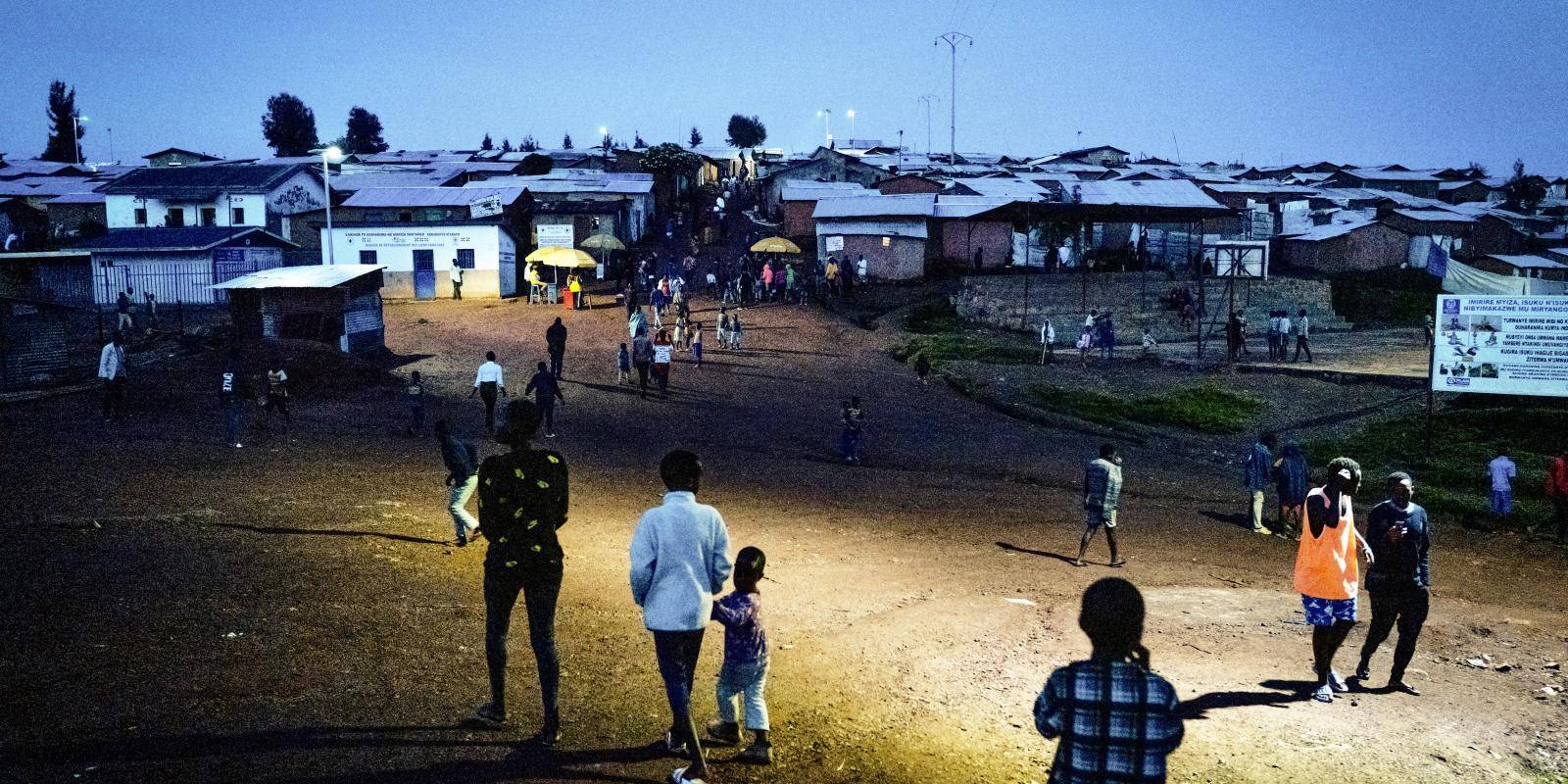
People who have been forced to flee their homes are often left outside national policy and planning for the provision of clean, safe and sustainable energy, even though most live and operate within a local economy.
Trends in forced displacement and the global response
Over 100 million people are currently forcibly displaced. The number of people forced to flee their homes has doubled since 2011, and the UN and governments worldwide are struggling to accommodate the growing numbers of refugees and internally displaced persons. Most of these people – around 80 per cent – are hosted by low- or middle-income countries.
When, in September 2016, UN member states agreed the New York Declaration for Refugees and Migrants, they pledged solidarity and a shared responsibility for the protection of the rights of refugees and migrants. They committed to ease the burden on developing countries that host the majority of refugees by adopting the Comprehensive Refugee Response Framework (CRRF), which aims to shift from shorter-term humanitarian aid to longer-term development solutions. The CRRF was further elaborated, in 2018, in the Global Compact on Refugees and the Global Compact on Migration, both of which actively consider the impact of migration on the environment and highlight the role of renewable energy in assisting the displaced.
The New York Declaration acknowledged the ‘positive contribution made by migrants for inclusive growth and sustainable development’. This came a year after UN member states agreed Agenda 2030 and the 17 Sustainable Development Goals (SDGs), including – under SDG 7 – new ambitions to enable access to sustainable energy for all. These principles and ambitions are aligned with the Global Compact on Refugees, specifically the aim to ease pressures on host countries and enhance refugee self-reliance.
Success for the CRRF depends on high-level coordination led by host governments, pursued through integration of refugee and host communities in national and sub-national policies, plans and programmes. However, the extent to which the CRRF has moved from theory to changed realities on the ground largely remains to be seen.
Achieving SDG 7 for displaced people
While global data remain patchy and unstandardized, available research estimates that more than 80 per cent of refugees in camp settings do not have access to modern energy solutions. Existing data show that refugees have disproportionately lower access to grid electricity than their surrounding host communities, and a comprehensive study published in 2022 cautions: ‘Without substantial investment and decisive political action, Sustainable Development Goal 7 is highly unlikely to be achieved in displacement contexts by 2030.’
With the global average ‘age’ of a refugee settlement standing at around 18 years, there is a need for long-term, sustainable solutions to close this energy access gap. Investment in clean energy access can help to catalyse local economic development and energy technology upgrading, reduce land degradation and deforestation, as well as greatly increase the quality of human health, create livelihood opportunities and mitigate greenhouse gas emissions.
More broadly, the provision of clean, safe and sustainable energy (the focus of SDG 7) is one of the principal needs of developing-country populations, including energy for cooking, heating, communication, education, livelihoods and security. SDG 7 is therefore often referred to as an ‘enabling SDG’, i.e. one that all others depend on. While global progress is being made towards SDG 7, albeit unevenly, displaced populations are not formally included in global tracking. There is a lack of reliable and comparable data to track progress and needs. Equally significant is the fact that displaced people often remain outside national energy policy and planning, even though most live and operate within a local economy.
In global-level discussions on achieving SDG 7 in situations of displacement, much emphasis has been given to the importance of collaboration among members of the UN’s Global Platform for Action (GPA), as a means to gather and coordinate resources to complete the journey from ‘assessment to investment’. The vision of the GPA is that ‘Displaced persons, host communities, and associated humanitarian response mechanisms have access to affordable, reliable, sustainable, and modern energy services by 2030.’ Global action on humanitarian energy has been necessary as the UN and its partners worked to design and consolidate the global structures and processes to implement UNHCR’s Clean Energy Challenge, launched at the Global Refugee Forum in December 2019.
How relevant is global and national policy in clean energy transitions?
The question of how to widen access to clean energy in low-income countries has inevitably triggered much debate about the role and importance of government policy. However, most in-depth studies of this topic agree that government policy, including targets, legislation, pricing and taxation, are important factors in driving the green energy transition, alongside fundamental capacity and enforcement issues. Conflict and political instability risk undermining or negating such progress, while influxes of forcibly displaced people complicate both energy needs and required solutions.
Government intervention (including on policy) is crucial to overcoming barriers to sector-specific innovation and growth. Alongside this, research also points to a consensus on the importance of learning by ‘exploring and doing’ in clean energy market creation and entrepreneurial success. Just as important as policy measures is ensuring that relevant infrastructure and institutional frameworks do not inadvertently act as major barriers to innovation and market growth.
Furthermore, recent research has looked at the role of transnational actors such as regional and multilateral development banks, UN agencies and international non-governmental organizations (NGOs) in the development of clean energy technology markets. These external forces both influence and are enabled by national and local efforts to create and expand such markets in low-income countries. At the highest level, this growing body of work reveals the primacy of inherently global and political processes in driving and steering growth in clean energy markets.
In low-income countries, clean energy access projects targeting populations of displaced people and the surrounding host communities can build on – or accelerate – existing efforts to pursue national low-carbon development pathways. This includes the observed uptake and diffusion of solar photovoltaic (PV) technologies driving (albeit unevenly) a rapid socio-technical transition in the energy sector across Africa.
A focus on market-based solutions requires greater understanding of national-level policy and governance
Conventional humanitarian policy and practice tends to be characterized by the implementation of short-term solutions: for instance, the pursuit of relief in the form of immediate measures to improve people’s welfare. The humanitarian system originally evolved to intervene in crises to try to protect human lives, not to get involved in long-term development issues. This short-termism is incentivized by traditional humanitarian budget cycles, whereby allocated donor funds must be spent within a given financial year. When it comes to providing energy, this still mostly translates into the procurement of diesel generators and/or the distribution of solar lanterns or improved cookstoves, regardless of the underlying needs, preferences or economic circumstances that could inform the design of more sustainable solutions.
In the last five or so years, there has been a marked shift in thinking regarding responsibilities for delivering the benefits of sustainable development for all, including energy to displaced people. Given fundraising shortfalls and the lack of technical capacity for things like energy management in the humanitarian sector on the one hand, and recognition of protracted displacement needs on the other, this change in thinking seeks to move away from short-term relief and free distribution of products. Instead, newer approaches aim to harness market-based models and partnerships with the private sector (especially given the emerging consensus on the need to pursue market-based solutions). At this juncture, it becomes vital to understand national policy and regulation governing this area.
Creating an enabling environment for private sector investment in clean energy requires a detailed understanding of the various financial and non-financial barriers and constraints, and analysis of how to overcome them.
In order to invest in clean energy, business and finance decision-makers want to have confidence in the longevity of policies – they need to be ‘long, loud and legal’. In many countries, this confidence is lacking and the specific conditions around displacement situations add uncertainty. As such, creating an enabling environment for private sector investment in clean energy – even at the micro level of, for instance, selling solar home systems in a refugee camp – requires a detailed understanding of the various financial and non-financial barriers and constraints, and analysis of how to overcome them.
For all the global initiatives and the increasing focus on the subject, little attention has been paid to the significance of national host government policy and governance in creating ‘effective ecosystems for implementation’ of clean energy objectives in situations of displacement. While development agencies tend to consider these issues carefully and conduct research, in-depth analysis and stakeholder consultations, humanitarian agencies rarely have the time, scope, budget or expertise to fully engage with these issues.
Joining the dots on policy solutions for refugee energy access
This paper examines the ways humanitarian efforts to scale up more sustainable electricity and access to cleaner cooking have been affected by the policy context – global and local – with a focus on five country case studies. Insights on these national policy contexts show the influence of policy and governance structures (or lack of them) in the delivery of clean energy for refugees and host communities, while the analysis attempts to identify the key factors of an ‘enabling environment’. In the concluding chapter, the authors discuss the role that UN agencies can play in fostering this enabling environment, and thus help to secure technical and financial resources that can assist refugee-hosting countries in achieving SDG 7.
Specifically, the paper attempts to answer the following questions:
- What difference do host governments’ policies and governance (including organizational structures) make to enabling energy access in displacement-affected areas?
- What types of engagement between host-country authorities and the global humanitarian sector have benefited attempts to increase access to sustainable energy?
- What does recent experience mean for future energy planning in displacement situations; and how can host countries benefit from evolving international interest in this area?