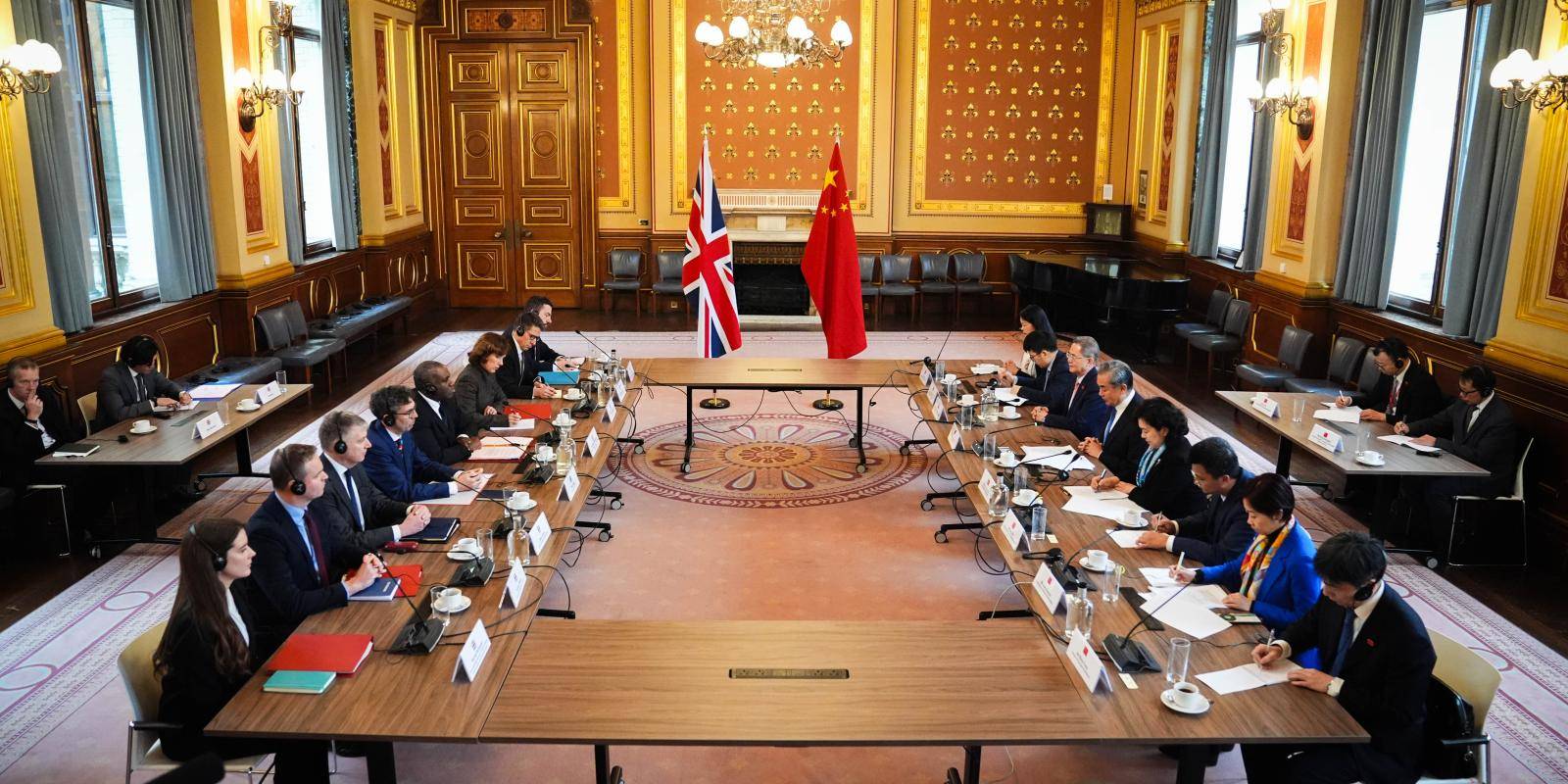
Running through these decisions is the dilemma of balancing access to economic opportunities and technology against the need to protect national security, align with allies, and avoid dependence on Chinese supply chains and goodwill. It has taken time for UK government thinking to adapt to the speed and scale of China’s global rise, to China’s growing footprint in the UK, and to the opportunities and risks that this presents. This has resulted in inconsistent bilateral engagement. However, there have been signs of change. The Labour government has made consistency a priority for the UK–China relationship. The UK has resumed high-level bilateral dialogues such as the Economic and Financial Dialogue and the Energy Dialogue. The government has also conducted an ‘audit’ of Britain’s relationship with China – although this much-publicized exercise has resulted in only limited and general commentary being made publicly available as part of the government’s Strategic Defence Review and national security, trade and industrial strategies. This makes it very difficult to judge the methodology, recommendations and evidence considered. However, what has been published does not amount to a systematic and detailed stocktake of China’s commercial and cultural presence in the UK, and makes few specific judgments on where and where not to engage with China or how and to what extent to do so.
It has taken time for UK government thinking to adapt to the speed and scale of China’s global rise, to China’s growing footprint in the UK, and to the opportunities and risks that this presents.
So far, UK government priorities and media and parliamentary debate on China have focused on short- to medium-term questions of boosting economic growth and securing the equipment required to meet net zero emissions goals. Where debate has addressed other challenges, such as the implications of the bilateral relationship for UK resilience, technological security and national security, it has typically been reactive in nature. This has occurred, for example, when specific events or news-making issues – from plans for a new Chinese embassy to the threatened closure of British Steel furnaces by the company’s Chinese owner, Jingye Group – have briefly captured public attention. What remains lacking is evidence that the UK has a clear idea of what it fundamentally seeks from a relationship with China in the long term, particularly in a world in which the post-1945 rules-based order no longer carries as much force.
That is not to say the government is blind to these issues. The UK is building the China expertise and capacity in Whitehall required to pursue a systematic, long-term strategy. The China capabilities of the Foreign, Commonwealth and Development Office (FCDO) are already substantial, and include a China network distributed across UK embassies which draws praise from European partners. There is also a clear recognition across Whitehall of the need to better coordinate China policy and analysis between departments, and to improve awareness beyond government, including in academia and industry. Presently, however, UK capabilities remain disproportionately concentrated in the FCDO. They are also focused on understanding China in and of itself, as opposed to understanding how the nature of the bilateral relationship affects UK interests, what the UK can hope to get out of its relationship with China, and how the UK can ensure its approach strikes the right balance between openness and security. This is especially true when it comes to understanding the long-term trajectories of both countries’ economies and technological capabilities, and how these factors are likely to interact (see Section 3, ‘Selectively encouraging Chinese investment’).
How can this approach be improved?
This paper argues that the UK government’s current approach to engagement, as sketched out above, is insufficient to address the economic, technological, security and foreign policy challenges presented by China’s continuing rise as a global power. The UK needs a more systematic, clear-eyed and long-term strategy for dealing with the magnitude of these challenges.
Coordination as a prerequisite
The first task, underpinning other policy changes, is to improve coordination on China: between government departments; between civil servants working on different policy areas; and between government, business, academia and civil society. To this end, the paper endorses a recommendation made repeatedly by other observers: that the UK government establish a cross-departmental ‘China coordination centre’ to gather and share expertise across government, garner input from business, academia and civil society, and develop understanding of China’s footprint in the UK.
This paper recommends that such a coordination centre should have the following responsibilities:
- Hosting regular cross-departmental meetings attended by policymakers and analysts to share approaches to China-related issues;
- Establishing and maintaining a fund for open-source China research, allowing bids from individuals, think-tanks, academia and the private sector;
- Conducting a regular, thorough audit of China’s political and economic footprint in the UK (see, in particular, Sections 2 and 3); and
- Developing government-certified training modules for use across central and local government, academia, business and civil society to develop baseline knowledge of China’s political system, strategic goals and influence operations.
To accompany this work, the government should once again establish a dedicated body for assessing the safety of Chinese digital components and software used in UK products and systems. Such a body could usefully be modelled on the Huawei Cyber Security Evaluation Centre (HCSEC), which operated from 2010 but was reported as inactive in 2024 (having not published annual reports since 2021). HCSEC provided analysis to the UK government on the risks associated with the involvement of Huawei, a Chinese telecoms firm, in parts of the UK’s critical national infrastructure.
Proposing three specific aims of a long-term China strategy
In Sections 2, 3 and 4, this paper recommends embedding three core aims into the UK’s China policy. Effective strategy is about anticipating future challenges, taking steps to avoid problems before they occur, and mitigating them when they are unavoidable. An effective China strategy should prioritize the long-term security and resilience of the UK’s economy and way of life over short-term economic and diplomatic gains, to ensure flexibility in the context of protracted great power competition between China and the US. The three proposed core aims are as follows:
- Protecting the UK’s democratic norms and civil liberties from malign political influence, making clear that human rights issues affecting the UK are matters of UK sovereign interest;
- Ensuring the UK’s relevance in emerging technology supply chains, while securing access to Chinese technology where this is beneficial; and
- Maximizing the UK’s strategic autonomy, in terms of both insulating the UK from Chinese economic and political influence and pursuing a China strategy fully independent of the US.
Why are these aims necessary?
The ongoing decline of the post-1945 rules-based liberal international order is likely to be irreversible. Alongside China’s continued dominance of global manufacturing and critical supply chains, its growing leadership in emerging technology, and its rising military power, this trend will increase China’s capacity to project power, leverage dependencies to advance its interests, and entrench its influence on global issues where Beijing and London have divergent priorities. Such issues include digital governance, maritime norms (including freedom of navigation and respect for exclusive economic zones) and human rights. China will not necessarily displace the US as a global hegemon, but China’s influence will continue to grow as a function both of its own development and of the US’s relative decline and retreat from internationalism.
This means the UK finds itself in a geopolitical position for which no obvious analogue exists in its modern history. It is a middle power whose own relative power is declining, with an open economy geared to operating in a global order that is rapidly receding in relevance. The UK faces often-competing demands: navigating relations with an increasingly inward-looking US; protecting and developing economic ties and common defensive interests with Europe and other US allies, even as those allies now fear abandonment by their key security partner; and responding to a rising superpower, in the form of China, whose political system and strategic thinking come from an entirely different tradition and are based on very different values.
Dealing effectively with both China and the US in this context represents an entirely new challenge. The UK’s strategic thinking can no longer rely on the assumptions and worldview that served UK governments during the post-Cold War period of US hegemony. Today, in the absence of a single hegemon, the international system is again characterized by the presence of great power competition (between the US and China, rather than between the US and the Soviet Union as previously; unlike the Soviet Union, China is a serious economic competitor to the US with far closer ties to the rest of the world). The ongoing US–China trade war demonstrates how rapidly great power relations can deteriorate, and how far-reaching the effects can be. The UK must be prepared for an increased likelihood of geopolitical shocks, including: protracted China–US trade tensions; the potential eruption of conflict over Taiwan, and the associated risks of catastrophic escalation; and domestic issues in China that could affect global trade and supply chains.
The UK must also be willing to rethink its diplomatic relationships, particularly the degree to which it aligns with the US. The close UK–US alignment that has been the norm for the past eight decades is now less consistently in the UK’s interests in a world of heightened US–China competition. At the same time, UK policymakers will find common interests with other like-minded partners in Europe and the Indo-Pacific, and should be open to flexible and pragmatic engagement with countries across the Global South. It would be a mistake to allow a justifiable focus on European security to lead to the neglect of the UK’s relationships in the Indo-Pacific, especially when it comes to dealing with China. This is discussed further in Section 4; priorities for the UK’s other relationships in the Indo-Pacific will be explored in more detail in the upcoming companion publication to this paper.
A key challenge in developing effective countermeasures to the risks posed by China is the likelihood that singling China out on a particular issue will provoke a backlash from Beijing, potentially to the detriment of a productive relationship. But the UK need not adopt such an approach in most cases. There are very few areas where protective measures are relevant only to the relationship with China. On questions of resilience and avoiding economic and technological dependency, similar measures make sense in relation to the US and indeed many other countries. Making clear that the UK’s China policies are part of a wider strategy of adaptation to a world of great power competition, and combining this messaging with a triaging of priorities on conflicts of values, will help to avoid antagonizing China and could also mitigate the UK’s dependencies on the US.