Morocco: Decentralization with a national vision
Empowered regions and investor confidence
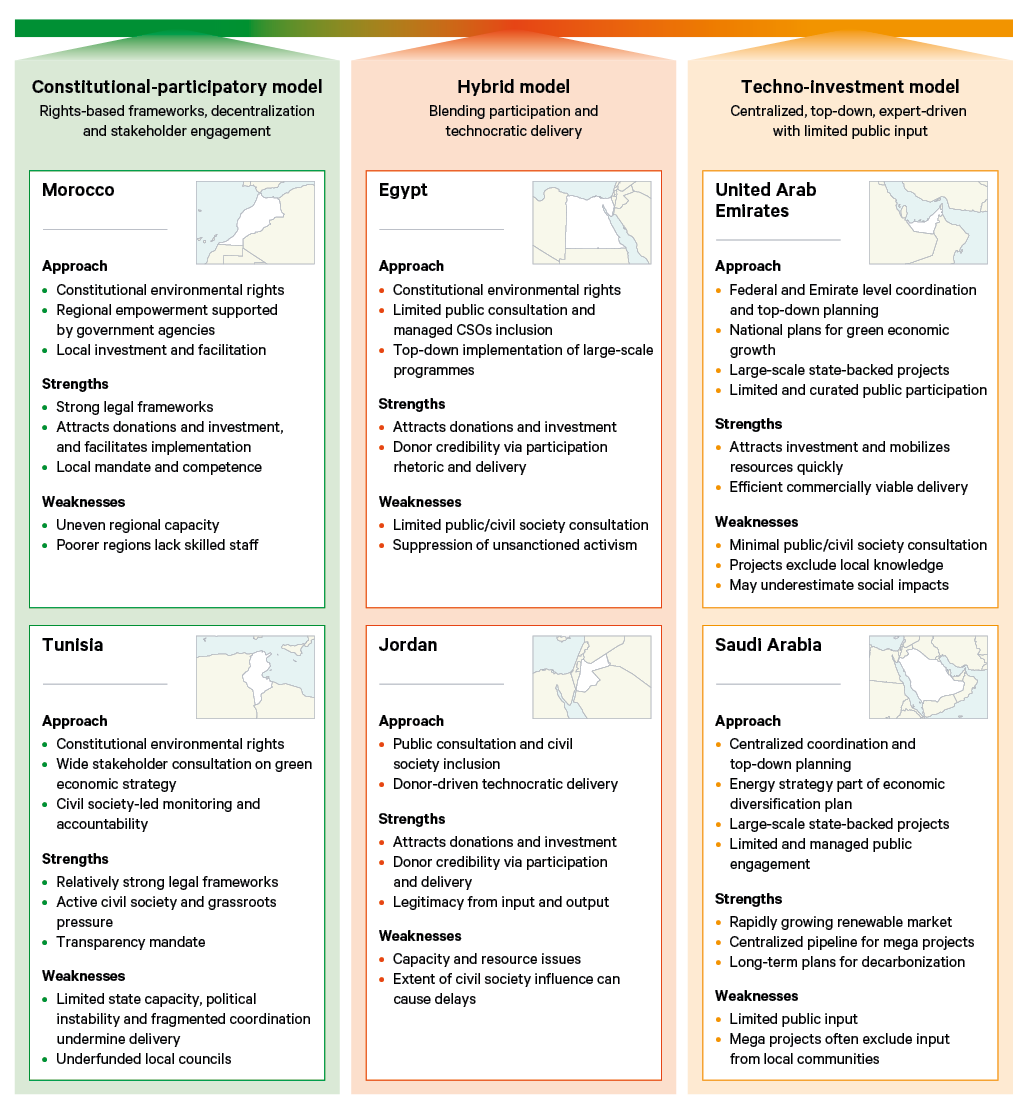
Morocco has pursued a climate strategy that combines a national vision with empowered local institutions. Constitutional reforms in 2011 recognized the importance of sustainable development and decentralization: with Article 31 outlining the state’s commitment to equal access to water, a healthy environment and sustainable development for all citizens, and Article 35 safeguarding natural resources for future generations. To achieve these goals, authority and resources have been delegated to the regions, supported by oversight bodies such as an environmental police force and water basin agencies.
Furthermore, regional climate committees, often part of broader regional councils, enable local officials, businesses and civil groups to plan and oversee climate projects. For example, rather than being micromanaged by central government in Rabat, the flagship Noor Ouarzazate solar complex – the MENA region’s first mega solar array with a capacity of 580 megawatts (MW) – was facilitated by the local Regional Investment Center. This local body functioned as a one-stop shop streamlining permits, land acquisition and coordination with local agencies, thus facilitating investment.
The effectiveness of this model depends on a combination of delegated authority and administrative capacity at the local regional level. In Morocco, it works because regional councils have both a legal mandate to approve investment projects and sufficient competence to coordinate among ministries and private actors. However, such arrangements may be harder to replicate in countries where central agencies are reluctant to cede control. For example, Algerian provinces remain constrained by limited authority and climate literacy. Meanwhile, Morocco’s streamlined decision-making procedures, combined with its more than 50 free trade agreements, have positioned the country as a manufacturing and export base for green technology.
Local participation and resource management
Morocco’s participatory ethos extends to critical resource sectors such as water. The National Climate Plan 2030 empowers basin-level water councils and regional committees to tailor adaptation measures – such as small dams and drought-resistant crops – to local needs. This decentralization enhances the scalability of investments, as regional committees manage local priorities and help align projects with on-the-ground realities. This is reinforced by national legislation such as the National Charter for the Environment and Sustainable Development (2011), Environmental Assessment Law (2020), and Water Law (2016), all of which embed participation and sustainability into regional planning. National interventions such as the Agadir Declaration (2017) underscore the role of local and regional governments in climate action.
This decentralized approach that reduces the distance between decision-makers and local needs has yielded tangible regional successes. In Souss-Massa, beyond regenerating 10,000 hectares for the Argan biosphere reserve and expanding drip irrigation, the Regional Climate Plan allocated over 507 million dirhams ($52.5 million) in 2016 to priority climate projects, including integrated coastal management and fisheries-focused ocean monitoring. The region also implemented World Bank-backed structural flood protection works.
Lessons from Morocco
While Morocco’s governance model balances ambition and participation, not all regions of the country have the same capacity. Poorer regions such as Drâa-Tafilalet may lack skilled staff or budget, slowing project roll-out. Furthermore, while municipalities have strong regulatory frameworks in waste management, they often lack sufficient technical expertise to enforce them effectively. Strengthening local governance capacity could ensure that ambitious plans translate into consistent delivery nationwide.
It is important to note that major initiatives still must align with King Mohammed VI’s strategic direction, meaning local plans operate within the parameters set out by royal priorities. While this may seem to constrain local activities, the 2011 constitution’s enshrining of the right to sustainable development provides civil society a legal hook to hold government accountable, though public climate litigation remains rare.
Overall, Morocco demonstrates how a decentralization framework, anchored in constitutional rights and backed by investor-friendly facilitation, can make climate action both participatory and competitive. The challenges ahead lie in increasing local capacity and ensuring all regions can deliver to the same standard, so that climate benefits and economic opportunities are shared across the country.
Tunisia: Progressive reforms, practical hurdles
Climate rights and decentralization on paper
Tunisia took a bold participatory turn after the Arab Spring. Its 2014 constitution is one of the region’s greenest, explicitly mentioning that ‘the state guarantees the right to a healthy and balanced environment and the right to participate in the protection of the climate’ (Article 45, 2014 Tunisian Constitution). This laid the foundation for laws to empower local governments and elected municipal councils, aiming for bottom-up climate action. In theory, Tunisia has covered all good governance requirements with strong environmental rights, transparency mandates and the decentralization of authority.
Furthermore, Tunisia’s long-term green economy strategy, formulated in the mid-2010s, was developed through broad consultations with ministries, local authorities, private sector actors and civil society organizations (CSOs), and is now embedded in sectoral plans for energy, transport and water. Such integration reflects how participatory climate governance can align economic diversification – particularly towards a more sustainable economic model – with public engagement and support.
Beyond consultation, CSOs help sustain climate governance by monitoring state performance and translating complex policies for vulnerable communities. In Tunisia, several climate-focused CSOs have piloted local accountability tools, such as citizen audits and participatory feedback mechanisms, to track municipal adaptation plans and service delivery. National non-governmental organizations (NGOs) such as Al Bawsala have strengthened accountability through initiatives like Marsad Baladia, which tracks municipal budgets, transparency and service performance across the country. By making data public and exposing gaps in local delivery, these monitoring tools have compelled some municipalities to adjust practices and improve responsiveness. Together, these forms of civic participation show how Tunisian civil society can generate pressure for corrective action and strengthen governance outcomes, even in a challenging institutional environment.
Gap between promise and implementation
In practice, however, Tunisia has struggled to turn its progressive laws into tangible results due to lack of state capacity. Government coordination is fragmented and, due to a culture of ministerial silos, climate change has not been fully embedded into all ministries’ agendas. As of 2025, only the Ministry of Agriculture, Water Resources and Fisheries employed a coordinator for climate change. The Ministry of Environment, which in principle should lead on climate, saw frequent changes in leadership and has limited political sway in government.
Tunisia has struggled to turn its progressive laws into tangible results due to lack of state capacity. Government coordination is fragmented and, due to a culture of ministerial silos, climate change has not been fully embedded into all ministries’ agendas.
Decentralization too has been nominal. Local councils exist but often lack the funding and technical expertise to implement plans. A review of Tunisia’s climate institutions concluded that climate action ‘is not being mainstreamed’ across ministries, a gap exacerbated by insufficient capacity, institutional fragmentation and poor local resources. Additionally, Tunisia’s subnational governance struggles, where local authorities are underfunded and face inconsistent guidance, further explain the gap between national plans and current outcomes. The share of subnational government expenditure on climate has in fact dropped from 7.8 per cent of general government expenditure in 2016 to 3.8 per cent in 2020.
With fragmentation between ministries, insufficient funding at the local council level and wider political turbulence all delaying renewable energy projects, the challenge here is not participation, but the absence of clear authority to implement decisions and limited capacity for civil society engagement to influence delivery.
Tunisia’s renewable energy roll-out exemplifies the tension between participatory frameworks and effective delivery. In 2019, the government awarded contracts for 500 MW of solar power, but political instability and fragmented authority meant many of these projects stalled for several years without approval for financial investment. By late 2023, however, momentum began to build with 200 MW under construction and another 300 MW close to being confirmed. In 2022, Tunisia also launched a 1,700 MW renewable energy tender (1,100 MW solar and 600 MW wind), which is still ongoing. By early 2025, licences were granted to four international firms for the solar component – Qair International (300 MW), Voltalia (100 MW), Scatec (100 MW), and Aeolus (100 MW) – which confirms some progress in project delivery.
Civil society and public pressure
Civil society remains a bright spot in Tunisia’s climate governance. Local organizations and community groups have played an important role in exposing environmental and service-delivery failures, particularly around water access. Across interior regions such as Kairouan, frequent community mobilization – including more than 150 protests recorded in June 2020 alone – has drawn public and governmental attention to failing water systems, underscoring how grassroots activism can surface climate-linked vulnerabilities and pressure institutions to act. NGOs and grassroots movements regularly invoke Article 45 of the 2014 constitution when pressing authorities on other matters such as water mismanagement, even if much of this pressure happens outside formal courts.
Lessons from Tunisia
Tunisia’s climate governance highlights the importance of institutional capacity and local delivery. While national frameworks like the 2014 Constitution and updated nationally determined contributions (NDCs) commit to ambitious goals, implementation is hampered by a culture of silos, weak local funding and poor coordination. It demonstrates that strong participatory guarantees and vocal civil society can elevate climate issues. However, without functioning institutions and resources to support such participation, intentions under this model do not necessarily translate into results. Participatory frameworks need to be underpinned by coherent institutions and economic stability. For Tunisia, this may mean reinforcing its participatory model with a central climate authority and streamlined approval for priority projects, while also ensuring local councils and civil society have the resources to contribute effectively.
UAE: Technology driven climate action
Central coordination with clear lines of authority
Climate governance in the UAE runs through a federal coordination structure: the UAE Council on Climate Change and Environment aligns ministries and emirates on strategy and delivery, and has appointed the Ministry of Climate Change and Environment (MOCCAE) as the lead institution. The National Climate Change Plan of the UAE 2017–2050 provides the overarching framework for mitigation, adaptation and green economic growth, guiding implementation across government. The UAE’s Energy Strategy 2050 complements this by aiming to increase the country’s installed clean energy capacity to almost 20 gigawatts (GW) – accounting for 30 per cent of the energy mix – by 2030. These strategies were prepared within the federal government and announced as national visions rather than co-produced through broad public consultation.
Large-scale projects with rapid gains
Implementation has centred on the rapid establishment of state-backed utility-scale renewable energy assets. The Al Dhafra Solar project (2 GW) became operational in 2023, Noor Abu Dhabi (1.2 GW) has been online since 2019, and Dubai’s Mohammed bin Rashid Solar Park is scaling towards 8.1 GW by 2030. When fully operational, the Barakah Nuclear Plant will have a baseload generation capacity of 5.6 GW, which will enable it to play a significant role in both diversifying the energy mix and increasing energy security. These projects were developed through government-to-government and corporate tenders, not public consultation, and stakeholder input was limited to industry players, financiers and selected research institutes.
From projects to regulations
In 2024, the UAE enacted Federal Decree Law No. 11 on the Reduction of Climate Change Effects, introducing mandatory measurement and reporting of greenhouse gas emissions across all companies and the requirement for adaptation planning. Consultation for this law has been limited to federal–emirate coordination and structured workshops with companies and agencies, rather than open citizen participation. Broader public consultation could have strengthened the law by identifying local implementation barriers, incorporating community knowledge into adaptation planning, and reducing compliance burdens for smaller actors. Engagement with the UAE’s diverse municipalities, small and medium-sized enterprises (SMEs), sectoral associations and civil society organizations would have revealed practical local constraints that federal–emirate coordination alone may overlook. Early dialogue with affected groups could have also informed phased implementation or targeted support mechanisms.
At the emirate level, Abu Dhabi’s Climate Change Strategy 2023–2027 – which sets a target of reducing emissions by 22 per cent by 2027, compared to a 2016 baseline – was coordinated by the Environment Agency Abu Dhabi in partnership with government entities and selected private stakeholders, but not through broad citizen consultation.
The UAE couples its green growth story with industrial diversification. This is exemplified by Masdar City, which functions as a clean-tech hub. Meanwhile, the UAE’s Hydrogen Roadmap (2021) and National Hydrogen Strategy 2050 chart long-term industrial pathways.
This close alignment between state institutions and major national energy companies, has enabled swift mobilization of large-scale climate investments. However, it also risks reinforcing incumbent interests and limiting space for structural energy reform.
The strong relationships between these emerging industries and incumbent oil industries should not be underestimated as fossil fuel companies play a role in shaping national policies. Sultan Al-Jaber, the CEO of Masdar (Abu Dhabi Future Energy Company), one of the world’s largest renewable energy companies, is simultaneously the president of ADNOC, one of the region’s largest national oil companies. He also served as the president of COP28, which was hosted in Dubai. This close alignment between state institutions and major national energy companies, has enabled swift mobilization of large-scale climate investments. However, it also risks reinforcing incumbent interests and limiting space for structural energy reform.
Lessons from the UAE
Centralized investment has yielded rapid renewable energy roll-out and commercially viable projects, but the narrow nature of consultation – limited largely to ministries, emirate-level agencies and selected private partners – reduces the system’s ability to anticipate social or local impacts, build public buy-in or incorporate community knowledge into adaptation planning.
While there are examples of public consultation, these have also tended to not take full advantage of the benefits of broader discussion. For instance, during the early stages of the UAE’s nuclear energy programme, Emirates Nuclear Energy Company (ENEC) and the Federal Authority for Nuclear Regulation (FANR) included stakeholder consultation components as part of the environmental impact and licensing process for the Barakah nuclear plant. These sessions included local and national stakeholders, and followed formal review procedures and were disclosed under environmental licensing requirements. However, publicly accessible reports illustrate that such consultations as part of a structured regulatory framework are seen as a way of communicating climate risk to stakeholders rather than broad avenues for civic debate and public deliberation.
For other climate action, MOCCAE’s National Dialogue for Climate Ambition runs industry-specific sessions with key economic sectors. Similarly, the Climate-Responsible Companies Pledge involves corporate commitments to net zero, with 131 UAE firms signed up by late 2023. On adaptation, MOCCAE partnered with the Global Green Growth Institute for technical workshops to validate climate-risk assessments with invited agencies and partners. However, civil society groups or independent NGOs are not part of formal policymaking, and participation is tightly circumscribed. While the UAE’s centralized model has delivered rapid progress, the absence of broader civil-society input can limit the system’s ability to detect social or local impacts early, incorporate community perspectives into adaptation planning, and communicate trade-offs in ways that build long-term public support. In many climate adaptation domains – such as water management and labour conditions under extreme heat – civil society actors hold knowledge and perspectives that can complement expert-led planning, improve the durability, equity and public acceptance of climate initiatives.
Saudi Arabia: Ambition at the centre with accelerated delivery
Central coordination, targets and framing
Saudi climate policy is guided from the top through the kingdom’s Vision 2030 programme, which is part of a series of announcements on sustainability including the Saudi Green Initiative (SGI) and the broader regional Middle East Green Initiative. The SGI commits Saudi Arabia to planting 10 billion trees domestically and achieving net zero emissions by 2060. Strategic coordination and progress tracking are overseen by the SGI secretariat, which operates under the Royal Court to align ministerial and state-owned-company initiatives with the kingdom’s Vision 2030 framework. Ministries lead on implementation (e.g. the Ministry of Energy on net zero and renewables, and the Ministry of Environment, Water and Agriculture on afforestation and biodiversity) while the SGI secretariat primarily ensures cross-sectoral reporting and public communication.
Renewable energy delivery is managed under the National Renewable Energy Program (NREP) by the Ministry of Energy and the Saudi Power Procurement Company (SPPC). Parallel delivery channels operate through the Public Investment Fund (PIF), the country’s sovereign wealth fund. In 2024, the Ministry of Energy pledged to issue 20 GW of renewable tenders annually. Saudi Arabia plans to tender between 100 GW and 130 GW of renewable energy capacity by 2030, as announced under the SGI, in line with the national goal of sourcing 50 per cent of the power mix from renewables by that date.
Large projects and a fast-filling pipeline
The kingdom’s green drive began with the 300 MW Sakaka solar project and 400 MW Dumat Al-Jandal wind farm becoming operational in 2021. In 2023, expansion accelerated with the Sudair solar project (1.5 GW) and the Rabigh 300 MW solar station. June 2024 saw a significant scaling with 5.5 GW of solar power purchase agreements signed across Haden, Muwayh and Al-Khushaybi solar photovoltaic projects. In 2025, Riyadh finalized one of the world’s largest renewable energy deals, committing $8.3 billion to develop 15 GW of new solar and wind projects in a single package. Almost all renewable energy projects planned under Saudi Arabia’s NREP and the PIF are designed to be commercial, revenue-generating projects.
Saudi Arabia’s plans also include developing civil nuclear power, ostensibly to diversify energy sources and free up more oil for export. The official logic is that atomic energy could displace the 1.4 million barrels of crude burned for power during peak months, instead allowing those barrels to be sold abroad for profit. However, analysts question the economic viability of Saudi nuclear plans. Given the kingdom’s vast solar resources and cheap domestic gas, nuclear-generated electricity would likely be more expensive than either renewables or gas-fired power under current conditions. In fact, one study found nuclear only becomes economical if gas prices rise above about $13.6 per million British Thermal unit (MMBtu), far above Saudi Arabia’s prevailing gas costs of $2.15 per MMBtu. This suggests that the push for nuclear may be motivated less by near-term return on investment and more by strategic factors. Riyadh’s quest for nuclear technology appears driven by an energy security calculus – due to the more reliable nature of nuclear compared to solar or wind power – the desire for technological parity and geopolitical rivalry, rather than purely profit.
Hydrocarbons alongside the transition
Saudi Arabia’s energy and climate strategy is part of the country’s economic diversification plan. The aim is to decarbonize the nation’s economy, releasing more oil and gas for export and generating revenues that can be used to invest into new economic sectors before the world’s demand for oil starts to dwindle. Saudi Arabia also has a vision for global decarbonization based on the circular carbon economy framework, where fossil fuels remain, but carbon emissions are to be reduced, reused, recycled and removed. This framework, which was endorsed during Saudi Arabia’s 2020 G20 presidency, guides the kingdom’s climate policy, and justifies its green hydrogen projects, and its carbon capture and storage projects including for enhanced oil recovery via carbon dioxide injection.
From programmes to procurement, and the limits of consultation
Saudi Arabia’s central government is the main driver in translating policy into project procurement. The official process has certain stages including Request for Proposals, Request for Clarification, and Power Purchase Agreements, but not public deliberation. Environmental and social impact assessments (ESIAs) are required for lenders, and these occasionally contain invited stakeholder sessions. Climate and large-scale clean energy policies also appear absent from Istitlaa, a government platform that seeks the opinions of the public, government entities and the private sector on laws and regulations issued by government entities prior to approval.
Limited and managed public engagement
Citizen participation in climate governance is tightly controlled in Saudi Arabia. Broad policy design is not opened to NGOs or elected bodies, but the state promotes controlled avenues of involvement. For example, the SGI forum, held annually since 2021, convenes ministers, business leaders and selected climate experts to highlight progress and announce new environmental programmes, rather than serving as a forum for open policy debate.
Project developers such as ACWA Power are required to conduct ESIAs, which include formal stakeholder engagement processes. The ESIA for the Haden solar project, for example, included a dedicated stakeholder engagement plan featuring consultations with local municipalities, regulatory agencies and landowners, consistent with both national rules and international lender standards.
In late 2020, Saudi Arabia launched the ‘Let’s Make It Green’ campaign to plant 10 million trees nationwide by mid-2021, mobilizing schools, volunteers, NGOs and the private sector in a campaign branded as a patriotic mission.
Lessons from Saudi Arabia
Saudi Arabia has shifted from slow beginnings to become one of the fastest-growing global renewable energy markets, supported by a centralized pipeline of multi-gigawatt auctions and PIF-spearheaded mega projects. Yet even in this highly coordinated model, long-term success depends on increasing transparency and broadening participation. This is not because of public pushback on renewable energy itself, but because greater openness can boost the success rate by accurately identifying local impacts of projects, anticipating local implementation barriers and allowing public contribution to ESIAs.