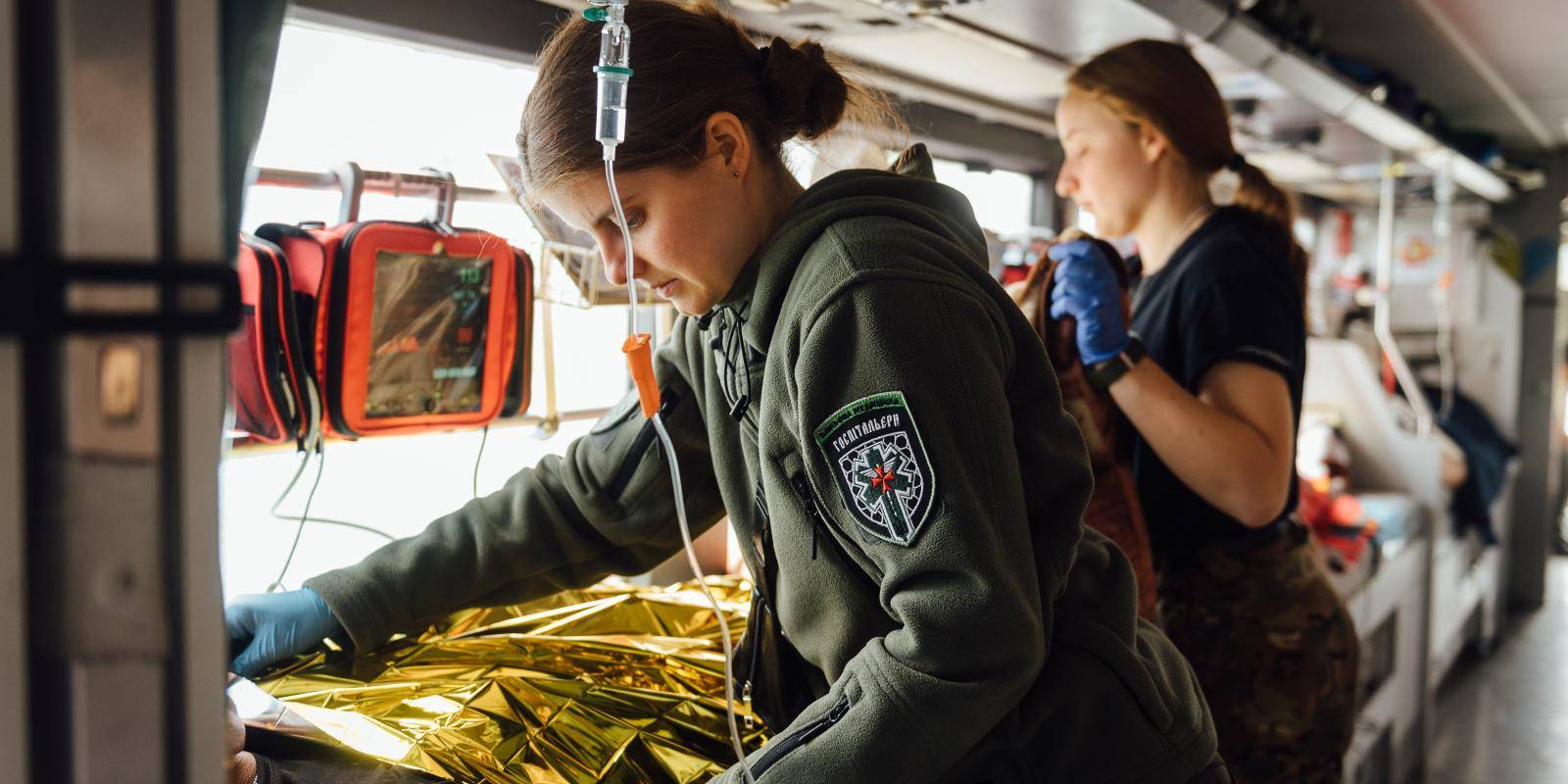
In the decade since the adoption of UN Security Council Resolution 2286, on protection of the wounded and sick, medical personnel and humanitarian personnel in armed conflict, widespread alarm at the impact of conflict on the provision of medical care has not equated with better protection on the ground.
The number of armed conflicts around the world continues to rise, and with them there has been a weakening of respect for the law that protects civilians and limits suffering. This research paper discusses one aspect of international humanitarian law (IHL) where respect for the rules is being severely eroded: the provision of healthcare in armed conflict.
The entitlement of the wounded and sick to receive medical care is a foundational principle of IHL. Despite this, in many recent conflicts the provision of medical care has been severely impeded. Conflicts in Gaza, Sudan, Syria and Ukraine – among others – provide multiple examples. In the decade since the adoption of UN Security Council Resolution 2286 (2016), on protection of the wounded and sick, medical personnel and humanitarian personnel in armed conflict, stark evidence of the impact of conflict on medical care has not equated with better protection on the ground.
Healthcare facilities and transports have been attacked or damaged by active fighting in their vicinity, leading to casualties among patients and healthcare providers and frequently leaving local populations without medical care. Military and law enforcement operations have been conducted within and around healthcare facilities. Passage of medicines and medical equipment has been delayed, and medical facilities have been looted. Equally problematic are the misuse of medical facilities and transports by belligerents, and the failure to respect the distinctive emblems of the red cross, red crescent and red crystal. These practices put patients, and healthcare providers and facilities at immediate risk, and have longer-term consequences for the continuity of healthcare for entire communities. Less apparent but equally problematic are the interference with access by the wounded and sick to medical assistance, and the intimidation or punishment of those who provide medical care.
The rules of IHL include safeguards to prevent such abuse, but the actors with responsibility for prevention are frequently powerless to prevent the abuse or are themselves responsible for it.
These examples illustrate the current widespread disregard for all aspects of the rules protecting healthcare in armed conflict: the obligation to respect and protect medical facilities; the prohibition on misusing them for military purposes; the entitlement of all wounded and sick to receive treatment; and the prohibition on punishing those who provide it.
Protection is significant but not, as is frequently stated, absolute. Failure to appreciate this point contributes to a narrative of flagrant violation of the law. This is not to understate the gravity of any conduct that impedes the delivery of medical care in armed conflict. Nonetheless, inaccurate reference to absolute protection risks undermining perceptions of the law’s ongoing relevance, potentially leading to further violations.
In recognition of the pressing need to improve the situation, the protection of hospitals in armed conflict is one of the seven workstreams of the International Committee of the Red Cross (ICRC) Global Initiative to Galvanize Political Commitment to International Humanitarian Law.
1.1 The protection of medical care under IHL
IHL aims to minimize and alleviate the suffering caused by war. The wounded and sick are among the most vulnerable, and their need to receive medical care was the incentive for the first ever Geneva Convention of 1864. Legal protection that was initially granted only to military wounded and sick and medical facilities was progressively expanded to their civilian counterparts. In 1977, Additional Protocol I (AP I) established a unified approach that applies to all the wounded and sick, and to all medical facilities and transports.
To ensure that the wounded and sick receive the medical attention required by their condition, the law grants medical facilities and personnel protection that allows them to serve their functions, sometimes referred to as ‘specific’ or ‘special’ protection. This protection is coupled with obligations and prohibitions that aim to limit its abuse.
Not all healthcare facilities nor all persons who provide medical assistance are entitled to this specific protection. It is limited to facilities and personnel that belong to a party to the conflict or that are authorized by a party to the conflict, and over which that party retains control.
IHL also includes rules regulating the conduct of hostilities, which are extensively codified in Additional Protocol I. These rules set out important general protections applicable to all civilians and civilian objects. Civilian healthcare personnel, facilities or transports that do not belong to the armed forces are civilians or civilian objects, and are thus entitled to the protections afforded to them. The general rules set out protections and prohibitions in more detail than the rules on specific protection, and apply to all healthcare providers, facilities and transports.
For historical reasons, the rules granting specific protection to the wounded and sick, medical personnel, and medical facilities and transports are dispersed across multiple instruments in distinct treaty provisions. This is an artificial separation. To give effect to IHL’s objective of ensuring that the wounded and sick receive the medical care they require, these rules, complemented by the general rules on the conduct of military operations, must be interpreted and applied in a holistic manner that promotes continuity in the provision of, and access to, medical care in armed conflict.
1.2 About this paper
With a focus on the provision of healthcare by civilian rather than military actors, this paper complements the international initiatives mentioned above. It responds to a call for accurate clarification of the rules of IHL relevant to the provision of medical care in armed conflict, addressing specific questions and challenges that have arisen in recent conflicts.
Some of these questions reflect a basic misunderstanding of the extent of the protections under IHL. Others relate to points on which either the law is unclear or, more frequently, in relation to which, in view of contemporary realities, it is challenging to determine how the rules apply in practice.
There are, however, issues on which the law is clear, but where belligerents appear unwilling to comply. Most troubling among these are measures that indicate a rejection of the foundational principle that wounded and sick enemy fighters are entitled to medical care, and that medical personnel and others are entitled to provide that care. This is particularly the case in conflicts where a state is fighting a group it labels as ‘terrorist’ or ‘criminal’.
While this paper cannot overcome lack of political will to comply with IHL, it recognizes that practical measures to give effect to IHL obligations and oversight arrangements are key to achieving the protections foreseen by the law.
This purpose of this paper is, accordingly:
- To clarify specific questions of law that have been identified in consultation with key stakeholders as needing explanation or elaboration;
- To identify good practice and make recommendations for the range of measures that can be adopted to respect and ensure respect for the law, and to mitigate the adverse impact of military operations on medical care; and
- To contribute to states’ conflict preparedness by identifying concrete measures to ensure ability to comply with IHL, and to facilitate continuity of medical care at home and in areas of operations.
This paper addresses IHL specifically. International human rights law and medical ethics provide additional protections and safeguards.
In this paper:
- ‘Fighter’ and ’combatant’ are used interchangeably to refer to members of state armed forces or organized armed groups.
- ‘Healthcare facilities’ is a generic term that includes hospitals, clinics and dispensaries.
- ‘Medical facilities’ are facilities that fall within the definition in Article 8(e) AP I and comply with the conditions in Article 12 AP I.
- ‘Healthcare personnel’ are persons with professional medical qualifications, administrators, other operators working in healthcare facilities and ambulance teams.
- ‘Medical personnel’ are persons who fall within the definition in Article 8(c) AP I.
- ‘Military’ refers to the forces of states and of organized armed groups.
The paper includes references to particular incidents to illustrate the challenges posed in applying the rules in question. Their inclusion does not endorse the account presented.
This paper has been elaborated on the basis of a desk study and interviews with humanitarian, military and legal practitioners. Its initial findings were discussed at two expert meetings held at Chatham House in 2025, attended by representatives of armed forces, humanitarian organizations and leading academics.