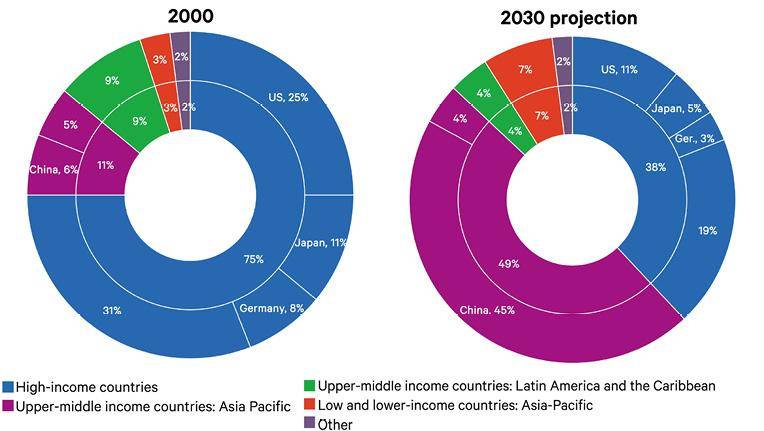
The scale of the projected transformation is therefore significant. China will gain around 16 percentage points in global manufacturing market share over the next few years, if the UNIDO predictions are borne out. This will mean that the global manufacturing hierarchy has been comprehensively reshaped in the first three decades of this century. Back in 2000, the US accounted for 25 per cent of global manufacturing while China had just 6 per cent.
Such assessments of where Europe stands in the global technology race are further amplified by quantitative research. According to the Critical Technology Tracker compiled by the Australian Strategic Policy Institute (ASPI), China leads research in 66 out of 74 critical technologies, marking a significant shift from US dominance two decades ago. This tracker does not seek to measure a country’s current technological level but rather to rank its research efforts in each field, as assessed by a rolling five-year count of high-impact papers produced by the country’s researchers. Papers defined as ‘high impact’ are the 10 per cent most cited.
In terms of funding too, China is moving up a gear. OECD estimates, in purchasing power parity (PPP) terms, show that China’s gross domestic expenditure on research and development reached $859 billion in 2024, narrowly eclipsing the US for the first time. The US total was estimated at $848 billion in PPP-adjusted dollars.
Impact on European competitiveness
Chinese companies are gaining market share both in Europe and in third countries where European and Chinese corporations compete. One reflection of this lies in the ballooning trade deficit that Europe has with China. The EU’s trade deficit with China in 2025 totalled €359.81 billion, the second largest deficit for a decade after the €397.3 billion registered in 2022. The recorded deficit for 2022 is seen as somewhat anomalous because the figure that year was inflated by an upsurge in imports from China to replace those from Russia following the latter’s invasion of Ukraine. If this anomaly is stripped out, the trend shows a steadily deepening deficit each year since 2019.
The EU’s trade deficit with China in 2025 totalled €359.81 billion, the second largest deficit for a decade after the €397.3 billion registered in 2022.
EU exports to China have dwindled in recent years as Chinese companies have developed increasingly advanced technology and replaced items – in particular vehicles and chemicals – that were previously imported from European companies. At the same time, Chinese high-tech exports to Europe are starting to outcompete long-standing European brands in their home markets. Even Chinese luxury and high fashion brands are starting to make inroads into European markets that are dominated by French, Italian, UK and other incumbent producers.
Ngozi Okonjo-Iweala, director-general of the World Trade Organization, has criticized China’s global trade surplus – which rose to almost $1.2 trillion in 2025 – as ‘not sustainable’. She added that the surplus risked triggering fresh protectionist barriers worldwide because ‘the rest of the world cannot absorb it’.
So far, Europe has resisted a ‘trade war’ with China, although the EU has taken a few measures such as imposing ‘anti-subsidy tariffs’ on exports of Chinese cars to Europe, launching anti-dumping probes targeting various Chinese products, and scrapping a duty-free rule for a range of low-cost imported parcels shipped by platforms such as Temu and Shein.
But in some quarters, at least, the language is starting to harden. The Haut-
commissariat à la Stratégie et au Plan (HCSP), which advises the French prime minister, published a report in 2026 that looked at the impact on Europe of China’s competitive threat. Chinese competition, it said, threatened one-quarter of French exports and one-third of German exports. It added that Germany has lost 240,000 industrial jobs in about a two-year period as Chinese competition hit. These numbers could not be independently confirmed.
Other commentators have seen the China challenge in terms of Europe’s growing technological dependency on the country. Peter Wennink, former CEO of ASML, the Dutch lithography company vital for semi-conductor manufacturing, wrote in a report that ‘if we depend on the technology of others and they hardly depend on us, we lose strategic relevance’. If this happens, Wennink added, then others will ‘set the conditions and prices for our access to technology’. Indeed, out of the world’s 50 largest technology companies only four are European, and the EU is only competitive in four out of 14 critical technology areas, Wennink wrote.
China’s rapid technological rise is heaping competitive pressure upon many European companies. Even ASML, which is widely regarded as one of Europe’s most technologically advanced companies, is facing challenges. A Chinese company has begun producing deep-ultraviolet lithography (DUV) machines – an advanced chipmaking tool hitherto dominated by ASML, according to a report by Reuters. ASML’s share price slid following the publication of this article.
China’s structural advantages in high-tech development
A series of interviews and company visits conducted by the author in the spring of 2026 underpin the sense that China’s emergence as a global leader in high technology is not a one-off. On the contrary, China’s advance derives from a whole-of-system effort that is itself in part the product of decades of industrial policy. This feature, in turn, reinforces a crucial reality: China’s competitiveness is set to endure and intensify in coming years, unless unforeseen disruptions or crises blow the country off course.
This industrial policy goes far beyond the ‘Five-Year Plan’ (FYP) that is drafted by the Communist Party of China Central Committee and formally approved at the National People’s Congress (China’s state legislature) every five years. For example, over the course of the 14th FYP (2021–25) there were dozens of lower-level, sector-specific plans – covering distinct fields such as technology, green energy and climate change – that fleshed out the principal blueprint. In addition, there were many more local plans adopted at the provincial and city levels across China. In each of these subordinate plans, government agencies or local governments are given latitude to adapt the master blueprint FYP to specific conditions to hedge against ineffective and wasteful investment.
A representative example of how industrial policy has helped to drive efficiencies in China’s high-end manufacturing sector concerns telecoms, AI and automation.
High-bandwidth, fast download 5G telecoms were mentioned as an enabler of industrial and digital upgrades as far back as the 13th FYP in 2016. This theme was fleshed out in the 15th FYP (2026–30), which called for the rapid buildout of a new generation of telecoms infrastructure. Known as 5GA, this new technology delivers a tenfold increase in speed and capacity compared to 5G and operates with a fraction of the latency. These characteristics enable a new suite of AI and industrial uses, including high-capacity AI agents, high-performance factory automation, autonomous driving, eVTOL (electrical vertical take-off and landing), and direct satellite-to-phone communication, according to industry executives. The roll-out of 5GA in more than 100 Chinese cities by mid-2026 – far exceeding this new technology’s penetration anywhere else in the world – has facilitated a new frontier in China’s tech advancement. For the diffusion of AI into the economy, 5GA is a crucial enabler because its vastly superior capacity allows multiple AI agents to run simultaneously – thereby allowing many tasks to be undertaken at the same time.
The provision of high-capacity, high-speed, low-latency telecoms has taken factory automation in China to the next level. One striking example of this is the Xiaomi EV Hyperfactory in Beijing, which uses 100 per cent automation in core processes to manufacture a new car (such as the SU7) every 76 seconds. Some human workers at the plant are still deployed for supervisory roles, quality checks, maintenance and a few specific assembly tasks that require human oversight. Nevertheless, the removal of humans from core processes has improved efficiency. Lei Jun, CEO of Xiaomi, has spoken of the advantages bestowed by ‘smart manufacturing’ enabled by high-bandwidth telecoms.
Thus, the diffusion of cutting-edge telecoms throughout the economy has acted as an indispensable precursor to the smart manufacturing revolution. Moreover, China is already preparing to roll out 6G, which will bring further improvements in capacity and speed over 5GA. By 2035, China is expected to deploy 900 billion AI agents (a vast increase on what is believed to be millions of AI agents currently in use) to boost efficiency and automation in manufacturing and services throughout the economy – and the roll-out of 6G is seen as an enabler for this. The 15th FYP’s ‘AI Plus’ strategy prioritizes AI as a driver of productivity in almost every important sector of the economy and foresees a 90 per cent penetration rate for AI devices, agents and applications in all key economic sectors by 2030. These are aspirational goals rather than actionable key performance indicators but nonetheless they carry weight because of their prominence in the latest FYP.
By 2035, China is expected to deploy 900 billion AI agents to boost efficiency and automation in manufacturing and services throughout the economy – and the roll-out of 6G is seen as an enabler for this.
Factory automation is enabled by both cutting-edge telecoms and AI. The roll-out of industrial robots across China is driving measurable increases in factory productivity and allowing China to keep producing low-cost items. In Shaodong, Hunan province, for example, the production costs of cigarette lighters have fallen to a fraction of what they were a decade ago after robots and automated assembly lines replaced workers. In 2024, China installed some 295,000 new industrial robots, more than the number of newly installed industrial robots in every other country in the world combined in the same year. The productivity gains reaped from this deployment – which is likely to remain strong for years to come – is set to underpin China’s industrial competitiveness for the foreseeable future. The diffusion of AI into different industry sectors is already enhancing innovation, as shown in pharmaceutical R&D (see Chapter 3).
Such foundations are further enhanced by numerous other features of the Chinese economy. Scientific and engineering talent is plentiful in a country that was projected to produce some 77,000 STEM PhDs per year by 2025, compared to around 40,000 in the US. The influence of this talent has also helped to propel an extraordinary increase in the number of patents won by Chinese companies over the past decade. Huawei, one of China’s leading technology companies, holds more patents than the combined total of its main competitors in the West – Qualcomm, Nokia and Ericsson – and files some 35,000 new patent applications each year on a global basis. The superiority of the Chinese supply chain, in which it is possible to source almost all components quickly and more cheaply than anywhere else in the world, is another central factor in the country’s competitiveness. ‘There is nothing you can’t build or make in or nearby Shenzhen’, the head of a large supply-chain company in Shenzhen told the author. ‘And it is almost always cheaper, faster and better than anywhere else in the world.’
Logistical efficiencies on a high-speed railway system that boasts more than 40,000 km of track and the ubiquity of an inexpensive parcel delivery service that covers every city in China combine to contribute to a low-cost environment for manufacturers and service companies alike. Plentiful subsidies from both the central and local governments for specified technological sectors and more generally for manufacturers in a range of industries also help to reduce costs and boost efficiency.
The four industry case studies in the next chapter have been chosen because they each show some of the technological strides that China has made. They also showcase aspects of the impact that these advances are having on different sections of Europe’s industrial base.