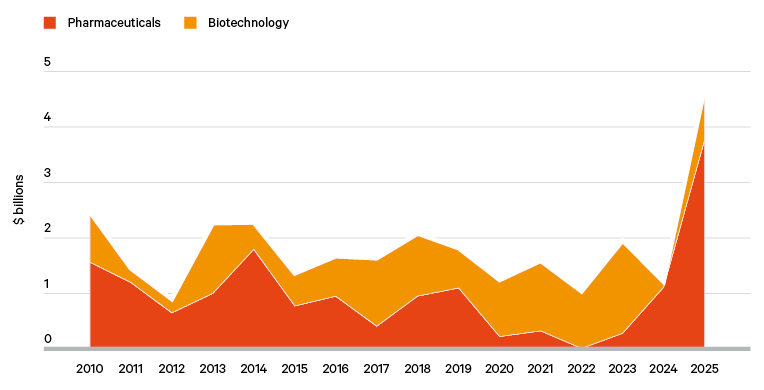
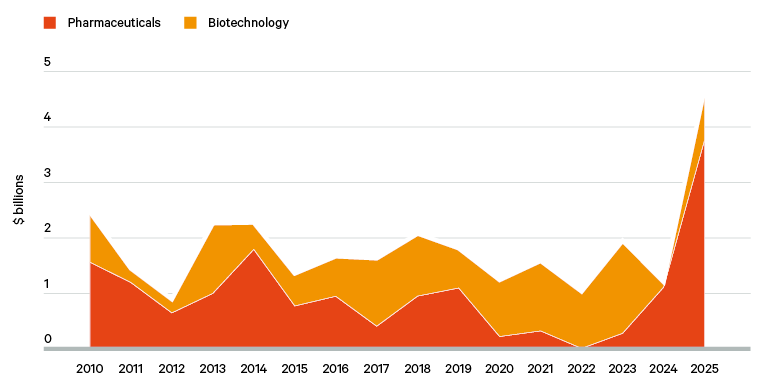
In early 2026, the average size of out-licensing deals to China grew significantly by 76 per cent on the 2025 level. As part of this, AstraZeneca, the UK–Swedish pharmaceutical giant, agreed a licensing deal with China’s CSPC Pharmaceutical worth up to $18.5 billion. One part of this planned investment was to secure the exclusive global rights – outside the Greater China region – for SYH2082, a long-acting drug for the treatment of obesity and type-2 diabetes that was developed by a CSPC subsidiary. One feature of CSPC’s work is its use of proprietary AI platforms to assist in research and drug development.
AstraZeneca’s bold deal with CSPC was widely seen as a bid to catch up with Eli Lilly of the US and Novo Nordisk of Denmark – both of which use China as a development base in the race to gain an advantage in the weight-loss industry.
For the first time, China’s total number of conducted clinical trials moved past both the US and Europe in 2020, and the gap has sharply widened in the years since then.
Clinical trials are another aspect of China’s leadership in pharmaceutical innovation. For the first time, China’s total number of conducted clinical trials – which are regulated studies on the safety, efficacy and side effects of new drugs – moved past both the US and Europe in 2020, and the gap has sharply widened in the years since then. The speed and cost-effectiveness of these trials in China make for rapid drug development at costs that are hard to match elsewhere in the world.
One upshot of the rise in clinical trials has been a record 76 innovative drugs approved in 2025 by China’s National Medical Products Administration, outpacing the number authorized by the US Food and Drug Administration and the European Medicines Agency during the same year.
European disruption
Europe’s pharmaceutical industry ranks as one of the continent’s most important sectors. In 2025, the industry’s total regional revenue was estimated to be around $514 billion, representing 29.6 per cent of global sales. But competition from China has started to impact Europe’s presence in the industry worldwide. In 2024, Europe’s share of global new drug approvals was around 10 per cent, down from 20 per cent in 2015. This share of global approvals was far below that of China in 2024 (at around 40 per cent).
In one case, Chinese competition has contributed to the disruption of Novo Nordisk, the Danish pharmaceutical giant that suffered a 70 per cent fall in its share price between its June 2024 peak and 24 April 2026. Local competition from Chinese biotech companies, combined with the expiration in early 2026 of the patent for semaglutide (an active ingredient in weight-loss and diabetes drugs) in China, have dealt a shock to the company’s bottom line. As a result, the company had to slash its prices of popular weight-loss drug Wegovy in China, after a clutch of local companies including Hangzhou Jiuyuan Genetic Biopharmaceutical and CSPC Pharmaceutical Group developed competitor drugs. Some factories in European countries have already closed, partly because of the impact of Chinese competition.
Electric vehicles: Chinese EV exports roil Europe’s competitive landscape
China’s march to dominance in EVs and batteries is well understood. These two sectors stand as torchbearers for the country’s technological advance. Companies such as BYD, the world’s leading EV maker, and CATL, the world’s largest EV and energy storage battery manufacturer, are setting the pace globally and disrupting competitors in Europe, Japan, South Korea, the US and elsewhere.
China accounted for nearly 75 per cent of global EVs manufactured in 2025 and an even higher proportion of battery cells produced in the same year. The sleek designs and high technology content of these EVs, combined with competitive pricing, has allowed Chinese car brands to make rapid inroads into global markets. In 2026, total Chinese auto exports, the majority of which are new energy vehicles (NEVs), are projected to reach close to 10 million units, up from 7.1 million units last year. In addition to large developed markets such as Europe, Chinese EV companies are also making headway in Brazil, Mexico and Southeast Asia.
The prices of Chinese EVs sold around the world are highly competitive, helping brands such as BYD (which outperformed Tesla in terms of global sales in 2025), Geely, Great Wall Motor and SAIC (MG) to gain recognition in several new markets. This pricing advantage, which derives from China’s hyper competitive supply chain, has helped to offset the impact of tariffs in overseas markets such as the EU, where countervailing duties of up to 35 per cent were imposed in late 2024.
A second impetus behind the Chinese EV export juggernaut has been the high price of oil that followed the outbreak of the Iran war in early 2026. Wang Chuanfu, chairman of BYD, said that in markets such as Australia, the Philippines and New Zealand the company was selling as many cars every day in March as it might previously sell in a two-week period. Consequently, BYD raised its overseas sales target for 2026.
In the battery industry, CATL is the world leader, having expanded its share of the global EV battery market to around 42 per cent in early 2026. The company supplies a diversified portfolio of carmakers, including Tesla and Toyota. In April 2026, CATL unveiled six new battery innovations, including an EV battery with a driving range of up to 1,500 km – greater than the distance from London to Barcelona. Another of its innovations is the Shenxing Superfast Charging Battery that the company says can achieve around a 90 per cent charge in 6 minutes and 27 seconds, significantly improving previous charging records.
Most of CATL’s competitors – including six of the world’s top 10 EV battery makers in terms of installed capacity – are from China. This dominance is disrupting the business of non-Chinese competitors such as LG Energy Solution of South Korea, which experienced a slump in profits in 2025 to a fraction of CATL’s. The Korean company’s fastest battery charging times have fallen significantly behind those of CATL, and LG’s R&D budget was significantly less than that of its Chinese rival in 2025.
European disruption
The shockwaves emanating from China’s EV phenomenon are not restricted to one region of the world. In Japan, Toshihiro Mibe, CEO of Honda, remarked that his company had ‘no chance’ against China’s high level of factory automation and supply-chain competitiveness. Honda reported its first annual loss in more than 70 years as a listed company in March 2026, partly due to Chinese competition.
Major European car brands were unprepared for the appetite of Chinese consumers for EVs. Chinese brands increased their share of the domestic passenger car market to about 70 per cent in 2025, a sharp increase compared to the 38 per cent seen as recently as 2020. Much of the increase in share for Chinese brands came at the expense of the big three German brands – VW/Audi, BMW and Mercedes-Benz – all of which experienced a contraction in their market share in China during 2025. Japanese brands also suffered an overall decline in market share.
Toshihiro Mibe, CEO of Honda, remarked that his company had ‘no chance’ against China’s high level of factory automation and supply-chain competitiveness.
The big shifts underway amount to much more than a cyclical adjustment. They represent a coming-of-age for Chinese carmakers in terms of technology, design and customer service. The response of VW – and other Western carmakers such as BMW and Ford – is a strategy that is being referred to in the industry as ‘in China, for the world’. In other words, investing more in Chinese R&D, boosting autonomy from headquarters in Germany and embracing a much faster pace of innovation inside China. Thus, Germany’s most famous company is doubling down on the China market – where it has some 50 million customers, 39 factories and 90,000 employees. It has also built an innovation hub in the city of Hefei, which VW says will bring technologies to market ‘around 30 per cent faster’ in future. The company has announced plans to launch a whole batch of new electrified vehicles this year, including pure electric, plug-in hybrid and range-extender variants. The first model, developed with Chinese partner XPENG, was launched in April 2026 and looks significantly different from a traditional VW. The company has said it has no plans to export the Chinese-designed models to Germany, but they are due to be shipped to other parts of the world.
The investment and attention being lavished by VW on its China operations stands in contrast to the bleak headlines surrounding VW’s business in Germany, where the company is in crisis. News reports have said that VW is considering closing four plants and cutting tens of thousands of jobs as part of a thorough restructuring.
Wind power: Can Europe’s industry survive Chinese competition?
For Europe, dependence on Chinese suppliers for renewable energy equipment is a critical concern. Following the collapse of the German solar industry from around 2010, China now supplies over 95 per cent of Europe’s solar panels. In wind power, the situation is significantly different, with European companies such as Vestas, a Danish wind turbine manufacturer, Siemens Gamesa, a Spanish–German company based in Zamudio, and Nordex of Germany maintaining a significant presence in the European market.
Nevertheless, the competitive challenge from Chinese manufacturers, even in the European market, is strong. This is mainly because of several advantages that Chinese producers enjoy, including their huge domestic market, the subsidies that different strata of the Chinese government provide to national champions, the competitiveness of China’s supply chain, larger R&D budgets and rapid innovation. All of these factors combine to mean that a Chinese-made wind turbine can cost at least 30 per cent less than those made by European and US companies, according to industry executives who declined to be identified.
Including the UK and Norway, the European wind industry employs 370,000 people and is investing some €14 billion to build new factories or expand on existing sites across the region. By 2030, the number of people employed in the industry could grow to 936,000.
Europe’s wind industry represents a strategic asset that the region can ill afford to lose. Including the UK and Norway, the European wind industry employs 370,000 people and is investing some €14 billion to build new factories or expand on existing sites across the region. By 2030, the number of people employed in the industry could grow to 936,000. The EU installed 12.9 gigawatts (GW) of new wind capacity in 2024 and predicts that between 2025 and 2030, it will install another 140 GW, corresponding to 23 GW a year on average. Much of the new capacity envisaged between now and 2050 is likely to be in the offshore market, according to EU planning documents. Last year, EU countries agreed to work towards 89 GW in offshore capacity by 2030, rising to 366 GW by 2050.
The size of these ambitions, coupled with the strategic nature of the sector, puts Chinese competition in Europe into a relevant context. The crucial question now is whether the European wind industry will go the way of the solar industry before it, becoming eviscerated by China’s wind power giants that can use superior pricing power and more advanced technology. China already accounts for over 60 per cent of the global manufacturing of wind turbines, along with components such as gearboxes, generators, power converters and castings. The rare earth magnets essential in such components are almost all made in China.
Chinese wind power companies are making inroads in third markets, such as India and Brazil, often by underbidding and displacing European companies. Now the battleground is moving to Europe itself.
Competition grows in Europe
In 2021, a German wind turbine manufacturer, Senvion GmbH, was replaced by China’s Ming Yang Smart Energy as the turbine supplier for the 30-megawatt (MW) Taranto offshore wind farm in Italy. This followed the insolvency of Senvion due to high debts, a downturn in the German market, delayed projects and strong competition. In Croatia, Shanghai Electric Wind Power Equipment was selected as the turbine supplier for a 156 MW onshore wind power project in 2019. By 2024, however, these and other installations by Chinese companies amounted to less than 1 per cent of Europe’s installed wind capacity – a tiny footprint compared, for example, to the 41 per cent share that Envision, the Chinese energy giant, holds in India’s domestic market.
Nevertheless, Chinese wind power companies are making some headway both inside Europe and on the periphery. In Serbia, which is not a member of the EU, Chinese manufacturer Windey has been chosen by project developer Fintel Energia Group of Italy to supply turbines to the 854 MW Maestrale Ring project, one of Europe’s largest onshore wind farms.
A significant planned investment by Ming Yang to build a £1.5 billion offshore wind turbine manufacturing plant at Ardersier Port in Scotland was blocked by the UK government in March this year, citing security risks. The Chinese company has said it remains interested to ‘engage constructively’ with the UK government.
In Italy, Ming Yang has signed a memorandum of understanding with Renexia, an Italian renewables developer, to build a €500 million wind turbine manufacturing plant. In March 2024, Zhenshi Holding Group acquired an Airbus factory in Spain to produce wind turbine blades, within a year the factory had already manufactured its first wind power products. At the time, the company stated that this turnaround demonstrated its ‘Zhenshi speed’ to bring the factory online without delay and display the ‘hard core strength of Chinese enterprises’. Given the competitive advantages that Chinese wind turbine manufacturers enjoy, allied with a pipeline of new products including Ming Yang’s 50 MW floating offshore turbine (nearly double the capacity of currently available turbines), it appears likely that China’s competitive challenge in Europe’s wind market is set to intensify.
Machine tools: Eroding Europe’s industrial base
Machine tools represent a bedrock technology, often called the ‘mother of all machines’, that constitute the backbone of a country’s industrial base. They cut, shape, grind and drill materials such as steel, aluminium, copper, titanium and other metals into the precision parts that create manufacturing machines.
A decline in a country’s machine tool industry therefore can impact that country’s ability to sustain a thriving industrial base. In Germany, the stress of Chinese competition is starting to tell.
In 2025, China overtook Germany as the world’s leading exporter of machine tools for the first time. While China has produced more machine tools than Germany in recent years, the superior quality of German products in the past served to secure growing or stable export markets. But this is changing fast. Following industrial advances in China, exports of high-tech Chinese machine tools rose by 21 per cent in 2025, while German machine tool orders fell during the year.
This shift represented a watershed moment. Germany and Japan have dominated global machine tool manufacturing for more than a century. Now in all but a few ultra-high-end areas, Chinese producers have caught up and are selling competitively priced products to the West.
Franz-Xaver Bernhard, chairman of the German Machine Tool Builders’ Association (VDW), said he was ‘very concerned’ about the competition from China, adding that further ‘capacity adjustments’ would be required, following a significant reduction in employees in the German industry in 2025. He called for a series of industrial reforms to sharpen Germany’s competitiveness.
Competition in Europe grows
Another industry segment that is suffering a competitive shock from China is computer numerical control (CNC) machines, which are automated machining tools (such as drills, lathes, mills and routers) that run on computer programmes. China has emerged as the market leader in CNC over the past decade, controlling the lion’s share of the global CNC market in 2025.
However, German companies such as Hermle and Siemens along with Japanese firms FANUC and DMG Mori are thought to maintain an edge over Chinese competitors in the advanced five-axis and above CNC machines. But several industry executives interviewed in early 2026 in China said that the Chinese industry is on the march even in the most advanced segments.
Some Chinese CNC companies, for example Wuhan Huazhong CNC, are integrating AI into their products to achieve precision in milling that can produce objects thinner than a human hair. The HNC-10 Intelligent CNC Model, one of Huazhong’s flagship machines, incorporates both an AI chip and a large-scale AI model that help it make autonomous decisions and achieve cutting-edge levels of precision.
Technological upgrades in China have started to impact even the most advanced European competitors. Siemens reported sharp drops in factory automation orders in China, including a 55 per cent plunge in the first quarter of 2024 and a 31 per cent decline in global orders for its digital industries division, partly due to Chinese market weakness.
Integrating with China
One common response to the upsurge in Chinese competition is to integrate more deeply into Chinese supply chains, often while laying off workers back in home markets in Europe. German auto supplier ZF Friedrichshafen, for example, recently announced job losses in Europe while continuing to expand its production capacity in Shenyang, northeastern China.
Meanwhile, Schaeffler, another German producer of auto parts, which aims to double its business in China in the next six to seven years, has announced plans to close some of its European operations and cut around 3,700 jobs.