


Richard Haass is President Emeritus of the Council on Foreign Relations, having served as its president for 20 years. He is also senior counsellor at Centerview Partners. Previously, he served as Director of Policy Planning for the US State Department and was President George W Bush’s special envoy to Northern Ireland. He is the author, most recently, of ‘The Bill of Obligations: The Ten Habits of Good Citizens’ and writes ‘Home & Away’, a weekly Substack newsletter. Here he talks to Leslie Vinjamuri, Director of Chatham House’s US and the Americas Programme, about the impact of Kamala Harris on the presidential race and the prospect of an unconstrained second Trump administration.
How have Kamala Harris and her choice of running mate Tim Walz changed the character of the presidential race?
The defining development of this political cycle was the decision of Joe Biden not to seek re-election. Had he stayed in the race, the prevailing wisdom – one I agree with – is that he probably would have lost to Donald Trump in a manner that could well have resulted in Republican control of the entire federal government: the White House, both chambers of Congress and the Supreme Court. Now with the Harris-Walz ticket Americans have a real race. Democrats, and I would expect a good many Independents, are energized to come out and vote. The stakes are the same, but the outcome is incomparably more up for grabs than it was.
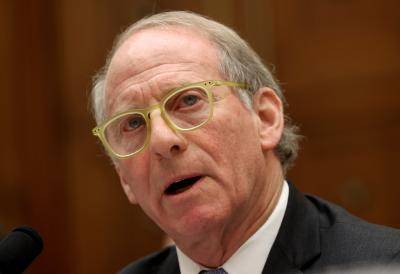
Richard Haass warns of a more disorderly and confrontational world if Trump wins a second term and turns America ‘inward’. Photo: Win McNamee/Getty Images.
There has been some criticism of Harris’s supposed lack of foreign policy experience. Is that fair? And is her occasional deviation as vice president from Biden – taking a tougher line on Israel’s conduct in the Gaza war for example – significant?
Criticism that the vice president lacks foreign policy experience is plain wrong. It is hard to imagine a better vantage point to gain foreign policy experience than the vice presidency. There are the meetings with foreign leaders, overseas travel, National Security Council meetings, time spent with staff and the president. Some of the better foreign policy presidents, including Richard Nixon, George HW Bush and Joe Biden, had the advantage of being vice president.
You mention the Middle East, one area where there has been some daylight between Biden and Harris. There may well be others – I don’t know – but no vice president is permitted to have his or her own foreign policy. Plus, we are not privy to what the vice president has advocated for with the president in private. All that said, I expect we might see some other hints of what a Harris foreign policy would look like as the campaign unfolds.
If Trump wins in November, would his foreign policy be radically different to Biden’s? How might that foreign policy differ from his first term?
When Donald Trump won in 2016, I thought that he would tack towards the middle, that a lot of his populism [on the campaign trail] was said with a wink. I got that wrong. Trump seems to have concluded that he wasn’t Trumpian enough in his first term. If he were to win a second term, many of his advisers would not be part of the establishment, and he would be more confident.
You might have elements of an anti-European foreign policy based upon what Europeans do or don’t do in terms of defence and based on his fascination with Vladimir Putin. Economically, he would be confrontational with China – there are a lot of similarities between the Trump and Biden policies there.
But I don’t know if he would confront China by defending Taiwan militarily. In the Middle East, Trump might be more confrontational with Iran, but also more supportive of Israel. He would be tougher on immigration – the question is whether [he] would also be [tough on] legal immigration. ‘America First’ has implications.
People say what they say in campaign pledges to get elected, but in Trump’s case I take it pretty seriously. If he were to be re-elected, he would be the first President of the United States significantly outside the consensus that has guided US foreign policy for three quarters of a century.
The Indo-Pacific has been a big part of Biden’s strategy. If Trump is re-elected and becomes more protectionist, how much more tense might relations become with China?
Trump and Biden have emphasized a more protectionist policy towards China, keeping tariffs, technology controls and so forth. Now China is re-embracing what you might call an export-led economic growth model – that would be as unpopular with the Trump administration as it has been with the Biden administration, probably more so. I think you are looking at a more confrontational economic relationship with China, regardless of who wins.
Part of Biden’s approach has been to strengthen allied relations above all with Japan. Would the Trump administration be so confrontational economically that it would get in the way of working closely with Japan? I don’t know. Also, would the pressure on South Korea to do more militarily be such that Trump would make good on his threat to pull US forces off the peninsula? It’s part of my larger question about whether Trump in the Indo-pacific would match his tough economic stance with a tough political-military stance. I’m sceptical.
Where do you see America’s influence and power going in the medium term in the Middle East, and how much does the outcome of the US presidential election matter?
The war in Gaza clearly hurt Biden politically, particularly with certain constituencies. It has also hurt the president at home and abroad, because there has been a big gap between his rhetoric and US policy. Whether it’s on use of military force or settlements, we have failed to persuade the Israeli government, and they haven’t paid much of a price.
It has made the US at times look impotent or feckless. Donald Trump’s history was to give Israel pretty much a free hand. His approach to the Abraham Accords, which normalized relations between Israel, the United Arab Emirates and Bahrain, was to cut out the Palestinians. It’s hard to imagine that he has had a revelation that would lead him in a different direction.

It is often said that America’s failure to be more effective in the Middle East and in other parts of the world creates opportunities for China to fill the gap and to work with Russia and Iran. What is your view?
We are heading into a world of greater disarray. What worries me is if America turns inward, the alternative is a much more disorderly world. It is not so much a China-led world, as led by different actors in different regions. So, Russia might have a bigger role in Europe, China in Asia, North Korea in its neck of the woods, Iran in the Middle East. Global arrangements to deal with trade, cyber, AI and the climate will all fall short.
The biggest question mark going forward is the US. Foreign policy begins at home. My recent book about American democracy, The Bill of Obligations: The Ten Habits of Good Citizens, explores how America’s internal stability and solidarity has become the biggest national security question in the world.
In the balance between the forces of anarchy and society, America is potentially still the biggest thumb on the scale in favour of society. Will we choose to put our thumb there? If Donald Trump is elected, the answer is, no. If Kamala Harris is elected, the answer is more likely to be yes, but there are bigger questions about her ability to bring Congress and the American people along with her.
What can Britain, Europe and the rest of the world do about these fundamental questions of democracy in the United States? Do they have any influence, or should the rest of the world just prepare?
The answer is not a lot. For better and for worse, we in America are going to shape our own democratic future. The graciousness in the recent transfer of power in Britain was really impressive. But the best thing people who care about democracy can do is demonstrate the strength of democracy. That gets noticed. So, the real question for Britain is, can it come back economically? That is difficult for any number of reasons.