The best example of a country that has engaged in a successful effort to escape dependence on primary commodity exports is probably Indonesia. From 2009 onwards, the Indonesian authorities had started to ban the export of raw mineral ores, but only after 2014 did these restrictions really bite. Nowadays, Indonesia forbids the export of unprocessed nickel – of which the country holds nearly a quarter of global reserves – as well as of bauxite and copper ore.
These bans have been ruled unlawful by the World Trade Organization (WTO) – though Indonesia has appealed – and have attracted the opposition of the IMF. They have also generated a good deal of anger on the part of China-based smelters whose business models depended on importing unprocessed ore. Notwithstanding this, Chinese FDI into Indonesia’s refining industry has grown sharply, to a point where Chinese firms now control about 75 per cent of Indonesia’s domestic nickel refining capacity.
Since Indonesia’s resource endowment also gives it a particular advantage in the manufacture of lithium batteries, the country has been able to attract investments by Chinese firms such as BYD, a carmaker, and CATL, a battery manufacturer. This has encouraged the Indonesian authorities to pursue their ambitions to establish the country as an electric vehicle (EV) manufacturing centre; the government wants to put 2 million electric cars and 12 million electric two-wheelers on Indonesian roads by 2030.
Not every developing country has Indonesia’s extensive natural resource endowment, geographical position near China or large domestic market, and so to some extent this story is sui generis. Yet it helps to illustrate how, for developing countries, the most promising form of economic integration with China may sometimes lie in seeking to attract FDI flows from Beijing.
If there is an ‘Indonesia model’ of attracting Chinese FDI into a commodity-exporting economy, the countries with the most to gain from its application would logically seem to be in sub-Saharan Africa. More than 60 per cent of the region’s GDP is reliant on natural resource endowments, and the energy transition is boosting global demand for minerals of which sub-Saharan Africa has abundant supply. The concept of ‘beneficiation’ – raising the value-added of Africa’s resource production by increasing the domestic refining and processing of raw ore – has long been a focus for African policymakers, and yet their rhetoric has not been matched by implementation. China may not have helped here. As one analysis puts it: ‘Currently, China’s investment in Africa’s critical minerals sector adds little value as they [sic] primarily focus on export-oriented projects to feed plants in China.’
Moreover, the transferability of the Indonesian model is potentially limited by Africa’s many barriers to industrial development. Water scarcity, a lack of reliable energy supply, weak logistics, infrastructure gaps, insufficient human capital, low ease of doing business and a shortage of manufacturing know-how are all constraints to developing domestic refining capabilities or moving up the critical minerals value chain in other ways. As such, banning exports of ore or other primary products is likely to be less feasible or less attractive for governments on the continent.
The fact that Indonesia lacks these constraints has enabled it to leverage ore export bans as means of catalysing FDI inflows into the economy. Since Africa generally lacks similar leverage, its strategy needs to be different: one option would be to focus more on a minerals-for-infrastructure arrangement, or what is sometimes called the ‘Angola model’: this would envisage China providing funding in the form of both loans and FDI to help the continent ease development constraints, albeit on terms that are less straightforwardly commercial than has been the case in, say, Indonesia. However, progress towards this goal is likely to require coordinated pressure on China – and/or on competing providers of FDI – among African governments, which they so far seem reluctant to exert. Overall, sub-Saharan Africa’s leverage seems low.
If Indonesia provides an example of how industrial policy – in the form of ore export bans – can indirectly stimulate inflows of Chinese FDI, then Turkey is an example of how trade policy can achieve the same goal for certain countries. In March 2024, the Turkish government imposed a 40 per cent tariff on EVs made in China, and extended the measure in June that year to imports of all Chinese vehicles. But rather than shutting China out of the Turkish automotive sector, the policy seems to have had the opposite effect: it evidently led to, or at least accelerated, a decision by BYD in July 2024 to skirt the tariff problem altogether by building a $1 billion EV manufacturing facility in western Turkey. Turkish officials acknowledge that ‘tariffs are a part of this effort’ to increase inward FDI, in a process some describe as ‘tariff jumping’.
Turkey’s ability to use trade leverage to boost inward FDI from China is critically dependent on the fact that the Turkish automotive market is already highly developed and sits on Europe’s border, and that Turkey is in a customs union with the EU. Another country that ticks similar boxes is Morocco, which in addition to a free-trade agreement with the EU has the advantage of possessing vast phosphate reserves that are critical to the new generation of lithium-iron-phosphate (LFP) batteries, for which demand is growing rapidly. Partly as a result of a large inflow of Chinese FDI into the Moroccan automotive sector, Morocco has become the leading car exporter to the EU, ahead of China, Japan and India. Some of China’s investments in Morocco are shaping up to be very large indeed. For example, Gotion, a Chinese battery manufacturer, recently signed a $6.5 billion agreement with the French government to produce EV batteries and energy storage systems in Morocco. Energy and infrastructure are also target sectors for Chinese FDI in the country.
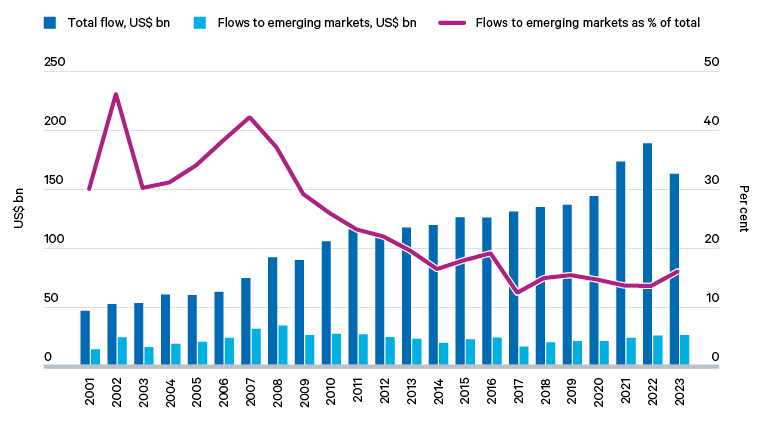
China’s outflows of FDI have been accelerating, and gross outflows have exceeded $100 billion in every year since 2010.
In global terms, Chinese FDI has become a meaningful source of investment capital for a number of countries in recent years. China’s balance-of-payments data show that outflows of FDI have been accelerating, and gross outflows have exceeded $100 billion in every year since 2010. Meanwhile, the collapse of FDI inflows into China means that China has become a consistent net provider of FDI to the rest of the world since 2022.
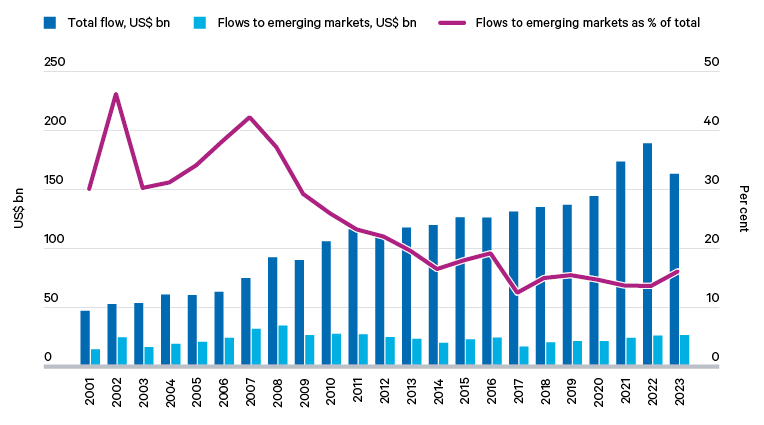
However, emerging economies do not seem to be the main beneficiaries of this trend. China’s balance-of-payments data don’t tell us where exactly the FDI is flowing to, but data from China’s Ministry of Commerce – which are compiled on a different methodological basis – indicate that not very much of this capital is going to countries in the Global South (see Figure 6). Excluding flows to Hong Kong, emerging economies received $26 billion of Chinese outward direct investment in 2023, out of a total of $163 billion. China’s flows to emerging economies haven’t exceeded $30 billion since 2008. (By way of digression, it is worth adding that this weakness in Chinese direct investment flows to emerging economies is part of a global phenomenon. The World Bank observes that FDI flows to emerging economies from all sources have, in the aggregate, fallen to less than half their 2008 peak. The bank argues that such flows are ‘likely to remain subdued’: an unfortunate prognosis, particularly in view of the bank’s analysis that a 10 per cent increase in net FDI flows to developing countries can raise GDP by 0.3 per cent after three years.)