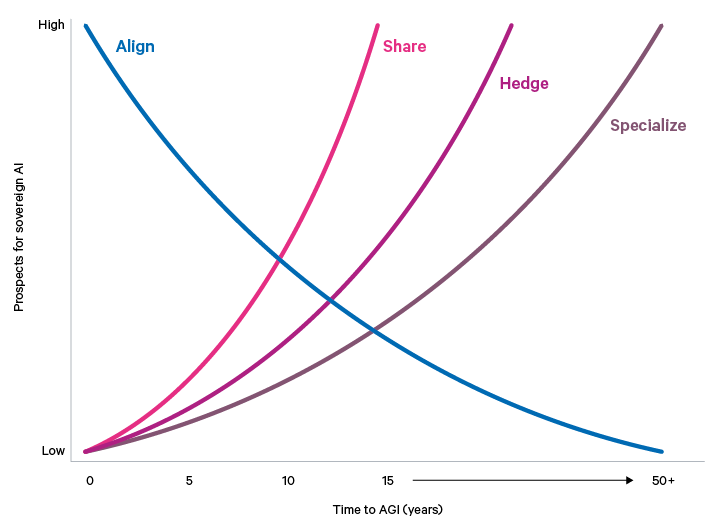
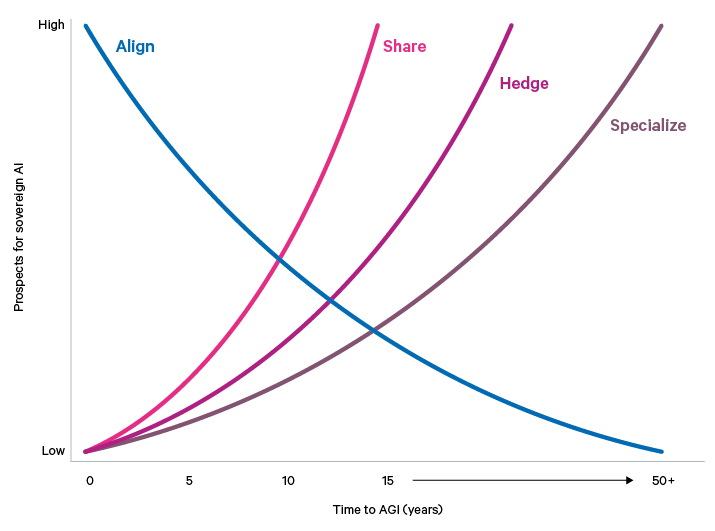
The rest of this chapter walks through four pragmatic sovereign AI pathways for middle powers. This is relevant to middle powers whose AI ambitions fall short of global hegemony but are resistant to pure capitulation. While a conclusive stance on which AGI scenario is the most likely to occur is beyond the scope of this paper, the below recommendations fall into the intermediate-to-long-term category.
Specialize
For middle powers with existing industrial strengths, specialization offers a pathway to strategic influence: by achieving dominance in a specific segment of the AI supply chain to gain leverage. Rather than competing across the full stack, states concentrate resources on becoming indispensable in one area. These might be advanced hardware components, specialized chip fabrication, energy infrastructure for data centres, or AI applications in specific domains.
The Netherlands’ ASML is the global leader in photolithography, producing the machinery necessary for semiconductor manufacturers to make more powerful chips. ASML’s dominance as currently the world’s only provider of extreme ultraviolet lithography systems for chip printing is unmatched, which provides the Netherlands with a geopolitical bargaining chip while igniting fears about bottlenecks, black market or secondary component acquisitions and changeable global markets, such as in trade restrictions and export controls. Taiwan’s TSMC – operating since 1987 – is the world’s largest semiconductor ‘foundry’, which means it offers manufacturing and design services to clients like NVIDIA. TSMC’s critical position in the global semiconductor supply chain is of strategic value to Taiwan. However, TSMC must contend with geopolitical realities in relation to the potential for instability between China and Taiwan.
Readiness to carve out niche specialization in global AI supply chains demands both intelligence (about the likely trajectory of frontier capabilities) and large investment. Which companies may become the TSMCs and ASMLs of the 2030s is an open question. They will likely be dependent on the advancement of AI technology itself as well as market dynamics. With the well-resourced US and China crowding the frontier, middle powers must lean on sovereign secondary building blocks for AI, such as investments in human capital and research ecosystems, accompanied by strategic partnerships with and investment from powerful AI companies.
At the same time, middle powers must be strategic forward-planners, wary about maintaining control over specialized and promising capabilities. The acquisition of UK-grown Deepmind by US-based Google in 2014 is a cautionary tale. At the time, the deal – valued at over $500 million – was viewed as a vote of confidence in the UK’s AI ecosystem. Today, the UK’s failure to keep Deepmind onshore should be considered a major strategic loss. The case underlines the importance of a long-term, risk-based approach to developing and retaining sovereign capabilities. Specialized capabilities must be insulated against geostrategic impacts, such as volatile US politics and governmental entanglement with major technology companies.
This approach to sovereignty prioritizes national control over a specialized primary capability (such as niche hardware essential for the future training and operational needs of advanced AI) that can be bolstered by diverse foreign investment. To achieve this, countries should:
- Conduct supply chain audits to identify specialist niches where existing national strengths can translate into global leverage, then concentrate investment in 1–2 areas rather than allocating resources too broadly.
- Establish foreign investment review mechanisms with the authority to block acquisitions of AI-relevant capabilities that constitute strategic assets.
- Negotiate formalized partnerships with frontier AI companies that exchange specialized capabilities for guaranteed long-term access to advanced models or compute infrastructure.
Align
For many middle powers, the most strategically coherent pathway to sovereign AI is deliberate alignment with either the US or China. Rather than fragmenting limited resources across multiple partnerships or attempting to build independent capabilities, aligned states commit fully to one superpower’s ecosystem in exchange for guaranteed access, preferential treatment, security and reduced costs.
In this scenario, middle powers choose not to bear the costs associated with building niche specialization in the global AI supply chain. Nor do they seek interest-based alliances with other middle powers to pool resources and gain collective leverage vis-à-vis the US and China.
As an example, middle powers could explore partnerships with frontier labs, such as Google Deepmind or Deepseek, that are advancing the development of more efficient, smaller models, referred to as lightweight AI. Greater research into strategies like model distillation – where smaller, more efficient models are trained to replicate the behaviour of larger, more complex models – could provide an AI approach for middle powers that is more accessible and reduces the computational costs of both training and running AI models.
This is not a surrender from weakness but a strategic choice. The UAE exemplifies alignment executed from a position of strength. As the first international partner in the US Stargate initiative, the emirates have traded aspirations of full technological independence for privileged access to American AI capabilities and massive infrastructure investment. But Abu Dhabi negotiated this alignment carefully, leveraging its capital, energy resources and geopolitical position to extract substantial concessions, notably by anchoring itself into the US data centre ecosystem and gaining access to advanced models. The UAE is dependent on US technology, but it is a valued partner, not a vassal state. The UAE’s investments allow the US to reinforce its global dominance.
Alignment offers stability and speed. Middle powers avoid the costs and risks of developing capabilities domestically or managing complex multi-vendor architectures. They gain access to the most advanced technologies without shouldering the full burden of innovation. For states with acute security threats, limited technical capacity, or strong existing geopolitical relationships with a superpower, alignment can be the most rational option.
But alignment carries clear costs. Junior partners have limited room for manoeuvre if the superpower’s strategic priorities shift. Those that align face vulnerability to disruption if geopolitical relationships sour. They may be forced to adopt the AI superpower’s standards, regulations and values even when these conflict with domestic preferences. And countries that choose to align are excluded from technologies, markets and partnerships controlled by rival blocs. Alignment is not a hedge: it is a bet that one superpower will remain both willing and able to provide access over the long term.
The key for middle powers pursuing this pathway is informed dependence: formalizing the terms of alignment, understanding what is being exchanged, monitoring risks and maintaining options for an exit if circumstances change radically. Alignment should be deliberate, not passive. To achieve this, countries should:
- Where possible, formalize terms through bilateral agreements specifying mutual obligations, access guarantees, data sovereignty provisions and conditions under which arrangements may be suspended.
- Maintain domestic technical capacity to integrate, monitor and evaluate foreign AI systems to preserve options should alignment terms deteriorate.
- Leverage strategic assets – geographic position, market access, energy resources – to secure infrastructure investment, preferential access or technology transfer at the point of alignment.
Share
Middle powers that view total alignment with a superpower as unacceptable and lack the capacity for individual specialization can pool resources and negotiate collectively. Regional or interest-based blocs allow states to exercise influence that they cannot achieve alone, through joint investments in infrastructure, harmonized regulation, shared R&D programmes and collective bargaining with AI providers and superpowers. This frees up middle powers to pursue sovereign AI strategies without necessarily having to match superpower scale in compute or data.
Proposals for a jointly governed, cross-border model or infrastructure development project – in the same way that Airbus was formed by regional European collaboration to compete with dominant aircraft manufacturers – reflect aspirational but growing interest in shared sovereignty arrangements among trusted partners. These models often complement national strategies: some states curate national champions while simultaneously contributing to open-source or consortium-based efforts that distribute cost and reduce strategic dependence. France’s Mistral and Canada’s Cohere – two leading labs with substantial backing from their home governments – are potential case studies for this dual approach of backing national AI champions while benefiting from collective and cross-border action. Embedding such hybrid approaches within multilateral or cross-country AI initiatives would expand the set of viable alternatives to countries seeking to diversify away from dominant foreign ecosystems.
The EU will not become a frontier AI leader, but by pooling sovereignty it can secure a degree of strategic autonomy and collective leverage vis-à-vis the US and China.
The EU offers the most developed example of shared sovereignty in AI. Through initiatives like the European High-Performance Computing Joint Undertaking, Horizon Europe research programmes, and the AI Act’s harmonized regulatory framework, Brussels is attempting to build collective capabilities that no single member state could afford. The EU will not become a frontier AI leader, but by pooling sovereignty it can secure a degree of strategic autonomy and collective leverage vis-à-vis the US and China.
Shared sovereignty works best when states face common threats, trust each other sufficiently to coordinate, and can enforce collective discipline. Smaller regional groupings such as Gulf states might leverage energy abundance to build compute infrastructure. A small group of Nordic countries might make use of their cooler climates to coordinate investments in green data centres. Smaller groupings like these may achieve coordination more easily than large, diverse blocs like the EU whose member states (despite the rhetoric of European sovereignty) remain overwhelmingly dependent on US hyperscalers for cloud services and frontier models. Shared sovereignty amplifies a nations voice, but it does not automatically deliver autonomy, nor will it match superpowers in terms of scale and scope.
The strategic appeal of the share pathway lies in its defensive value: collective action reduces the risk that any single member state can be isolated or coerced. Countries should:
- Establish multilateral infrastructure funds with regional or interest-based partners to jointly procure compute, build data centres or develop shared models in targeted domains.
- Harmonize procurement standards and regulatory frameworks across partner states to create economies of scale and collective bargaining power with technology providers.
- Create joint research consortiums that share technical talent and compute while structuring intellectual property rights to enable both collective advancement and national commercialization
Hedge
For middle powers with strong technical capacity, diversified economies and a preference for strategic flexibility, hedging offers an alternative to alignment or collective action. Rather than committing to one superpower’s ecosystem or pooling resources with a regional bloc, states that hedge deliberately assemble a hybrid AI stack – cherry-picking capabilities from multiple foreign providers while building targeted national strengths in areas where independence is essential.
Japan’s recent AI strategy illustrates this agile approach. Tokyo relies on NVIDIA and US cloud providers for compute and access to frontier models, partners with domestic firms like SoftBank for telecommunications infrastructure, and invests in Japanese-language AI models for government services. The country’s latest AI Promotion Act seeks to balance the needs of providers with the national requirement for better interoperability – aiming to guide technical innovation through long-term thinking on AI rule-making.
Open-source AI makes hedging more viable. National builders can adapt multiple open-weight models to local contexts and languages without depending on a single proprietary provider. Governments can encourage competition between open-source or public AI models to avoid lock-in while accessing near-frontier capabilities. For middle powers with under-resourced languages or unique regulatory requirements, the ability to customize models locally creates genuine opportunity.
But hedging is technically demanding. It necessitates sophisticated procurement frameworks that mandate interoperability, penalize vendor lock-in and require compatibility with multiple competing systems. It demands expertise to integrate disparate technologies – US cloud infrastructure, European privacy tools, Chinese hardware, domestic domain models – into coherent national systems. And it requires continuous vigilance: the global AI market’s extreme consolidation means vendor lock-in can happen through stealth, as proprietary application programming interfaces (APIs), data formats, isolated talent and training dependencies accumulate over time.
Hedging also carries geopolitical costs. Diversifying across US, Chinese and European providers may trigger suspicion from all three, particularly in sensitive domains like defence or critical infrastructure. And managing a multi-vendor environment increases complexity and integration costs compared to committing fully to one ecosystem. These costs underscore the erosion of middle power flexibility in an ever-polarized world order.
This pathway works best for middle powers, such as Singapore and Japan, that can afford the coordination costs, have deep technical expertise to manage hybrid systems and face no immediate existential security threats that would push them towards alignment. The goal is not independence – full autonomy remains unrealistic – but rather strategic flexibility: the ability to switch providers, adapt to disruptions and avoid becoming captive to any single superpower’s technology ecosystem. Countries aiming to hedge should:
- Mandate multi-vendor interoperability standards in government AI procurement to prevent proprietary lock-in through closed APIs, incompatible data formats or opaque integration requirements.
- Invest in sovereign capacity selectively – build genuine independence in critical domains (defence, essential infrastructure, sensitive government services) while accepting pragmatic dependence elsewhere.
- Establish contingency mechanisms, including reserved funding and pre-negotiated alternative partnerships, to enable rapid provider substitution if primary suppliers restrict access due to geopolitical tensions.