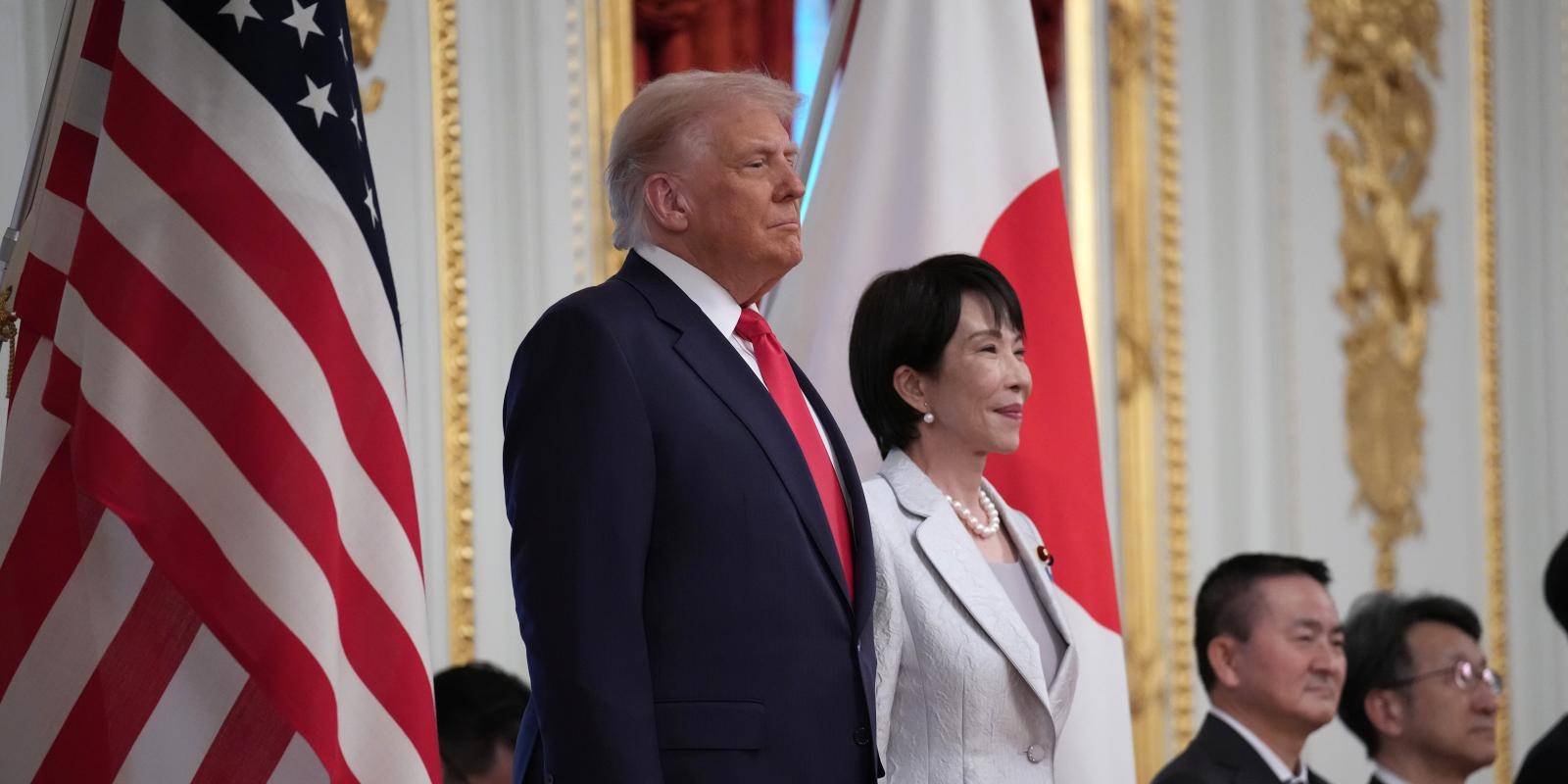

If President Donald Trump is expecting effusive praise for his war on Iran when Japan’s prime minister arrives in Washington on Thursday, he is likely to be disappointed. Sanae Takaichi, re-elected in February in a landslide victory, says she intends to be ‘candid’ in pointing out that Japan’s oil-dependent economy is suffering badly from the conflict.
Takaichi, Japan’s first female prime minister, has won a remarkable mandate and is known for her conservative policies and forthright views. But she cannot afford to be cavalier about this White House visit. Oval Office encounters have become bear traps for many foreign leaders.
She will want reassurance about the US’s security umbrella, the cornerstone of Japanese foreign policy since 1945. Trump is likely to repeat instead his demand for Japan to pay more for its own defence.
That exacerbates the already difficult questions facing Japan: how assertive should it choose to be with China? And how can it make more of its other alliances around the world if the US has become a less reliable partner?
Economic troubles
At a Ministry of Finance conference in Tokyo on 9 March, snow falling just days before the first cherry blossom is due, the impact of the US–Iran conflict injected new concern into an already difficult economic picture.
Japan is the fifth largest importer of oil in the world. 95 per cent of that comes from the Middle East. And prices are spiking as supplies are stuck in the Strait of Hormuz, with the weakness of the yen increasing the import bill further.
This potential hit to growth comes as Takaichi plans a 21.3 trillion yen ($134 billion) investment programme to stimulate the economy that is already worrying investors. Bond yields reached record highs in January, reflecting that new concerns have been added to long-standing ones about Japan’s ability to carry its debt with an ageing population.
Takaichi, like other prime ministers (the UK’s included), is finding that a war in which her country has no part is driving up the cost of living and potentially, despite her recent electoral victory, driving down her ratings too.
Takaichi will want to use the good rapport she struck up with the US president at a meeting in October to make the point about the impact of the war on other countries.
After a week of exultant rhetoric from Trump and US Secretary of War Pete Hegseth about killing Iranian leaders, that may strike a jarring note. She is likely to emphasize Japan’s considerable new commitments: accelerating a target to reach 2 per cent of GDP on defence spending, a pledge to develop aerial defences as part of Trump’s ‘Golden Dome’ missile defence plan, and an agreement to invest $550 billion in the US in return for lowering tariffs from 25 per cent to 15 per cent last year.
China
So far, so predictable. The interest for the wider world hangs more on their exchanges about China. Takaichi provoked a furious response from Beijing when she declared in November that if China moved to take over Taiwan, it could prompt a military response from Japan.
That is little more than a repetition of Japan’s established stance. But China’s fury was audible at the Munich Security Conference in February when Wang Yi, China’s top diplomat, after a stately, scripted speech about relations with the US, lashed out at Japan in answer to a final question, proclaiming it ‘a militaristic nation’ and invoking Pearl Harbour.
Takaichi will want to probe Trump’s stance towards China. Many in the region question whether the US lacks the resources or desire to contest China’s assertiveness in the South China Sea – let alone Taiwan. Japan has noted – as have other regional leaders – that the two US destroyers normally based in Japan were in the Arabian sea last week, according to the US Naval Institute.

Her encounter with Trump comes just two weeks before he visits President Xi in China, a visit whose lack of prepared agenda and unpredictability is attracting widespread comment in the region.
China is balancing the value of US distraction – as Iraq and Afghanistan showed – with Trump’s unpredictability and apparently growing taste for sudden military action.
For Japan, these considerations mark a decisive if unwanted shift in its relations with the US and its wider foreign policy. The US’s defence protection has underpinned Japan’s profound post-Second World War pacifist stance.
Japanese governments had gradually been toughening that stance given China’s expansion of claims in neighbouring waters – but Trump’s conviction that allies have been free-riding on the US and must now pay more has brought an acceleration of that movement.
There is an urgency in Japan’s government about the need to look for more allies, on both economic and security fronts, to uphold the rules-based international order which it has supported and needs.
China’s economic coercion – threatening to withhold critical minerals from companies if they do not relocate to China or from the country overall if it objects to its policy – has led to recent new minerals deals with Australia.
Japan’s role in the CPTPP trade group, where it stepped into the leadership when the US quit, is one prime tool, particularly given the rising influence of Canada (another CPTPP member) in searching for new alliances.