Geopolitical change is reshaping the visibility, distribution and management of water insecurity in global value chains. The trend complicates attempts to agree and implement international measures promoting responsible and sustainable water use.
The global order is undergoing a structural transition away from the post-Cold War period dominated by the US to a more contested multipolar international system. This geopolitical fragmentation has implications for trade policy, investment decisions and supply-chain configurations – and in turn for efforts to trade virtual water more sustainably and equitably.
Over the past few decades, the expansion of global trade and investment has embedded virtual water ever more deeply in cross-border supply chains, concentrating water use, pollution and ecosystem pressure in upstream production regions, while much of the value capture has primarily gone to consumer countries. The scale and environmental implications of globalized virtual water trade are well documented, and pre-date the current phase of geopolitical realignment.
Yet even at the high point of post-Cold War multilateralism and expanding international development cooperation, these water risks were only weakly addressed in regulatory frameworks and the policies of international institutions, despite growing recognition of other shared environmental challenges. Whereas climate change, desertification and biodiversity loss were each anchored in dedicated UN treaty regimes, challenges around sustainable water use per se never acquired a comparable multilateral governance architecture. Instead, responsibility defaulted to voluntary disclosure and coalition-based initiatives.
The current fractured geopolitical environment does not alter the extent or prevalence of unsustainable water footprints in trade, but it further constrains the already limited pathways through which these impacts may be addressed. In particular, the operating assumptions that once enabled collective action on long-term environmental risks are eroding. The US’s withdrawal from its role as the principal guarantor of the rules-based international order is reshaping the conditions under which cooperation between states occurs. This reflects a deeper structural shift, in which coordination on environmental risks must increasingly contend with rivalry and transactionalism among major and lesser powers alike.
Geopolitical fragmentation as a driver
of water risk
The transition away from a predominantly unipolar international system has sharpened geopolitical rivalry and weakened the institutional foundations that previously supported collective responses to shared risks. Power is now more diffusely distributed, with the US and China exerting influence through competing economic, technological and security strategies, while middle and regional powers also pursue more transactional forms of alignment. As this fractured, multipolar environment becomes more established, cooperation on addressing long-term, geographically distant risks – such as water stress embedded in global supply chains – will be harder to initiate and sustain.
At the same time, rivalry among major powers has intensified competition over trade, technology and strategic resources. The rise in China’s economic might and international status, alongside the country’s pursuit of regional hegemony, industrial dominance and control over critical inputs, has contributed to an international environment in which supply chains are instrumentalized for geopolitical purposes. The US, as demonstrated in its 2025 National Security Strategy, has increasingly framed trade and industrial policy through a national security lens.
In this context, consumer countries are more likely to externalize the water-related risks embedded in production systems or to defer efforts to address those risks, particularly where impacts are geographically distant from centres of consumption and decision-making. At the same time, water-scarce producer countries may increasingly prioritize domestic production of staple foods in order to remain independent from external suppliers – a strategy that makes a certain sense from a national self-sufficiency standpoint but risks, among other consequences, tightening supply in export markets or encouraging domestic agricultural policies unsuited to local conditions.
These dynamics interact with, rather than displace, long-standing pressures on multilateral cooperation. The authority and financial base of the UN system are under unprecedented strain. Aid budgets across G7 economies have declined sharply as a share of GDP, while bilateral and multilateral development finance is being redirected towards security. For water-stressed regions in developing countries, this reduces investment in institutional capacity and risk management at precisely the moment when climate change-aggravated exposure to water scarcity, flooding and pollution is intensifying.
As geopolitical rivalry deepens and institutional support weakens, the range of available mechanisms for addressing ‘upstream’ water impacts – i.e., impacts that have accumulated in producer regions while remaining weakly prioritized in consuming economies – is narrowing.
Regulatory retrenchment and geo-economic competition
Geo-economic competition is increasingly reshaping the regulatory environment through which environmental risks are identified and managed. In Europe, concerns over competitiveness, industrial strategy and strategic autonomy have altered the trajectory of sustainability regulation. The European Green Deal initially sought to extend corporate responsibility beyond territorial borders, including making EU companies responsible for environmental impacts traced to global supply chains. Subsequent political choices and regulatory change, however, have narrowed the scope and ambition of the strategy as well as those of other key instruments.
In particular, the EU Corporate Sustainability Due Diligence Directive (CSDDD) has been significantly weakened. The CSDDD came into force in 2024, requiring multinational companies to identify and address adverse human rights and environmental impacts – including excessive water consumption and water pollution – across their value chains.
However, a recent European Parliament vote on a simplification package established higher thresholds for companies to be covered by the CSDDD, limited civil liability provisions, and reduced due diligence requirements in relation to outsourced suppliers so that requirements focused on companies’ direct suppliers. This change reflects a broader ongoing recalibration of regulatory priorities due to geo-economic pressure. There have also been repeated delays in implementing the directive, along with pushback from some member states and companies concerned about compliance costs and trade impacts. As a result, the revised CSDDD’s roll-out has been delayed to 2027, smaller companies have been excluded, and the supply-chain focus is now on a company’s own operations, subsidiaries and direct partners, with suppliers occupying secondary or more distant tiers in supply chains only covered if risks are deemed ‘significant’.
Similarly, the Corporate Sustainability Reporting Directive (CSRD) – designed to standardize and strengthen corporate disclosure of sustainability risks, impacts and dependencies – has faced mounting resistance from some EU member states. This aligns with wider debates on European competitiveness and economic performance, most clearly articulated in the so-called ‘Draghi review’ (prepared by Mario Draghi, a former Italian prime minister and former president of the European Central Bank); the review has exerted growing influence over the political framing of sustainability regulation in the EU.
Comparable pressures are evident in the renewed urgency policymakers are attaching to international trade agreements. An example is the EU–Mercosur trade agreement, concluded in early 2026 after more than two decades of intermittent negotiations. Political leaders from both blocs have been explicit that the agreement serves the geo-economic purpose of diversifying trade relationships and reducing strategic dependencies. Despite opposition from green parties and civil society organizations (CSOs), which argue that the agreement risks environmental harm and sits uneasily with elements of the European Green Deal, political decision-makers have proceeded on the basis that geopolitical positioning and market access take precedence.
This reflects a political choice under constrained circumstances. While the EU–Mercosur agreement includes sustainability language, the environmental provisions remain limited. Much of the expanded trade which the agreement enables centres on agriculture and raw materials – sectors with substantial water footprints and well-documented risks of significant abstraction, pollution and ecosystem degradation impacts in producer regions. Concerns raised by some critics over the risks of deforestation and water stress have not prevented the deal from being concluded, underscoring the extent to which geo-economic hedging and supply-chain diversification are now prioritized over mitigation of upstream environmental externalities.
These regulatory and trade-related shifts have direct implications for water risk in global supply chains. Narrower due diligence requirements and weakened accountability reduce incentives to identify and address unsustainable upstream water footprints. Where regulatory frameworks were originally intended to strengthen visibility of, and accountability for, geographically distant environmental impacts, political recalibration has limited their reach. In terms of the implications for water scarcity, the consequence is that responsibility for sustainable practices has been shifted to producer regions that are already hydrologically stressed, while consumer economies retain the benefits of trade but with fewer formal obligations to address associated risks.
Elements of this pattern are evident in the EU’s approach to water security. The European Water Resilience Strategy represents a significant step in elevating water risk within the EU’s strategic agenda, yet its primary focus remains internal. Despite Europe’s substantial dependence on water embedded in external supply chains, the strategy gives limited attention to upstream water dependencies and impacts beyond EU borders. In this sense, the strategy reinforces rather than resolves one of the central structural disconnects addressed by this paper: the fact that water resilience is increasingly treated as a domestic security concern, while water-related risks generated through global production systems remain weakly governed.
Displacement of the international aid regime
Alongside regulatory retrenchment, the international aid architecture that has historically supported water risk mitigation is undergoing a sharp and unprecedented retrenchment. While aid budgets have been politically vulnerable for more than a decade, recent declines in aid commitments reflect a more explicit reallocation of public spending towards defence in response to changing security priorities. Across G7 economies, official development assistance (ODA) has fallen as a share of GDP, the result of political choices to prioritize military readiness and strategic autonomy. In Europe, commitments to increased defence spending – reinforced through the NATO spending target of 5 per cent of annual GDP – have been financed in part through reductions to aid budgets, including through the repurposing of development spending to support security objectives.
This reallocation of financial support reflects a broader global shift in public spending priorities. Annual global military expenditure reached an all-time high of $2.7 trillion in 2024, with defence budgets rising across more than 100 countries, while fiscal space for development spending has continued to narrow.
The posture of the US has been particularly consequential. The effective dismantling of USAID and the US’s withdrawal from development-focused multilateral institutions have removed a major source of finance and coordination for water infrastructure and governance in low- and middle-income countries. This retrenchment risks creating cascading effects across the development assistance ecosystem, including reduced funding and weakened institutional capacity, alongside greater reliance on ad hoc or bilateral arrangements.
Reduced investment in early-warning systems and flood protection increases exposure to hydrological shocks, while underinvestment in pollution control and basin-level planning compounds longer-term vulnerability.
For water-stressed regions, the consequences are significant. Reduced investment in early-warning systems and flood protection increases exposure to hydrological shocks, while underinvestment in pollution control and basin-level planning compounds longer-term vulnerability. Where water risks are embedded in export-oriented production systems, the contraction of aid further entrenches asymmetries between producers and consumers.
Changes to the international aid regime therefore interact with geopolitical rivalry and regulatory retrenchment to narrow the space for preventive action.
Future water risks under sustained geopolitical fragmentation
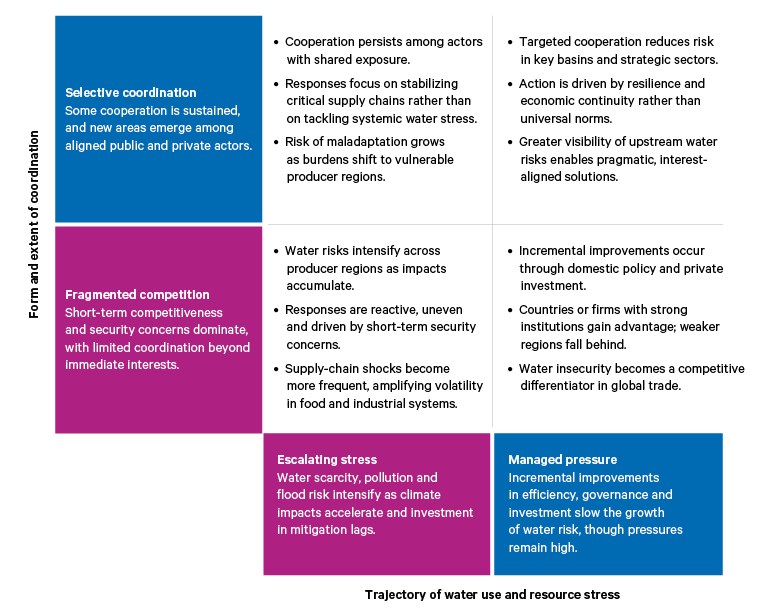
In Figure 3, below, we set out scenarios for how water insecurity and shifting geopolitics may plausibly interact in the future. The defining assumption in each scenario is continued global geopolitical fragmentation and realignment: rivalry between major powers will persist, multilateral capacity will remain constrained, and international cooperation will become more selective and uneven.
At the World Economic Forum in January 2026, Canadian prime minister Mark Carney described the international system as having entered a period of ‘rupture’, arguing that middle powers must move beyond performative support for a fading rules-based order towards a ‘variable geometry’ of pragmatic, issue-based coalitions capable of operating under sustained geopolitical rivalry.
Within this context, the future of water risk in global supply chains will likely depend on two main factors: the trajectory of resource use and water stress; and the extent to which coordination between states emerges despite geopolitical competition. A further factor is how committed countries are to measures to allocate and manage water sustainably.
Recent global risk assessments help to situate these dynamics across various time horizons. The World Economic Forum’s Global Risks Report 2026 identifies geo-economic confrontation as the most severe risk facing the international system over the next two years. At the same time, the report finds that environmental risks continue to dominate the long-term global risk outlook. This divergence highlights a central feature of the current fracturing of international order. While geopolitical realignment absorbs political attention in the short term, slower-moving environmental risks, including water insecurity, continue to accumulate. What distinguishes the present moment is that the tools previously relied upon to mitigate those risks – notably development finance and multilateral norms – are weakening just as the need for mitigation intensifies.
A January 2026 national security assessment by the UK’s Department for Environment, Food & Rural Affairs reinforces this view. The document examines the security implications of global biodiversity loss and ecosystem collapse, and concludes with high confidence that environmental degradation will pose escalating risks to national and international security beyond 2050. The assessment identifies pressures on freshwater systems, food security and land use as key channels through which these risks are transmitted, and anticipates that state responses are more likely to prioritize security and strategic autonomy than renewed multilateral cooperation.
This bleak assessment supports the plausibility of scenarios in which water use acts as a risk multiplier amid conditions of sustained geopolitical fragmentation: environmental stress continues to accumulate, while responses remain uneven and reactive, driven primarily by security imperatives rather than by collective risk reduction. As water systems are among the principal vectors through which the impacts of climate change are felt, changes in water use increasingly translate climate impacts into economic and social stress through water scarcity, pollution, flooding and ecosystem degradation.
Taken together, these dynamics define the space within which future trajectories of water risk and governance are likely to unfold. To explore how outcomes may vary under sustained geopolitical fragmentation, in Figure 3 below we adopt a simple futures matrix structured around two interacting dimensions: the form and extent of coordination that may occur over water access and governance; and the trajectory of water use and resource stress.
Across all four scenarios, producer-country agency remains critical, reflecting the sovereign role of governments in determining how to manage and allocate their own water supplies. While consumer countries can manage demand, producer-country agency is the bigger factor in supporting geopolitical equity – as a state has sovereignty over its own territorial natural resources, including water, and governs those resources according to its own principles and goals. The political economies of water-stressed exporting regions will thus continue to be the principal factor shaping outcomes, although choices by importing states, foreign companies and investors will have a supporting impact. In short, the futures outlined here do not absolve consumer economies of responsibility, but nor do they assume that water insecurity can be resolved through external pressure and demand adjustments alone.
The broader implication is that future cooperation on water security will look markedly different from the norm-driven multilateralism of the 2010s. Action is more likely where water risk is made visible as a constraint on economic stability, supply-chain resilience and long-term economic growth.