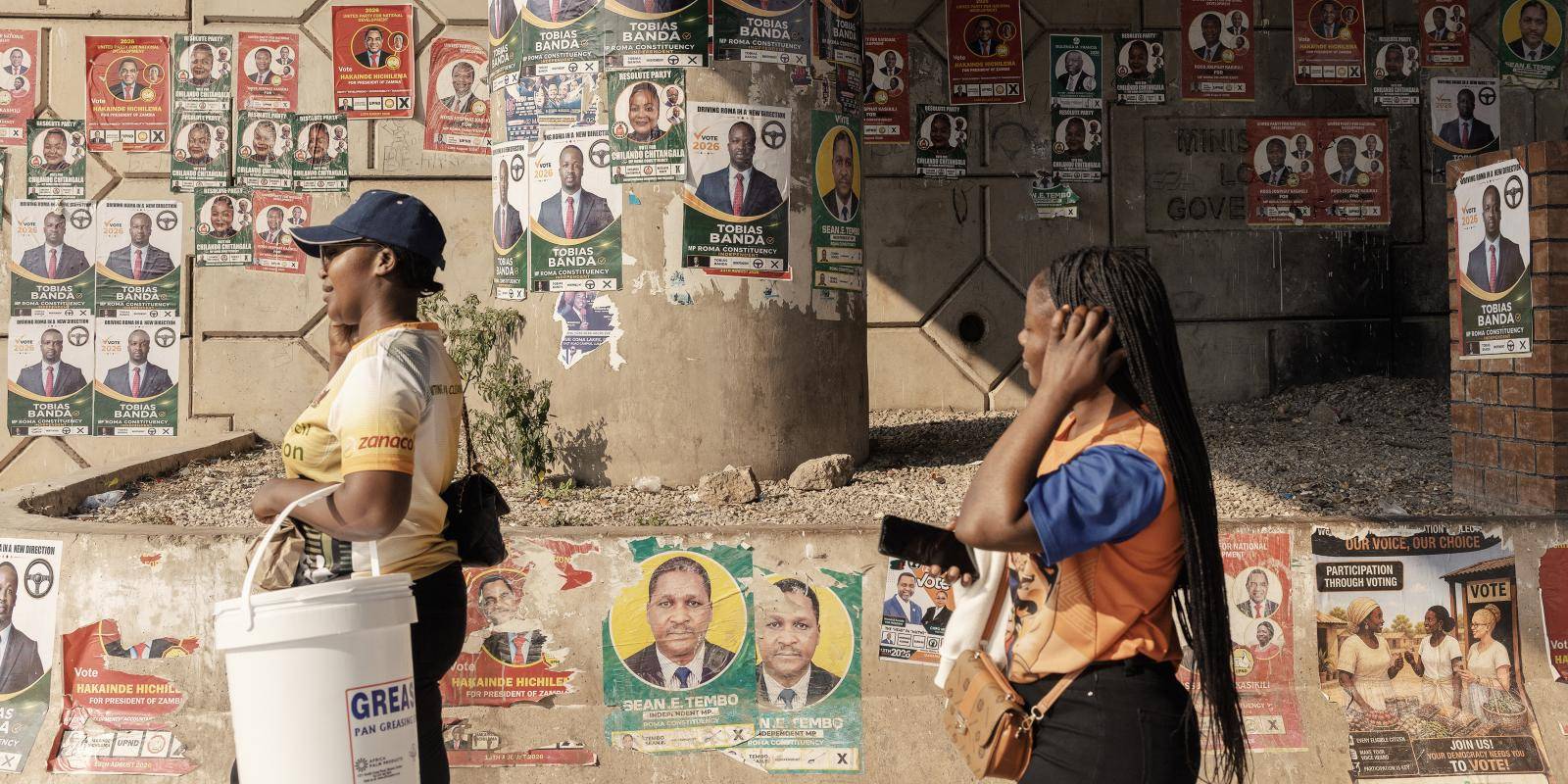

Zambia’s general election on 13 August has far greater international significance than the country’s landlocked status and modest economic size might imply. The winner of the presidential poll will take power over a country at the centre of Africa’s critical minerals competition, debt diplomacy and shifting regional alliances. Zambia’s prized democratic reputation will also be tested.
President Hakainde Hichilema’s first term has been defined by the tension between intersecting priorities. On one hand, his economic and political reforms require policy consistency and a commitment to maintaining the country’s democratic institutions. On the other, a lag between headline economic reforms and a tangible sense of improvement for Zambians increases the risk his party is rejected at the ballot box.
The president has been accused by the opposition of taking an authoritarian approach to shore up his support. But Hichilema can secure a second term without democratic backsliding. And a credible election is vital to preserving the faith of investors. The UK, EU and Zambia’s allies across Africa must now act as critical friends to ensure that this election is not overshadowed by authoritarianism.
Expectation gap
A key feature of Hichilema’s first term government has been its pursuit of difficult macroeconomic reforms and debt management. The early years of his presidency saw Zambia’s standing in international economic circles restored and its macroeconomic position stabilized via a debt restructuring process. The Zambian Kwacha was the best performing currency in Africa in 2025, with Finance Minister Situmbeko Musokotwane earning plaudits for his role. Yet the country’s financial rehabilitation remains abstract to many voters who are yet to feel the benefits in daily life.
Meanwhile the outlook for the mining sector – the backbone of Zambia’s foreign exchange earnings and critical to its stabilized macroeconomic position – is ambitious but uncertain. The government has declared an output target of three million tonnes of copper per year: more than triple the present output. That would require at least 10 new mines of an equivalent scale to Zambia’s largest current operations.
Such rhetoric has attracted global attention and some notable new investment commitments. But the fact remains that pledges are not mines, exploration is not production, and announcements are not revenues. The lengthy process of reforming the national mining code into two new pieces of legislation created significant uncertainty. And many major investors are worried by repeated political rhetoric pushing resource nationalism and accusations of discretionary changes to licences on the online cadastre.
What matters now is whether the policy environment remains consistent enough to create confidence in the sector. Investment might walk away if improvements are not seen soon. Without the rejuvenation of the nation’s most important industry, it will be very difficult to meet Zambian voters’ demands.
Authoritarian tightrope
Zambia is a flagbearer for democracy in Southern Africa. Six presidents from three parties have been elected since the first multi-party vote in 1991 – though the transition of power has not always been smooth.
Hichilema rejected the outcome of elections in 2015 and 2016, which he lost narrowly, on each occasion refusing to recognize the victory of Edgar Lungu. Hichilema was imprisoned on treason charges in 2017 before being released. His 2021 election victory was his fifth attempt to win the presidency.
The political and diplomatic capital he accumulated in opposition – including during his imprisonment – was premised upon support for democracy and pluralism. He therefore did not come to power with a blank cheque, but a mandate to protect the institutions that carried him there.
With the election poised to be a referendum on his government’s economic record, Hichilema may be tempted to use his powers to tilt electoral odds in his favour: the opposition say the government is restricting their campaigning – a charge Hichilema denies.
What should allies do?
This leaves Zambia’s international partners in an uneasy position. Their economic interests may be best served by the predictability of a second term for the president. But these interests are tied to the strength of Zambia’s democracy and institutions.
In the early years of Hichilema’s presidency, allegations of authoritarian drift were often dismissed as partisan, especially when raised by figures from a discredited opposition.
But over time those concerns have become harder to ignore, particularly around freedom of speech, criticism of politicians and individual rights. For example, rights groups have argued that Zambia’s new cyber legislation has widened the scope for surveillance, criminalized forms of expression too broadly, and created a self-censoring effect on journalists and critics.
Nonetheless, some of the most controversial proposed legislative changes have been removed from bills before making it to presidential assent. The government has sought to balance control with appeasement of domestic and international criticism.
This approach to the presidency was described in one recent Chatham House event as ‘Hichilema with glitches’.
The 2026 elections process
There are also concerns around the Electoral Commission and the wider framework for voting. The number of parliament seats won through nomination and proportional representation has increased. Boundaries have been changed, and wards added in supposedly incumbent strongholds – all this could amplify the president’s electoral gains. The Electoral Process Act, passed just before parliament’s dissolution, also introduced candidate nomination requirements that some argue are seemingly preferential to Hichilema’s party, the United Party for National Development (UPND). However, thus far the changes to the electoral environment do not amount to a significant undermining of the electoral process.
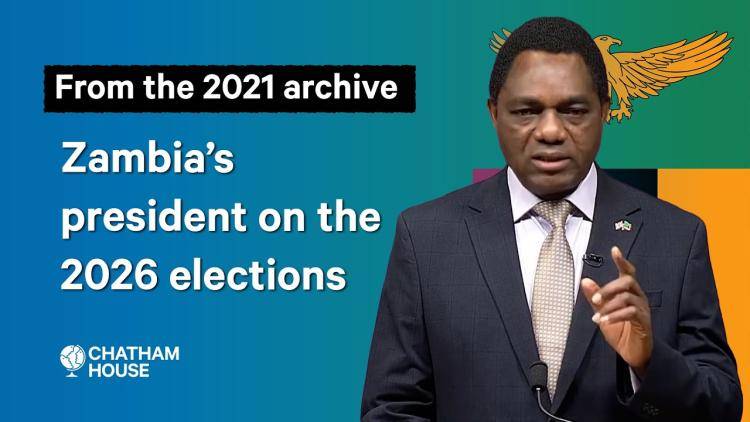
President Hakainde Hichilema speaking at a 2021 Chatham House event about the 2026 election.
Timely results announcements will be important: delays will feed perceptions of manipulation and could trigger unrest. Zambia’s elections have historically been relatively peaceful, but domestic observers have already pointed to some instances of political violence.
There is one other significant change this year: Former President Rupiah Banda, who died in 2022, was instrumental in managing the transition from President Lungu to Hichilema following the 2021 election. Banda’s absence will increase the importance of regional and international observers.
The EU already has a long-term observation mission in the country. And the African Union (AU) and partners including the Southern African Development Community (SADC) will also work collectively. They will need to complement local observation, especially by the Christian Churches Monitoring Group, the largest and most independent domestic election observation body.
Regional and international credibility
The AU and SADC were important balanced critics of the Tanzania elections in October 2025. There is less expectation of electoral violence in Zambia this year. But it will be important for the mission to uphold agreed standards and call out irregularities. To succeed, observers will need to characterize their mission as cooperating in Zambia’s democratic project, and avoid any perception of being deployed to manage a worst-case scenario.
Hichilema’s political story is one of repeated rejection by a system, followed by his triumph as a democratic champion. His international friends helped him through this journey, but their support should not be unconditional. They need to remain consistent in supporting economic reform and democratic values, and remind the government that democratic credibility is not preserved by victory alone, but by restraint in power. The best outcome is one that confirms Zambia’s democratic reputation without damage to its foundations.