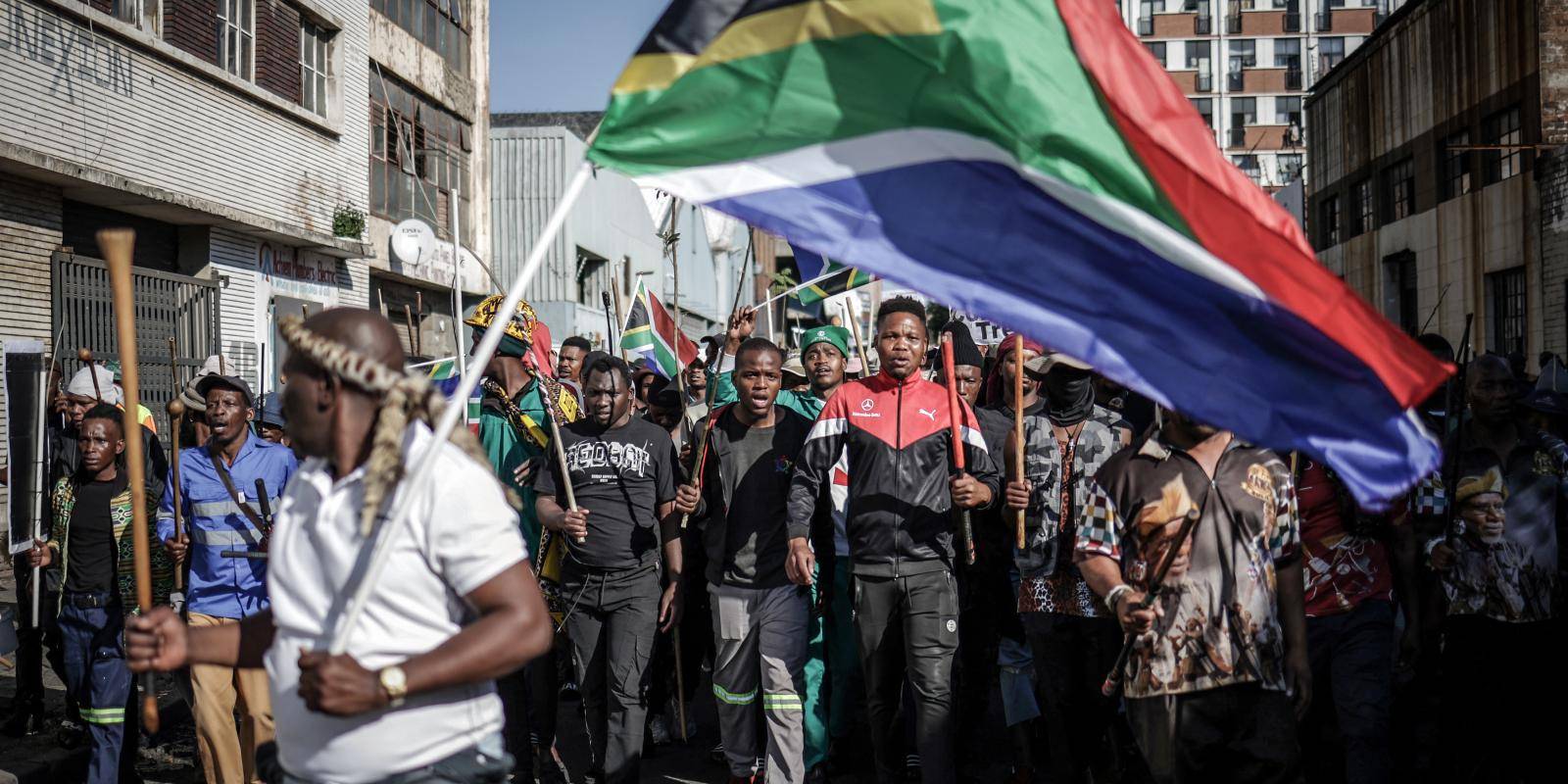

South Africa has been in the grip of anti-immigrant protests and violence over its winter months, leading to the deaths of four foreign nationals - two Mozambicans, an Ethiopian and a Malawian. Tens of thousands more have been left in fear of their lives and livelihoods.
Many have queued outside diplomatic missions in Johannesburg and Cape Town, seeking to escape from a nation that once styled itself a beacon of continental solidarity. It is not the first time the country has experienced xenophobic violence. What distinguishes this outbreak, though, is not just its unprecedented scale, but the widening demographic of protesters and the extent to which it has become politically organized.
In the face of these forces, the coalition government led by the African National Congress has been caught flat-footed, struggling to control events. With elections in Johannesburg and across the country in November likely to bring further tension, is South Africa’s politics approaching a sea change?
This year’s protests are different
The two largest waves of xenophobic violence swept over the country in 2008 and 2015, under the ANC government. The 2008 attacks began in Alexandra township in Johannesburg before spreading nationwide, killing at least 62 people and displacing tens of thousands.
Seven years later protests spread once again, this time from near Durban, amid frustration with the presidency of Jacob Zuma. In both cases, the violence was largely confined to impoverished communities with high levels of unemployment and was fuelled by rumours of foreign nationals taking opportunities from South Africans.
The contrast with this year’s protest is stark. ‘This wave of anti-migrant sentiment draws from the same grievances as previous waves but is more politicized and better coordinated,’ said Aimée-Noël Mbiyozo, a senior researcher at the Institute for Security Studies. She said anti-illegal immigration groups have brought more discipline to their efforts, with identifiable leaders, social media networks and political demands.
The group March and March made international headlines when undocumented immigrants were given an ultimatum in March by its leader Jacinta Ngobese-Zuma, a former radio presenter, to leave the country by 30 June.
Before the June ‘deadline’, Ngobese-Zuma said: ‘We are not calling for violence. No one will be killed on 30 June, and no looting will take place in our name.’ In some areas, vigilante groups went beyond street protests, going door-to-door to ‘arrest’ migrants, documented or not. The mobilization reached around 100 locations, with the largest marches taking place in Johannesburg, Pretoria, Durban and Pietermaritzburg. One of the most alarming developments is the widening social reach of anti-migrant politics, with xenophobic sentiment increasingly resonating among the middle-classes.
Causes of resentment
How did South Africa get here? After three decades of electoral dominance, the ANC lost its parliamentary majority in 2024. Yet the subsequent government of national unity, a multiparty coalition led by the ANC’s Cyril Ramaphosa, has made some progress. Structural reforms to improve fiscal stability have been praised by analysts and privatization policies aimed at the rail and energy sector have improved capacity.
But the coalition’s macroeconomic competence has not led to improved living standards for ordinary South Africans. Unemployment remains stubbornly above 30 per cent, while services including water and electricity have broken down in many areas. Rampant crime has added to middle-class insecurity. And in the absence of tangible progress, the blame has shifted to migrants.
Groups like March and March and Operation Dudula are the most visible and organized face of this xenophobic sentiment. For the past year and more, March and March has called on the government to make radical changes to migration laws and declare illegal migration a national disaster.
These actions reflect a clear hardening of attitudes towards migrants, especially since the Covid pandemic. In a 2025 South African Social Attitudes Survey, 42 per cent of respondents said they would not welcome any migrants into the country - the highest level recorded and an increase from 28 per cent in 2020.
In this climate, anti-migrant groups have spread harmful myths about undocumented foreign nationals causing unemployment among South Africans, committing crimes and being a burden on services. March and March says its supporters will protest ‘until all undocumented migrants have left South Africa’ and claims there are up to 30 million illegal immigrants in South Africa, nearly half its population. According to Africa Check, a fact-checking organization, the real figure is closer to 2.4 million.
‘The facts about migration are clear and consistent,’ said Mbiyozo. ‘They make up a small proportion of society and contribute 9 per cent of GDP.’ Yet misinformation about ‘outsiders’ taking from a ‘fixed pie’ of resources is rampant.
This narrative has found fertile ground in South African politics. All parties, from the ANC to the Democratic Alliance, have increasingly blamed migrants for South Africa’s struggles. Now, politicians are echoing the March and March demands. The populist MK Party, led by Jacob Zuma, has called for sweeping immigration enforcement, while others, including the centre-right ActionSA, have campaigned on stronger deportations and tougher border security.
Politics by other means
Many argue that the government’s response has fallen short. When protests escalated in June, President Cyril Ramaphosa acknowledged what he called South Africans’ ‘deep concerns about illegal immigration, border management and pressure on public services,’ while insisting the challenges ‘must be addressed within the framework of the constitution and the rule of law’. Between 26 June and 11 July, the government said it had processed more than 50,000 foreign nationals for deportation or voluntary repatriation and deployed more than 200,000 private security officers.
But these measures have not resolved the underlying political fractures. After losing its majority in the 2024 election, the ANC was forced into a fragile coalition with opposition parties whose policy priorities often differ sharply. These divisions have undermined institutions such as the police and immigration system and created a political vacuum being filled by groups like March and March.
The result is the effective delegation of state authority to vigilante organizations. ‘Xenophobia, Afrophobia, ethnic chauvinism and vigilante politics offer no way out,’ stated a national campaign against bigotry, backed by more than 120 organizations. ‘They will not create jobs, reopen factories, fix municipalities, end austerity or hold the powerful to account.’
Alex van den Heever, a professor at the Wits University School of Governance, warns of the risks from this continuing vigilantism. ‘The state has a monopoly on legitimate coercive authority precisely because its actions are constrained by law, procedures, courts and accountability mechanisms,’ he said. But ‘vigilante organizations are not subject to these safeguards’ which make them much harder to contain.
Electoral tests
Municipal elections in November will serve as a test of how far xenophobic sentiment has disrupted political discourse. Will the demands for improved public services outweigh concerns over immigration?