

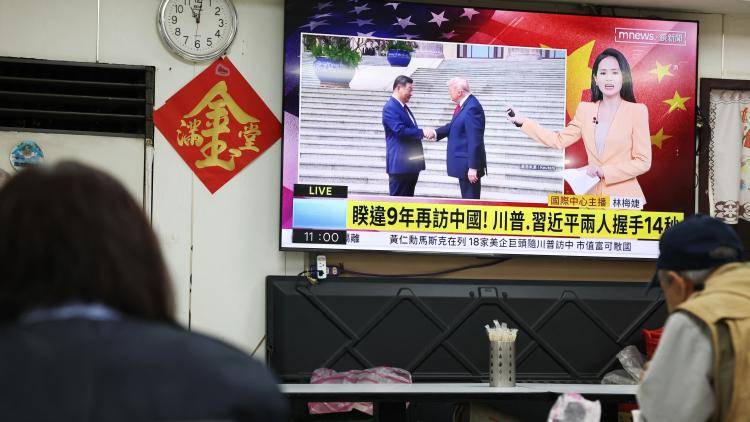
A superpower summit is a big deal. As US President Donald Trump and China’s President Xi Jinping meet in Washington this week, they have a lot to cover. They will try to extend a trade truce that expires in November, including China’s pause on rare earth export controls and America’s delay on chip restrictions. The leaders will also tackle Taiwan, where Beijing wants Washington to halt a $14 billion arms package, as well as China’s purchases of Iranian oil and a proposed dialogue on the national security risks of artificial intelligence (AI).
In their negotiations, each side may be tempted to focus on the other’s weaknesses. But underestimating the other’s power would be unwise.
China has many weaknesses – but should not be underestimated
Many observers argue that China’s economic vulnerabilities will limit its international ambitions. Its growth model is faltering; its households still are not spending, so Beijing continues to push surplus production overseas. This has provoked a backlash of trade barriers from the US, EU and beyond. The property sector – once a quarter of the economy – is in its fifth year of slump, while a mountain of hidden local government debt threatens to drag down China’s growth for years to come.
Meanwhile Xi’s government has become steadily more restrictive: tightening political control (such as the new travel restrictions) and placing national security at the centre of economic life.
But Washington should not misjudge Chinese power. China possesses formidable industrial might, with dominance in areas such as electric vehicles, batteries, solar power, drones and telecommunications equipment. China also rivals the US in AI: its models now match leading American systems at a fraction of the cost and are used by developers worldwide (including many in the US). Although gaps in Chinese technology remain – notably in advanced semiconductors – there, too, Chinese firms are likely to grow increasingly competitive.
Many observers will again be tempted to predict that Xi’s tightening grip will choke Chinese innovation. But it is time to bin the argument that authoritarian China can only copy and cheaply produce what other countries invent. Indeed, many of China’s recent innovations have come amid tightening control. The AI sector took off only after Xi came to power and flourished despite his regulatory crackdown on technology firms and entrepreneurs.
China’s innovation model is simply different. The state picks strategic sectors and drenches them in cheap capital, subsidies and guaranteed demand. Fierce competition among firms, a vast domestic market and the world’s deepest manufacturing base bring research into mass production faster than anywhere else.
This approach has its problems; not least that it is wasteful and prone to overcapacity. As an autocracy, Chinese innovation may never outpace that of the United States. But even in second place, China is a daunting technological competitor. The US should thus adopt policies to support domestic innovation and help US firms keep their lead for as long as possible.
China’s economic weaknesses also do not imply strategic weakness. When Trump escalated the trade war last year, Beijing targeted US dependence on Chinese rare earths. The threat of Chinese export controls forced Washington into a truce, agreed when Trump and Xi met in Busan last October. Extending that truce will be high on this summit’s agenda.
China has also spent decades developing considerable military capabilities that have shifted the balance of power in Asia. Beijing has made clear its long-term intentions to control Taiwan – and economic costs are unlikely to deter it from pursuing this goal. Indeed, before China cracked down on Hong Kong, many observers argued this move was unlikely because it would be economically unwise for China.
Military costs, however, are a different matter and likely have already deterred Beijing from the overt use of force. The strength of Taiwan’s defences – such as through US arms sales – will continue to influence Beijing’s calculations. Continuing US arms sales are vital, not a bargaining chip that might be traded away for something else (as Trump has suggested).
American dysfunction does not equal decline
Just as Washington should not mistake China’s problems for strategic weakness, Beijing should not mistake US dysfunction for decline.
Xi will see a weakened superpower: with historically unprecedented deficit spending and a burgeoning debt of $40 trillion. Washington now spends more on interest on its debt than on its military. Its dire finances are raising its borrowing costs and jeopardizing the future of the US dollar as the global reserve currency. By 2032, social security will be underfunded and Medicare will soon follow. Neither Republicans nor Democrats are willing to cut benefits or raise taxes but the money will have to come from somewhere. As the largest item in the US discretionary budget, defence may be the obvious place.
The US ability to address this and other problems is hindered by domestic political polarization. Xi – like any visitor to Washington – will see a profoundly divided city. Nationally, Trump’s approval rating is at its lowest point in his second term. But Democrats are ill-poised to lead: the party is divided by the fault line of Israel. With its fiscal pressures and disunity, the US hardly seems poised to embark on a costly containment – or war fighting – adventure against a rising superpower.
Indeed, the US has shown itself unable to focus on China’s rise. For decades it has vowed to ‘pivot’ to Asia, but not even an administration that campaigned on ending wars in the Middle East could avoid starting one.
Xi may therefore be tempted to conclude that America is a mess – and that Asia is China’s for the taking. But underestimating the US would be foolhardy for China too.
The US economy is performing well, and the country remains the global innovation leader dominating emerging technologies. Its alliances and partnerships are built on shared interests and seem to be enduring despite recent upheaval.
The US also remains the world’s military superpower. It has longstanding ties to Taiwan, and its foreign policy establishment favours US intervention if China invades Taiwan. US alliances in Asia enjoy robust popular support, and American foreign policy leaders would not want to see a China-led Asia, given a perceived threat to US prosperity and security. Xi should remember that the US has historically paid high costs to prevent a country from dominating either Asia or Europe.
Trump and Xi would thus be wise to sit down at the table with a great deal of respect for the power and influence of the country represented by the man on the other side. Only then can they address what is perhaps the most important issue of all – making progress towards a US–China modus vivendi.
US–China relations – and the world as a whole – would benefit from an arrangement that acknowledges each country’s core security needs, prevents war and encourages cooperation on shared interests: rebuilding the global trading system, managing the risks of AI and tackling climate change. They will never get there by underestimating each other.