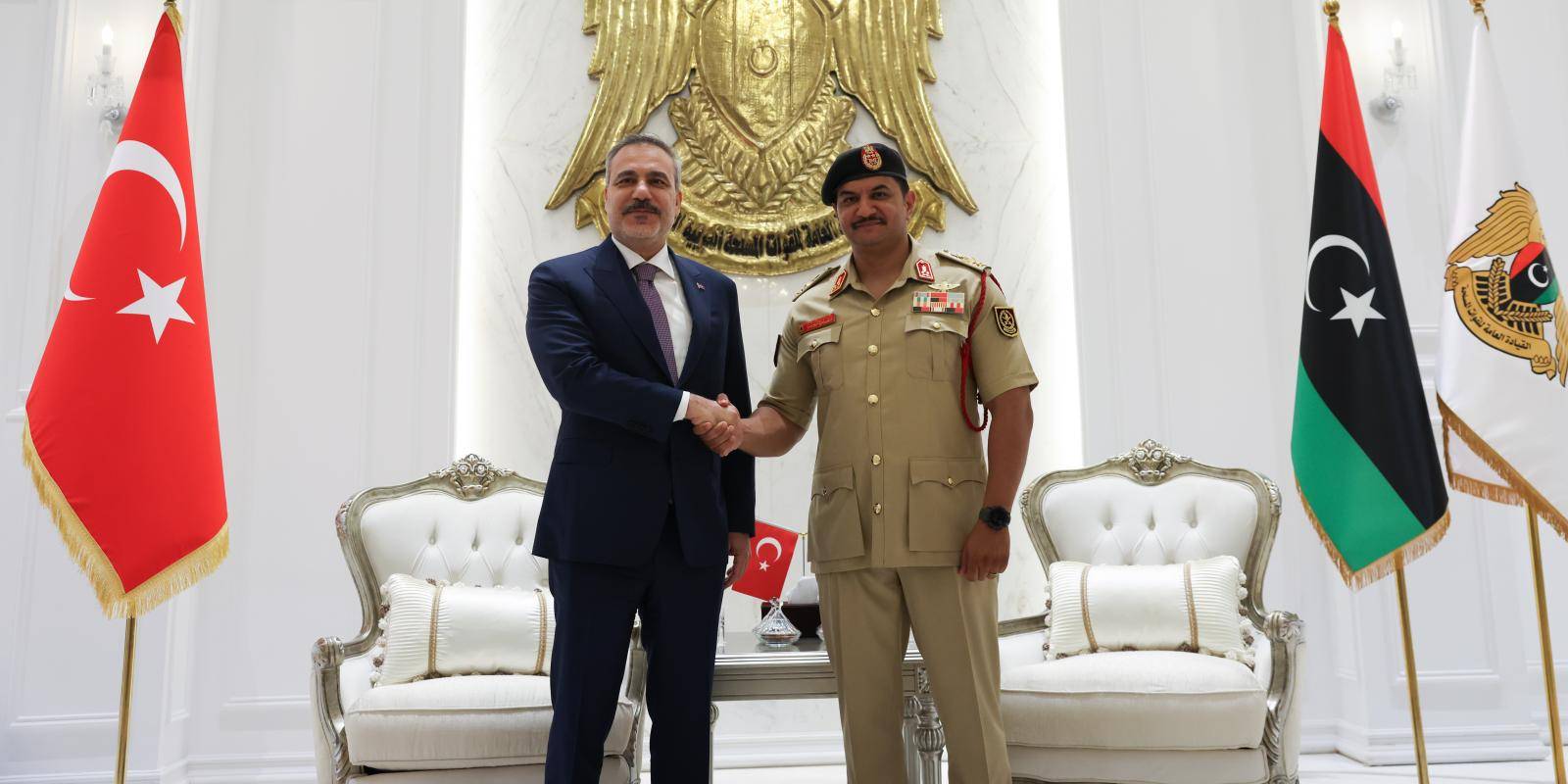

Saddam Haftar, the son of the Libyan Arab Armed Forces (LAAF) commander Khalifa Haftar, has recently visited several foreign capitals in an apparent attempt to boost his international standing. This has been seen as part of a concerted push to become Libya’s next president.
This effort will define Libya’s politics for the coming months. It has huge implications for the country’s political future amid a US-led push for a national government that would unify Libya’s two rival administrations: the LAAF-controlled administration in eastern Libya and the Government of National Unity (GNU) in Tripoli. Strong opposition to Saddam’s goals in western Libya also means that the risk of conflict is increasing.
Saddam becomes heir apparent
For many years, there have been questions over Khalifa Haftar’s succession. The assumption has been that Haftar, 83, would remain in direct control of the LAAF while alive. It was speculated that the LAAF could fragment without Haftar, given the LAAF’s status as a hybrid of a military institution and a family enterprise.
However, in recent years, Haftar has increasingly taken a back seat as his sons Saddam, Khaled, Belgassim and al-Sadiq have come to the fore. Their rise became clearer after the failure of the LAAF to capture Tripoli in 2020, which led Haftar to reassess his approach. Over subsequent years, the LAAF was restructured. Its forces were placed under the command of Saddam and Khaled, who gained responsibility for land forces and security units respectively.
Meanwhile, Belgassim developed strong networks and influence in political circles. He was instrumental in the formation of a new government that sought to replace the sitting GNU in Tripoli. In 2023, Belgassim also assumed the helm of the Libyan Development and Reconstruction Programme, formed after floods killed several thousand people in Derna, which provided a new narrative of development for the Haftar family.
However, Khalifa’s appointment of Saddam as deputy general commander in August 2025 sealed his position as heir apparent. Saddam has become the most powerful of the sons through not just his military position, but also his alleged increasing influence via proxies over the oil and gas and banking sectors in eastern Libya.
The Boulos initiative
Saddam’s rise is important in the context of the push for a unified government in Libya. This has been led by Massad Boulos, the US Special Advisor for Africa and the Middle East. Under Boulos’ plan, a unified government would be formed as part of a deal between the two ruling families: the Haftars, who control eastern Libya, and the Dabaibas, who control the Tripoli-based GNU.
While the US has not publicized the parameters of the deal, insiders have said that Saddam Haftar would become a member of the Presidency Council, the three-person body whose chairman is Libya’s de facto head of state. The Dabaiba family would retain the prime minister’s post.

Negotiating processes had previously focused on seeking agreement between Libya’s fractious institutions: the chronically divided House of Representatives in eastern Libya and the Tripoli-based High State Council. But the US plan has broken with this formula, instead seeking agreement between the Haftars and the Dabaibas. The first agreement made through this channel was a deal on budgetary spending in April 2026.
Subsequently, the United Nations adapted to the new format. The UN Mission’s ‘4+4’ committee brought together a combination of representatives from the GNU, LAAF, the House of Representatives and the High State Council. The 4+4 reached agreement on a roadmap for national elections in August.
This pivot towards negotiations being between the LAAF and the GNU – essentially between the emissaries of Saddam Haftar and the Dabaibas – is more significant than the content of the agreement. It officially places Saddam’s LAAF General Command as a negotiating party with parity with the internationally recognized GNU.
Path to the presidency?
Buoyed by these diplomatic advances, Saddam has recently made significant moves to expand his influence.
The ousting of the longtime speaker of the House of Representatives in October – and his replacement with a figure known for his support for the LAAF – is widely understood to have been orchestrated by Saddam.
Shortly after, the House of Representatives moved to ratify a controversial memorandum of understanding with Turkey over the recognition of drilling rights in the eastern Mediterranean. Insiders have said privately that Saddam pushed for this move, which angered Egypt and European countries, presumably with the aim of securing Ankara’s support for his push for the presidency in return.
Then, on 26 October, the governor of the Central Bank of Libya was replaced, reportedly due to a private agreement between the Haftars and the Dabaibas. The Central Bank holds a critical place in the management of Libya’s economy, overseeing the distribution of foreign currency and dinar payments that are so crucial to Libya’s leaders.
That same week, Saddam was in Turkey for talks with the GNU on military reunification.
Alongside strengthening his influence over important institutions in Libya, Saddam has consequently emerged as the apparent partner of preference for the some of the most influential international actors. He is seen as someone who can get things done and maintain order in comparison to the messy picture of contested power in western Libya.
The enduring Haftar ‘problem’ and the risk of conflict
Saddam is now central to any political effort to reunify the country. His ambitions to enter Tripoli are widely known. Those familiar with the security sector in the capital note that local allies of Saddam are seeking to prepare the ground for his arrival.
But opposition to – and mistrust of – Saddam in western Libya remains strong, especially in key constituencies such as the city of Misrata. This has not been helped by the uncovering of a sleeper cell, allegedly linked to the LAAF, that was accused of seeking to cause damage to oil and gas infrastructure in the city of Zawiya in August.
Many doubt that Saddam is willing to share power. It therefore seems no meaningful guarantees can be provided to Saddam’s opponents to reassure them. Western Libyan actors would like to separate the discussion of military reunification from political reunification as a result.
Consequently, while the Dabaiba family may be willing to cut deals to retain a modus vivendi with Saddam, it is highly unlikely to sign a deal making Saddam president. This is evident in the fact that no deal has yet been reached, despite intensive efforts over months by Boulos.
This, in turn, creates a problem. It is not clear how Saddam’s rapid rise and apparent aspirations for president can be squared with his opponents’ steadfast opposition to him. And they are unlikely to go anywhere, considering that the Dabaibas are entrenched in power too.
This fundamental difference runs deeper than the Boulos initiative. As one source in the security sector told me: even if there were elections, Saddam would not accept the results if he loses, and his opponents would not accept the results if he wins.
If Saddam continues to push for the presidency, Libya therefore faces a heightened risk of conflict. Many of his opponents would seemingly prefer the messy situation in Tripoli to prevail over a new order that could ultimately end up squarely under Saddam’s control. But, given the strength of international support building behind Saddam’s campaign, their options are narrowing.