Creon Butler
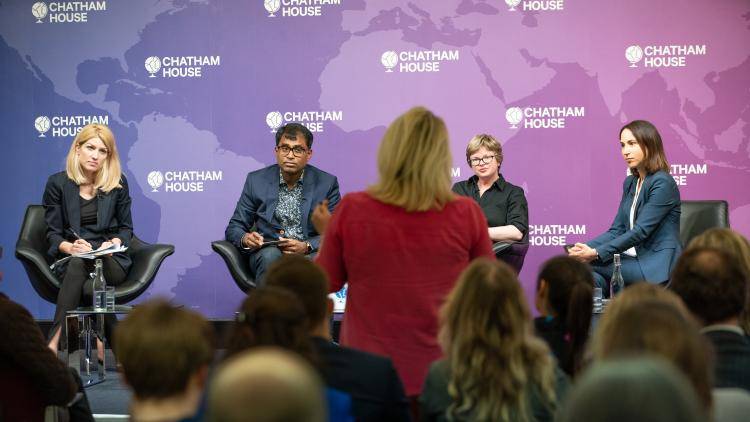
Well, hello, everyone. My name is Creon Butler. I’m the Director of the Global Economy and Finance Programme in Chatham House, and it’s a great pleasure today to welcome you to our panel. We have a fantastic topic. Formally, the question is, “Is the age of central bank independence under threat?” But I think, in fact, it’s, kind of, no less than, what is the future of central banking in today’s extraordinary times? And we have a really excellent panel to discuss this. On my immediate left is Megan Greene, who is an External Member of the Monetary Policy Committee at the Bank of England. Megan is also an Associate Fellow at Chatham House and has many other distinguished affiliations. Next to her is Chris Giles, Economics Editor of the FT – at the FT. And at the end, is our very own David Lubin, who’s the Michael Klein Senior Research Fellow in Global Economy and Finance Programme at Chatham House.
So, we’ll get straight into the substance very shortly, but a few housekeeping points, first of all. So, this session is on the record and is being livestreamed. We will have, first of all, a discussion among myself and the panellists for about 30 minutes, and then we’ll open it up to Q&A for the final half hour, so be ready with your questions. When you do want to ask a question, if you’re in the room, could you put your hand up and then wait for a mic to come to you when I ask you to put your question, and if you’re online, you can use the Q&A box. And, please, if you’re online, try and keep your question as short as possible, ‘cause I’m going to have to read it while at the same time, listening to the other panellists, and I’m not very good at multitasking, so please try and keep it as short as you can. And I’ll certainly try and get as many questions in as I can, and we have a hard stop at 1 o’clock.
So, with that, let’s kick off with the discussion, and Megan, if I may start with you, I guess my question is, how does it feel to be a Central Banker today? Do you feel your independence is under threat, and what are the main challenges you see in the present environment?
Megan Greene
Yeah, thank you. Thanks for having me, and as the resident Central Banker, you’ll be unsurprised to hear the spoiler alert that I’m in favour of central bank independence, but I just thought I’d talk a little bit about that. It’s an interesting time we just had an interest rate decision. As you all know, there is a budget coming up. I read a lot of sell-side research. Some of it said that we would hold interest rates because of the budget. Some of it said that we would cut interest rates because of the budget. I’m not sure what’s meant to be more or less political. I will assure you that, you know, the budget didn’t actually factor into the interest rate decision, other than that we condition our forecast on a number of assumptions, including market pricing for things. So, it could have been priced into markets if investors are making assumptions. But it’s an interesting time to have a panel about central independence, just given the moment of time that we’re in, and it does suggest that people at least might think that there might be some issue with central bank independence.
I will say that, you know, if – there are many indices of central bank independence, they’re based on, kind of, legal definitions, and there are a bunch of different ways you can define legal independence of central banks. I think they’re important, most of the studies you see on central bank independence are based on these legal indices. I would also say that culture and, kind of, norms matters a whole lot, as well. So, by way of example, I would say my colleagues are most useful to me when they disagree with me. Everyone might not feel that way, but they at least stress test my views, sometimes they change my mind, that’s great. If you feel like you’re under threat as a central bank, you might not be as willing to disagree with principles, and you certainly might be less inclined to disagree with a government, and so, I, you know, I think that would be a real shame, but that’s never measured in any of these indices. So, it’s worth pointing that out.
Empirically, if you look at correlations between central bank independence and inflation or inflation volatility, there’s a strong negative correlation, up until 2000, certainly, and a bit less until the financial crisis. So, you know, there is empirical evidence suggesting that the more independence you have, the more price stability you have, and the greatest public good a central bank can achieve is price stability. But this has become a question, I think, since the global financial crisis, in particular, because broadly, central banks have missed their targets, so after the financial crisis, many developed economy central banks were undershooting their targets. Since COVID and a war in Europe, many developed economies have exceeded their inflation targets. So, there’s a question about whether that correlation still really exists.
And I think to answer that, you can look at inflation expectations. So, it’s hard to know whether, you know, any of this is because of the central bank independence or if we just, kind of, lucked out with a great moderation. If you look at inflation expectations, though, it’s pretty clear that there’s a relationship suggesting that the higher central bank independence you have, the less volatility there is in inflation expectations, and inflation expectations is a really important piece of how we think about how shocks to the economy or structural shifts in the economy feed through to inflation. So, that does suggest that central bank independence matters.
And not only does it matter for inflation, but as long as inflation expectations remain anchored and you have policymakers who aren’t, in the words of Mervyn King, “total inflation nutters,” so who don’t just, you know, singularly look at inflation, but look at other things that might in – affect inflation, like output, then actually you can stabilise prices without making serious concessions in terms of output. So, that’s, kind of, a double win as a Central Banker.
You asked if I feel like monet – like, central bank independence is under threat. You know, UK Politicians have recently been on media waves asking why the Bank of England is independent, so it’s certainly something that comes up. Do I feel it in my day-to-day? Certainly not. We also can’t ignore what’s happening across the Atlantic with the US. The Lisa Cook case I think will be pretty significant in terms of the Fed’s independence. But back to the point I made at the start, there’s legal independence, and that’s one thing, certainly, but there’s also the culture, and the culture can shift even if the legal independence doesn’t, and so that’s worth thinking about.
Creon Butler
Just on that point, as you point out, there are different kinds of independence, and so in the UK, we have – well, initially we didn’t call it ‘independence’, we called it ‘operational autonomy’.
Megan Greene
Yeah.
Creon Butler
By contrast, in Europe, you have, you know, hardwired through an international treaty, which is…
Megan Greene
Yeah.
Creon Butler
…extraordinarily difficult to change, very, very strong degree…
Megan Greene
Hmmm.
Creon Butler
…of independence, and, you know, the ability to set goals and things of that kind. What is your view on – do you think it matters much what the precise form of independence is, or do you think it’s just a thing that – and in a way that each of these has its pros and cons? Or do you think actually there is…
Megan Greene
Yeah.
Creon Butler
…a really important thing about how you do independence, in a way?
Megan Greene
Yeah, so I think it does matter. My personal opinion, so the ECB, you know, it has its mandate and you can’t change that unless you open the treaties and then you are opening up a whole can of worms on all kinds of other things, and so it probably won’t happen. And I think that safeguards central bank independence for the ECB pretty significantly. The IMF have a index for central bank independence, and it’s based on legal things and some other things, but interestingly, they asked Central Bankers to fill out surveys, and so I can say that – I think it was 83 central banks that fed into it. I didn’t personally, I’ve just read about it, but it seems that Central Bankers broadly think that financial independence, so the financial means to actually implement what you need to, to hit your mandate, is the most important kind of legal independence.
Creon Butler
Okay. Chris, if you come from a central bank, I used to work there and – or if you’re from the, kind of, orthodox establishment, the idea of giving up independence is a, kind of, horrible thing, but I think, you know, one ha – as I think you would argue, you have to keep making the case. So, what do we give up by having central bank independence? What would be the counterargument as to why actually you may not want the forms of independence, we currently have in most countries today?
Chris Giles
Well, you very clearly give up democratic control. So, it is hard for a populace to vote out the central bank members. In the UK, it’s not that difficult, because if you think about the term structure and who appoints the members of the MPC, you could basically change seven of the nine in any five-year parliamentary term. So, you – if you wanted to put a whole bunch of yes people in there, you could, and in lots of ways, that – those sorts of things help. In the ECB, you’d find it much, much more difficult ‘cause you’d have to change the individual Central Bank Governor of every country, and then that’s very difficult for one populist government to do, so that’s not going to happen. But we are seeing that in the US, where we see the President saying, quite openly, that he’s wanting to seek a majority of the Governors on the Federal Reserve Board, who’s – who are not the people who necessarily vote on monetary policy, but they are the people, if you had control of the Governors, you would ultimately, if you wanted to be really extreme about this, be able to sack all the Regional Fed Presidents and get rid of them. We are not seeing that yet, but we might.
But why might you – but, you know, it is – I think you don’t want to be too pearl-clutchy about central bank independence. As Megan said, it’s – you – central banks have to demonstrate that they are running better monetary policy, having more stable financial systems and whatever else – whatever other tasks they’re given by government than a government themselves, a democratically-controlled government would do. Milton Friedman in 1962 said – and his question was, “Is it really tolerable in a democracy to have so much power concentrated in a body free from any kind of direct effective and political control?” And I think the answer is no, and that’s why you then have to say, “Well, they’re not entirely free.” That – so you curtail freedom in some ways, and you also control – it’s perfectly reasonable, I think, for democratic governments to control appointments to the central bank.
And also, central banks have to be mindful at all times that their legitimacy to do very important things in the economy has to be met – comes from being accountable and being accountable to Parliament or whatever form of ac – ultimately to the public, also requires a lot of transparency so that people understand the decisions they’re making.
Creon Butler
Yeah, and how do you think today’s central banks are doing in that, kind of, transparency space? I mean, we’ve recently had some changes in the way the Bank of England communicates the outcomes of…
Chris Giles
I think…
Creon Butler
…the MPC.
Chris Giles
…the answer is better.
Creon Butler
Yeah.
Chris Giles
Quite a lot better, in fact. I think the Bank of England is taking steps along this. It understands the issue and it’s taking steps. So, I think in the last – so last Thursday, the Bank of England had a big overhaul of its communication of its decision. And I think having each MPC member – so Megan had a paragraph in the minutes saying exactly her view of why she voted the same way – the way she did. All nine members had that, and I think that was extraordinarily helpful because it did two things. One, it showed people where the swing voters or who’s in the – ‘cause in the Bank of England it matters who’s in the median. The median voter is really important, especially when you’re on a – have a five-four type of balance on a committee, then the swing voter is the most important person in the room. It happens to be Andrew Bailey, doesn’t –wouldn’t nor – necessarily have to be the Governor, but it happens. So, his view got a lot of scrutiny last week, probably too much scrutiny, if I’m being honest.
So, those sorts of things I think work well. I think you’ve seen it pretty much everywhere. So, the European Central Bank is way more transparent. It still is a – it still is very, very nervous about releasing votes, particularly because of the nationalistic aspect of that. And I can un – I think that’s reasonable, and that’s why not every central bank has to be the same. And we see from the Fed, you see, I think, a good piece of transparency, which is different, and again, di – central banks don’t have to be the same, but they are very clear about what they control. They ultimately control the interest rate, and then they all give a view in their summary of economic projections every three months where they individually think – I think they could name themselves, as well, because they mu – they pretty much all come out of the pack afterwards and go on TV somewhere and say, “My dot is here.” So, they might as well all do it.
Creon Butler
Yeah.
Chris Giles
But I think – so all of these aspects of communication and transparency, I think, are improvement ‘cause – improving, ‘cause I think particularly after a period where economic performance and the inflation performance has been bad, central banks know that the legitimacy matters and that they have to work on that.
Creon Butler
Thank you very much. David, we talked mostly, I think, about advanced economies. At least that’s what’s in the back of our minds, but obviously independence, some of the tools of independence, inflation targeting, are now widely used in the emerging economies, as well.
David Lubin
Hmmm.
Creon Butler
So, what – do you think there’s this – a, kind of, a different picture in emerging economies, both in terms of performance, the debate over independence, or do you think it’s broadly the same? Or how would you characterise the picture in emerging economies on this issue at the moment?
David Lubin
Before I get to that…
Creon Butler
Yeah.
David Lubin
…Creon, can I just…
Creon Butler
Sure.
David Lubin
…make a couple of comments about why we’re asking this question?
Creon Butler
Yeah.
David Lubin
I think there’s a couple of things that I want to point out. The first is that in a, kind of, globalisation paradigm, where there’s a high degree of consensus about the broad parameters of economic policymaking and what economic policy is supposed to do, reduce barriers to trade, to improve the cross-border mobility of goods and capital and people, in that globalisation paradigm, it’s easy to, kind of, subcontract monetary – easier to subcontract monetary policy to technocrats. You know, we all know what we want to achieve, so let’s just let independent central banks get on with it.
And I think one reason why we’re asking the question here today is that we’re somehow moving beyond that globalisation paradigm, and so the parameters of economic policymaking are more up for grabs than they were, you know, a decade or two ago, and I think that is also reinforced by the greater prevalence of authoritarianism. I mean, you know, Donald Trump’s effort to control the machinery of the state is arriving at the Fed and, you know, his desire to control the Fed is, in some respects, just a, kind of, extension of policies that have been implemented with respect to the judiciary and the media and the universities and everything else. So, kind of, authoritarian instincts, you might think, move towards undermining central bank independence, although I want to come back a bit later and nuance that, because I think the relationship between authoritarianism and central bank independence, the relationship between authoritarianism and inflation is very complex. Russia under Putin is a very good example, I’ll come back to it.
But the other thing that I thi – want to mention, which I think, sort of, leads from talking about Donald Trump in this context, is the relationship between the debate about monetary – the debate about central bank independence and the level of public debt. Because, you know, when the public debt stock is very low, the cost of monetary policy independence is also low. You know, back in the early 1980s, when Paul Volcker was raising interest rates in the United States to very high levels, the public debt stock was 30% of GDP. So, the fiscal consequences of monetary tightening are nothing to write home about. These days, the fiscal consequences of a tremendous monetary tightening are something to write home about, and I think that makes it more difficult for central bank independence to have a, kind of, clear run in terms of the arguments.
Now, in terms of your exact question, Creon, I mean I think, you know, one –actually one interesting point is that if you look at the G7, the median inflation rate in the G7 that has an inflation target of two, the median inflation rate in the G7 is 2.4. The median inflation rate – the median inflation target for the 16 inf – you know, 16 largest emerging economies, the median inflation target there is three, but the inflation rate is 2.6. So, emerging markets, arguably, are doing better with respect to their inflation target these days than the G7 is doing with respect to its inflation target.
But I have to say that inflation targeting and central bank independence are separable concepts, you know, in the sense that, for example, the Bank of Russia is nominally independent, but not really independent. If Putin wanted to control monetary policy in Russia, he would – you know, he has, I think, pretty direct control over monetary policy but, you know, Russia has among the highest real interest rates on the planet these days. You know, the real interest rate, the inflation-adjusted policy rate in Russia is about 800 basis points, just below Brazil’s at 1,000 basis points.
So, Putin, as a matter of fact, just has a strong instinct or a strong understanding that high rates of inflation would undermine his legitimacy, and so he’s always, even, you know, well before the start of the invasion of Ukraine, he’s always had this, kind of, preference for low inflation, and always had a rather hawkish approach to monetary policy. So, there’s no reason on – in theory or in practice why authoritarianism should deliver higher rates of inflation. And, equally, there’s no reason why central bank independence necessarily should deliver high – lower rates of inflation, because within the emerging markets, we have these two very good examples, China and India, neither of whom have independent central banks, both of whom have very low inflation rates.
You know, in China, the PBOC is a direct agency of the State Council of the Cabinet. I mean, you know, inflation in China is basically zero, it was positive last month, but it’s been negative for the last – the previous few months. In India, where I’ve got it here the 1934 Reserve Bank of India Act, Section 7, “The government may give such directions to the bank as it may consider necessary in the public interest.” So, it’s on paper, the central bank – the Reserve Bank of India is not independent, but inflation is .3 at the moment. So, you don’t need central bank independence to deliver low inflation, but low inflation, or low and stable inflation, I would argue, is the goal. Once you get rid of that, then you go down a road that destroys society.
Creon Butler
But if you look at those emerging economies that are democracies and do have independence, so…
David Lubin
Yes.
Creon Butler
…it would be Russia, which I think is a pretty extraordin – unusual examp…
David Lubin
Yeah.
Creon Butler
I mean, it’s important, but China, India, put those to one side, but look at the countries where you do have a functioning democracy and you have independence. How is it working there relative to the advanced economies?
David Lubin
Ah, okay, interesting question. In Central Europe, there’s a very interesting experiment that I helped – that I think, sort of, you know, provides some answer to your question. So, you’ve got the National Bank of Poland, the National Bank of Hungary and the Czech National Bank, with more or less similar inflation targets. I mean, they’re slightly different, but let me put that aside for a minute. The Czech National Bank, by I think everybody’s understanding, is a really credible independent central bank. Oh, the main point to make is that all three of these central banks are institutionally legally, kind of, looks and feels the same. They’re all independent central banks that are target – that have inte – inflation targets.
But among those three, both the National Bank of Hungary and the National Bank of Poland have, in my view at least, been subject to enormous amounts of political pressure. The National Bank of Poland under Glapiński, when the PiS was in power, the party – the right-wing party that appointed him, when the PiS was in power, Glapiński kept rates exceptionally low…
Creon Butler
Yeah.
David Lubin
…even when inflation was accelerating.
Creon Butler
Yeah.
David Lubin
The National Bank of Hungary under Matolcsy, an Orbán appointee, clearly kept monetary policy looser than might otherwise have been the case. The result was that during the big surge of inflation in 2022, the Czech National Bank, the one of those three that really maintained its independence, had a lower peak of inflation and a faster descent to the inflation target range.
Creon Butler
So, in that ca – that’s an example where it seems to work.
David Lubin
Exactly.
Creon Butler
Yeah.
David Lubin
And it would have been even worse were it not for the fact that in both – well, in Hungary’s case, there was, kind of, a voluntary price restraint for telecoms firms…
Creon Butler
Yeah.
David Lubin
…and in Poland’s case, there was the so-called ‘inflation shield’ where electricity tariffs were capped for a long time…
Creon Butler
Right.
David Lubin
…to, kind of, keep inflation low. Without those in – administrative tools to keep inflation low, inflation in those two countries would have been much, much higher.
Creon Butler
Thanks very much.
Chris Giles
Of course, we had a – we had caps here as well. We had…
David Lubin
Yes, true.
Chris Giles
…[stewards – 25:05] caps.
Creon Butler
Great. Megan, I mean, we – so we talked about independence. We’ve had this extraordinary, kind of, 15-year period. We’ve had, after the global financial crisis, a sustained period of ultra-low…
Megan Greene
Hmmm.
Creon Butler
…interest rates linked to QE in some ways, or at least, you know, complemented by QE.
Megan Greene
Hmmm.
Creon Butler
There’s a lot of people looking back at it saying, “Well, it actually had a lot of costs in terms of inflated asset prices, distortions and so on.” Then we had the inflation shock after the – shortly after the pandemic. If central banks, again, as indeed Chris was saying, if central banks are going to maintain their case for independence, they’ve got to be competent.
Megan Greene
Hmmm hmm.
Creon Butler
Do you think the community as a whole has learnt the right lessons from this experience? You know, what do you think the main ones are that we have learnt, if you like?
Megan Greene
Yeah.
Creon Butler
And maybe I could, sort of, link it to another question, you know, we’ve got a lot of, you know, transformational changes underway in the economy, I mean, climate change is one, but we’ve…
Megan Greene
Hmmm.
Creon Butler
…also got technology and AI. We’ve got demography coming down the tracks, which is now really important in a country like Japan. Do you think we’ve learnt the right lessons and that in a way, we’re prepared for what’s coming, not so much in the principle of independence, but actually how central banks operate and work?
Megan Greene
Yeah, there’s a lot to unpack there. So, I will say, though, I’ve been on the MPC for two years, so I haven’t made any QE decisions, but when you do make these decisions, you make them with the information that you have. And so, I think often we forget that QE and – QE programmes that we’ve done in the UK have been designed to – with, kind of, a monetary policy purpose, right? It was to shore up demand in the economy with a view towards inflation, and so I think that’s the right motivation to do it. And I do think that having, kind of, our own mandate of price stability at 2% allows the Bank of England to focus on that and to act when there are emergencies.
Do we have the right tools generally? So, you listed a few shocks that we’re going to face, and I’ll add two that we just faced, which is a pandemic and a war in Russia, right? You know, those are both supply shocks and central banks famously have demand management tools, and particularly the interest rate, our main tool, which is a pretty blunt tool at that. And so, do we have the best tools for supply shocks? No, but can we respond to supply shocks differently based on what we’ve just learnt? Absolutely. So, I would agree with you that we just – you know, we’re facing into climate change issues. Those will present supply shocks. AI will present a positive supply shock, potentially, so that could move in the other direction. Tariffs seem here to stay. Economic statecraft seems like we’ll be facing that for a while. Those are all negative supply shocks. Typically, central banks look through supply shocks, negative supply shocks. Typically cen…
Creon Butler
On the grounds that they’re only going to last a limited period, or…?
Megan Greene
Yeah, so in part, because they’re temporary, they can represent price level shifts, but after a year might drop out, in inflation terms and, also, you know, we don’t have great tools for supply shocks. So, I think, you know, traditionally there’s been a view that it’s not really up to us to deal with it. But if we’re going to face all these supply shocks going forward, and they’re going to be successive and maybe sometimes hit at the same time, then I do think we can learn from recent supply shocks and maybe approach supply shocks a bit differently to react a bit more proactively to them.
Creon Butler
I mean, one could make the argument this is a case for less independence, ‘cause then you can co-ordinate what the central bank does with what the government does, which has, in a sense, many of the best tools for dealing with supply shocks, or do you think there’s a, kind of – other ways of getting better co-ordination between…
Megan Greene
Yeah.
Creon Butler
…government and central bank?
Megan Greene
So…
Creon Butler
I mean, climate change is one example, perhaps, but technology equally.
Megan Greene
I think that’s a false trade-off.
Creon Butler
Yeah.
Megan Greene
So, I think if you have a well-defined remit for the monetary authority and a well-defined remit for the fiscal authority, and both are addressing those, then I think you can have co-ordination in a…
Creon Butler
Hmmm hmm.
Megan Greene
…useful way without a loss in central bank independence. So, I mean, that’s the best of all worlds, certainly.
Creon Butler
And do you think the forms of independence we have now are well designed to encourage that co-ordination, or well enough designed, if you like?
Megan Greene
We in the UK?
Creon Butler
Yeah.
Megan Greene
Yeah, so I can speak with authority on that. I do think that there are very clear lanes for fiscal and…
Creon Butler
Right.
Megan Greene
…monetary policy. I think many viewed them to be blurred when balance sheet tools were implemented, and so they’re not as clear as they might have been once, but I do think that they’re still distinct.
Creon Butler
Great, thanks. Chris, can I put the, sort of, same question to you as to, you know, have we rernt the light – learnt the right lessons? Are we prepared for what’s coming down the tracks?
Chris Giles
I think we’ve broadly learnt the right lessons. We’ve learnt – well, one thing we’ve learnt is how difficult it is when you’re hit by a massive supply shock. So, if you think back to what we were hit with in Europe, so the whole of Europe in 2022, we were hit with energy prices that went up ten times. You know, well, that’s as big as the 1970s, probably bigger, as an energy price shock, and massive terms of trade effect if you’re a country like the UK, which imports most of its energy. So, you had a very, very sharp slowdown, im – which was hitting demand through the increase of price, the relative price of a staple good that everyone had to buy, and a big increase in inflation. Very, very difficult for the Bank of England.
So, when – I’m going to say this, so when you get Liz Truss going onto various, sort of, shows and saying, “It’s all the Bank of England’s fault,” all – they brought her down, it’s just nonsense, you know. The Bank of England had a very – Megan wasn’t – you weren’t on there; you weren’t on the committee at that stage…
Megan Greene
No.
Chris Giles
…so you couldn’t also presumably just about – it was very, very tough for the bank.
Megan Greene
Hmmm.
Chris Giles
It had to deal with something that at first it might want to look through. You realise suddenly that inflation at one stage, in the summer of 2022, was projected to be 18 or 19% by the end of the year, given the UK’s very high use of gas for heating and for electricity, and the fact that gas prices had gone up ten times. And then you actually had in term – the Liz Truss Government making quite a sensible, in my view, decision, which was to cap gas prices, which was – which kept – was the key thing that kept inflation at a peak of 11, not 18.
Megan Greene
Hmmm.
Chris Giles
And then the Bank of England, I think, also, very sensibly, you can argue about the timing, but how – you could not look through that, given that you know that when the price level overall is going up, well, it went up 16 or 17% over two years, there is definitively going to be a wage response to that. And it’s going to come across the whole of the economy…
Megan Greene
Hmmm.
Chris Giles
…and you just need to make sure that it’s in some sense, contained and that is what monetary policy’s job is. So, I think, ultimately, you know, it was very difficult – it is very difficult. We’re still going through the aftereffects of that. As, you know, we – if you look at the wage data at the moment, you see the public sector wages rising very sharply, and that’s because they didn’t go up very fast and private sector adjusted much quicker. And then you have a public-private sector issue where these things can be out of line, but they can’t be too far out of line for too long. And so, we’re still going through that process, and it’s, what, we’re three years on.
Creon Butler
Hmmm.
Chris Giles
So, if, again, if the Bank of England had done nothing and just said, “Let’s look through this supply shock,” we would be in a way worse period…
Megan Greene
Hmmm.
Chris Giles
…now. And I think the other thing that is just difficult, as David was saying, the fiscal consequences of monetary tightening, when you have a large balance sheet in a central bank, and I’m not saying that we shouldn’t have had one, I think we absolutely – again, how large you can have a long and probably quite boring debate about, but when you have a large balance sheet, that effectively is making your fiscal policy very reac – your monetary policy have immediate fiscal consequences. ‘Cause what you’ve done is you’ve turned quite long-term government debt into effectively overnight government debt. So, the moment you increase interest rate, that increases your debt costs.
And that inevitably has – makes Politicians think, oh, my Lord, what is the central bank doing to me? And the places where this is most acute is in the US, where the President has literally gone, saying, “I want interest rates at 1% because it will lower the funding cost of government and give me more money to play with.” You know, if he gets his way, that is dangerous. We…
Megan Greene
Hmmm.
Chris Giles
…can be absolutely clear about that. That is when central bank independence is – really, really, really matters. So, I’ve – the last section I said, well, you know, you’ve got to be careful and there needs to be limits on independence and there is a democratic loss, but why you don’t want Politicians who think like that in charge is because if that happens, you will get all the unpleasant consequences that we saw in the 1970s in a different form, but the same run-up in demand.
Creon Butler
I mean, one of – it’s interesting you link back to the 70s, ‘cause one of the things that started then was the, kind of, G7/G20 summitry, and I used to work on these things, but actually very often, at least in recent years, the easiest paragraph to write was the macro paragraph. ‘Cause you would say central banks would do their thing and government fiscal authorities will be responsible. I mean, there was – 2010, there was definitely differences on – you know, between, say, those who wanted to expand and those who wanted to do austerity, but the central bank bit was always straightforward.
Just imagine, we’re looking to 2026, the US will be presidency of the G20, we’re going to have to write, or the guy – some guys are going to have to write this paragraph and, you know, my guess is probably we’re not going to get anything. I mean, it’s almost impossible to bridge the gap, probably. And that raises the possibility of, if you like, a fragmentation in monetary policy, at least, you know, evidenced in that way. You have a group of countries that are orthodox and you have US and maybe some others that aren’t. So, Chris, and I may put the same question to David, as well, what do you think are the consequences of that? I mean, will that – is that what you think will happen or will there be a way to paper over the cracks? And if not, you know, what would be the consequences of it?
Chris Giles
Well, I don’t want to be rude about all your efforts about G7 communiques, but I don’t think…
Creon Butler
It mattered much.
Chris Giles
…if the G7 can’t find a macro agreement – so – and often the G7 peop –Sherpas will be up all night arguing about the placement of a comma…
Megan Greene
Hmmm hmm.
Chris Giles
…and now if they can’t agree, and we’ve seen G7s very recently not have communiques…
Creon Butler
Yeah.
Chris Giles
…the world has gone on. And I don’t think it – it’s clearly not good if the G7 – ‘cause the whole point of the G7 is it’s a caucus for – it’s – of like-minded countries. They’re no longer the biggest or most powerful in the world, but they’re like-minded countries and normally they can agree, and so they do agree broadly and then they can act as a caucus in wider forums. If that no longer is the case, that’s clearly bad for the world.
Creon Butler
Hmmm hmm.
Chris Giles
I’m not so worried about the communique in and of itself.
Creon Butler
Right. I mean, David, do you take the same view that in a way, if we have this fragmentation of approaches to monetary policy…?
David Lubin
Yes, I mean, the one thing I would say about the US debate, I mean, clearly, kind of, fiscal dominance, if you like, is a feature of the debate in the United States, when Donald Trump is saying, you know, “Every 100 basis points of interest rates is $300 billion of debt service costs.”
Megan Greene
Hmmm.
David Lubin
The one thing that’s worth – or I guess the good news in this, is that, on the one hand, Donald Trump wants lower real interest rates, but clearly Donald Trump doesn’t want out-of-control inflation, because he knows that the reason he won the election, or one of the reasons he won the election in 2024, was because of American voters’, you know, distress against the background of an inflation surge. So, you know, there’s a kind of – I guess, the hopeful spin on this is that there’s a, sort of, democratic ceiling on inflation tolerance. That even if debates about central bank independence in the United States were to, you know, move along the direction they seem to have moved in the last few months, we may not, you know, get 1970s style inflation as a, kind of, new equilibrium. But of course, you know, in countries like the United States and the United Kingdom, that debate is much more easy to have in its own terms than it is in Europe, for example…
Creon Butler
Hmmm hmm.
David Lubin
…where the ECB is, kind of, as good as the European Union. I mean, you know, monetary independ – or central bank independence in the EU, you know, will last as long as the EU. I can’t really see any other scenario.
But, in a way, the experience of emerging markets, and the fact that you’ve got, you know, authoritarians that are committed to low inflation, you’ve got non-independent central banks that deliver low inflation, and you’ve got, you know, in the case of Turkey, for example, a President who’s gone from a situation where he was arguing that low rates generate lower inflation, which, you know, does actually bizarrely reflect a small school of economic thought, but really was driven by his sense that if the bond market was, kind of, arguing for a rate hike in Turkey, then for a Turkish central bank to respond to that pressure from the market was, you know, the Turkish government giving into international capitalism. And he just didn’t like that feeling of being a victim or out of control.
But that was a, kind of, old Erdoğan. We’ve now got a, sort of, newer Erdoğan who really is, for the last couple of years, committed to central bank independence. I mean, you know, Turkish real interest rates are one of the highest in the world. You know, the policy rate is 39 something, inflation is 32/33, so, you know, real interest rates and ex-ante real interest rates are much, much higher. So, you know, Turkish monetary policy is really very tight. We’ve gone – you know, so within the Turkish experiment, you see different types of authority – different types of approach of an authoritarian leader towards inflation, towards central bank autonomy. So, it’s difficult to generalise.
Creon Butler
Yeah.
David Lubin
I think, you know, as I said earlier, and I think the main goal, or the only goal, should be low and stable inflation, because losing that is devastating for society, and – but I think the experience of developing countries is that you can deliver that goal in a number of different forms. It’s not necessarily…
Creon Butler
Yeah.
David Lubin
…formal central bank independence or formal inflation targeting that get you there.
Creon Butler
Yeah. I mean, certainly in India, my experience was that inflation was incredibly – you know, there was – there is an inflation cap, basically, because it’s very bad politically if you have inflation above a certain level because…
David Lubin
Exactly.
Creon Butler
…the poor parts of community suffer considerably.
David Lubin
Yeah.
Creon Butler
So, now let’s get some questions. If you’d like to ask a question, please put your hand up and we’ll take probably two or three. Yeah, we’ve got lots of questions. So, if we go to the gentleman at the back there, first of all, and we’ve got quite a few…
Philip
Hello.
Creon Butler
…online, so…
Philip
My name is Philip. I’m a recent Yale graduate. I have two questions; I’ll try and be brief. The first one concerns the point made by David, and then I think reinforced by Megan and Chris, about the salience of central bank independence becoming more of an issue, I suppose, in a high debt world, and we are arguably in a fiscal first world, monetary second world. I think another David, David Aikman, wrote a thought-provoking piece in the FT a few weeks ago that we might need a new monetary fiscal regime where, basically, monetary policymakers and fiscal policymakers end up talking to each other more. To what extent is that really a compromise of central bank independence? And he proposed two solutions, which was the accounting treatment on the indemnity, whereby the Treasury compensates the Bank of England’s losses on its portfolio, and also the effect that QT might be having directly on the government’s finances. The second que…
Creon Butler
The outcomes of a debate would be different, is that what you’re saying?
Philip
Yes.
Creon Butler
Yeah, okay.
Philip
The second question, I think perhaps more for Megan, is how do you think about the interaction between systemic risk, financial stability and central bank independence? Private credit is obviously a big issue. I think earlier this week, the executives of HSBC and Barclays were saying that in the UK, the banking system is relatively disadvantaged compared to private credit, and of course, the bank, I think, is doing a periodic review of its capital requirements, but in the US, the push for deregulation is levelling that playing field.
Creon Butler
Yeah.
Philip
Do you think this – yeah, do you think this, basically – do you think private credit creates a risk to central bank independence, where the central banks would rather have regulation in their own hands and the Politicians would do as they will?
Creon Butler
Thanks very much. Good questions. I got gentleman at the front here.
Dr Ishaka Shitu Almustapha
Thank you very much. I am Dr Ishaka Shitu Almustapha, a Lecturer at the University of West London, a Port Consultant, and also a Public Affair Analyst on Nigeria and West Africa. My question is this to David Lubin, and also to the MPC central bank member, Greene. Do you think central banking system in developing countries, like Nigeria, Ghana, South Africa, issues are more structural or more lack of political will? Because these banking systems, they still regulate, they lend and also capitalise for profitmaking. And David mentioned clearly inflation stability or lower inflation is the key of every central banking system globally. What do you think, those countries in Africa, developing countries, what are the key issues? If we are privileged to sit down with the leaders of this country, what will you tell them?
Nigerian President, the new one, President Ahmed Bola Tinubu, re – do reduce – bring the currency to 70% devaluations of naira and remove the fuel subsidy, which have been there for nearly 60 years or whatever, but that’s the economic shock in Nigeria…
Creon Butler
Yeah.
Dr Ishaka Shitu Almustapha
…in the last two years. Thank you.
Creon Butler
That’s a really good question. Thank you very much, and we’ll just take one more from the gentleman in the front to try and get as many in as we can. Yes, thank you.
Lachlan Kelly
Hello? Is this working? Yeah.
Creon Butler
Yeah, go ahead.
Lachlan Kelly
Lachlan Kelly, King’s College, London, War Studies. As we continue to see national leaders in developed economies get warmer and warmer with the idea of crypto, are we going to see that that’s going to affect central bank independence or not? Thank you.
Creon Butler
Very clear and straightforward question. Okay, so, Megan…
Megan Greene
Yeah.
Creon Butler
…there’s definitely an important one about financial stability and independence. You may want to…
Megan Greene
Yeah, sure.
Creon Butler
…tackle some of the others, as well.
Megan Greene
Yeah, sure. So, I focus my comments on monetary policy and central bank independence because I’m on the Monetary Policy Committee, but of course, the Bank of England also does financial stability and my colleagues on the Financial Policy Committee spend all their time on that. But I will say that this, kind of, double win you get with central bank independence and lower inflation volatility, lower inflation without real costs in terms of output is replicated on the financial stability side. If you run correlations between central bank independence and measures of financial instability, which are difficult in fairness, it’s difficult to come up with measures, but using a couple different ones, like, non-performing loans, it looks like there’s actually quite a negative correlation between those as well, and that actually you don’t suffer in terms of efficiency in your financial system. So, you get, kind of, a double win on the financial stability side, as well.
To your question about whether it – I think this was your question, whether, kind of, monetary and fiscal co-ordination is the answer to safeguard central bank independence, I don’t think it is. Like I said, I think having very clear mandates for each one and having both pursue their own mandates is probably a better option. For what it’s worth, I think the best way to safeguard central bank independence is something that central banks should be doing anyhow. One is getting it right, so bringing inflation to target, and, you know, as I think Creon mentioned, the Bank of England’s undergone this huge review that Dr Bernanke, Ben Bernanke, ran, and it is aimed at that partly. So, you know, it involves developing our modelling infrastructure, you know, providing cross-checks, all to, kind of, run at the same problem from many different directions to try to achieve our mandate of price stability.
The second thing is also helping people understand what we’re doing and why. And some of that happens, as Chris mentioned, in our communications, which we’ve just revamped also in response to the Bernanke review. So, having, you know, an individual paragraph for each MPC member setting out exactly why we voted the way we voted, that’s part of it. Some of it is in appearing in Parliament to explain to Politicians what we think. You know part of it is me speaking to Chris on or off the record and talking about my views. But quite a lot of it is going out to different parts of the country and, you know, next week I’m going to Yorkshire, I’ll be teaching in a school.
For example, the Bank of England put out a book called, “Why Don’t We Print More Money?” Which I think gets at the heart of this issue of, kind of, balance sheets and independence, that you don’t need a PhD in economics to understand, we’re putting out a new book on money soon. So, these kinds of things, sort of, financial literacy and communication, I think also is a good way to safeguard central bank independence, and these are things we should all be doing anyhow.
Creon Butler
Thank you very much. Chris, if I could particularly ask you to respond to the question on crypto. Central banks are very much in the lead, that’s not only…
Chris Giles
Yeah.
Creon Butler
…for them, but certainly in the UK and in…
Chris Giles
Sure.
Creon Butler
…the EU.
Chris Giles
I’ll just take the thing about the indemnity.
Creon Butler
Yeah.
Chris Giles
‘Cause it was in an FT article by an outside contributor, so I don’t have to agree with it, and I don’t agree with it.
Megan Greene
Hear, hear.
Chris Giles
And I’ll tell you the reason why. If you get rid of indemnity, you don’t change your fiscal position one iota. This is widely misunderstood in the UK, because what the – what our – all our fiscal targets are the consolidated balance sheet or – of the public sector as a whole, the Bank of England is part of the public sector. And if you did what the US does and you had a deferred asset, all you’re doing – well, that doesn’t actually change the way – that wouldn’t change the UK public finances. But if you then changed the UK public finance targets so that they were general government, not public sector, and had a deferred asset, all you’re doing is taking a great big broom and brushing problems under the carpet. They’re still – they still exist, the US will be – the US will not get seigniorage revenues from the Federal Reserve for years and years and years, because there’s 240-ish, I think, off the top of my head, billion dollars of accumulated deferred asset from that. And it just means that their fiscal posi – they’re just delaying their accounting for their fiscal problem. We’ve taken it all up front, that’s all that’s going on.
In terms of crypto, it’s very, very fashionable at the moment. I think the Bank of England’s new position on stablecoins is a very smart one, which I don’t think the Bank of England would put it this way, but it is, if we regulate stablecoins such that they are currency and not private money, and force them to be currency, then we’re quite happy with them. So, that we allow them, if they are a better technology, to take over, but we don’t allow them to take over ‘cause it’s some form of regulatory arbitrage…
Creon Butler
Yeah.
Chris Giles
…and that is a very good regulatory position in my view.
Creon Butler
And more broadly, this situation where the private sector, I mean, partly driven from the US, but it’s also partly here, is pushing hard, in some way, to undo many of the things we put in place after the financial crisis, for very good reasons I would argue, do you worry about that?
Chris Giles
Yeah.
Creon Butler
And, you know, do you think the, if you like, the central bank, the Treasury, are pushing back hard enough against this trend at the moment?
Chris Giles
Well, we know there’s some conflict between the central bank and the Treasury over some of these issues because it’s spilled out into the public domain. I think there’s a very interesting – if you look at the international sphere on one aspect of financial stability, which is bank deregulation, the US is going hell for leather for bank deregulation with the new administration and the change of the Vice President in the Fed from Michael Barr to Miki Bowman. And Miki Bowman makes a good point, so she says, “We are regulating banks so strongly that all of this” – so that “the regulatory boundary is very large, a very high boundary and very tight, and so people are trying to get round that, and that’s why you get this massive growth in private credit, and what we need to do, therefore, is lower the regulation on banks so that banks can do a little bit more.”
If you listen to Christine Lagarde on the other side, makes exactly the same point, and she says, “Well, this is all terrible. What we need to do is increase the regulation on private credit so that we level the playing field.” And that’s where the interesting international debate is. And given that the US is taking its own decisions and is going to lower banking regulation, that will almost certainly give US banks a huge advantage because they could lend more with no additional capital, and that’s going to create an interesting/difficult set of circumstances in the next few years.
Creon Butler
David, a number of questions…
David Lubin
Yeah, I mean…
Creon Butler
…but also, just the gentleman…
David Lubin
Yeah.
Creon Butler
…at the front who said, what would be your message to?
David Lubin
I guess my message mostly is sympathy in the sense that being a central bank Governor in a developing country is extremely difficult for a specific reason, which is that the most important price in a developing country’s economy is the price of a dollar, is the exchange rate. And so, in an economy like Nigeria’s where you’ve had this completely justifiable, I have to say, and valid, huge devaluation of the naira, the – because the exchange rate is the most important price in the economy, the inflation response to the devaluation is extremely unpleasant.
Now, I think in the case of Nigeria, things would be a lot more easy to manage if what Economists call the “monetary policy transmission mechanism,” which is usually reliable in developed countries, were more reliable in the case of Nigeria. In the case of Nigeria, the problem is the policy rate is now 27%, you know, very important, you know, to, kind of, bear down on inflation expectations against the background of the inflationary consequences of the devaluation, but the deposit rate – so if – and, you know, T-bill rates in Nigeria are around the 27% level. But if you put something in a Nigerian bank, the deposit rate is around 10%. So, fantastic news for the banks, you’re funding yourself at ten and you’re lending out at 27, you know, in rough terms, but it’s terrible news in terms of the efficiency of the monetary policy mechanism. So, I mean, I don’t know enough about, you know, the way the monetary bank – the monetary and banking system work in Nigeria to, kind of, give advice from this panel, but improving that transmission mechanism, in other words, having a mechanism in which bank rates respond more automatically to changes in the central bank’s policy rate, would go a long way to help.
In the case of South Africa – actually, you know, again, you know, I was just talking earlier in a, sort of, jokey way about how emerging economies’ inflation performance these days is, kind of, better than developed countries’ inflation performance. South Africa is a great example. In South Africa, the inflation target is a band of three to 6%, with a midpoint of 4½. A couple of Governors ago, there was a Governor called Gill Marcus. She interpreted inflation policy succe – you know, monetary policy success as being an inflation rate of 5.99. The current Governor, Lesetja Kganyago, defines it at the other end, I mean, to the point where he’s been arguing very successfully, and I think this will happen, that the inflation target in South Africa should be lowered. Because anything – any inflation target higher than 2% in the end, will lead to a progressive loss of competitiveness for whichever country is running at a higher inflation rate than its trading partners.
And so there is this in – you know, we’ve gone from – I mean, in a way, I was joking earlier about how Erdoğan has gone from being, you know, an inflation dove to an inflation hawk. The SAAB, the South African Reserve Bank, in some respects, in a very narrow sense, has also gone from being an inflation dove to an inflation hawk. But it’s kind of, a – well, a) an illustration of how, you know, this is a movable feast in any country, and b), how developing countries have, kind of, endogenized some of the lessons of disciplined monetary policy.
One point that I would like to make, though, is that I think that the whole policy framework, the whole macro policy framework in developing countries is often – often results from what you could describe as a, kind of, demonstration effect. You know, if a developing country policymaker is asking themselves, “What is the menu of options I have in terms of how I organise economic policy in my country?” Well, that menu of options comes from somewhere, and it comes from the developed world, and in particular, it comes from the United States. You know, the Washington Consensus wasn’t called the Washington Consensus for nothing. It was a reflection of the way in which the intellectual framework within which economic policy was made, you know, came from the United States.
Creon Butler
Inflation targeting didn’t come from the United States.
David Lubin
It came from New Zealand and indeed…
Creon Butler
Yeah, so, yeah, just a quite – so, we’ve got around seven minutes left, and I’ve got a lot of questions online. Some of them we’ve addressed in terms of crypto, but there’s two I’d like to take, but I’d just like to see, just from the audience here, if we can get another. There’s a gentleman who’s very patient. May I – any ladies who would like to ask questions? We haven’t had any. No? So, gentlemen there, and then I’ll take two online.
Member
So, unfortunately, this is an AI question. So, it’s important that central banks should be seen to be in good control of monetary policy and be able to meet supply shocks when they come, but AI is going to keep coming, it’s going to keep going, and there’s going to be continual periodic, monthly, six monthly, yearly AI shocks. So, do we think that the developed country central banking systems will be – can adequately cope with that over a period of time?
Creon Butler
Thank you very much, and I’ve got two questions from online I’d like to take, as well. Firstly, there’s a – to some extent we’ve addressed it, but it’s a – put it very directly, “How detrimental do you think President Trump’s pressure on the Fed will ultimately be for the US economy, for the role of the dollar internationally, and so on?” And the second one, which, kind of, picks up on a point David made earlier about, you know, degloba – well, I don’t – you know, the change to the globalisation…
David Lubin
That’s the best way of putting it.
Creon Butler
…change to globalisation. The question is, you know, should we be developing a new mandate, basically, for central banks in a world which is fragmented, more fragmented than hitherto? And I think it’s great to have an AI question. I mean, it’s an opportunity to give your general take on AI more broadly and its impact on how the economy works. I would just highlight there is a difference, I think, between Economists and tech people in this, which is really interesting, and there was a piece in the FT recently that addressed that. So, Chris, maybe I could come to you at the start, and unfortunately…
Chris Giles
I’ll be brief.
Creon Butler
…we’re going to have to be brief on these three questions.
Chris Giles
So, on AI, will – can central banks cope with a positive supply shock over a long period of time? Yes, they absolutely can. Will they? That depends on their performance. I mean, you know, that – but they absolutely can, especially if it’s a positive supply shock, way easier to deal with, unless it’s the one where everyone becomes unemployed. But that’s on the extreme end of the very, very, very wide range of people’s estimates of what AI will do.
The only one – other one I’ll take is how bad is Trump? Well, I would say in terms of central bank independence and what then the ultimate effect on the US economy, the truthful answer is we don’t know quite yet. We’ve had a lot of threats; we haven’t had a lot of action. Financial – I think it’s worse than financial markets expect, because if you look at financial markets and inflation expectations, you cannot see any threat to independence. So, I think it’s worse than that, but it depends crucially on the next six months. Who becomes the next Fed chair, what happens in the Supreme Court case against Lisa Cook, and what is Trump’s general attitude to the Fed in the next six months. If we get to May, when we get the new Fed Chair, and it’s looking a little bit like now, then hopefully not too much, but it could be much worse than that.
Creon Butler
Thanks very much, Chris. David…
David Lubin
Yeah, I mean, I…
Creon Butler
…short responses, yeah.
David Lubin
…I completely agree with Chris that it’s worse than – the situation in the United States is worse than is – than inflation is currently priced. My, kind of, pessimistic hunch is that there will be more direct political control over the Fed policy rates. That would naturally leave – lead to a steepening of the yield curve, and against the background of what I worry about is, kind of, a growing risk of, kind of, fiscal dominance, is that the response of the authorities to that steepness of the yield curve will be to introduce more measures around financial repression. Whether that’s, you know, yield curve caps or regulatory burdens on banks and financial institutions to own more government securities. I think that is – in a high debt world, that’s – you know, financial repression is relatively likely, I think.
Creon Butler
Thank you very much. Megan…
Megan Greene
Yeah, very…
Creon Butler
…last word.
Megan Greene
Yeah, okay, very quickly on AI and how will we cope, I mentioned we’re going to face a load of supply shocks. I also talked about how we should think about them differently and respond to them differently. That’s for negative supply shocks. For positive supply shocks, we mostly just applaud them and celebrate, so we tend not to lean against those. So, in productivity terms, that would be good news. In employment terms, there’s a big question about the implications there, and central banks might need to address that. There’s a third dimension, which is, kind of, financial stability terms, and there – you know, that remains to be seen, how much – there’s a lot of money going into AI, how successful will all these firms be? If they’re not all successful, what will the blowback be on other countries like the UK, a small open economy? So, that’s something that central banks need to think about, as well.
In terms of increased fragmentation requiring new mandates, I don’t think it requires a new mandate. I do think it requires considering how that affects how we operate. So, I can’t believe it’s been an hour, and as a Central Banker, I’m only bringing up the neutral rate now. But if you have global financial fragmentation on balance, that tends to push up the neutral rate, and so in so far as any of us can figure out where the neutral rate actually is, just knowing it might be a bit higher suggests that all else equal rates might have to be a bit higher, as well. So, considering that as part of your reaction function is important. I don’t think it requires a whole new mandate.
Creon Butler
Thanks very much. Very finally, and I’m going to ask you all this question, it’s a yes/no answer. So, particularly on AI, got three Economists here, are you an optimist or a pessimist in terms of the impact on the global economy in the long-term? Megan?
Megan Greene
I’m an optimist on productivity.
Creon Butler
Yeah. Chris?
Chris Giles
Likewise, fully agree.
Creon Butler
David?
David Lubin
I’m an optimist on productivity and a pessimist on humanity.
Megan Greene
Hmmm.
Creon Butler
Okay. Well, unfortunately, we’re – we’ve come to an end. I’d like to thank the audience and those online and those in the room for all their questions. I would very much like to thank our three excellent panellists for their responses, their insights, a fascinating discussion. I’d like to thank Tom Chappell, who’s over there, for putting this whole event together. It’s very good to have this, and also the rest of the CH – the Chatham House team for the organisation, and with that, perhaps you’d join me in thanking our panellists for [applause]…