Ben Bland
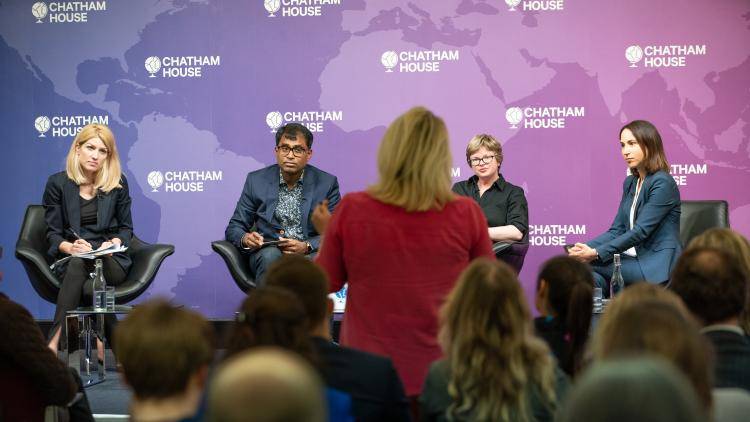
Hi, good morning to everyone at Chatham House, and those of you joining us online around the world, and welcome to this discussion about how Asia’s economies are responding to Donald Trump’s tariffs, and the broader shifts in the global geoeconomic order. My name, for those of you who don’t know me, is Ben Bland. I’m the Director of the Asia-Pacific Programme here at Chatham House.
President Trump’s return to the White House has blown new clouds of uncertainty over Asia’s economies at an already difficult time for many. I think it’s fair to say that protectionism was already on the rise around the world. Growing tensions between the US and China have cast doubt, I think, on the sustainability of Asia’s economic model, which relied up to now on good relations with both Beijing and Washington. And we know that China’s own economy has been facing its own increasing cyclical and structural challenges.
Trump’s initial reciprocal, and many other tariffs, hit Asia pretty hard. He’s since delayed imposing many of the tariffs until July, and he’s reached a temporary trade war ceasefire with China. But many Asian officials, I know from my travels to the region and other conversations, are still scratching their heads, like the rest of us, about what will come next, and with such a murky outlook, many private investors are sitting on their hands, thereby not delivering Trump or anyone else the boost that they want from some of these protectionist measures we’ve seen.
So, what can Asia do about Trump’s economic policies, and how far will he upend the model that’s brought peace, prosperity and stability to a region that’s the engine of global manufacturing and global growth? I’m joined by a great panel today to discuss this all. Down the line, we have Tengku Zafrul Abdul Aziz, who is Malaysia’s Minister of Investment, Trade and Industry. He’s been in office since 2022 and previously served as a Finance Minister. Before politics, Minister Zafrul was a prominent Banker, and investor in Malaysia, and in addition to his government service, he’s recently secured the far more important, at least from Malaysians’ perspective, job of President of the Badminton Association of Malaysia. So, yeah, good evening to you, Minister Zafrul, and thanks for joining us.
Tengku Zafrul Aziz
Good evening, Ben. Thank you for having me.
Ben Bland
Joining me as well on stage, I’m lucky to have two top colleagues. Next to me is Yu Jie, who’s our Senior Research Fellow for China, and next to Yu Jie is David Lubin, who’s a Senior Research Fellow in our Global Economics and Finance Programme. Before we get going, a quick reminder that this event is on the record and it’s being recorded and livestreamed. I’ll quiz our panellists for about 35 or 40 minutes, and then open up to questions from our audience, in person and online. If you’re on Zoom, please use the Q&A box to ask your questions and do get them in now, because I will feed them into the conversation as is relevant.
So, Minister Zafrul, I’m going to come to you first. Thanks again so much for joining us. I know you’re busy travelling around the world, you’re negotiating with the Trump administration, you’ve just been in Saudi Arabia. How difficult is the economic outlook at the moment from Malaysia’s perspective?
Tengku Zafrul Aziz
Well, first of all, thank you, Ben, thank you again, and the rest of my fellow panellists. Yeah, you’re right, I just came back from Riyadh, and before that, I was in the APEC meeting in Jeju in Korea for the Minister responsible for trade. For Malaysia, we are very much an open economy. As, you know, we look at our trade to GDP is about 180%, and obviously the Liberation Day has – will impact Malaysia’s GDP growth. For 2025, we are projected to grow, in terms of GDP, between 4.5 to 5.5%. That’s before the announcement by Trump administration and by Trump on the reciprocal tariffs.
So, now we are reviewing that, we’re still waiting for more information, we’re doing some sensitivity analysis. At the same time, as you said, Ben, we – I’m also leading the delegation in terms of negotiations with the Trump administration, so we’re waiting for that. We – well, we have a 90 day pause for now, but definitely if you ask the Analysts, you can see that they have revised the projection for Malaysia GDP by about 100 basis points, and for us, for the government, the Central Bank and the Ministry of Finance is reviewing our GDP forecast and it’s definitely going to be revised downwards, given the uncertainties and the impact – and the possible impact of the reciprocal tariffs.
Ben Bland
And what’s your sense, just looking a bit more broadly, like, where is this coming from? Do you think this broader shift towards protectionism is just about President Trump, or is there something deeper, either in America or in, kind of, the world economy, in our societies, that’s driving this broader shift?
Tengku Zafrul Aziz
Well, in your opening just now, Ben, you said this is not something new, and I somewhat agree with you, and you’ve seen that even during Trump 1.0. And if you look at global FDI, it has been declining since. But for ASEAN, it has bucked the trend, and ASEAN FDI has gone up, and why is that? I think one of the reason is companies have already started to realign their supply chain, you know, they – when they redesigned their supply chain, according to the geopolitics and the geoeconomic circumstances that they face, right?
So, Malaysia and ASEAN, and, you know, if you look at ASEAN centrality and ASEAN neutrality, it’s in a good spot where companies can then realign their supply chain to the region, and we’ve seen the global FDI going down, but FDI into ASEAN going up. And you’ve heard about this China Plus One, you know, Taiwan Plus One, everybody plus one, and somewhat – Malaysia, Indonesia, Thailand, Vietnam, of course, Singapore, have all been net beneficiary of this. So, you’re right, it’s not new, but whether it is here to stay, I think, well, your guess is as good as mine, Ben. But, of course, Malaysia, you know, I just – like as I mentioned to you before this meeting, we just – I just called for ASEAN Economic Ministers meeting before this call, where I chaired three meetings. One with the Chinese counterpart, Minister of Commerce of China, and then after that the Minister of Economic Trade and Industry of Japan, and then after that, Minister of Trade for both Australia and New Zealand. And all of us in that call, again, reiterated our prin – position in supporting the rules-based trading mult – rules-based multilateral trading system, with WTO at its core.
Ben Bland
Great. I think we’re going to come back to those questions about regionalism, about ASEAN, the Association of Southeast Asian Nations, a bit later. I want to turn to the other panellists now, maybe get a perspective from you, Yu Jie, first on, sort of, China’s, sort of, initial responses. We obviously saw this – I mean, I guess I called it a ‘temporary ceasefire,’ some people – I think Trump’s called it a ‘trade deal with China.’
Dr Yu Jie
Yeah.
Ben Bland
I mean, how do you think China has managed the first, kind of, few months of Trump on the economic side?
Dr Yu Jie
Hmmm hmm.
Ben Bland
And, you know, how does it feed into their broader thinking about, you know, the next few years of economic relations with America?
Dr Yu Jie
Well, thank you, Ben. Delighted to be here and share the panellists with several other experts in here. Obviously, the two ‘D’ words in here when it come to trade war after Liberation Day, the one was ‘détente’ and then the other one is ‘defiant.’ I think Beijing has chosen the latter, stay defiant. And obviously what Beijing has learned from Donald Trump first term, it is to offer that sense of maximum pressure to your opposition. So, what Beijing has done is actually borrowed the playbook from Donald Trump himself and given a maximum pressure from United States, and in order to make Donald Trump and his fellows come to the negotiation table.
Now, Donald Trump used the term ‘trade negotiation.’ I think if you examining the public statement put forward by the Chinese, they’re very califi – carefully by saying, ‘We’re glad this talk has now began in – began taking place in Geneva,’ which happened two weeks ago. So, China does not necessarily consider this is some, kind of, negotiation already took – take place, but only consider as being an initial getting in touch and getting to know each other and who to speak with. So, that is one thing.
Now, I think, secondly in here, Beijing is convicted that even if we’re going to have a permanent ceasefire on trade front – o you used the term ‘temporary ceasefire,’ and I would rather call this current period as a ‘truce.’ And then even if we come up with a permanent ceasefire, and what we’re going to have is we’re going to have a very weak trade agreement between Beijing and Washington. And Beijing clearly knows that Donald Trump may not really honour such agreement and may not keep the promises, as he’s been – he taking, like, the sense of unpredictability as a virtue, but not as a vice. So, that is another element.
So, Beijing would believe that even if there’s a agreement, so everything may not be agreed by Trump overnight, this leaves Beijing very little choice. So, the choice is that in the past, the model has been run through the Chinese economy, largely led by export-orientated high-end manufacturing to United States and Europe, and I think that model has already gradually shifting. And if I remember the data correctly, I think really by the end of 2022, ASEAN replaced the European Union as the largest trading partner with China. So, I think really, Beijing has learned from back to 2018 onward, trying to diversify its destination of exports, and try to also diversify its source of purchasing on agricultural products, which is absolutely essential for the Chinese population. And also try to diversify its source of purchasing on raw material that would fuel the Chinese economy. So, that is more on the preparation end.
Now, when it comes to the offensive end, I think what we have seen so far is that Beijing has now become more likely to use a very stringent export control on the critical minerals, which is something that Beijing know it has the upper hand in this. So, what I’m going to expecting and envisage is that Beijing will carefully examine the trade agreement between United States and a third country, and if they have discovered any elements that would actually harming China’s interest, and I think Beijing will go after third country at same time, and particularly to make the – those companies doing business with China more difficult, and have more stringent rare earth mineral control, as well. So, I think this is short-term.
Now, the longer-term, obviously there has been large debate within China whether to offer CTMLS and how far the CTLMS will go. But I think overall the target will be given to the lower to middle-income groups and offer them extra consumption vouchers, offer them extra income and income helps to large extent, because these are the core supporters of Xi Jinping. So, many things that perhaps make economic sense in here, Xi Jinping is consider in the political terms. Now, so far, he felt optically, he felt he has – now has the upper hand on this trade negotiation with Donald Trump and somehow to – at the domestic end, and he felt he has actually consolidated his power, both within the party, but also in the wider public, yeah.
Ben Bland
I think we might have to come back to that question later of whether China’s really diversifying its exports, ‘cause I think when you look in the data, actually, a lot of the exports to Southeast Asia are intermediate goods and machinery that are then being used to manufacture products that are being exported, ultimately…
Dr Yu Jie
Yeah.
Ben Bland
…to the US and Europe anyway. So, if the real ambition of the Trump administration is to, sort of, break up the China manufacturing machine, then presumably you would have to break up the linkages between China and other manufacturing centres, as well, but we can come back to that later.
So, I want to turn to you, David, to get the, kind of, broader perspective when you’re thinking and looking across the region. I mean, there was obviously this initial panic when Trump announced the very high reciprocal tariffs. Then there’s been a, sort of – this, kind of, strange relief, almost too much relief, when there was just a pause on the tariffs. But how do you think governments in particular – we can get onto the markets maybe, as well, in the second, but how do you think governments in Asia have responded to this challenge? Do you think they’ve taken it seriously enough? Do you think they’re just hoping it all somehow goes away after July, and do you think that’s realistic?
David Lubin
I think – I mean, governments, the corporate sector and financial markets each have, kind of, different responses to the period of uncertainty that we’re now in. I think for governments and corporates, uncertainty creates paralysis. You know, what can you do when the framework within which you’re making policy decisions or investment decisions is so completely in the air? And, of course, you know, the Minister and his counterparts are all in the process of, kind of, trying to minimise the damage. I suspect that that damage will be minimizable, but not eliminable, if you see what I mean.
And I think that from a financial markets’ perspective, what slightly worries me is that the market has, kind of, taken the pause to heart, too much to heart. So, you know, on the 9th of April, we had this, kind of, 90-day extension. In a way, from the 9th of April until the weekend – last weekend’s agreement, or the weekend before’s agreement, with Beijing and Geneva, we’ve seen this, kind of, extended period of Trump pulling back from the worst consequences of the announcements on the 2nd of April. What that’s commonly referred to in financial markets as the ‘Trump put,’ in other words, that there’s a, kind of, floor under asset prices below which, you know, stock market prices and everything else is just too painful for Trump to tolerate, and so that floor is in place.
I think it’s worth considering that as well as a floor on asset prices, there is also a ceiling. In other words, there’s a – there’s – there will be a long enough period of asset price stabilisation, and/or an increase in asset prices that is sufficient to give President Trump the sense that he’s rebuilt sufficient amounts of political and financial capital that he can then spend that capital by reintroducing disruption. And so, I think that we’re in a, you know, particularly with respect to financial markets, we’re in a, kind of, phoney war. This isn’t a new equilibrium. It’s just a period of calm before the reintroduction of volatility.
And I think that that’s true because, you know, the central objective of the reciprocal tariffs is to cut through what the Minister described as ‘realigning supply chains.’ What the Minister describes as ‘realigning supply chains’ is what Washington sees as tariff arbitrage. In other words, you know, either goods being rerouted through Southeast Asia and other countries, but mostly Southeast Asia and India, as well as a reallocation or relocation of Chinese manufacturing capacity. Both of those exercises, both goods rerouting and the reallocation of manufacturing capacity, which is, you know, one of the reasons why, as the Minister says, FDI inflows to ASEAN have been very robust. The objective of this is to sidestep the – sidestep Chinese tariffs.
And if the reciprocal tariffs didn’t exist, I’m just trying to explain the world from Washington’s point of view, if the reciprocal tariffs didn’t exist, then the Trump administration would need to be engaged in a game of, kind of, tariff Whac-A-Mole. So, you know, if manufacturing capacity moves to, let’s say, Vietnam, our goods are being rerouted through Vietnam, then I’ve got to increase tariffs from Vietnam, and therefore, all of that activity will just be pushed to Cambodia and other countries. So, what, in a way, the reciprocal tariffs are trying to do is to, kind of, cut through all of that, introduce a framework that allows the Trump administration, or gives the Trump administration the capacity to deal with tariff arbitrage, not in one fell swoop, because all of these – you know, this will be a dynamic process, but it gives them a framework to, kind of, address what they see as the, sort of, core problem.
Ben Bland
And from the perspective of Minister, of Malaysian companies, like, how – what do they see the core challenges as being right now? Obviously, as you said, Malaysia’s a really globally integrated, sort of, manufacturing centre. You have – you know, biggest trading partner is China, but you have a lot of major US investors in Malaysia, making semiconductors and many other electronic products. So, you talk to, you know, manufacturers, other companies, all the time, what are they worried about? Is it the tariff rate that you settle on with the US? Is it the, sort of, US–China tensions? Is it the broader environment? What are the core, sort of, issues they’re coming to you to try and solve right now?
Tengku Zafrul Aziz
Well, if you look at Malaysia, and when I talk to the companies, well, obviously, I talk to the companies that are exporting to the United States, what are their main concern? Number one concern will be the uncertainty, you mentioned about that, and they say that it’s very hard to plan investment, plan exports, plan everything, right? And therefore, that is the number one concern. Of course, at the same time, they want us to engage the United States, because if you look at the United States vers – and Malaysia, we have a very strong trade relationship. China is our largest trading partner, but US is our largest export market. So, Malaysia export – the largest export market is the United States, not China. Similarly for investment, the largest investor in Malaysia is the United States, not China, right?
So, US is a very important partner to Malaysia, and if you look at the exports to United States, you mentioned, Ben, ‘semiconductor,’ yeah. 60% of our export to United States is E&E and semiconductor, and out of that 60%, 65% comes from US multinationals based in Malaysia. So, therefore, of course, those multinationals that are based in Malaysia are supported by Malaysian companies. The ecosystem being built over the last 60 years enables Malaysian companies to also participate in their supply chain, so they will also be affected. So, the Malaysian companies, for example, one multinational, let’s say Intel or AMD, or any other big multinational, there will usually be three to 400 local companies supporting that multinational, so they are, of course, also worried.
So, when we talk to the United States, we must also understand what are their concerns? And I think one of my fellow panellist here talked about their concerns, about their supply chain, whether – because when you talk about ‘tariffs,’ it’s also about talking about ‘trade imbalance,’ also talking about ‘economic security,’ right? They want to know, you know, whether the technology that is being exported, the technology that are secure in terms of the rights of – towards the technology, but – so those are the concern about the companies. They are very uncertain about the markets, and at the same time they want us to engage the United States. And given that most of those companies exporting to United States are American companies, they themselves have offices in Washington that they also are engaging Washington on this.
But the other point that you mentioned correctly just now, I think one of my fellow panellists talked about the fact that we export ‘intermediate goods,’ so that is true. A lot of the American companies exporting to the US are exporting the semiconductor, are basically, intermediate goods. Where the finished goods are actually produced mainly in the United States. So, again, you know, this is important in terms of supply chain resiliency and supply chain security.
Ben Bland
And I mean, I think there’s a broader question here for countries like Malaysia and I think many, many others in the region, that you’ve thrived by being this bridge between, kind of, the US as an ultimate source of final demand, also a source of investment and technology, and China as a source of, sort of, manufacturing capacity, and increasingly, to a certain extent, demand as well. But in the good times, when relationships between Beijing and Washington were positive, that was a great place to be. But we know that, you know, this US–China competition is not just about Trump, you know, it predates Trump, and it obviously continued through the Biden administration, and it’s being driven on the Chinese side, as well. So, how secure do you think countries like Malaysia can feel in the model you have, thinking about the next, not just the next four years, but the next ten/20 years ahead? Do you think you are going to come under pressure to, sort of, make choices about who you side with economically? And do you think that, you know, you’ll need a different model that isn’t so reliant on both the US and China, going forward?
Tengku Zafrul Aziz
Ben, I think it’s a combination of both. We have already understand the concerns of both – understood the concern of both. In the last five years, we have started to diversify, to mitigate that risk. We can’t eliminate that risk, we can’t eliminate the impact, and you can see that even today, as we mitigate that risk through accessing new markets. That’s why we are in the midst of concluding Malaysia UFTA, we just concluded Malaysia UAE FDA, we’re going to announce at Malaysia GTC FDA next week. And we’ve seen, you know, the total trade to Malaysia and US is around 11%, right, and Malaysia trade with China is about 12%. So, both is less than a quarter of our total trade with the rest of the world, and that number is declining, right, despite the absolute term going up.
So, it shows that our diversification strategy is working, we also request to be members of other blocs, economic blocs. I think, you know, which blocs we are talking about, we are talking about BRICS. We are also members of 17 FDAs – we signed, sorry, 17 FDAs, both bilateral and multilateral, you know, including the l – CPTPP, ASEAN, etc. So, that is definitely something that we will continue to do, and supporting our companies, as well, to get that market access through our relationship with – to other countries and other economic blocs. But one must not forget ASEAN itself, I think Malaysia took this year Chair ASEAN – even trade within ASEAN is less than 25%. It’s – today intra-trade within ASEAN member states is around thir – 23%. That shows the opportunity to increase that. So, yes, we need to do more with other countries and we need to do more with our neighbours, as well.
When we look at other issues regarding trade, definitely there are concerns. One cannot deny the fact that sometimes people assume that Malaysia or Singapore, any third country, will have to make a choice between United States and China. But let me say this, in my negotiations with the US, there’s never been one case where US said you have to choose, right? You know, but we know, we understand that the concern is more on the supply chain and on economic security. So, we need to ensure that technology safeguards are in place, we – maybe there are issues about supply chain and not – ensuring that that supply chain is secure, right, especially in technology, or in areas like pharmaceuticals.
Ben Bland
Okay, I think we, yeah, we might come back to this question about ‘trade deals,’ but I wanted to come to you, David, on this and, sort of, broaden it out a bit, to think about how countries have been responding and, you know, whether it’s enough. So, you know, the – I think the Minister mentioned, sort of, defending the rules-based trading system, but in practice, we’ve seen a lot of countries, including the UK and Malaysia and many others, sort of, making their own ways to the White House trying to cut deals. So, on one hand they talk about, sort of, ‘upholding the system,’ on the other hand, there is a, sort of, bilateral, almost beggar thy neighbour approach to get your own, sort of, exemptions from Trump. So, do you think countries are doing enough to, sort of, maintain an open rules-based system? And is that even possible, to be honest…
David Lubin
Hmmm.
Ben Bland
…when you have the world’s biggest economy, sort of, checking out of the system?
David Lubin
Yeah, I mean, I think a lot of the answer to your question depends on who can replace the United States as the importer of last resort. You know, the US is just saying, ‘We do not want to be the importer of last resort anymore.’ Now, maybe they’ll fail in implementing that vision. It’s quite possible, because at the end of the day, the US trade deficit is not a function of what Trump wants, it’s a function of the difference between savings and investment in the United States. Very, sort of, deep underlying macro phenomena determine the US trade deficit.
But let’s say the US – let’s say Trump is moderately successful in implementing his vision of wanting the US not to be the world’s importer of last resort. The question then becomes, who is going to take the place of the United States? And that’s a very difficult question to answer. It may be possible to make an optimistic case about Europe, because fiscal policy and monetary policy are both loosening in the eurozone and, you know, the Ge – new German Government is committed to build – you know, spending a lot of money on infrastructure and defence, as many other European governments are. But the problem there is, a) it’s not going to happen – we won’t see the fruits of that soon, and b) the whole point of the spending is that it should be domestic spending. If – you know, the whole point is for this new spending not to bleed out to spending on other countries’ goods. So, I’m not sure there’s a gr – a very optimistic case coming from Europe in it – terms of its capacity to take the place of the United States as the world’s importer of last resort.
Then the other obvious question is about China. Now, I think the Chinese authorities can be having two equally plausible conversations with themselves. On the one hand, they can say, ‘Well, you know what we need to do? The Chinese economy is currently being faced with a terribly negative external shock. The right way to respond to a negative external shock is to accelerate the disbursement of additional fiscal stimulus to support the economy, to protect Chinese households from the conse – the negative consequences of this external shock.’ And therefore, one way of thinking about the direction of Chinese policy is that there will be more macroeconomic stimulus and that, you know, could erode China’s current account and trade surpluses over time and turn China into the importer of last resort.
I think that’s extremely unlikely, because I think the other conversation that the Chinese are having with themselves is to start by saying, why do we have a trade surplus in the first place? We have a trade surplus partly because the surplus provides a layer of insulation for the Chinese economy. It provides a, kind of, insurance against geopolitical risk by, kind of, keeping the world at a distance from China, by limiting China’s dependence on the rest of the world. And if you follow that line of argument, well, from the Chinese point of view, the need for geopolitical insurance has just gone up, not down. And so, I think that the chances of China, kind of, just saying, ‘Yeah, don’t worry, we’ll be the world’s importer of last resort,’ I think that that’s very like – very unlikely, indeed.
And so the problem is who’s – you know, if the United States really can – if Trump really can implement this vision of wanting to withdraw from the world, it’s very difficult to imagine big economic powers stepping up to that plate, and so the, you know, the – I think the global macro consequence of this is a, sort of, permanent downward shock to global trade growth, a permanent downward shock to global GDP growth.
Ben Bland
What about for China, then, Yu Jie? Presumably it’s similar. I mean, what is the alternative to the US as the source of final demand? ‘Cause it’s all well and good to talk about ‘Global South’ and forming new partnerships with other countries, but how many, you know, small developing countries do you have to increase your exports to before you can get to the, kind of, demand you can tap in the US in one, sort of, massive unified, you know, super wealthy market? So, in a sense, sort of, Trump’s, sort of, phoney war is, you know, saying he’s going to push tariffs and imagining there’s no cost, but Xi Jinping is also pushing this, sort of, self-reliance. But I don’t think he’s surely really countenanced the costs of what it would mean if China were ever to be, sort of, denied access to the US market at scale.
Dr Yu Jie
Yeah, I mean, the clear answer is no-one really knows. Firstly, even if we’re talking about tariff as what – where we stand as now between China and United States, I mean, this is still 34% towards each other. So, for any Chinese exporter who want to make a profit and the tariff have to be below 30%, so because the profit margin is earning around between ten to 20% of that tariff. And that means whatever the Chinese exporter does, and even within this 90 days, there’s still going to be a lossmaking in terms of, like, when they come to demand and supply, in that case.
But I think, secondly, judging from Beijing’s end, they don’t see this as something of short-term symptom, but they would rather see this longer-term of respond to United States. As I said earlier, what China has been doing in – ever since 2018 is about de-Americanization. So, when we’re talking about ‘decoupling’ between China and United States, actually, China already entertained that idea well before then. In a way, try to refocusing on the – firstly, the alternative market, but secondly, that sense of technology self-reliance. I mean, David, you were earlier talking about ‘geopolitical insurance’ based on trade and export, but really what I considered so far is the domestic spending, that massive spending on technology self-reliance, on innovation, on domestic innovation, and making the government procurement, in a way, largely focusing on with a domestic manufacturer, and I think that’s really the way forward.
So, in a way, it’s very sad case really. A open trade system, like, a sense of economic globalisation that China embraced in the past, and now they have abandoned themselves. So, I really don’t really see a clear answer whether China can find another alternative to replace United States and EU, but the reality is that the door is shut for China from US and from European Union. As you can see, even after Liberation Day, that China had some hope that could to improve its trading relationship with European Union, and that did not happen. Reason why is because of structural economics challenge between China and EU now, because what China is producing now come across as a compact – conta –in terms of, like, being compatible towards European Union, and also, suddenly become a peer competitor with European companies.
So, that would also rise in term of certain larger size Global South countries, for example, Brazil, that already filing the EV tariffs against China with WTO. So, there’s more trade frictions take place, given what China’s economic model want to be, so there’s no clear answer.
Ben Bland
So, Minister Zafrul, given these, kind of, challenges for global trade, which, yeah, as we’ve all discussed, aren’t unique to Trump, I mean, does a country like Malaysia need to think about a different model going forward that’s maybe less dependent on global trade? If the barriers are going up, you know, around the world, then maybe being this, sort of, connected, global trading manufacturing base isn’t going to be the most sustainable model. So, is this, sort of, trend also going to drive, you know, a place like Malaysia to rethink your economy in the next few years and think about what you can do differently, not just negotiate better deals, but thinking about a whole different structure that’s less dependent on export-led manufacturing?
Tengku Zafrul Aziz
Hmmm. Well, Ben, for Malaysia, we can’t afford to think that way, given the size of our economy. We are not China, we are not US, we are not India, even, you know, we are a population of 34 million people. Even if you look at ASEAN as a whole, with ten ASEAN member states, the entire ASEAN GDP is only US$3.8 trillion, right? So, there’s no way we – that we can change the model in such a way that we become self-reliant on all major critical needs of Malaysia, right? That’s something that I think is not sustainable, and you will, you know – at the end of the day, I believe, and I’m sure my colleagues in my – in ASEAN believe, that we need to support the rule-based multilateral trading system, you know. The principle of multilateralism is here to stay for us, right? And that’s why we talk about ‘Global South,’ we talk about other – you know, worst case scenario, like I said, the world trade with US is less than 15%, there’s still 85% of trade out there.
You know, we – definitely, we need to relook, we need to transform what we have today, may not – it’s not perfect. But to change and overhaul in such a way that the principles of multilas – multilateralism are no longer relevant, I – WTO, there are weaknesses, no doubt about that. So, let’s look at ways to improve, to make sure that WTO continues to be relevant. And I discussed this with the DG of WTO a week ago. I had a meeting with her, and we both acknowledged the shortcomings. We’ve seen what happened in MC13 in Abu Dhabi, and now MC14 in Cameroon, where, again, you know, we need to resolve issues. And, of course, we know the dispute settlements mechanism doesn’t work with the appellate body being what it is today.
But these are things which we – we need. We need to fix things, rather than, you know, destroy what we have achieved so far. I mean ASEAN is growing today at four to 5%, and because at the end of the day, because we are living in a area or in a bloc where there is peace and prosperity, right?
David Lubin
Can I just add? I think I left something unsaid when I was talking earlier, and I think in order – my advice, for what it’s worth, to, you know, to ASEAN and other country – other developing countries, is that if you want to maintain, if you want to uphold the global rules-based international trading order, then I think it behoves developing countries to try and put some pressure on Beijing to start to put its money where its mouth is. And in order – you know, that – you know, developing countries need China to import more stuff from developing countries in order to, kind of, uphold that order, because otherwise, it’s just, kind of, words.
And in a way, you know, Malaysia’s been relatively lucky or skilful, I don’t know, over the last few years, you know, in the sense that in 2017 or betw – you know, between – you know, after 2017, Malaysia’s trade deficit with the – with China has increased by as much as its trade surplus has with the United States. So, in a way, it’s, kind of, square. But other countries in the region have, kind of, experienced different things. You know, Vietnam, for example, its trade surplus with the United States has gone up way more than its trade deficit has gone up with China. And so, the US has all sorts of reasons to be super upset with Vietnam, because it’s kind of, you know, leveraging all of this, kind of, redirection of supply chains.
Thailand, on the other hand, has, you know – so, you know, if you’re Vietnam and your trade surplus with the United States goes up by more than your trade deficit with China goes up, then you attract the negative attention of Washington. Thailand, for example, has seen its trade surplus with the US go up by less than its trade deficit with China has gone up. So, that’s just terrible bad news for the China – for the Thai economy, and so you’ve got different experiences. I mean, I would say Malaysia has, kind of, had the best experience of this, in the sense that you’ve – you know, there’s a, sort of, a balance there, as a result of the fact that the trade deficit with China has gone up by more or less as much as the trade surplus with the US.
Ben Bland
And I want to – Minister, I want – Zafrul, I want to come back to you on the, sort of, the ASEAN question which you mentioned earlier, that, you know, interregional trade is around, you know, ‘a quarter,’ but I think it’s been at that level for some time. You have an ASEAN summit coming up this this weekend. I mean, meaningfully and practically, what can ASEAN do, you know, as a response to what’s happening, to try and boost internal trade and to try and, you know, support fairer trade or rules-based trade, trade that works in your interest, practically? As the Chair of ASEAN this year, what can Malaysia do and what can ASEAN do?
Tengku Zafrul Aziz
Yeah, well, just to pick up on what David talked about on the need for China to import more from countries like ASEAN. One of the things we’re doing, in fact today, during our meeting, our ASEAN meeting, Economic Ministers meeting with our counterpartner, Mr Wang Wentao, who’s the Minister of Commerce for China, we all agreed that we will conclude – and in fact, we just concluded at the chief negotiation – negotiator’s level, at the working level, on the upgrade of the ASEAN FTA with China, right? There’s a – we have today the version 2.0, so it’s upgraded to version 3.0, that I – we hope will increase ASEAN’s exports to China.
But for intra-trade with ASEAN, what is happening today. I mentioned the GDP size of ASEAN is US$3.8 trillion, and we look at the population of ASEAN today, it’s close to 680 million people, of which we look at the number of those who under the age of 30 is 50% of that 680 million people, so it’s growing. But if you look at the companies, they are mainly SMEs and micro-SMEs. So, to encourage them to trade outside their domestic comfort zone, you require support, capacity building, etc., but e-commerce is one area where we feel that it will help for trade to be more inclusive.
So, we are in – at the final stage, and we hope by October, when the leaders meet again, we can conclude the Digital Economic Framework Agreement, we call it DEFA. Which is first of its kind for a economic bloc, where we will increase the participation of many companies in the intra-trade within ASEAN. Where we, you know, we have the rules, the guidelines, and also the payment system etc., to encourage more companies to trade. And this we hope will increase intra-trade within ASEAN, because many of companies within ASEAN and are SMEs and micro-SMEs.
Ben Bland
I mean, in addition to ASEAN, Malaysia’s also in the CPTPP, this Trans-Pacific trade agreement, which the US, sort of, orig – was originally pushing, and then belatedly pulled out of, the UK joined, as well. I mean, do you think in terms of scaling up these efforts to support sys – the trading system, that, you know, you should be looking to expand CPTPP, or at least deepen co-operation with other big trading blocs like the EU? I know that the Singapore Prime Minister and New Zealand Prime Minister, who are both CPTPP members, recently discussed with the EU ways to co-ordinate on global trade. So, yeah, do you see the potential for doing more, I mean not just for – as ASEAN, but as a member of CPTPP, to combine or work together with the EU and other blocs to try and get some scale in these efforts?
Tengku Zafrul Aziz
Yeah, definitely. In fact, today, we discussed that, and as you know, UK is now also member of CTPP and now UK and AS – have has got an agreement with the EU as well. I’m not sure what happened to Brexit. But – so we – when we look at, you know, this – like it or not, what’s happening today has actually accelerated some of that discussions. EU and CPTPP, ASEAN and CPTPP, because many ASEAN members were also CPTPP members. Also RCEP, Regional Comprehensive Economic Partnership, frame – agreement, RCEP, you know, comprised of ASEAN plus China plus Korea plus Japan, Australia and New Zealand. So, how do we increase membership of that?
CPTPP itself also increasing membership, with many new countries and new applicants, and we just approved one, Costa Rica, now going through the process. So, we all are looking at using the current multilateral platform, or multilateral agreement, that we have on trade and bringing new members in. At the same time getting blocs, one bloc – one economic bloc to talk to another economic bloc, and that’s happening at a much faster pace than ever before.
Ben Bland
That’s good to know. I’m going to come to your questions in the room and online in a second. So, please, yeah, do you get thinking here and put your questions online in the Q&A box. I just want to come to you, David, and ask, we’ve talked a lot about, sort of, the downsides of the current situation, are there any winners? I mean, India often, sort of, paints itself as a winner in this world, a, sort of, transactional country that’s been quite protectionist and has a huge labour force and big technology sector. You know, they like to think they can win out of, sort of, US–China tensions and decoupling and tariffs. I mean, do you see India as a winner in in the trade tensions right now, and do you see any other winners, either companies or countries or individuals?
David Lubin
If India is to be a winner, it’s got a lot of work to do, I think. The manufacturing sector has been declining as a share of the economy for the last 20 – you know, 15 years or so. I think back in 2010, manufacturing was 17% of Chi – Indian GDP, now it’s 13% of GDP. There’s been this utter collapse in foreign direct investment flows into India in the last few years. You know, back in 2020 net FDI inflows into the Indian economy was about $50 billion, last year it was less than $10 billion.
So, there’s, you know, there’s – on the one hand, there is this, kind of, you know, very positive Indian story and there’s clear desire on the part of Modi to establish India as a, sort of, manufacturing hub. And, you know, the Production Linked Incentive scheme was a, sort of, central part of the effort to, kind of, support India’s aspirations as a manufacturing hub. It just doesn’t seem to have worked very well. And now there’s an additional headwind because Trump has kind of, you know, noticed that the – a lot of iPhones are going to be produced out of India and he wants them being produced out of the United States. And so, there’s, you know, there’s a lot of disruption that the US is capable of injecting into all of this.
I mean, I think, India should be able to take advantage of this. The question is, a) if India wants to be a manufacturing centre, whether it can implement policies designed really to attract manufacturing capital to India. Which seems to be doubtful at the moment, given this extraordinary and weird decline in foreign direct investment flows into the economy in recent years. But there’s also a, kind of, more fundamental question about whether India should be prod – you know, supporting or, sort of, focusing on manufacturing as the be all and end all of what it takes to lift incomes. Maybe it’s services that India should be focusing more on, or maybe it’s some, kind of, you know, more balanced basket of manufacturing and services. You know, Modi does seem to have, in ver – in a way, very similar to Donald Trump, a, kind of, manufacturing obsession.
There is this sense in which, you know – I mean, and ultimately, I have to say, this is dif – a point difficult to separate from concerns about national security, national defence and, ultimately, about being able to win wars. You know, a number of administration officials express the view, you can’t win wars if your economy is based on advertising revenue from Google. You can only win wars if you – you know, if you’re manufacturing steel and manufactured goods. And I think that helps to explain the Modi obsession with manufacturing. And so, you know, in a way, the more countries like the United States and India obsess about bringing manufacturing into their economies, the more I worry about the state of the world.
Dr Yu Jie
Can I just add in that? I mean, based on what we’ve discovered lately – we co-author, together with my colleague, Chietigi Bajpaee, on China–India paper. One thing what examined quite interestingly is, India’s economic boom, and particularly on the manufacturing, actually largely rely on China…
David Lubin
Hmmm.
Dr Yu Jie
…because India taking the so-called ‘demographic dividend’ than compared with the Chinese, and that’s one thing. Now, secondly, when it come to manufacturing, and I think there’s three factors we shall remember in here, first is manpower, and secondly is infrastructure, and thirdly is national resource. Now, China have the three…
David Lubin
Hmmm.
Dr Yu Jie
…quite right in the last two decades or so, and if you look into India, the infrastructure is not to be there. The manpower for sure…
David Lubin
Hmmm hmm.
Dr Yu Jie
…but when it come to natural resources, how you devise those natural resources at the…
David Lubin
Hmmm.
Dr Yu Jie
…added sectors which at need and – and is nowhere to be found.
David Lubin
Yeah, that’s…
Dr Yu Jie
So, I think that’s the differences…
David Lubin
…a very important point.
Dr Yu Jie
…between China and India, yeah.
David Lubin
Very important point. Just to add…
Dr Yu Jie
Hmmm.
David Lubin
…you know, you know, one of the things Modi was good at doing was spending public money on infrastructure. But that seems, you know, under, you know, fiscal constraints and other things, that seems to be, kind of, you know, a, sort of, diminishing force in the Indian economy. So, that, you know, in order to be optimistic about the Indian economy, one of the things you need to, kind of, be able to rely on is the idea that the private sector will take up the slack in capital expenditure that is left over – that is left by the government, you know, relying less on CapEx as a, you know, source of public spending. And I’m not sure that risk – that animal spirits in the Indian economy is sufficiently robust to be confident about private sector CapEx.
Ben Bland
Okay, alright, well, it’s now time for your questions, so, yeah, please put your hand up if you have one and just tell us who you are, any affiliation, and please make it a question, not a statement. We’ve got one at the front.
Caroline Smith
Thank you. My name is Caroline Smith, I’m a student at SOAS. Japan has been a key ally for the United States, and after Trump’s tariffs against Japan, what does the future of that allashi – allyship look like, and how does that affect the balance of power within Asia?
Ben Bland
Do you want to take that, David?
David Lubin
Well, my view, for what it’s worth, is that the only way to, kind of, impose some sort of rational structure on Trump’s vision of global order is to consider the idea that he’s, kind of, breathing new life into the Monroe Doctrine, and that what he’s aiming for is an international order based on spheres of – regional spheres of influence. Now that doesn’t make the US administration indifferent to what goes on in the rest of the world. You don’t retreat behind your regional – you know, once you’re the regional hegemon, and that’s – you know, for Trump that means, you know, that explains his obsession with Greenland and Canada and Panama and all the rest of it, once you’ve established yourself as the regional hegemon, International Relations Theorists like John Mearsheimer argue that that’s not enough.
What you need to do in addition to establishing yourself as the regional hegemon is to make life difficult for the other regional hegemons. Which is why he, you know, he’s, sort of, pivoting to Moscow to try and prize Russia away from China, and I think that’s why, you know, the State Department, for example, has adopted a more, kind of, aggressive, rhetorical stance on Taiwan, for example, you know, on – in terms of the statements on its website.
But I think the fact is that it – well, difficult in my mind to get away from the idea that if Trump is moving towards an international order based on regional spheres of influence, that does, kind of, pose an existential threat to Japan, to Korea, to Taiwan. And I mean, I don’t know how to develop that thought further, except to make the point that if I’m right in thinking that there’s at least a tilt towards an international order based on regional spheres of influence, that in a way, by definition that that makes the US–Japan, US–Korea, US–Philippines, US–Taiwan relations much more fragile.
Ben Bland
And in a way, Yu Jie, wouldn’t that all be, sort of, in line with Xi Jinping’s vision of a, sort of, Asia for the Asians?
David Lubin
Hmmm hmm.
Dr Yu Jie
Well, I mean, that’s very much in line with Xi’s vision, but whether – I think it’s – it’s not depend on himself, but also largely depends on the recipients of those economies, whether they buy into that line.
Ben Bland
Hmmm.
Dr Yu Jie
I think what we have so far is we have this enormous largely size of the economy and is able to producing many things and desperately looking for customers. So, I think that’s the challenge for Xi Jinping and his cabinet, is where to find the next customers that is would buy in large bigger than United States and sustainably have that level of sustainable interest of buying things. And so far, I think that customer is somewhere on the guard and nea – nowhere to be found…
Ben Bland
And…
Dr Yu Jie
…so, yeah.
Ben Bland
…and, Minister Zafrul, for Malaysia, on – economically, does a, sort of, Asia for the Asians model – I mean, I know some of your former leaders in the past, like Mahathir, have talked about this too, is that appealing for Malaysia, kind of, economic spheres of influence, you know, regional development, regional growth, rather than global?
Tengku Zafrul Aziz
I think it has to be both, yeah. You know, Mahathir last time look at the Look East Policy, right? And we add China for the Look East Policy. But, you know, we’re talking about, today – in fact, yesterday, our Prime Minister, Anwar Ibrahim, talked about the ‘Global South,’ right, ‘working together.’ So, it’s about countries just at a different stage of development, different stage of growth, working together. We –I think we discussed this earlier about developing countries, as well.
So, it’s about, you know, understanding where everyone stands at that particular cycle of growth. You know, you look at GDP per capita, you look at GNI per capita, where are we today? And so, let’s – you know, we all face the same challenges in a way, but at the same time, we also need each other. So, to me, it’s, again, you know, I don’t believe in Asia for Asia. It’s – we all live on the same planet.
Ben Bland
And another question for you, Minister Zafrul, from online, from Francisco Perez Gonzalez, who’s asked, ‘In particular, what role is there for the WTO?’ You – I mean, you mentioned some of the limitations to the appeals process. So, what can the WTO do, and its members, right now, at the moment, to support the system in practical terms?
Tengku Zafrul Aziz
I think, Ben, I need another two hours to explain.
Ben Bland
We’ve got about five or six minutes, but yeah, hopefully quicker than that.
Tengku Zafrul Aziz
Yes, of course. I mean, I’ll give you a very brief answer. I mean, we have seen – to be fair, America or United States is still a member of WTO, right? That’s positive, right, in the dialogue. Even APEC that we just had a week ago in Jeju, in Korea, United States still a member of APEC, and US Trade Representative, Jamieson Greer, turned up at the meeting. So, everyone is still there. That means everyone still believe that WTO, or multilateral platform like WTO, still has a role to play. It’s just, like, what is the role and how effective is that role today? And can that role be made relevant to the archi – the global architecture, or global economy architecture, today?
So, I think if we make it relevant, it – and we get everyone to agree. I mean, and I will not name countries here, but, you know, United States is not the only country that always have something to say when we discuss about new ideas or new proposals on WTO.
Ben Bland
And any thoughts, David, from your perspective on what can be done about the WTO?
David Lubin
Not really. I mean, I think it’s difficult, I think – and this is a slightly depressing point, I depress myself making this point, that…
Ben Bland
And it’s before lunch, don’t make us too depressed.
David Lubin
Ah, lunch, that’s made me feel better. That when we talk about the ‘rules-based international order,’ at the end of the day, it’s difficult to talk about that over the last 80 years without talking about the US power that has underwritten the rules-based international order. So, when you take US power from underneath the rules-based international order, it’s very, very difficult to hold it together. I mean, I completely understand the desire of countries in Europe, in Asia and the rest of the world, in Canada, and, you know, everywhere, to, kind of, cobble together some framework to hold it up. But it – but all I’m saying is a, kind of, descriptive point, or an analytical point, that it’s a very difficult thing to achieve when it’s been US power that’s been, kind of, the basis for that order for 80 years.
And in a way for, you know, for people who want the – to make the WTO work, to make all the other institutions of the order work, it, kind of, behoves those countries to bear in mind this, kind of – the shock to the system that has been created by US withdrawal and the need to find some way of recreating realpolitik underpinning for the – for the world order. Because that’s, you know, it’s underpinned by realpolitik…
Ben Bland
Yeah, I think…
David Lubin
…and ultimately by military power.
Ben Bland
That’s a really good point, and I think there’s often this false dichotomy, people talk about the ‘rules-based system,’ and say, ‘Is it – was there really a rules-based system or was it just American hypocrisy?’
David Lubin
Yeah.
Ben Bland
But, in fact, it was both, like you say.
David Lubin
It wasn’t…
Dr Yu Jie
A member of both, yeah.
David Lubin
…called the ‘Washington consensus’ for nothing.
Ben Bland
Exactly. Yeah, we have a question over here.
Arnab Das
Thanks. Arnab Das from Invesco. I mean, I wonder, you know, what you’re both saying, what everyone’s saying actually, sounds suspiciously like the US is still the indispensable nation. And so, if that’s correct, then I’d be interested in your thoughts on an alternative interpretation than that the US is withdrawing and becoming – or maybe becoming a regional sphere of influence, a Donroe Doctrine, kind of thing.
And so, that would be that 80 years ago, it, sort of, made sense for the US, as a very large, very rich economy and very secure, to offer security guarantees to the rest of the world – to much of the rest of the world, and access to its domestic market in exchange for alliances. Now that no longer makes sense because the US is not so much larger. In fact, in terms of manufacturing that wins wars, it’s much smaller than China in particular. So, actually what’s going on is a, kind of, unilateral rewriting of that grand bargain, and what it consists of is, ‘I’ll give you security guarantees, you give me access to your markets and you give me investment in mine.’
And that’s a deal that you can strike with China, maybe not, but with Japan, probably yes. Maybe with Europe, maybe with the Middle East, India, probably not, or, you know, there’s some, sort of, deal that you can work out with several of these countries, but not China, right? So, therefore, that’s the world that’s on offer now, and if the US is still the indispensable nation, then, ultimately, other countries are going to sign up to that deal, other than China. What do you think of that proposition?
Ben Bland
Minister, did you want to come in there?
Tengku Zafrul Aziz
Well, again, you know, for Malaysia and for ASEAN, we have always stated that no-one is indispensable, and therefore, we are going to be friends with all. But definitely, the US is – well, like it or not, I mean, they – if I’m not mistaken, I’m not sure what the latest figures are, but I believe it’s about 25% of global GDP, United States, right? Around there, I don’t know. I think maybe David and Yu Jie, you know better. It’s a quarter of the – but – so, in that sense, if you look at the size of the US economy, obviously everyone wants to engage the US, right? But at the same time, there will be limits.
In democracies like Malaysia and many other countries, we have – we are also answerable to our constituents, right? I will not be sitting here if I agree to everything the United States want. I’ll be kicked out in the next general election. And we’ve seen the impact on elections in three countries, right? You’ve seen intra – backlash in Canada, in Australia, even in Singapore, right? So, there will be a point where any countries, be it US or China, just like Malaysia, or even the UK or EU, we will have to put the interests of our country first, coun – the interests of our people first, right? So, there I think it’s not as straightforward as it may seem, Ben.
Ben Bland
Yeah, thanks. Yeah.
Dr Yu Jie
Yeah, okay, I think, similarly, what has happened in the last, let’s say, three or four decades or so on US-China is largely based on this whole idea US providing security across the world, and China come in as the commercial player and having that sense of economic statecraft, and working under that security architecture. But at the moment it seems to be that existing ar – security architecture is winning. And China by no means, with no interest, in extended and overstretch itself into the regions and areas which are little known to be the Chinese and Chinese policymakers. So, what we have seen so far is a withdrawal of a superpower, and another reticent superpower at the same time, and potentially quite dangerous, because that would left a security vacuum in this world and no-one would really want to take care.
And I’m not expecting the Chinese will come in sooner or after, for example, given the what happened with the Middle East that China would come in as more active mediator, and so and so forth, in order to secure its commercial interest. But I think, ultimately, we’re going to be facing a multipolar world, and that each of country picking sectors they prefer to be aligned with, not exactly aligned and totally with one way to another.
Ben Bland
I think the Minister’s had to rush off to another meeting, I believe…
Dr Yu Jie
Ah.
Ben Bland
…but David, I think 30 seconds…
David Lubin
Yeah.
Ben Bland
…left for you to answer this question.
David Lubin
I think it’s a very interesting framework. The thing about the framework that worries me is the US ability to attract manufacturing capital back to the United States. It is extraordinary – you know, the US – I don’t know what the phrase is, what the term is, for the envy that one has for one’s enemy. But clearly the US wants to turn its trade deficit into a trade surplus. It wants to turn its economy from a consumption-based economy to a production-based economy, from a services economy to a manufacturing economy. In other words, what Trump wants is for…
Dr Yu Jie
Trump wants…
David Lubin
…the US economy to look…
Dr Yu Jie
…a China.
David Lubin
…a bit like China, right? The problem though is that the toolkit – he would – he wants what China’s got, but he doesn’t want to use the toolkit that China relied on to get there. In other words, he rejects the idea of subsidies and the process of dismantling the IRA, and the Chips and Science Act, and the Infrastructure Investment and Jobs Act, because he thinks that tariffs and deregulation and tax cuts and a weaker dollar are going to be a sufficient set of tools to bring manufacturing capital back to the United States. a) that’s cr – I think it’s just nonsense, and b) even if it was the case, even if he could use this toolkit to attract capital – manufacturing capital back to the States, it’s not going to support US jobs.
The US manufacturing wage is $60,000 a year, the Chinese manufacturing wage is $15,000 a year. And in spite of the fact that you – that ma – China’s manufacturing wage is a quarter of the US, China has, let’s say, 35% of global manufacturing, but it has more than 50% of the world’s industrial robots. So, even with a manufacturing wage at $15,000 a year, China’s commitment to automation is very, very strong. And so, the idea that even if the US was successful in bringing factories back to the US, that that would actually support US employment, I think is just nuts.
Ben Bland
Thanks, well, there you go, China – America wants to be China, but China doesn’t want to be America, but anyway, we’re out of time, I’m afraid.
Dr Yu Jie
The grass is always greener on the other side.
Ben Bland
So, we can continue that conversation later, but please join me in giving a round of applause to all our great panellists today, thanks. And thank you, Minister, for joining us. I know you’ve got to head off.
Tengku Zafrul Aziz
Thank you, Ben, thank you, David and Yu Jie, thank you.