Bronwen Maddox
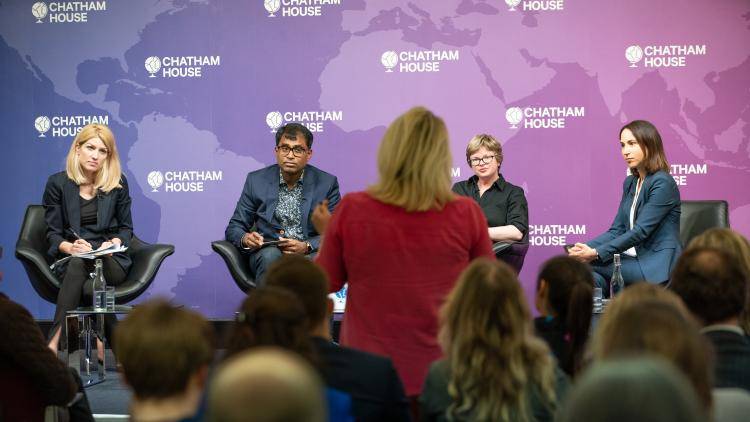
Welcome, everyone, welcome to Chatham House. Welcome to Trump week, if I can put it that way. I’m Bronwen Maddox, the Director. Very good to see you all. Welcome to those of you online. Well, we’re having this discussion this evening, “Global Britain Meets America First,” those obviously being the slogans, at times, of the different governments, “What Next for the ‘Special Relationship’?” That much debated topic, and we’re just ahead, by hours, of the state visit beginning, and so, talking about the transatlantic ties between the US and the UK, really, up to very live questions about deals that may or may not emerge, as well as the wider relationship.
Delighted to have an in-house panel. We start with Laurel Rapp, our – it is her debut here on a panel for Chatham House, as one of us, as the new Director of the US and Americas Programme, and we’re delighted to have her with us. She’s joined us from the US State Department, where she was Director – oh, sorry, where she was Direc – Deputy Director of the Secretary of State’s Policy Planning staff, particularly responsible for the US’s grand strategy, and has also covered the US policy to the United Nations, Europe and the Middle East, in a range of assignments across US Government. And has had nearly two decades of experience at the Department of State, White House National Security Council, the US Senate and non-profit organisations.
It’s also the debut on a panel, not your – it’s not your first time at Chatham House, but again, as one of us, as a Senior Consulting Fellow, General Sir Richard Barrons has joined our International Security Programme within our Global Governance Centre, and we’re delighted about that. And that’s only this month, the – very good to have you with us. He has been many things. I was discussing with him beforehand how he wanted to be described, but most recently, as one of the Authors of the Strategic Defence Review for the UK, which we are still discussing the implications of and that will come up tonight, as well. From 2013 to 2016, he was Commander, Joint Forces Command, now known as Strategic Command. That means one of the six Chiefs of Staff leading the UK Armed Forces, and he described to us beforehand as having, oh, a “post-Cold War career,” but you said, “a decade of the Cold War,” you said, “in retrospect,” you “enjoyed.”
General Sir Richard Barrons KCB CBE
I did.
Bronwen Maddox
And then, covering Bosnia, Kosovo, the Balkans, Northern Ireland, Iraq, Afghanistan. Again, brings us very much up to date; those questions still with us.
And absolutely not a debut for our longstanding eminent Director of the UK and the World Programme, Olivia O’Sullivan, who I don’t even need to reach back into the past before she joined Chatham House but was in the UK Government in development and foreign policy. So, great to have you all here. Let’s plunge straight in with – we’re going to talk about the overall relationship and then, go into the particular trade and economic questions and what might come out of this week, and the security questions. And then, I’m going to come to questions from you all. Let’s start, Laurel, with the overall relationship. How is it going?
Laurel Rapp
So, President’s Trump’s plane, Air Force One, is in the air right now and he’s going to land in a country that has been the bedrock of US Security and Economic Policy for decades, and it’s no different with this administration. So, the US administration has great regard for this ‘special relationship’. It is indeed one based on very deep economic ties that we’ve seen as the, sort of, first big political prize announced, the first trade deal of the “90 deals in 90 days” that the Trump administration announced this spring. Details are still being sorted there, but that was a very big gesture for the value of this relationship. We’ll also see a lot, likely, on tech. The US sees tech as a source of its great strength and power in this AI revolution and the UK is a key piece, in the US’s view, as it seeks to, sort of, build out and continue to build out its capacity, especially as China seeks to do the same.
Look, the – it’s not all good news, though, here. There are a number of areas that will be areas of frustration, concern. It starts on Ukraine and the, kind of, US approach to Ukraine and whether the President will be bringing forward greater US tools to shape Putin’s behaviour, which we have not yet seen to date, and Prime Minister Starmer has, sort of, stepped up in a – in several ways over the summer to nudge the administration in that direction. Gaza is going to be another flashpoint.
The Prime Minister has promised to recognise the State of Palestine next week in New York, and that’s something that Secretary of State Rubio, just a day or two ago in Israel, said would ‘embolden Hamas’. So, there’s going to be a question of how that piece is managed and this is something that the US administration cares very deeply about and is going to not want to have distractions as it seeks to execute its strategy.
Bronwen Maddox
We’ll come onto some of those points, but Donald Trump, when he was here just not very long ago, a couple of months ago, did seem to give Keir Starmer the room to deviate on that particular point. So, whether or not my view, but you can have your own view, but as you said, there’s been words from the administration, other officials, not quite saying that since.
Laurel Rapp
Not quite saying that and there is now a sense that Secretary of State Rubio has said that there are days or “weeks before any deal window closes.” We’ve heard this from past administrations, as well, but these next days are going to be – look, when the world gathers in New York for the UN meetings, there’s typically a flurry of activity in the days leading up. We’re seeing that right now and the UK had a card to play in this because they are stepping forward to take a step that carries some leverage with it.
Bronwen Maddox
And these are the UN General Assembly meetings which start – well, a lot of them going on at the moment.
Laurel Rapp
That’s right.
Bronwen Maddox
And the big one’s the week of the 23rd of this month. Would you say, just to calibrate, if you like, or test the special relationship, that the UK has got a better deal on trade so far, on the tariffs, than other countries, and that’s a measure of this relationship?
Laurel Rapp
So, we don’t really know yet. A lot of the pieces…
Bronwen Maddox
You went as…
Laurel Rapp
…are…
Bronwen Maddox
…far as reaching for it, but I wasn’t quite sure what you were going to say, yes, a deal that may or may not be a deal?
Laurel Rapp
The contours that emerged in May were a five-page framework of what an arrangement can and should look like, and some of those pieces have been operative since June. A lot of them are not yet fully fleshed out yet. So, on UK vehicles imported to the US, there is…
Bronwen Maddox
I’m sorry.
Laurel Rapp
…sort of, a path – there has been a path on that for the past months. But on other pieces, like steel and aluminium, which is a huge, sort of, market share issue to sort through, that has not yet been resolved, as is a host of other pieces. The UK deal is ahead of the curve on almost all of the other arrangements that the Trump administration is working on. So, there is questions coming this week as to whether there will be more clarity on the – both timeline of full implementation, as well as the contours of a lot of these details, which often take years to sort. The average length of a free trade agreement negotiations, so that has been about two and a half years. The US Trade Representative negotiates that. It’s a small team and I imagine that team right now is very pressed and stretched as it works around the world to put together elements of trade deals from Asia, to other places in Europe and beyond.
Bronwen Maddox
And just let me ask you one final thing, whether you think the free speech row is going to surface. So, one of these improbables, I’m sure that Keir Starmer’s team does not want it to surface, but we had the big protests in London at the weekend, the – that being a theme, among others, that those people were protesting against. We know it’s a big passion of J.D. Vance and others in the administration. Do you think it’s going to come up?
Laurel Rapp
Questions of speech are a huge political issue in the US, and we have seen that…
Bronwen Maddox
Particularly after the Charlie Kirk murder.
Laurel Rapp
And this is an issue that the United States, this administration has raised in many different fora around the world, and they have had a range of concerns about UK and EU approaches to content moderation and free speech. I would not be surprised to see that also very much on the agenda on his visit, from the Washington delegation.
Bronwen Maddox
As I said, probably against what the UK contingent would like to discuss this week, because they want deals, which we will come onto.
Laurel Rapp
Yes.
Bronwen Maddox
Richard, I wonder if you could – bring you in now. Well, first, what you think of that and then, we will dig into the defence and security piece. What do you say is the overall state of the relationship?
General Sir Richard Barrons KCB CBE
So, I think the relationship is on the cusp of quite profound change. I don’t think there’s a script to it. I think everyone is feeling their way forward in a very different world, which we – you might talk about. I – oh, you know, the term ‘special relationship’ has been passed around for a long time. As you know, it’s rooted in a couple of hundred years’ of shared history, often quite antagonistic. It’s not a relationship between equals, everyone understands that. My own sense of it is that it’s – the UK likes to talk of it as a ‘marriage’, but it is – essentially operates as ‘friends with benefits’, and everyone, kind of, understands that is the way it works. And…
Bronwen Maddox
Well, that phrase, though, does describe symmetry, which you’re…
General Sir Richard Barrons KCB CBE
Yes.
Bronwen Maddox
…saying is not really the…?
General Sir Richard Barrons KCB CBE
Yes, and I think it’s much more – it has been much more special to the UK than to the US. And, you know, every three or four years, the UK Government asked the – it became known as, “What have the Romans ever done for us?” question about the US. When we were falling out and when you put that in the balance, the US does this for us, and we do that for the US, so it’s special to us. But now, and I’m sure we’ll talk about this, in the field of…
Bronwen Maddox
It’s a phrase you don’t hear a lot in Washington, other than in the gardens of the British Embassy.
General Sir Richard Barrons KCB CBE
Yes. Yes, so it’s going to change now and that’s going to be difficult for both sides, I think.
Bronwen Maddox
It was very striking in the defence review, I don’t want to caricature or simplify it or – it was a long piece of work by you and your colleagues, but the US in that, the portrayal of the relationship in that document, seemed to assume a continuation of the very close relationship, as if any other was very hard to conceive, or – for Britain.
General Sir Richard Barrons KCB CBE
So, the truth of that, bearing in mind this is a document that was written starting in July last year and published in June this year, is that there was a sense that it’d be very good not to provoke a difficult debate about the nature of the special relationship, because clearly, now, in the short-term, for the foreseeable future, it’s really important to UK and European security. And so, us conjecturing wildly about how it might have to be different in the future, on the basis of US policy, that – I don’t think many people wanted us to prod that. That’s for another day.
Bronwen Maddox
And obviously, as you said, it came out just four months after Trump’s inauguration.
General Sir Richard Barrons KCB CBE
Yes.
Bronwen Maddox
It would not have been politic, in some sense.
General Sir Richard Barrons KCB CBE
No.
Bronwen Maddox
It’s a…
General Sir Richard Barrons KCB CBE
And if the – and the review…
Bronwen Maddox
…review on how things might be otherwise.
General Sir Richard Barrons KCB CBE
And the review pivoted profoundly in February this year, largely as a result of Mr Trump.
Bronwen Maddox
Changed in what way?
General Sir Richard Barrons KCB CBE
Well, four things changed in a week, and this was the arrival of the Vice President, and the US Secretary of Defense came, and first of all, it felt like the US were reaching to make friends with Russia over the heads of Europe. That was uncomfortable.
Secondly, it was clear, and the US has been saying this for 20 years, they’re going to do less for European security, but in that week, it felt like it might be now, and it would be a cliff edge rather than a managed exit.
The third aspect of this was we were going to have to spend more money on defence than the government had planned to put in the review, so it changed the financial profile.
Then the fourth, and the one that is much underestimated, is the US said, “And you now have Ukraine, and you will guarantee the outcome in Ukraine, almost whatever that is.” And that meant for UK and other European states, as opposed to planning that you might have to have a difficult debate with Russia in about ten years, when they’d finished in Ukraine and gathered strength, now you’re planning to have it maybe in 2025 or 2026. That’s…
Bronwen Maddox
And so…
General Sir Richard Barrons KCB CBE
…pretty…
Bronwen Maddox
…before we move onto the economy and trade, let me just ask you about that point. What do you think the UK is wanting to get on Ukraine this week and what might it get?
General Sir Richard Barrons KCB CBE
So, the most important thing is that the United States guarantees to underpin with sufficient capability whatever it is that the West is going to do for Ukraine, and that comes down to some very specific capability. It won’t be boots on the ground, but American air power, American intelligence, American technical knowhow and above all, American politics and an American lever on sanctions. All of that provide the foundations in which you can engineer a European operation in and around Ukraine, at the level of deterrence, without which we’ll all be wasting our time.
Bronwen Maddox
And so, we have this preliminary depan – demand I repeated several times, by Donald Trump, including today, as saying, “Well, let’s see NATO cut off its purchases of…
General Sir Richard Barrons KCB CBE
Yes.
Bronwen Maddox
…Russian oil and gas.”
General Sir Richard Barrons KCB CBE
Yes.
Bronwen Maddox
And the most difficult for Turkey, but not easy for European Union either?
General Sir Richard Barrons KCB CBE
Yes, and much as the US have said, “Look, we can’t ask our taxpayers to subsidise 500 million prosperous Europeans any longer,” it was fine in 1949, it’s not so cool now, “why should the US impose secondary sanctions on trading partners around the world, inflict a cost on the US economy, if Europe is still saying we can’t go there?” They have a point.
Bronwen Maddox
Yeah, and they have a point, so I don’t want to quote the outgone UK Ambassador to the US, but did say there was “a kernel of truth…
General Sir Richard Barrons KCB CBE
Yeah.
Bronwen Maddox
…in some of the points Trump makes.” Olivia, let me come to you. First, what you think of the overall relationship and then we will dig into some of these trade questions.
Olivia O’Sullivan
Yeah, thank you. You know, I think the – this government has not done a bad job of managing a very volatile and unpredictable US administration, and we can see that strategy playing out in this state visit. It’s all being carefully corralled away in Windsor, all of the things that Trump personally likes are being emphasised, Facetime with The Royal Family, this kind of thing. So, it’s a bad idea to make predictions at this point, but they’ll probably get through the diplomatic choreography okay. I don’t know what Trump will say in a press conference, but getting through the week and the, kind of, tactics of managing the diplomacy and managing Trump as a personality, is something this government’s been quite thoughtful about. It’s not just the Starmer-Trump relationship. David Lammy, who was Foreign Secretary until a few weeks ago, cultivated that relationship with J.D. Vance.
They’ve thought about it quite carefully and it’s paid off to some degree, as Laurel says, the trade pact, there’s still a lot to be implemented and worked out, but the UK hasn’t got a bad deal compared with a lot of other countries in a similar position. But if you zoom out, there’s some wider questions for the UK here about this relationship. What was once a very dependable pillar of the UK’s security, the main security partner, is changing, its politics are changing, its attitude to European security is changing and the demands it places on allies are changing, particularly in terms of aligning with the US against China. And we can see clues about that in the tariff pact that was announced. There was language about the UK assuring the US on security of supply chains. I expect if we see a tech partnership announced this week, there’ll be language in there about the UK assuring the US in some way that it will manage or reduce or derisk its ties to China, particularly in the arena of advanced tech.
So, what was once, you know, kind of, a core, sort of, security pillar for the UK, is becoming this much more, in one way, much more transactional. The US is asking for more in terms of what it sees as its big strategic competition with China, but it’s also more chaotic, because I think the UK, sort of, understands that might be the cost, some of these assurances on China might be the cost of a tech partnership, energy partnership, some of the deals it’s been looking for this week. But what I think is becoming more and more difficult is that this administration isn’t clear what it wants from allies. That’s one way of seeing it, but it’s also imposing all these, kind of, costs on apparent obvious allies against China, like Japan and South Korea, who’ve had a very difficult time getting a trade deal.
So, there’s one theory of the case, which I think the UK is pursuing, if we align with them on China, if we, kind of, work together on tech, there’s a long-term partnership, there’s long-term benefits the UK can get out of it. But as this administration becomes a bit more chaotic, a bit more personalist, as the different camps in the Trump administration pull in different directions, I think that’s going to become very difficult to – potentially difficult to maintain. As Richard says, there’s – but there’s some – we might get through the week, but there’s probably some big changes in the relationship…
Bronwen Maddox
Hmmm.
Olivia O’Sullivan
…coming.
Bronwen Maddox
I’m going to come on to China in a moment. Thank you for bringing it in, and indeed, Europe. But just a bit on the trade deal that we night – or – it’s not exactly a trade deal, but there is a deal, isn’t there…
Olivia O’Sullivan
Yeah.
Bronwen Maddox
…of some type that Downing Street has begun talking up, and it – for the past couple of weeks? And it focuses on tech, whether that’s AI or quantum or defence, and we’ve begun hearing a bit about the price that the US may extract for that, which is waiving the digital services tax…
Olivia O’Sullivan
Yeah.
Bronwen Maddox
…that’s the tax on our tech companies. Possibly allowing AI giants to scrape data is something that they very much want. They might throw into the picture going easy on some of the online harms legislation. Do you think there was a chance of a substantial deal coming out?
Olivia O’Sullivan
There seemed to be a few deals in the mix here. So, there’s the tariff pact that was agreed in May, and the question about that is although the UK did well to get some concessions there…
Bronwen Maddox
Yeah.
Olivia O’Sullivan
…as Laurel says, the question about that is it’s still not fully implemented. They’re still working out exactly how to – some of this relief tariff quotas on steel, exactly how that will be implemented in practice. So, there’s – you know, making that real is one. There have been a couple of things trailed already, including this energy partnership, where the UK is looking to harmonise some aspects of regulation on nuclear power with the US, which is a tick in the box for the UK, because if that means the UK can build nuclear power, civil nuclear power, more quickly, one of this country’s big challenges is high energy prices, getting the energy mix right.
And then there’s this technology pact, which, you know, from what we’ve heard from Mandelson, from others, might well involve more talent mobility, facilitating more investment. I mean, all of these investments are commercial deals with gov – which governments are, you know, seeking to facilitate, but have all of the unpredictabilities that commercial deals do…
Bronwen Maddox
Yeah.
Olivia O’Sullivan
…right? Laurel was saying earlier, this is a – we’ve both been in our respective governments, we’re very familiar with the process of packaging things up as announceables and then checking that they actually do happen later.
Laurel Rapp
They always happen.
Olivia O’Sullivan
They always happen, sorry, they always happen. But the – I think there are questions that we should ask about this tech partnership, because the UK have actually signed a similar MOUs in deals with the US before. Rishi Sunak and the Biden administration had the Atlantic Declaration, which had some very similar language that Mandelson was echoing earlier in September about the strategic clash with China and the need to work together on tech. AUKUS, the nuclear submarine production deal, a big foundational pillar of that, is co-operating on advanced tech, and it’s been very slow to actually happen in practice.
Bronwen Maddox
Hmmm.
Olivia O’Sullivan
So, I can see what…
Bronwen Maddox
They’ll talk about it unravelling…
Olivia O’Sullivan
Yeah, yeah, and it’s very…
Bronwen Maddox
…of Australians getting rather worried…
Olivia O’Sullivan
…little feedback on that.
Bronwen Maddox
…about…
Olivia O’Sullivan
…now.
Bronwen Maddox
…this, the US sounding less than certain that it will…
Olivia O’Sullivan
Yeah.
Bronwen Maddox
…actually go ahead.
Olivia O’Sullivan
Indeed.
Bronwen Maddox
So, let’s just go, Laurel and Richard, to this China question that Olivia’s rightly brought up. How much do you think, Laurel, the US wants its allies, whatever those are these days, but to act against China? How explicit is that becoming in the relationship?
Laurel Rapp
It’s becoming incredibly explicit, and in this visit, it may not be the top headline, but it’s going to be the subtext throughout. It’s become a complete cliché in Washington. Having just spent 14 years there and my second week here in London, we said that the one – the singular piece that will be a bipartisan – will have bipartisan continuity across administrations and across flips in the House and the Senate, is a very strong stance on China and a, kind of, consensus of the challenge and the risk China poses to the United States. Now, there are gradations within that consensus, but that is the predominant view in Washington, and…
Bronwen Maddox
Of both parties?
Laurel Rapp
Of both parties, and the previous administration and this one, as well, will want to see strong partnerships and alliances to look at the full suite of ways that the US might seek to cabin China, to limit China and to, kind of, seek comparative advantage on the whole suite of domains, whether that’s on the emerging technology race, whether that’s on economic and trade matters. Of course, it’s on, sort of, military alliances and relationships around the world. And so, this is – the UK Government’s recent reopening of trade talks with Beijing just several days after conversations in Washington, they may raise eyebrows.
Bronwen Maddox
Hmmm.
Laurel Rapp
And, you know, I think many would argue these are not mutually exclusive or zero-sum economic relationships. Countries should have the right, and indeed, do have the right, to build relationships with those that would bring about commercial and economic benefit to their people. But at the same time, it would be, sort of, perhaps naïve to not also think that there will – they – certain relationships will be viewed in certain ways in Washington, especially today.
Bronwen Maddox
Hmmm, and it’s obviously diff – Olivia and her team spent quite a bit of time trying to describe the “triangle of relationships,” key relationships the UK has, so China, Europe, the US, and trying to get all those right. Obviously, it has a lot of other relationships across the world, but the tension between those ones. Richard, what should we make of the US’s China strategy? And I’m thinking, on the one hand, of the pivot to the Indo-Pacific, on the other hand real questions about whether or not it would defend Taiwan. In which case, what is it trying to do on its own behalf in the Indo-Pacific? And I – just before we get onto the UK components of this, I would just love your view of what it is trying to do, the US.
General Sir Richard Barrons KCB CBE
So, again, from a defence and security perspective, my sense of this is that the US feels it is locked in a very difficult discussion, which is occasionally a confrontation, with China, over how the Indo-Pacific works. And some of this is about things like freedom of navigation and most of it is about trade and influence. And this feels like a Thucydides Trap moment, where we’re used to a world where there was a single superpower called the US, and now we live in a multipolar world. We mostly accept we live in the Asian Century. That’s where power and wealth is coming to, and this is very discomforting for the US and potentially, also, for Europe.
I think there’s still a consensus that if that confrontation fell into conflict, there are no good outcomes for anybody, and Taiwan, for many, has become the focus for that. My own view is I think that can be overblown. The least likely thing, in my view, China would do, is assault Taiwan in a D-Day like way. Much more likely to absorb it by siege over time, keep it below the military threshold. So, the reason – how that spills into war might be less clear. I think what’s actually much more likely to occur in terms of the way the US and China relationship works, it will come from an – a foreseeable, but actually, unknown consequence, of the effect of things like population growth and climate change, providing something massively destabilising them. It might be connected to migration or deprivation, but it’s hard to tell, although I think we should do better at looking.
Europe’s part in that, I think it – there’s a developing consensus, is not to feel that it needs to be on the pitch much, and in a security sense, what the US is really asking Europe to do is to look after itself, and it’s currently a very testy relationship with Russia. It doesn’t really add much to what might happen Ind0-Pacific. There’s a lot of stuff squaring off there. So – and I think there are many advantages for Europe for finding a path in a multipolar world that acknowledges that China is an enormous force in our world, so is the US, but maybe try not too hard to choose right now.
Bronwen Maddox
It clearly is the UK’s strategy. Olivia, is – are there any points coming up where you think the UK might be forced to choose?
Olivia O’Sullivan
Well…
Bronwen Maddox
Other than on the embassy that China wants so much and the US does not want the UK to give it?
Olivia O’Sullivan
I think a lot does depend – you know, the…
Bronwen Maddox
Deadline October 18th, I believe, hmmm hmm.
Olivia O’Sullivan
You know, the UK – this UK Government has not broken that much with previous ones on China in their – we’re trying very carefully to extract economic benefits from a rela – the relationship where possible, but manage the risk of dependencies and, sort of, China’s tendencies around using its dominance of certain supply chains in negotiations, kind of, using that as a weapon. And this is one of the things that is really difficult for the UK. Now, outside of a larger trade bloc, as you say, this is something we think about a lot in the programme, how do you navigate between those three points of the triangle, having left a big trade bloc, the EU, just at a time when trade is increasingly a weapon? Like when, on one side of the Atlantic, you have the US…
Bronwen Maddox
Is a good way of putting it.
Olivia O’Sullivan
…increasingly imposing tariffs, relatively at the whim of the President, and then you have China increasingly using its economic power to get its way. And you have an EU that is also not sure how to navigate this terrain but does have greater weight in that – in those potential confrontations.
Bronwen Maddox
Very much, yeah.
Olivia O’Sullivan
The – so, I think the big question is, if the US does seek to extract greater, kind of, loyalty, or there are costs for some of these things the UK is seeking from the US. We’ve only had vague language so far about this, and I think it’s – I do think it’s increasingly unclear what the US wants from allies on China. But a future administration might be much clearer and actually, much more transactional in terms of asking the UK to come on board with tech export controls, with much stronger investment, you know, rules against Chinese investment in the UK, for example. So, where the US goes, I think will be a really big question on this.
Bronwen Maddox
Hmmm.
Olivia O’Sullivan
Equally, I think – and we have said this in research that we’ve done, it would be good and beneficial for the UK to get a clearer sense of its own interests in this and a clearer sense of its own economic exposures to Chi – to, sort of, Chinese manipulation and coercion. But that’s very challenging in a small open economy that’s, so far, benefitted from that open trade. I don’t think I’ve quite answered your question…
Bronwen Maddox
No, no…
Olivia O’Sullivan
…though.
Bronwen Maddox
…no, no, you have. You have, it’s interesting. Just before I come to everyone else’s questions, Laurel, let me ask you one thing…
Laurel Rapp
Hmmm.
Bronwen Maddox
…sort of, taking us back to the beginning, just picking up a phrase that Olivia just used of, “What does America want?” You were talking in the context of China, what does it want from its allies? Does it even recognise the concept of allies anymore? Thinking, indeed, of the President’s remarks about China and so on. But I just would like your thoughts on what this administration is doing, but also, whether that reflects American public opinion, of, essentially, asking the world to demand less of the US in terms of military action and indeed, to pay it more for the relationships?
Laurel Rapp
This administration has an ‘America First’ approach, right? Which is not a new casting of, sort of, centring economic protectionism and the, sort of, build-up of the US industrial base as a strategy. And they – this administration is pursuing it in ways that we haven’t seen in recent administrations, but these, sort of, trend lines are not new instincts in US economic and foreign policymaking. So, I think on a – but America First as some – sort of, the tagline goes, is not – also, doesn’t mean America alone, right? We are geographically isolated, but it – we – the US cannot – doesn’t – needs trading relationships, needs markets for its goods. It needs some level of collective security agreements around the world to protect our own soil, right? These are core national interests that we cannot accomplish ourselves, given the way the world is structured and power relationships exist today. So, there as a di…
Bronwen Maddox
But it – the only time that Article 5 of NATO has been exercised is in the US’s response to…
Laurel Rapp
That’s right.
Bronwen Maddox
…911.
General Sir Richard Barrons KCB CBE
Hmmm hmm.
Laurel Rapp
And so, the flavour of these relationships are very different from ways that they’ve been in the past, but I think that there is a recognition that partners matter, in some ways, at some times, when it is squarely in US national interests and not, sort of, on the value side of the ledger. As we’ve seen in some past administrations about shared human rights values or defence of democratic – defence of democracies, those, sort of, values are probably unlikely to feature in the public statements over the next couple of days. But on the very core national interest pieces that Secretary Rubio has set out for his work for us, you know, he said when he came into his job, he said, “Does it make America – does this policy make America stronger, safer and more prosperous?” And so, that is the lens through which US Diplomats are currently executing US foreign policy.
Bronwen Maddox
And how popular is that in the wider country, because it’s one of the questions that the world is wrestling with, of how much is this Trump a political phenomenon and how much does it reflect what Americans now want from their country, from their leadership, from the world?
Laurel Rapp
Well, I think we are not a singular America at this point.
Bronwen Maddox
Not at – absolutely fair point and never were. It’s a country…
Laurel Rapp
And that…
Bronwen Maddox
…of many, many different kinds of people who think very different things.
Laurel Rapp
And that has been evidenced through a series of recent presidential elections, but also midterm elections. We’ll have another test of this next year with the midterms. So, this is a debate we’re having within our country right now about the United States’ place in the world.
Bronwen Maddox
Hmmm.
Laurel Rapp
It’s a really emotional one and a fraught one, but it’s one that we are actively having about both what Americans – the benefits Americans derive from our relationships with those around the world, and the benefits that the rest of the world enjoy from close relations with Washington and the United States.
Bronwen Maddox
Okay, let me go to questions. We haven’t got onto the pharmaceutical row or other details of it, but we have started and ended with the bigger picture. Let me take them in pairs because it gives people a chance to answer in different ways. There’s – was a hand up here, just two off the aisle and then, off the other aisle, but first, here.
Bronwen Maddox
Hi, can you hear me?
Bronwen Maddox
Absolutely.
Allison Dore
Okay.
Bronwen Maddox
If you could say who you are, please.
Allison Dore
Oh, okay. I don’t know if I should stand up. I don’t want to block everybody. My name is Allison Dore. I’m from the States, living here in the UK. I know that Trump’s going to be on his way soon, so I know everybody’s getting ready. I know it’s, kind of, been – as far as everybody walking on eggshells for the President. Given the so-called ‘special relationship’ often looks like a policy alignment, it’s more like a reflection of the personalities at the top. So, for instance, like, with Blair and Bush, they had a special relationship, to Johnson and Trump, to Sunak and Biden. How sustainable is this relationship, and if it depends on more of personal chemistry – and does it depend on more a personal chemistry than shared strategy? Basically, in other words, are we dealing with a relationship between nations or just a series of personal flings between leaders?
Bronwen Maddox
Really interesting, thank you, and let me take a second one that was on the aisle, as well, the other aisle, just here.
Member
So, my name is [inaudible – 37:19]. Currently, the far-right on both sides is also enjoying a very special relationship based on mutual admiration and encouragement for each other’s action. What I would like to know how does Trump administration view the protest that took place on Sunday and what are their expectation from Keir Starmer’s government to deal with the – these protests and their demands?
Bronwen Maddox
Thank you very much. Olivia, do you want to start?
Olivia O’Sullivan
Sure.
Bronwen Maddox
You don’t each of you have to answer…
Olivia O’Sullivan
Yeah.
Bronwen Maddox
…both of them, but I will make sure that both of them are answered somehow.
Olivia O’Sullivan
I think the se – well, I’ll take the one about the far-right. I think that’s a great question, and I expect one of the chief risks that the UK Government are thinking about now with the state visit is, is Trump going to comment on domestic politics, or is – you know, are the – any of these alignments going to, sort of, surface amid all of this choreography around Windsor? You know, with…
Bronwen Maddox
Well, we have had lots of comments on domestic stuff…
Olivia O’Sullivan
Yeah.
Bronwen Maddox
…in the – since January.
Olivia O’Sullivan
Indeed.
Bronwen Maddox
From…
Olivia O’Sullivan
Right.
Bronwen Maddox
…grooming gangs to freedom of speech, to whatever.
Olivia O’Sullivan
Yeah, and I think this is a real – I mean, so one of the interesting cleavages here, obviously, is that Trump and Elon Musk have, kind of, fallen out and it’s Musk who seems to have influence on that element of the far-right in the UK. I think it’s a very difficult dilemma if you’re Nigel Farage, by the way, because you perhaps aren’t sure where exactly, you know, want – who you want to appear aligned with in this particular political landscape.
I think it’s a bit of a reflection of there seems to be aspects of that populist right camp in the US who are – they seem very interested in the UK. You can see this reflected in Project 2025, the document The Heritage Foundation wrote, which is by no means a playbook for this administration, because as we’ve all been reflecting, it’s a very chaotic administration, with different camps in it. But it does have a few lines in it about the UK and about particularly that the goal of a conservative US administration should be to keep the UK away from Europe and to prevent it falling back into Europe’s orbit.
So, I think you see some of these ways of thinking reflected in some of this particular antipathy towards Europe, this particular, sort of, fondness and interest in the UK, but maybe not in the way we would prefer, because it’s a vision of the UK that is, sort of, civilisational and about their politics and their anti-migration politics. I guess the one cleavage that might be helpful for Starmer here is that there’s this – this is not one coherent political grouping on the US side. They are also all falling out and it’s somewhat chaotic and their approach to the UK is unclear. But – so, I don’t know if that quite answers your question, but I think they…
Member
Hmmm hmm.
Olivia O’Sullivan
What – I think what the UK Government will be hoping to do this week is make its way through without Trump either commenting thi – on this, or by managing to, sort of, avoid some of these linkages with these further, more radical, more populist elements of the right in the US. But there clearly is, because a lot of this is happening in online spaces, they clearly do influence each other and there clearly are linkages between them, yeah.
Bronwen Maddox
Hmmm, thanks for that. Richard, what do you think? And I’m thinking particular of the personal chemistry of the leaders, but also, we hear a lot about the importance of the military and intelligence relationships…
General Sir Richard Barrons KCB CBE
Hmmm.
Bronwen Maddox
…and how strong those are. I’d love your thoughts on both of those, the individual and the…
General Sir Richard Barrons KCB CBE
Yeah, so…
Bronwen Maddox
What is your…?
General Sir Richard Barrons KCB CBE
Again, from my perspective, in that relationship between the UK Prime Minister and the American President, it’s not clear that in Mr Trump’s head, there’s any division between what’s in his head about his interests and America’s interests are in any way now different. And so, sometimes that feels like that, in the US there’s been a, sort of, restoration of the monarchy with a, sort of, giftshop attached, and we are learning to manage that. And therefore, from the Prime Minister’s perspective, in order to secure UK’s interest, he has to manage that personal relationship in a way that is dictated absolutely by the character and extraordinary charisma of President Trump. And often, I think, and I suspect this week will be the same, that’s about playing to get through to the end of the week without it getting worse and making sure that you don’t lose a really important issue in an unguarded moment or as an accident. I think that’s really difficult, and – but it is like it is.
On the other hand, there’s an awful lot in the relationship between the US and the UK at a military level which is continuing absolutely unaffected by the change in the political atmosphere in the US. So, in the level of intelligence and other forms of co-operation between professionals, you’d be hard to spot that there was any change, except in two ways. One, American colleagues more – looking over their shoulder more to make sure they don’t fall out of step with their political leadership, which is to be expected. And secondly, there’s a very clear sense that now is the time that the UK and European partners picked up their end of the log and that this eternal sense of being beggars and borrowers has to finish. And that can be managed, it just can’t be managed in an – really, in an instant.
So, this just feels different and more difficult, but we are now in transition, in that Europe and the UK will start to hold up their end of the log and the relationship will then become more balanced and still important.
Bronwen Maddox
How much do you think Iraq and Afghanistan damaged the relationship between the US and UK? Obviously, the wars were, I want to say bluntly, a failure…
General Sir Richard Barrons KCB CBE
Yeah.
Bronwen Maddox
…of US policy. The UK offered a big part and then, there was a whole lot of criticism for it not…
General Sir Richard Barrons KCB CBE
So…
Bronwen Maddox
…being able to hold up its end, whether in Basrah or in Helmand.
General Sir Richard Barrons KCB CBE
So, I think it’s damaging in a number of ways and at one level, the – neither of those campaigns were spectacularly successful. They, kind of, had their moments and in both cases, absolutely the UK overpromised and underdevelop – underdelivered, and the US ran out of patience with getting opinions and not a whole lot else, and lots of demands for help. So, that has recovered somewhat, because the UK does have a lot to offer, but it definitely changed the nature of the relationship.
I think, by far, the bigger problem of the outcome of those two campaigns is that they left, in the sense of the public in the US and Europe, that military en – intervention of this type is a disaster, and you shouldn’t do it. So – but the fact is, those interventions were of their type. They were discretionary interventions when…
Bronwen Maddox
Or “acts of…
General Sir Richard Barrons KCB CBE
Okay.
Bronwen Maddox
…choice,” as people would say.
General Sir Richard Barrons KCB CBE
Yeah, well, “wars of choice,” this is a very good expression. And so, I think for many people, they don’t – the – why should they? They don’t naturally distinguish between poor “wars of choice,” with the fact that now, in the world we live in, they are going to have to contemplate standing up for existential interests, which has a higher bar. And so, I think the scars of Iraq and Afghanistan, in both countries, are a reluctance to contemplate the use of military force, but now we have to think about it as a matter of self-interest, not some sort of slightly weird altruism.
Bronwen Maddox
Hmmm.
General Sir Richard Barrons KCB CBE
And that legacy is yet to work its way through.
Bronwen Maddox
Hmmm. Laurel, could I ask you particularly about the protests question, the protests in London…
Laurel Rapp
Hmmm.
Bronwen Maddox
…and in what way that resonates in the States? We, obviously, as I said at the beginning, are talking in the wake of the murder of Charlie Kirk, but also, the repeated interventions, particularly by J.D. Vance, saying how concerned he wa – is about lack of constraints on what he sees as freedom of – what he sees as constraints on freedom of speech, at his big Munich speech about the decay of Europe and then some pointed remarks about the UK itself. Is there a real resonance being picked up by elements of American politics, or that they see in those protests something they feel stands for a problem?
Laurel Rapp
There – it does seem to, increasingly, be a, sort of, transnational set of interlocking relationships in some of the far-right conversations that are happening in the United States. And I think that’s – for those who were here over the summer to see Jamie Raskin speak, the Representative from – re – the Member of Congress from Maryland, he spoke about this dynamic. And he – sort of, his analysis was that there is this growing – these growing connections and ties and intentional efforts to link across Europe and beyond. But there has not been any, sort of, equally compelling, kind of, counterweight on, sort of, ‘democratic values’, as he called them. And I think that’s – that was an interesting point, and I think one that is resonating right now, as well.
This is a deeply – this past weekend, particular, deeply painful, sort of, conversation we’re having in the United States and on the topic of political violence, this is – the assassination of Charlie Kirk was a true tragedy for his family and friends. And it’s also just a very scary reminder about the presence of political violence in the US and how we should have – there should be no place for that violence. And I think many across the political spectrum made that point very clear over the past week, but it is a – it is, indeed, a – for many of my friends and family across – former colleagues across the US this week, it is a – it’s heavy in our hearts.
Bronwen Maddox
Just let me take a couple more questions, and we’ve got some good ones online. Okay, we have tons here. Great, let me go right to the front, here. Can you wait for a microphone, please, so that people online can hear you?
Richard Castle
My name is Richard Castle. I’m Head of Legal of LIM MILIBAND. My question it concerns two comments in particular made by the panel. The first comment concerns the reassessment of America’s place in the world by the new Donald Trump administration, and then the second point is to do with the economic balance between America and China and the world. So, what I’m asking is, since World War II, it seems that the UK and the NATO countries have invested in the leadership of America as geopolitically protective, but at the same time, very economically pos – spurious. So, now that we are living in the times of the extreme right in the sense that the shock victory of Donald Trump was part of the extreme right movement. Internationally, German had a coalition the – with Alice Weidel, an extreme right leader. The Polish election resulted in an extreme right leader, and also, Donald Trump, who’s shock victory, being a Republican or part of the extreme right.
So, with the America First and this policy being applied to the new Trump administration, how are the reassessment of America’s place adequate in order to resolve some of the international conflicts concerning the armed conflict in Israel and also, in Ukraine and this economic balance between China and America?
Bronwen Maddox
Okay, so we’ve got two sorts of things there, America’s – about America’s role in the world, but one about resolving conflicts, and then one about the economic balance with China. Let me go right to the back. I’m going to take three at this point because there are lots of hands up. Right in there, yeah.
Dom
[Pause] Oh, hiya, I’m Dom. I’m an individual member here. I just had a question about the Indo-Pacefi – Pacific and, like, the, sort of, shift in gravity towards that region, ‘cause you, sort of, mentioned it briefly earlier. I’m just, sort of, wondering – I’ve got the, obviously, the question, sort of, here more formally, so, I’ll, sort of, say it like that. To what extent do you think Britain and Europe are able to fundamentally influence the longer-term geopolitical trajectory in the Indo-Pacific, given how far away we are from the region? Will geography always mean our influence will be limited in what it can achieve?
Bronwen Maddox
Thank you for the question and let me come right here to the front. Woman here.
A’ja Beckham
Hi, my name’s A’ja Beckham, like David Beckham. I’m a Former BBC Washington Journalist and Fellow with Foreign Policy for America. My question is very specific. We’ve seen Trump attack different media agencies. Recently he said that he would sue the New York Times for 15 billion, but also, on the other hand, we see agencies, media agencies like the BBC, awarded the Integrity in News Award at the recent White House Correspondent Dinner. What is it about – this is a very specific question, what is it about British media agencies that Trump isn’t going after? And when we think about freedom of press…
Bronwen Maddox
That’s interesting, hmmm.
A’ja Beckham
…and freedom of speech, why hasn’t Trump gone after British media agencies?
Bronwen Maddox
Okay, that’s great. I’m actually going to take one more right at the end, there. Again, I would steer people on the panel not to answer all of them, but to answer some.
Dr Andrew Payne
Yeah, my name’s Andrew Payne. I’m a Research Director here at Chatham House. So, state visits are all about personal diplomacy and Pomp and Circumstance. Two people who have built up good relationships with members of this administration were David Lammy, with fishing with J.D. Vance, and Peter Mandelson dropping in on Trump in the Oval Office. They’re both gone. Does that matter and how should the UK Government think about the future of those positions?
Bronwen Maddox
Okay, great, thank you, and I’ll just say online, we’ve got interesting questions. Vijay Shrah, thank you very much for your 14 questions, many of them extremely good, but they are on, sort of, points we’ve covered, and I may have to leave there for lack of time. A lot on tech, Israel, whether that is a point of difference, and the dollar and the US economy, which is a, sort of, different subject that we did return to a lot. So, forgive me, I’m not picking out those individually. Okay, so we have US’s role in the world and conflicts, and particularly about China. We have, from Donald, the UK and Europe, can they influence the Indo-Pacific, given where they are geographically? British media and the relationship with Trump, which is interesting, and the individual relationships, plural, not just at the top, do they matter? Olivia, why don’t you start?
Olivia O’Sullivan
Okay, yeah.
Bronwen Maddox
Yeah, pick any, but I will make sure the gaps are filled, if there are any.
Olivia O’Sullivan
Okay, well, I might do a couple quickly. I think that ‘personal relationships’ do matter. I think it, yeah, I think it matters that Lammy spent time, even before the election, building up that relationship with J.D. Vance. That was something that Labour did, sort of, see around a corner about, and the government picked Mandelson precisely because they wanted a political actor who would be good at what they see as the courtly personal politics of Donald Trump. So, I’m sure a lot of Officials had their head in their hands this week about both of those relationships either changing or Mandelson leaving his role.
But I think it is recoverable, precisely because I think a lot – the UK has put a lot of weight on it, a lot of other countries have too, this idea that if you build up personal relationships with the Trump camp, you can mitigate, but not completely eliminate, risk. Narendra Modi had this very warm personal, apparently, relationship with Trump, and now the US-India relationship is very tense and very difficult. So, I think it is just the nature of the beast, unfortunately, that personal ties are important, but we – can’t be completely relied on. And of course, this whole thing, you know, is an operation, this state visit, much wider than just personal relationships. All of the choreography of it, all of the thinking about what appeals to Trump that has gone into it, means – I think it matters, but I think they can mitigate that risk, and I think they’re probably going to seek to keep Lammy in that Deputy Prime Minister position, maybe continuing to capitalise on that relationship with Vance.
Just very quickly on the Indo-Pacific. Thank you, it’s a great question. I think we should – I think that geographical distance is – it’s not the only barrier to influence in a region. Particularly if you think about some of the UK’s relationships with Australia, with Japan, through some of the military procurement projects, the new fighter jet with Japan and Italy, AUKUS with Australia. But also, if you think about, kind of, the UK’s – you are absolutely right, the geographical distance is important, but I don’t think should be a barrier to us thinking about a region that is going to be the centre of global economic growth, where the UK has a lot of interests, a lot of allies. Particularly as the world gets a bit less American, as – just beyond our capability to influence.
But I think the UK needs to think a bit more carefully about that region and not just think about itself as what sort of military role could it play adjunct to the US in the event of a conflict, but what kind of overlapping ties would it be important to build? We actually published a research paper about this recently, so…
Bronwen Maddox
It’s an excellent one and do look it up, everyone, it’s very readable, really interesting, on exactly this point. Let’s move on. Richard, do you want to pick up, also, this Indo-Pacific question, is it realistic of the UK and Europe to try and influence the region at all? Obviously, the UK has lots of relationships there, and then this one about the US’s role in the world, particularly in conflicts, indeed, resolving them?
General Sir Richard Barrons KCB CBE
So, I think we’re at this defining moment for Europe, driven by the certainty that two thirds of the world’s population will be in the Indo-Pacific, that China has a quarter of the global total of R&D Scientists and China will be the technological benchmark for the world across most disciplines by no later than the end of the 2030s. And Asia has a manufacturing capability that nobody in Europe can really match, except in terms of niche bits of quality work. But – and the struggle, therefore, for the Europe is it has spectacularly failed to align political and military power with its combined economic power.
And in order for the 500 million people in Eur – including the UK, to have a voice in a global conversation about how the world works and what the terms of trade are, it is going to have to come together. Otherwise, it’ll be picked apart individually by major powers, such as China and no doubt, the US. So, for the ar – from my perspective, from the – Europe has to find a voice by finding a more homogenous and unified presence than its customarily done. And that’s not necessarily going to be easy or necessarily popular, but the alternative is to be picked apart.
In terms of the US and resolving conflicts, we got used to a world where the US, as a single, so far, was some sort of global Policeman, and it exercised policy and in some cases, force, on that basis. And it is now no longer inclined to do that, and in any case, there are now other powers in the world, China being the leading example. And I think, therefore, from a UK perspective, and I would say the same of our European partners, if you look at what our UK national interests, we rely on a world that provides energy and food and other resources, and we share a common environment.
And so, it is no longer – if the US is not going to shoulder the burden of conflict resolution, then countries like the UK and many others are going to have to find their role in it. And the example we are all about to see is an outcome in Ukraine and this Coalition of the Willing, because the European habit would be to want to look at that as a short-lived and inexpensive and risk-free excursion around some light training and that kind of thing, and that will not work. For it to work, Europe is going to have to underpin genuine deterrents and reset the terms of relationship with Russia, and this is uncharted territory, with the future of European security at stake. So, I think we’re about to find that in our own national interests, we and other countries in the world are going to have to relearn the art of standing up for ourselves.
Bronwen Maddox
As one Middle East leader, not one of the ones we’ve had on the stage recently, but – said to me, “It’s not just that countries are opportunistically starting conflicts, but that no other country comes in at this point to shut those conflicts down,” which is why we have lots, then. Laurel, look, we’ve got one minute. This interesting question about, as I took it, right, the Trump administration’s view of British media, and I think you said ‘why they’re not’ – special immunity, does that exist?
Laurel Rapp
So, we’ve seen from this administration different, sort of, contested relationships with different institutions, right? So, we’ve seen it with US universities, we’ve seen it with other governments in trade – the trade war tariffs, and we’ve seen it with the administration’s relationship with pieces of the US media. And a lot of them, a lot of – two of those [inaudible – 61:08], right, the universities and the media, are in legal channels right now. And there is learning that is – it’s iterative learning that’s going on from these institutions and from the administration on strategies to both, sort of, pressure and counter – sort of, to punch and counterpunch, right? And we’re seeing, as these go through the courts and as settlements are reached, what’s working and what’s not working.
We haven’t yet, and we may not, see that come to the UK, but there – on the media piece in particular, but there’s going to be a long trail of datapoints on how – everyone’s going to get better on both sides of the ledger at, sort of, executing their agenda and we’ll see what happens in the months ahead.
Bronwen Maddox
Thank you, and fascinating question. I feel there’s a lot behind it that we could explore on your side, but we don’t have time but thank you for that. We’re going to have to stop there. For the questions as I said, the groups of things online, on the Middle East we are doing a lot at the moment, as you may have seen, particularly with a determination to try and focus on what comes next and what the options are for that. On tech, we will be publishing something after the state visit, seeing what comes out on that, commenting on that, and our Economics Team does a lot on the dollar and whether that compromises the US’s ability to have the role in the world that it is trying. Can I commend you, as well, The World Today, the current issue just out, which has a fantastic lot of pieces, but one in particular on what will and won’t endure, “As the Rest Succeed the West,” and an absolutely hypnotic illustration on the front, illustrating the controlled divisions of the world at the moment.
Thank you all very much for coming. Can you join me in thanking the panel?