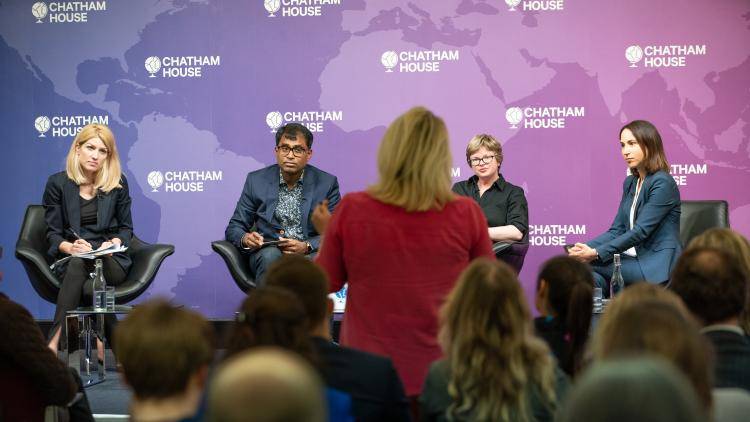
Christopher Vandome
Right, so we’re on time. Good evening, everybody, thank you all very much for coming. So lovely to see some familiar faces here today. My name’s Chris Vandome. I’m the Lead of our Critical Minerals Initiative here at Chatham House, and I’m very delighted to welcome you all this evening to our event on the “UK critical minerals strategy: Building national resilience through global political and commercial collaboration,” with Minister Chris McDonald. This is a really important meeting for us. This is something that we’ve been in conversation with DBT for quite a long time around and is part of our work going forward of platforming various different global strategies, financial strategies, around critical minerals and where different countries see themselves in this global sphere.
I’m not going to take up too much of your time. I know that you’ve already had a safety briefing, but just as a cultural nod for the industry in which we are going to be discussing tonight, I think it is important, also, to recognise that we are talking about an industry that does impact livelihoods, that does impact workers, where we are still seeing huge issues around safety within the industry. And that is something that we’re going to hear what the UK offers in terms of standard safety, as well as where the UK sees itself.
So, delighted to welcome, first off, to the stage, our CEO, Bronwen Maddox, who’s going to introduce the event, and then we’ll hear from the Minister himself. So, Bronwen, thank you very much [applause].
Bronwen Maddox
Good evening, everyone. Welcome, including the Ministers, plural, we have here. This is a really important gathering and one that I’m delighted to be opening in this way. In the 21st Century, mining will replace drilling and burning and the global economy is shifting from dependence on fossil fuels to reliance on the extraction and processing of critical minerals, and it weaves its way into pretty well every conversation we have about geopolitics, geoeconomics, even what decisions people are going to make the next day.
Critical minerals are the foundation of modern life. We need them for electric vehicles, renewable power, datacentres, AI, defence, phones, medicine. I was very struck at the Munich Security Conference just a week ago how they were in every conversation, even ones that apparently were simply about pharmaceuticals. They’re becoming really essential to our prosperity and security. Yet, no one country possesses all the minerals that it needs and an over-reliance on certain countries for processing, especially China, has led to chokepoints that are vulnerable to manipulation.
So, securing resources means co-operation. It means collaboration on shared investment, on production and processing, transparent supply chains and responsible mining standards. Only through international partnership can we deliver the dual promise of sustainable growth and a just, environmentally sound transition. It’s the same way that we can guarantee we have the minerals we need to protect our national security. For the same – in the same way, we will build the incentives we need for investment across nations. It’s very revealing that President Trump is championing international collaboration on minerals but challenging other aspects of the international order. We’ll hear more in his State of the Union Address very soon.
Recognising the urgency and the significance of these questions, last year I chose to set up a Critical Minerals Initiative at Chatham House, and this is being led by Chris Vandome. It will officially launch later this year, but it’s not being shy about its presence at the moment, and it is very highly active already, here and internationally. The initiative brings together our work on energy, trade, environment, security and our regional teams, which span the whole world, and it puts Chatham House at the centre of this global conversation. Our flagic – flagship China series this year is going to include a session on critical minerals.
We feel that our independent and trusted research and convening will add a lot of value to shaping these strategic approaches to mineral supply. I’m really delighted that I’m able today to welcome Chris McDonald MP, the Minister for Industry, who’s going to present the UK’s Critical Minerals Strategy. Announced at the end of last year, the strategy lays out an ambitious plan for increasing domestic capacity for production, industrial support and international leadership. What else it does, we will have to hear from him. I’m looking forward to this presentation and the discussion, and the questions to him and our other panellists to come, and I’m keen to hear from you all, not just today, but in the future, where we can take this conversation next. Thank you very much [applause]. The stage, thanks so much [applause].
Chris McDonald MP
So, thank you very much, Bronwen, for that kind introduction and of course, to Chris and everyone here at Chatham House for the work that you’re doing on critical minerals. I’d very much like to welcome all of you, but particularly, I’d like to welcome the Mining Minister from the – the Mining Minister from Mongolia. I had a great pleasure in meeting the Mongolian Deputy Prime Minister quite recently and we have much in terms of shared interests on mining, and I’m looking forward to our meeting later this week, as well. So, delighted that you’re here. Thank you very much, and I hope that you’ll find something of interest in the discussion.
So, it is a real pleasure to be here at Chatham House. I think there probably isn’t a more appropriate place to be discussing not only critical minerals, but really, a resurgence in mining interest. And mining has been, and clearly it continues to be, at this intersection of geopolitics, of security, of economics and of technology development, and that’s why it is so important that we are focusing on this aspect of critical minerals. Because every aspect of our lives is becoming more dependent on technology and on the natural materials that are under our feet, and our ability to extract and utilise those materials is only ever going to be more competitive.
We need critical minerals to fulfil our ambition of becoming a clean energy superpower, to create a strong digital economy, to deliver our industrial strategy, to grow our advanced manufacturing sector, which is a personal priority for me, as the Industry Minister. Our challenge is that the supply chains which underpin these industries have been too concentrated and too vulnerable to shocks. Now, when this government came into office in 2024, we knew that work must’ve be – must be done straightaway to overcome these challenges, and our Critical Minerals Strategy responds with a very clear message, that the UK will be a reliable and responsible partner. That we’ll work internationally to build secure, diverse and resilient critical minerals supply chains that support sustainable growth for all of us.
We start from an understanding that even as we expand our domestic supply chains, which we are doing, these alone will not meet our future demands. Our – as our strategy lays out, by 2035 we want to see 10% of our demand being met through domestic primary production and 20% from recycling, but with no more than 60% of any critical mineral being imported from a single country. That’s a significant change from where we are now. These are bold targets and they need to be. The global energy transition, our national security and our economic independence demand nothing less than these efforts, and such ambitions can, of course, not be achieved in isolation. Meeting them requires trusted partnerships, joint investment and a shared commitment to open and transparent markets.
Building these international relationships has been and remains a key focus of this government. Earlier this month, we signed a memorandum of understanding with the United States, with a shared ambition to diversify and strengthen critical minerals supply chains. This agreement will support further investment into UK mining, processing and recycling, and deepen co-operation between our industries, our Researchers and our financial institutions. We’re also intensifying our work with Canada, a natural partner with whom we share both values and deep mining expertise. Through the G7, and bilaterally the UK and Canada, and mapping supply chains, identifying vulnerabilities and exploring co-investment opportunities in strategic projects. This kind of upstream to downstream ves – visibility is essential if we are to reduce exposure to concentrated supply and enforce resilience across economies.
Of course, our relationship with the European Union remains central to secure supply of critical minerals. Through the United Kingdom’s Critical Minerals Intelligence Centre, we’re building a shared understanding of supply chain risks and opportunities across Europe, recognising that our supply chains are, and will remain, deeply interconnected. We’ve also deepened collaboration on rare earth elements, with Australia marketed – marked by recent investments in Ionic Rare Earths at their Belfast facility.
These partnerships reflect a wider reality, that securing supply is not simply about access to minerals, but about the quality of the relationships which are built on transparency, responsibility and trust. And this includes championing the ambitions of nations rich in resource, to ensure that their mineral wealth translates to real long-term development. The UK is actively supporting programmes that help countries to sustainably map, mine and process their minerals, supporting them to build capacity, strengthen governance and secure prosperity that lasts.
Our greatest strengths as a country lie in our mineral resources and our midstream processing technology. Indeed, I hope you have all seen our recently published investor prospectus, alongside the Critical Minerals Association, which sets out the extraordinary capabilities that we, as a country, have to offer. The UK is home to Europe’s largest lithium deposit and the world’s largest tungsten deposit outside of China. We have the world’s largest platinum group metals refinery and Europe’s only cobalt refinery outside Finland. And just recently, HyProMag opened its rare earth magnet recycling facility, a major milestone in the development of a circular and secure supply chain for these strategically essential materials.
Our strengths are reinforced by world class research, and our research and innovation body, UKRI, is working with other countries on technologies ranging from advanced extraction to waste remediation. We’re ensuring that the next generation of supply is not only larger, but greener and more efficient. Similarly, our universities and technical institutes continue to lead in geoscience, materials engineering and clean processing innovation. This includes the work of our world-renowned Camborne School of Mines, which I had the pleasure of visiting back in November. London also remains the world’s most important centre for mining capital. Our markets, from the London Stock Exchange and the London Metals Exchange, to AIM and Aquis, raise more capital for mining and critical mineral projects than any other comparable financial hub. AIM alone raised more than half of all capital in European growth markets over the last five years.
This financial depth combined with our global leadership in legal engineering, insurance and standard services, makes the UK a natural place for companies to raise capital, secure offtake agreements and access the professional expertise that underpins responsible mining. Government backed finance is amplifying this strength, as well, with our new National Wealth Fund, where – which is making three investments, in UK critical minerals already, and UK export finance, which has launched a guarantee product specifically designed to support overseas projects that supply critical minerals to the UK.
But resilience requires us to support partners as well as secure supplies, and British companies are recognised globally as trusted, responsible operators. This year, for example, we supported strong industry delegations at major global mining events, including the Future Minerals Forum in Saudi Arabia and Mining Indaba in South Africa, demonstrating our commitment to promoting UK expertise and deepening international relations. Across Europe, companies with links to Britain are advancing lithium, copper, nickel and gallium projects that have now secured EU strategic partner designation.
Tungsten West is an important recent example and we’re actively supporting other projects based in the UK to follow suit. These are exactly the kind of partnerships our strategy aims to foster, collaborative, commercially credible projects, based on shared standards. We also recognise the practical market access barriers that hol – that can hold back investment and international trade. That’s why our Trade Strategy, together with the new Ricardo Fund, is putting in place the necessary steps to help British companies overcome these barriers, so they can expand overseas and contribute to resilient supply chains.
As we look ahead, the message is clear. The UK is determined to work with all of you, with governments, investors, industry leaders and Researchers. Together we can reduce the risks of dependencies, support responsible development, build supply chains that underpin the global transition. Our ambition is bold and it’s matched by our capabilities, world-leading financial services, research expertise, responsible business practices and a growing portfolio of domestic projects. It’s also reinforced by our partnerships with allies in the G7, the G20, the International Energy Agency and beyond.
The UK stands ready to be a reliable partner. We stand ready to mobilise investment. We stand ready to support sustainable development in resource-rich countries, and we stand ready to work with likeminded partners to bisil – to build the resilient critical minerals systems that are essential for our shared economic security. Thank you [applause]. Would you like me to take my seat down there on the stage?
Christopher Vandome
No, please, if you’d like to take a seat. Minister, thank you very much and I’d like to welcome onto the stage our other panellists, Dr Sarah Gordon, who is the Co-Founder and Global CEO of Satarla, and Georgina Hallett, who is the Chief Sustainability Officer and Head of Physical Markets at the London Metal Exchange.
And in terms of introducing our speakers, I think we all know the Minister. And Minister, I’m going to be honest, we were all quite – I think there was quite a strong positive reaction from the industry when you were appointed as the Minister, because the Minister does have a background in industry, having worked in Tata Steel, as well as having studied chemical engineering at Cambridge. And there was quite a positive response from many in the industrial sector when the appointment was made.
Dr Sarah Gordon, Sarah’s helping me on our inclusivity quota this evening, because I’ve got a point of any event that we do on mining, we do need a Geoscientist present. So, we have at least one this evening. Sarah started Satarla in 2014, originally a Geoscientist, and sits on numerous board and Advisory Panels, including Critical Minerals Expert Committee for the UK Government. And Georgina’s our steef – Chief Sustainability Officer and Head of Physical Markets at the London Metals Exchange and also acts as the LME’s Chief Ventures Officer.
Georgie, I’m going to come to you first. Based on what the Minister said there, and ambitions for domestic processing, ambitions for, sort of, domestic industry, you know, what’s your perspective from the LME? The LME has been mentioned in the strategy. What’s your perspective of where you see British entities, such as yourself, sitting within this government strategy and how do you see that relationship, and what do you think that you can contribute towards it? Thank you.
Georgina Hallett
Thank you and thank you for having me today for this fantastic event. Yeah, I think, you know, we were thrilled to read the strategy, and, you know, the LME has been at the centre of pricing and standards for the metals industry for almost 150 years. Give us one more year and we’re there. And it’s great to see mining and the metals industry so central to discussions at the moment, and I think there is a number of ways that what the LME does supports the government’s industrial strategy, and we’re thrilled to help as much as possible.
So, just to cover a few. I mean, I think we’ve heard a lot about standards-based markets. The LME has set the standards for metal that’s traded on the Exchange for almost 150 years and that has historically, been metallurgy based, but in the last five to ten years, has increasingly incorporated ethical and sustainable standards, as well. So, we’ve had a number of conversations with stakeholders in the government about our experience of trying to define your scope for what’s included in sustainability, how you measure it, how you ensure it’s fairly executed across different parties, and very happy to bring that to bear.
Ditto on transparency. So, we have a platform called LME Passport, where all of the metal that is traded on the Exchange can disclose publicly. It’s a free to view site, you don’t even need a login. They can disclose all of the ESG and sustainability metrics that they meet, with third party evidence, you know, audit, etc., that proves that’s been met. And, you know, increasingly, we see people going to that because it provides a, sort of, one-stop access point that you look – can look up a particular producer or a particular brand and know all of the great work they’ve done.
And I think that’s key because mining has historically been quite backwards about coming forwards about the good work it does, I think ‘cause it’s historically also taken a beating. And we need to be much more open about the progress that is being made, acknowledge the risks, acknowledge where there’s more work to be done, but also, you know, be proud of what has been achieved. And then, obviously, key for the LME is the pricing piece. So, we provide the pricing for nine core base metals, including various that count as critical minerals, like, copper. And that pricing is centralised, it’s regulated, it’s transparent and hopefully, can be very useful as this critical minerals develops.
But we also agree that we can do more. So, sustainability pricing, for example, I took your point in the speech, Minister, about recognising the value and the investment and time and money that’s gone into producing metal on a more sustainable basis. And we’re very interested to find out if people can achieve a premium for that. So, we have set up an entity to do just that. So, we’re looking at the price discovery for sustainability premia, for copper, zinc, lead and aluminium, sorry, copper and aluminium. And, you know, to really try and answer that question is, will consumers pay more for metal that has been sustainability – sustainably produced? And, you know, from a personal perspective, I very much hope it is, because it would be great for people to be able to realise the financial return for that, that can then be reinvested into making further progress.
But we also want to support on the critical minerals pricing too, and that entity gives us the ability to much more quickly react to these pricing challenges that we see in critical minerals and start producing centrally discovered prices that all parties can contribute to across the critical minerals spectrum, if that would be helpful. So, we are in ongoing conversations with Chris’s team about that, as well. So, I think, you know, there are – in short, there are a number of ways that we can help support the government in this and very proud to be able to do so.
Christopher Vandome
Georgie, thank you very much and yeah, certainly that point around sustainability is something that we also share and that’s been a core part of the foundation of what we’re doing here, as well. Sarah, I want to follow on from what Georgie was saying there and you’re – you’ve got two very – people who represent two parts of the conversation here, the government part and the government-industry linkage. And what’s your perception of that, both in terms of, you know, relationship between government-private sector here in the UK and also, where the UK sits, sort of, in the international landscape on these discussions?
Dr Sarah Gordon
Yeah, so I think that – I mean, from a domestic perspective, we obviously, heard that ambition in terms of by 2035, 10% of the raw materials we need being sourced domestically. Well, we can see on the map, just from a geological perspective, or a geographical perspective, we’re quite small. So, therefore, we don’t actually have very many rocks in the ground compared to perhaps some other countries. But we can be clever with regards to how we extract those, and I think that’s very much where the research and the innovation actually really comes to the fore. And the Minister’s already alluded to some of the research that’s going on in terms of reprocessing of some of that mining waste that we – is, you know, is providing an environmental hazard as it currently is. But can we use our need for some of those materials now to act as the catalyst for cleaning up some of that waste that’s already causing us – or, you know, a lo – an awful lot of expense at this precise second in time?
Another aspect, I think that’s key to mention is that until very recently, the term ‘mining’ was not necessarily a prudent thing to mention in the hallowed halls of Westminster. And I think back in COP26, so back in 2021, actually, when you were talking about climate change, mining as a sector wasn’t really very welcome at that conference. But it was during that event that really it came to the fore, “Well, where on Earth are we going to get all the materials that we need for the energy transition?” And I think credit goes to the government, because the Critical Minerals Strategy that we now have on the tables is not the first version of it in the UK. In fact, it’s the third version since 2022. So, you see this constant evolution of this strategy that’s coming to the fore, and every time it lands on our desks, we see a bit more detail, a bit more thought. A bit more information and knowledge has gone into framing that.
So, what is the position of the UK, both from looking inwards for ourselves, but also looking outwards, as well? Well, we’re not going to be exporting a huge amount of material around the world. Although there is a British Geological Survey report that was released recently that shows that we are a net exporter of copper. And that is because we take all our waste, we put it on a ship and we send it off overseas, ‘cause we don’t, actually, at this current moment in time, have the processing capability onshore within the UK to be able to deal with that waste. So, immediately, there is an area of opportunity there. So, this is something here where we’re not going to be shipping material out, but how can we work with those nations around the world to not only make sure that we have the security of supply, but it’s done correctly?
Mining is one of the oldest sectors, not just because there are some strange people, like myself, who really like looking at rocks and every so often, licking them. More on that later. But also, because as human beings, we have used these materials for an awful long time, but we’ve got a catalogue of examples of where we’ve done it badly or wrong. We’ve also got lots of examples of where we’ve done it really well and the natural resources in the world has acted as that catalyst for societal development. And I think what we’ve got in front of us right now is not only the demand, but the expectation that going forwards with regards to our need for critical minerals, where we do need to extract them from the ground, we do it in the right way.
But then also, from a circular economy perspective, we view this as a materials challenge. So, how do we design the electric vehicles, or whatever else, to either be repurposed or reused or maintained so they have a longer life? But also, as well, where they do need to be recycled, we can pull apart all those exciting alloys that our Material Scientists have developed. So, how do we keep these materials in circulation that, therefore, minimises the amount of material we actually needed to get out of the ground in the first place?
Christopher Vandome
Hmmm, and so, Minister, perhaps coming back to you, then, on, you know, your response to the points that have been made, and particularly Sarah’s point there that for a long time, you know, mining wasn’t something that could be spoken about positively around Westminster, and potentially, not – possibly to do with something that happened in the 1980s and the impacts of that. Do you think that it – you know, is it coming back? Can you feel it? Can you feel that, yeah, this is now something that is, you know, that is taken seriously and is becoming a – sort of, the in topic again?
Chris McDonald MP
Well, look, Chris, when you introduced me, you mentioned that I’ve worked in the steel industry. Actually, I just worked out today, I worked in the steel industry for 29 years before I became a Member of Parliament. I started young, and so, for me, mining’s never gone out of fashion. So, I grew up in a coalmining area, as well, actually, so for me, mining has never gone out of fashion. I wrote my first paper on responsible mining in 2014, I think, and my first paper on critical minerals in 2016. And I used to kick around down here sometimes when I worked in industry, and come and talk to Politicians about it, and at that time, if you were talking to people about gallium, germanium, neodymium and tellurium, they thought that you were singing a Lira song, or something like that, or – rather than actually something that really gripped their attention.
But we are in a very, very different paradigm now. I mean, most people can name elements in the periodic table that you just never thought that they would know, and it’s really seeped into popular consciousness. And I think that – and one of the things I was really trying to draw out in my speech is without really a huge amount of planning on this, the UK finds itself in this position of really being incredibly blessed, both with primary resources – accepting your point, Sarah, but, you know, I mentioned the tungsten resource we have is the biggest out – in the world outside of China, the lithium resource is the biggest in Europe. So, in primary resources, but also in secondary processing, and that’s as a result of some real innovation over the years. So, the – you know, the only cobalt refinery in Europe outside of Finland, I didn’t mention in my speech, the only large-scale nickel refinery in Europe, outside of Russia. And these businesses continue to compete in the UK because of their innovation. Ultimately, that’s why they continue to do it.
But we’re taking actions beyond all of the things that I mentioned in my speech around trade agreements and all of these things. We’re also taking action on energy prices, as well, for industry, through our clean power mission, to deliver lower energy costs, both for consumers and for industry in the UK, because ultimately, that’s where we get a critical advantage. And really, it’s this processing component that we really need to build back in, and this was a really good point, I think that you made, Sarah, about that, when you mentioned about the copper exports. As it happens, we send all of our aluminium scrap overseas for processing, as well, and that’s purely a, you know, an energy costs argument, and we get that in the right place and we’ll see that processing come back to the UK, too.
So, in all of these areas I think there is – you know, if we get energy costs right and we get innovation right, we form the right trade agreements amongst friendly nations, then we will see a huge resurgence in this industry, both in primary extraction and in processing, as well, in the UK.
Christopher Vandome
Oh, Chris, thank you very much, and I’m now going to turn to the audience, because with such a full room, I’m sure that we’re going to have a number of questions. If you would like to ask a question, please raise your hand. Please note that we are on the records this evening. We’re not under the Chatham House Rule, and yeah, I will – depending on how many we have, I’ll take them in, sort of, ones and twos. But first off, so the gentleman over here was the first to have his hand up, and then there was a gentleman, sort of, in the – over by the door, so we’ll second, but please.
Roger Atkins
Thank you. Roger Atkins, I’m a LinkedIn storyteller, and Chris, you just mentioned “popular consciousness,” so I wondered, how well do you think we’re doing, or how much better could we do in telling the story, particularly to the general public? Because ultimately, some of this can get conflated with the negative arguments around Net Zero, etc., etc. And whilst I have a go at this myself, with a relatively small audience on LinkedIn, if you look at somebody like Ed Conway on Sky, who is actually a past master at this, I would strongly recommend, kind of, looking to maybe sign him up in some form or fashion, with the government, to help tell this story to the general public. His explainers on the 17 rare earth metals and various other parts of the story are second to none, and his book, “Material World,” if anyone’s not familiar with it, I recommend it, really are like a Bible to the cause.
So, my question is simply that, how much better can we be at storytelling and how could we do that? And sorry, as a final note, how refreshing to have a Politician who’s not a career Politician and knows the subject matter that they’re involved in. So, I wish you all the very best and in any way I can, and anyone else, help you, please just ask.
Christopher Vandome
Hmmm, thank you very much, and the gentleman over in the row by the doors, there.
Junior Badila
Thank you. My name is Junior Badila, Journalist from the DRC, Democratic Republic of Congo. Your Minister, cobalt and coltan are DR Congo most strategically asset, and giving to ongoing conflict between DRC and Rwanda, how can the UK ensures that critical mineral entering global supply chains are no linked to all the dynamic conflict in eastern part of Congo? Thank you.
Christopher Vandome
Thank you. I’m going to – so, there’s questions there around the socialisation and the importance of getting that message across that mining is important and storytelling and then, a question – let’s broaden it out beyond just DRC to make it more about responsible sourcing, conflict-free sourcing, and I think the, sort of, the verification of claims around that responsibility. Minister, there’s some, you know, responses to those questions, I see the other panellists nodding, so they’re going to get their chance as well, but Chris, please.
Chris McDonald MP
Hmmm hmm. Well, first of all, to the gentleman over there, thank you for the work that you’re doing explaining this to people. Whether it’s via LinkedIn or whatever medium you use, it’s a really valuable thing to do. So, you’re right, I’ve got industrial experience. The corollary is I’m never going to be the world’s best Politician, but I can continue to do the job that I am doing.
On this point about storytelling, I mean, I think the important thing to recognise is if you get out to a lot of the country, you don’t need to tell the story. Look, I spent a great day in Cornwall – excuse me – when we launched the Critical Minerals Strategy. I don’t think I have to explain to many people who live in Cornwall how important this industry is. I’m from the North-East, I also don’t need to explain it to people in the North-East, either. We have just had an announcement that the Europe’s biggest lithium refinery is going to be built a stone’s throw from my constituency. People know it’s a good thing because it brings good jobs and the kind of jobs that they want, and it’s the same if you were in the West Midlands or South Wales.
So, I do realise there is a job of explaining to be done, largely here in Whitehall and Westminster. That’s where it needs to be done to get people on board who maybe aren’t as in touch with industry and manufacturing as people are around the rest of the country. But I think if you travelled from the north of Scotland, down to Penzance, you – on that, sort of, seven-hour train journey that it takes to do that, you would find people all along that route who want to see really good manufacturing, industrial processing jobs, and they’d buy into this in a heartbeat.
To the man from the Democratic Republic of Congo, I mentioned that I’d written an article on ethical materials sourcing in 2014 and ultimately, this was the topic, and it was cobalt mining in the Democratic Republic of Congo. I mean, hopefully what you heard from me in my speech is that the covernment – the government is keen to use the relationships that we are forming with people around the world to drive up standards in mining. And also, from a UK perspective, of course, the more that we invest in secondary processing here will give us surety of our own supply. But primary sty – supply is still important and we really do believe that there is an opportunity here to help countries that are resource-rich to exploit these resources in a way that they get really strong economic value in their own countries, but to do that in a way that’s responsible, both in terms of the natural environment, but also in terms of people, as well.
Christopher Vandome
Hmmm. Sarah, is there something to that you want to add?
Dr Sarah Gordon
Yes, I mean, I think firstly, to Roger, to yourself, totally agree in terms of the storytelling. In fact, I was so frustrated by this that a few years ago, set up a production company called Critical Productions…
Roger Atkins
Yeah.
Dr Sarah Gordon
…and we do exactly that. So, attempting to create, be it social media fodder, but then, also, as well, documentaries. And this time last year, we filmed a documentary in the Natural History Museum, where we invited 100 volunteers to come to the museum at night-time. And they didn’t know why we’d invited them, but if you get invited to go to the Natural History Museum for an evening, lots of people are intrigued and say, “Yes, we’d like to come along.”
Georgina Hallett
Exactly.
Dr Sarah Gordon
And what we did in this documentary, which is called “100 Perceptions,” and you can find it for free on YouTube, is that of those 100 people, we started off by asking them a range of questions and they got more and more emotive. And the final question we asked them was a statement that they needed to either agree or disagree with, was, “I believe that mining is more good than bad.” And we just wanted to see what people thought, what were their perceptions? And I won’t give the game away in terms of what we found at the end of this, because we then played some games, shared some information and asked the same questions again, and people did change their minds. ‘Cause the key thing was critical thinking, and I know we’re overusing the word ‘critical’ here but allowing people to understand that there is a choice. There’s also tension, as well as potential opportunity and threat, in terms of how do we source these materials? How do we respect these materials, as well? And what can they do in terms of enhancing different parts of the world?
Which, of course, from a DRC perspective, so I’ve worked in Kolwezi, so with regards to the copper and the cobalt mines, the rocks are phenomenal. In terms of the above surface areas of threaten and opportunity, immensely complex in terms of the different dynamics that are there. But this is something here where, from a UK perspective – so, anything from the Serious Frauds Office here in the UK, where we’ve seen that be enacted with regards to different companies working in the DRC, but then also, as well, through into the world of transparency. And I’m sure you’ve got some aspects to mention there with regards to the London Metal Exchange, of how do we make sure that when that cobalt is ending up in that battery or whatever, it’s actually helping to enhance where it came from, rather than harm where it originally came from?
Christopher Vandome
Hmmm. Georgie, is there something you want to add there?
Georgina Hallett
Yes. Actually, just on the storytelling point first, though. My colleague and I were at the Camborne School of Mines about three weeks before the Minister’s visit. We were made very clear that we were the warmup act for the main event.
Chris McDonald MP
Did a good job.
Georgina Hallett
But I think what was really amazing, ‘cause we, the LME, the sponsors a couple of students through the programmes there as part of our, sort of, commitment to the pipeline of talent coming into our industry to – you know, the ongoing renewal. They were so excited about what was about to happen, about putting UK industry on the map using this natural resource that we have. So, that was great to be part of, albeit a bit early.
But yeah, to the DRC point, you know, I made a very brief comment in the earlier remark about setting the scope of your standard, and that sounds so casual and easy, and actually, it was two years’ worth of work. Because what you’re really looking at is which metal can you include in, sort of, global supply chains? And inclusion for that is so important because the more you can keep in the tank, the more opportunity you have to make improvements over time. The LME price of tin, for example, is a global price, and to be global, it has to be representative and that means sourcing it from everywhere.
So, to Sarah’s point, you have to make sure that you are doing justice to where it’s coming from and providing the assurance that people buying it need that it has been sourced in line with internationally accepted standards, and that is not an easy thing. You know, we wrestled with these questions for artisanal mining versus large-scale mining, how you keep including people, how you accept that that comes with risk but is worth it for the value that you can add over time if you accept that in the short-term, you know, it’s – it could be uncomfortable. So, that is really important to the Exchange, both for our, sort of, core physically settled contracts and for all the prices that we hope to produce in the future in support of the critical agenda, is that we keep that global representativeness, that inclusion remains key and that we are genuinely helping improve things over time, not just going for the, sort of, easy routes.
Christopher Vandome
Hmmm hmm, thank you very much. I know on the point on traceability, there was a paper on our website, I believe, that we did for the European Parliament Development Committee in June last year, on “Traceability of critical raw materials in Africa,” that is – I’m biased, but I think is quite a good, sort of, primer on some of those issues. A lot of talk about Cornwall and lithium, including online, and the Camborne School of Mines. I’d like to recognise that the MP for Camborne and Redruth is in the audience. He’s not on stage, so we can’t put to him the questions that are coming through around Cornish separatism, or we can perhaps discuss that later.
I’ll take another round from the hall and then, I’ll come to some of the questions that are online, and the lady here was first and then, the gentleman here and the lady behind. So, we’ll do three, but the lady here first, please.
Member
Thank you. My question is going to be on the topic slightly different to green energy. As the issue of supply chain disruption was raised, is there a shortage of medicine supply expected as a result? If so, is the UK looking to diversify its supply chain for minerals deployed in pharmaceutical manufacturing, as well as for medicine import, or is it looking to produce this locally? And which option is more feasible rather than desirable?
Christopher Vandome
Okay, thank you very much, and then, the gentleman here with – at the back of this front block, yeah. Thank you, Rob.
Rob Macaire
Yeah, thank you. Rob Macaire, I’m a council member at Chatham House, but I also did a few years in the mining industry. Minister, the – you talk, rightly, about the leading role the UK plays, and a lot of that story is around responsible mining. But at a time when ESG and the component parts of ESG are, sort of, becoming a taboo concept in the United States, how much does that threaten the underlying story that we seek to tell about responsible mining and where the rightful place of regulation in that?
Christopher Vandome
Thank you, and the lady in the white shirt immediately behind Rob, there, please. Thank you.
Catherine West
Thank you very much, Chair, and hello Chris. Catherine West, MP for Hornsey and Friern Barnet…
Chris McDonald MP
Hmmm.
Catherine West
…Labour MP.
Chris McDonald MP
Hmmm hmm.
Catherine West
Some of us don’t know each other as well as we could, even though we’ve been together for 18 months now. Big intake. Just a quick question. I am also the Trade Envoy for Pakistan and Vice Chair of the APPG for Mongolia, and welcome to our Mongolian delegation and the lovely Fiona, who represents us over there. I wanted to ask about a bit more, sort of, hard data on jobs. Obviously, being somebody who’s come through, kind of, thinking about things abroad, I will often think about the context of mining abroad, but I am curious about, sort of, what assessment the Minister’s made regarding the number of jobs back here in the UK. Not just from exciting things happening in Cornwall and the North-East, but also around, you know, jobs in London, being a London MP, but in other of our cities, as well, around some of the other industries that feed into that, insurance or financial services. The recycling point, which our other panellist made. So, yes, jobs, numbers of jobs and resource that goes behind the strategy from a government point of view. Thanks.
Christopher Vandome
Thank you very much. So, there you go, Minister, you’ve got medical supply and reminder of the diversity of utilisation of critical minerals, responsible mining and jobs. Thanks.
Chris McDonald MP
So, maybe it might make a bit of sense if I start with the ESG comment first. So, the – there are a number of forums through which we are engaging with our partners in order to set up collaborations on critical minerals, and maybe it’d be helpful if I said just a little bit more about that. So, there is quite a strong activity through the G7 and all the G7 members are keen that we will collaborate in this way. And some G7 members, you know, such as Canada and to a far lesser extent, ourselves, have natural resources that we can trade amongst ourselves. But clearly, we recognise that there is a need for resources that runs beyond that, as well. And I mentioned, I think, specifically the relationships that we form with the European Union and the memorandum of understanding that we’d signed with the USA.
But clearly, it’s – this – as I said in my opening remarks, the issue of critical minerals is more than an issue of gaining resource. It is an issue of security, so it’s also an issue of foreign policy, as well. And, you know, I think I was quite clear in my remarks, but I shall restate it now, that in relationships with resource-rich countries, it’s incredibly important to us that those resources are developed responsibility – responsibly. And that’s, you know, it’s part of the government’s foreign policy, and hopefully, you find that somewhat reassuring.
On the issue of sourcing of critical minerals, whether it’s for life sciences and medical products or for any product, actually, in the economy, you know, I mentioned, I think specifically, clean energy, which will be a big user of critical minerals, but also digital technologies, as well, we think a mixed approach is quite important, actually. So, ensuring that we can make best use of our primary resources is why we’ve set this 10% target, so 10% of our demand from our domestic resources, and then a further 20% from, essentially, from recycling, so from the circular economy. Now, well clearly, that’s still a minority of the resources that we need, you know, 30%, but that’s why we’ve also got this additional target which is no more than 60% from any one country. That’s quite a significant change from where we are now and why it’s so important that we’re forming these international links and why our trade policy is part of this, too.
And then Catherine, it’s lovely to see you, hello. It’s always nice to see a colleague and yes, I noticed [Puren – 47:19] is sat over in that part of the room, as well. Your question about jobs is a really good question. So, the – so, in short, the jobs that are being created in this industry are spread across the whole country, and I’ll come back to your point about cities and London last, if you don’t mind, I’ll come back to that last. ‘Cause you – obviously, there’s been quite a lot of talk about Cornwall and there are a number of natural resources there, and then you mentioned, also, the North-East as where there’s lithium resources there. We had lithium in the North-East too, and I mentioned a lithium refinery in Teesside, which is a classic, sort of, processing location. But also, a HyProMag in Birmingham and Ionic Technologies in Northern Ireland and the projects in Scotland, as well, actually.
So, these processing projects are around the country and they’re generally in cities or city regions, you would say, but in – primarily in areas that would take that kind of capability and where there’s a university that they’d work with. So, the, sort of, classic industrial processing sorts of areas. I think when we look at this from the point of view of the green transition, as well, where we’ve got industries that are naturally reducing workforce as a result of the green transition, that is a great opportunity to promote a just transition, a social transition in those areas.
But then your final point, which I think is very important, which is this point about other services, like insurance and finance and so on, and the impact that could have here in the City. I agree with you about that. I think there is a strong opportunity for London, a really strong opportunity, because, you know, as I described, you know, the UK’s the global finance centre for mining. The thing I think that where we haven’t been good at, or at least won’t happen unless we work hard at it, is how we make sure that that financial engine works to the benefit of those other bits of the UK economy, as well.
And it’s actually a question that I, you know, I’d, kind of, like to direct it to Georgia. You might have some thoughts on this, as well, in that the London Metals Exchange is such an amazing asset for us. We’re so fortunate, as a result of history, we have the London Metals Exchange here, but those companies that I’ve just mentioned, I’ve just, sort of, rhymed off a whole list of companies that have got amazing processing technology, we want them to scale up and grow in the UK and become amazing UK corporates and partner with other countries around the world and so on. So, helping them to understand how to access that finance and really get that capital from the UK capital markets flowing into the UK economy, that’s something that concerns me now and I want to do more on. And Catherine, hopefully, that’ll be a benefit from – to your constituents, as well. But really, Georgia’s the expert in that, so you might want to comment on that…
Georgina Hallett
So pleased to hear it.
Chris McDonald MP
…later. It was a polite challenge, there we are.
Christopher Vandome
No, please go for it.
Georgina Hallett
Oh, thanks, right now?
Christopher Vandome
No, please respond, yeah, yeah, yeah.
Georgina Hallett
Okay, yeah, no, I think it’s a fair question and there isn’t an easy answer, because the LME itself is actually a relatively small company, you know. We’re about, sort of, 400 people and therefore, there’s some employment for UK, but in and of itself, it’s not an especially exciting story. I think where we can really add value is through this pricing piece, and it goes back to how we can launch new prices. Because historically, physically settled contracts, like we have at the LME, that’s the core of our market, i.e., it doesn’t happen very often, but if you wanted to buy physical aluminium through the Exchange, you could. They only really work for metals where there is huge tonnages of productions, millions of tonnes per year.
And for a lot of the critical minerals that we’re talking, with the – some exclusions, like copper, for example, most of them, the production tonnages are too small to really support a physically delivered contract. And that has been a huge barrier to entry for those markets and as a result, pricing has remained relatively isolated or regionalised. Often, it’s producer pricing, where they get to set their own prices, and that makes it difficult for consumers because there’s no reference point, or sufficiently robust reference point, to challenge them on.
So, I think what’s really exciting about the work we’re doing now with this new entity to deliver a greater range of pricing methodology is an – I could talk about that all day, but I suspect we’re going to bore people very quickly. But the output of that is designed to be able to produce, for example, a tungsten price much more quickly and easily, such that people producing tungsten in the UK, and I’ve actually been to the Tungsten West plant, can use that price to get fair value for the work they’re doing. And equally, it’s a fair price, so even the consumers are happy to use it too, because they think it’s the right price. It’s not unfairly biased in favour of one side of the value chain or the other. So, I think, you know, the UK will benefit and hopefully, the rest of the world, as well.
Christopher Vandome
Hmmm hmm, thanks, and Sarah, did you want to pick up on anything from those questions, maybe around the responsible sourcing?
Dr Sarah Gordon
Yeah, absolutely. I mean, I think, you know, it’s a great question with regards to ESG. I mean, that’s just happens to be the term that’s been used recently, I mean, in previous iterations, CSR, etc., whatever acronyms you want. But what we find is that depending on which datasets you look at, between 60 and 80% of big capital projects in the mining sector fail or are over budget over time due to those environmental, social and governance risks coming to fruition. So, it’s not a case of going and hugging a tree or being nice to somebody. It’s a case of resilience and success. It’s a case of certainty. So, it doesn’t actually matter what we call sustainability. If we don’t take it seriously, then there is a high chance of those projects failing.
And just finally, if I may, with regards to jobs and skills in London, we’ve heard Camborne School of Mines mentioned a lot recently. I will lose my job as a Professor of Practice at Imperial College London if I don’t mention the Royal School of Mines, which is, of course, based here in London. And interestingly, over the last few years, what we’ve seen is actually, an uptick in people applying to come and study the likes of geoscience…
Georgina Hallett
Hmmm hmm.
Dr Sarah Gordon
…at Imperial, which is fantastic. But one of the main reasons why that’s happening is you’re seeing that focus in on the responsibility, the sustainability aspects, and seeing how the likes of mining materials, etc., fits into that more global piece. All of which can then go and enhance the opportunity for skills, be it anywhere within the country.
Georgina Hallett
Hmmm hmm.
Christopher Vandome
Yeah, thank you. On that university piece, I’m also connected to the University of Witwatersrand in Johannesburg, which also started as a School of Mines. So, yeah, the mining industry…
Georgina Hallett
Yeah.
Christopher Vandome
…has a lot to answer for in terms of skills development.
Georgina Hallett
Yes.
Christopher Vandome
I’m going to come back to the audience just now, but I’m going to pull out some themes that are coming through on the questions online. One of them is around, sort of, U – comparing the UK approach to say, the US approach and what we’ve heard in the last few weeks. So, there’s a lot of questioning around pricing and I think that, Georgie, this comes to the point that you were talking about pricing. And yeah, I would love for us to sit down and have a four-hour conversation around what exactly pricing looks like, ‘cause I think that there’s a lot of misunderstanding around how contracts and prices actually…
Georgina Hallett
Yeah.
Christopher Vandome
…work in real-time and what interventions, therefore, are necessary in order to create those price incentives. And it’s one thing to say, okay, well, we need market incentives. It’s another to then look into the actual reality.
So, there’s some stuff in here around pricing and also around stockpiling. There’s also a question arou – well, there’s – a lot of the questions are around the timelines and the time horizons. So, what we’re talking about now, but in terms of mine development, in terms of permitting, in terms of all of the things that mining, you know, is – that is needed in mining, a lot of these things take ten plus years. So, there’s also, sort of, a credible commitment problem of yes, we’ve had, you know, three strategies that have now come out, two under the previous government, one under this government. How do we know that, you know, that strategy is still going to be there, or that this is still going to be important in ten years’ time, when anything that we’re putting money into now is coming online?
And there’s also questions coming around, and perhaps, Chris, this is one for you, if we’re coming down the line, the UK exports beyond just mining and minerals. You talked about the services, but also, what about the norms, the institutions, the way of doing business? You know, does the UK see itself as having a role in that space and the export of, sort of, ideas and, you know, the institutional governance, beyond just responsible sourcing, but, sort of, as a way of doing business? So, perhaps we’ll come down the line and then, we’ll take one final round from the audience. Georgie, hmmm.
Georgina Hallett
So, four hours on pricing starting now?
Christopher Vandome
Four hours on pricing, well, yeah, clear your diaries, guys.
Georgina Hallett
Look, I think I agree, pricing is both very straightforward and very complicated at the same time. And probably you’re right, you know, it’s difficult to assess from the inside how much it’s understood from the outside, and perhaps it goes to that point about socialisation and engagement with wider industries. Well, the markets have pretty good pricing structures and market economics generally work. They sometimes get a bit skewy, but generally speaking, supply and demand brings the price back to roughly the right place. So, the question is, it becomes very quickly, what exactly are you pricing and how? And there are various different methods to do that.
Like, just to – almost to go back to Chris’s question about the – what the LME can do for the UK. Recycling pricing, for example, is an area that I’m really interested in at the moment, because everyone’s agreed recycled – recycling is great, and I completely agree with Sarah, the opportunities for the UK are big and we should be taking advantage of them, but my challenge is how do you price that? Because the amount of specifications that you can have in recycling is huge, and people talk about, “Oh, this is great for emissions,” and it is because generally, recycling much better for emissions than primary, but they’re not talking so much about the social risks associated with recycling. You know, if children have picked bits of copper wire out of a supply dump, is that still what you want? Is that – is the lower emissions still worth it?
So, I think recycling at any costs needs to be tested hard as a theory and then, how you price it. So, what are the specs? What kind of recycling were you talking about? How much energy’s gone into separating it from other materials? And those are the kind of detailed technical questions that pricing venues can and should be getting into, because once you’ve provided a price with a clear specification, you’ve set the market free for the market economics to take over, and if the su – if the demand is there, the supply will come forth. So, you know, I would say this, I work for an exchange, but I think pricing can be extremely key for getting those markets up and running.
Christopher Vandome
Nice, more research needed, we love that answer. Sarah.
Dr Sarah Gordon
So, onto, I guess, timelines. I mean, doesn’t four hours go quickly…
Georgina Hallett
Hmmm hmm.
Dr Sarah Gordon
…when you’re talking about pricing? But yeah, in terms of timelines, so there are lots of fantastic stats out there, and the most recent one, perhaps, or the most recent update of one, is “It takes, on average, 17 to 18 years to go from” actually “finding rock in the ground to it turning into a mine.” Now, finding rock in the ground, I started out life as an Exploration Geologist, and most Exploration Geologists don’t find that rock in the ground, okay? Also, as well, another stat, “out of 1,000 exploration projects, only one of them results in a mine.”
Now, why is this? Is this because we’re just looking in the wrong places? Is it because we’re really bad at our jobs as Exploration Geologists? Or is it because again, we’re not taking that more holistic view of what it is we’re looking at?’ ‘Cause we’re not just looking for the rock, we’re looking for the right social setting, we’re looking for an environment in which we can actually do this without causing a huge amount of harm, above ground risks. We’re looking for something where we have an element of certainty in price…
Georgina Hallett
Yeah.
Dr Sarah Gordon
And I know I’ve said ‘certainty’ ‘price’ but not for another 20 years, please.
Georgina Hallett
Yeah.
Dr Sarah Gordon
How do we do all of that, coming down to energy? So, Minister, you mentioned the cost of energy here in the UK. One of the reasons why companies are saying, “No, I can’t build my plant here” is because they think that the cost of energy might be too high in five years’ time compared to what they actually need. So, a lot of this in terms of those timelines, it’s about certainty. As soon as we can inject certainty into the system, we can bring those timelines down. And things like permitting that often get blamed for these long timelines, if you start collecting that environmental data really early, those timelines will come down. Because most of the delay is in waiting for things like those datasets to be collected. So, there are ways in which we can exacerbate this without sacrificing some of those standards that we really need to uphold when we’re doing this in…
Christopher Vandome
Right…
Dr Sarah Gordon
…the first place.
Christopher Vandome
…and the data piece is something that comes across our research, like the need for better data, better data management, data collaboration, that’s everywhere. Chris, please, hmmm hmm.
Chris McDonald MP
Yes, so you asked about pricing institutions and timescales, but I think I’ll just pick up on your thought on energy, as well, ‘cause I thought that was a point very well made. So, we know, obviously, the UK has high electricity price as a result of the infrastructure that we have, and our clean power mission as a government to move to renewables will deliver lower electricity prices from 2030 onwards. But you’re right, if you’re making a long-term investment, you need some certainty around that. So, I do – I am aware of that and we’re looking at various things there.
The schemes we’ve introduced, like the Energy Intensity user Scheme, Supercharger, our British Industrial Competitiveness Scheme, as well, will all help support industry in that period to 2030, but we do need to be able to help industry to understand what those prices will be beyond 2030. I think you’re 100% – I’ve seen enough investment and appraisals myself to know that, so it’s a point well made, I thought.
On this issue of pricing, actu – I thought it might be helpful just to, sort of, rollback to what is the objective of our Critical Minerals Strategy. So, we’re launching the strategy, and I realise none of you think this, but just to be clear, not because we think that the prices of critical minerals are too high, but because we’re concerned about concentration of supply and security of supply risk. So, fundamentally, if there’s something you want to buy and you’ve only got one shop to go to, and in this case for 70 to 90% of the processing that shop is China, then that creates too great a vulnerability. So, it’s about diversifying those supply chains, and I think it’s – as we’ve just heard, you know, from Georgia in terms of how the LME operates, we can be sure if we’ve got a free and open market, then those – that works effectively. But clearly, if someone has a dominant position in the market, we want to just look very carefully at how those prices are set. You know, that’s the point of our trade policy, essentially, to make sure that that works.
In terms of institutions, we’ve talked about financial institutions. I don’t think we’ve mentioned the British Geological Survey, but we can mention them, too. They also export their services. I’m a big fan of the British Geological Survey, recently commissioned some work from them. I think there’s more that they can do in the UK, but also, they’re doing a great job globally, as well. And on research, of course, we’ve got fantastic universities that are developing this midstream processing technology that is unique and is giving us this great advantage in the UK. That research is and of itself exportable, it – but of course, it’s far better if it’s exploited here in the UK because there’s a much greater leverage on the research investment. So, whilst it’s nice to export research services, I’d rather than we were – we had companies that were exporting technologies and critical minerals, because that’s better for the economy to do that.
And then, the final point about timescales. It does take a long time, clearly, to build a mine, but the South Crofty Tin Mine in Cornwall could be open within just a couple of years and in fact, sorry, for the – you mentioned the Cornish separatists. Not everything is in Cornwall, some things are in Devon, not as many things but some things are. So, I just thought I’d mention that, and in County Durham, as well. So, those projects actually are really quite close to completion and then we have the recycling technologies, as well. So, you know, to go from mines to magnets for batteries, that’s a decade-long project, but I mentioned the lithium refinery and then there are other recycling projects that we can get up and running much more quickly, as well. But, you know, the thing is, if you need something and it’s going to take ten years to do it, best start now. I think that’s…
Christopher Vandome
Hmmm.
Chris McDonald MP
…what I say, start now, let’s start on it.
Christopher Vandome
Well, look, I’m very conscious that we’ve got several MPs in the room and their Whips will be back down in Westminster looking at their own watches. I just want to finish up with a couple of points around where we’re going to go with this conversation, how you can be involved and where we’re going to go next. So, the work that we’ve been doing around critical minerals here at Chatham House. We’re, sort in, in the incubation mode at the moment, with some support from the Hoffman family, as well as BHP have come on board as our first core supporter. We’ve received support from the Foreign Office and from CRU for an event that we’re going to be doing at PDAC in Canada in a little over a week’s time. We have worked in partnership with the Mining Indaba down in Cape Town. We were a strategic partner for the Indaba this year and we’re also working with the Payne Institute at the Colorado School of Mines.
So, we’re looking to also embody that partnership. We also recognise that we can’t go it alone, because everybody’s working in this space, but through collaboration, we will be able to be – you know, we can tilt the needle, and we can resolve some of these global problems. Whether it be, you know, the UK’s positioning on it, whether it be pricing, whether it be responsible sourcing. So, if you want to be part of the next conversation, like I said, we are hosting an invitation only roundtable in Toronto on the side of PDAC, with both government representatives from the UK and Canada. So, please come along and – well, ask me for an invitation, as I say, it’s invitation only.
But look, thank you all very much for coming along to this discussion. Thank you for those who’ve given up their time, and please can we thank the Minister and the panel in the normal way? Thank you [applause].
Chris McDonald MP
Thank you, thank you.
Dr Sarah Gordon
Right, that’s [applause]…