Laurel Rapp
Good afternoon and welcome to Chatham House. It’s a pleasure to welcome Premier Danielle Smith here for a conversation about Alberta, of Alberta’s role within Canada and Alberta’s role in the world. My name is Laurel Rapp, and I’m the Director of the US and North America Programme here at Chatham House. Within this programme, we look at the changing role of the US and Canada in the world, what these changes mean for our partners and how durable these changes are over time.
I will remind you that today’s discussion is on the record, it’s being livestreamed. We will be in conversation for about 30 to 35 minutes, but then we want to leave ample time for questions and answers for the second half of our programme. The Premier will also begin with brief remarks at the podium, after a brief introduction from me.
The Hon Danielle Smith
Hmmm hmm.
Laurel Rapp
So, welcome, Premier Smith.
The Hon Danielle Smith
Thank you.
Laurel Rapp
Danielle Smith is a proud Albertan. As Leader of the governing United Conservative Party, she was sworn in as the 19th Premier of Alberta on October 11th 2022. She represents the riding of Brooks-Medicine Hat in the Legislative Assembly. Before re-entering politics, Miss Smith worked extensively in the media and in business, most recently as President of the Alberta Enterprise Group. Before that, she was a Radio Host with Corus Entertainment for six years.
And Premier, under your leadership, Alberta has forged a very assertive path, both with Ottawa and in the world, at a moment when Canada is redefining its role and its relationships with partners and allies both near and far. And Alberta’s doing this in a couple of different ways, pushing back on federal regulations in some ways, offering independent views on policies around energy and pipelines, trade strategy and also fostering closer relationships with neighbours to the south. And you are doing this from a position of strength as an energy leader of Canada. The vast majority of Canada’s oil and natural gas come from Alberta and so, at a time when Prime Minister Carney is seeking to diversify partnerships beyond just the US, you have a lot of cards to play in this conversation.
So, you have lots on your plate, energy projects, dynamics with Washington, trade negotiations that will begin with Mexico and Washington in the coming months, and then a referendum on – and an independence movement from the province of Alberta, as well. So, we’re delighted to host you here today, to hear your perspective on these issues and to get into the details. Please.
The Hon Danielle Smith
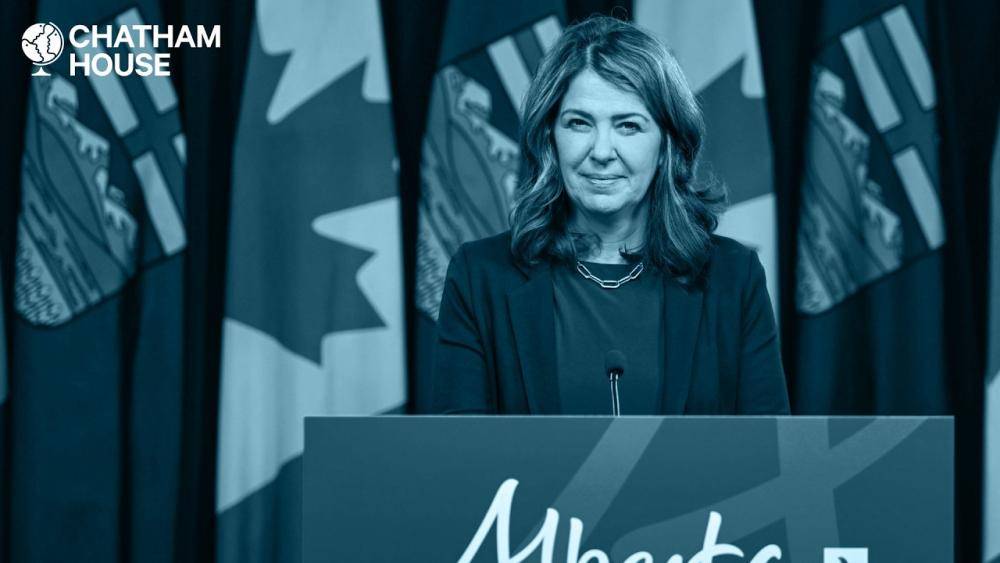
Thank you. Well, thanks, Laurel, for the very kind introduction, and I was telling Laurel when I got here, I’ve been hearing about Chatham House Rules ever since I got into – volved in public policy, and here I am in Chatham House, and we don’t have Chatham House Rules. We’re going to be having this livestreamed, but there is a plaque, I’ve been told, upstairs, that has the Rule written on it. So, I’m going to go and make sure I get a picture taken with that. And I am very grateful for the opportunity to speak at Chatham House and for the warm welcome. It is a pleasure and an honour to be here. We have a lot to talk about because we have a lot in common. Canada and the UK are bound by history and values and goals and a shared Head of State, and I notice His Majesty is in North America today, as I am over here, reminding the US President that he is the Head of State of Canada, as well.
And at the top of our list of shared priorities, of course, is energy security. Concerns about security of supply aren’t new, but recent global disruptions have reinforced a single point, that where energy comes from matters more than ever, and Alberta is the most prominent, promising and practical solution. Our province has enough energy within our borders to help meet growing global demand for decades. We have more than 177 billion barrels of recoverable oil at today’s price and today’s technology. That makes us the fourth largest reserve on Earth. We’re approaching five million barrels a day of oil production and our goal, which I stated a couple of years ago, is to get to eight million barrels per day.
Alberta’s proven and probably natural gas reserves also have increased. We are now at 144 trillion cubic feet, and with that revision to our reserve estimate, that has moved Canada into the top ten natural gas reserves worldwide. We’re expanding our natural gas liquids, propane, butane, ethane. We’re expanding our hydrogen industry and we even have helium, as well. For Alb – for Canada, the missing ingredients, clearly, is not resources, it’s the infrastructure to extract and to move commodities to market. Our energy industry is mature, with incredibly secure and resilient supply streams – supply chains and growing connections to overseas markets.
Alberta is keen to build new pipelines, west, east, north and south, without delay and without hesitation, to supply Asian and European and American markets with safe, reliable and responsibly produced energy products. And our province has recently signed a memorandum of understanding with the Canadian Federal Government that will help us do just that. It is a huge win for the world. With more outlets for our energy, the result will be less dependence on dictators and less chokepoints for oil and gas. Plus, every last drop is produced in line with the highest environmental and labour standards, because our cutting-edge technologies are reducing Alberta’s emissions, while meeting more of the world’s growing needs. We have established carbon capture utilisation and storage at scale, as well as pilot projects for direct air capture, so that you do have a safe, secure and reliable partner that you can count on for decades to come.
But it also applies to other resources, as well. We are leaders in renewable energy. We have more installed wind and solar in our grid, in our region of the – of Canada than any other province. We also have a growing geothermal. In fact, I was here and it – our first stop was in Germany, where we have an installation by Eavor, as an initial geothermal project that’s going to use modern, new technology, developed as a result of some of the drilling technology and engineering that we have in Alberta. And Canada also has abundant reserves of critical minerals and here again, Alberta’s out in front.
Recent land surveys in our province have convirmed – confirmed that we have some of the largest lithium reserve on the planet. We value it at probably about $1 trillion of today’s technology, from the brines that are hosting it. As well, we’ve got titanium and vanadium. We, I am told, also have uranium, although it’s our neighbour, Saskatchewan, that is result – they are exporting 20% of the world’s need for uranium, and I think they intend to continue to do – to be a leader there.
But it is also a trusted partnership that we have that extends into defence and aviation. Alberta is a national leader in unmanned systems, with some of the world’s top testing ranges. We’re already helping to strengthen the British Military. In fact, the UK has been in Alberta for more than 50 years. The British Army training unit happens to be in the constituency that I represent. You may have heard of Suffield, and that’s the training base. We’re also home to several Canadian Armed Forces bases in Alberta, with unmatched expertise in cold weather operations. You’re likely to hear more about Cold Lake, but certainly Edmonton and Wainwright, as well. And this lets NATO te – nations test in near Arctic conditions.
In civilian aviation, Alberta’s drawing big investments from de Havilland. We had a partnership with Europe in buying the first 22 water bombers from de Havilland, and Germany’s Lufthansa Technik, that is going to be doing the refurbishment of engines out of a new facility that’s set to break ground next year. They’re also expanding our aircraft assembly, maintenance and repair capabilities on a large scale.
So, we have a lot going in our favour. Alberta’s on track to take the most of these advantages, and it’s happening through close co-operation between the provinces, the federal government, Indigenous partners and our allies, which of course, includes the United Kingdom. So, I look forward to this discussion today.
Laurel Rapp
Thank you so much, Premier [applause]. Let’s begin with energy, since this is where you also began. You outlined some of the strategy Alberta has in the near-term and the medium-term. Can you talk us through a bit the long-term strategy for Alberta’s oil and gas production? You mentioned renewables as well.
The Hon Danielle Smith
Yeah.
Laurel Rapp
What do those sources look like to you over time and then, who are those markets you’re trying to reach?
The Hon Danielle Smith
Well, I think what we saw with the global disruption, first the Russian invasion of Ukraine, but then also the instability in the Strait of Hormuz, I think that’s causing a lot of nations to recalibrate on some of their emissions reductions targets, and I think Canada’s no exception. So, one of the discussions I’ve been having with our new Prime Minister, our Prime Minister Mark Carney, is how do we align ourselves around an emissions reduction target that is stretched out to 2050? Which most of the nations of the world had initially started at as a way of ensuring that we have a long enough timeframe for innovation to get us there. I think one of the meeting of the minds that we have had is that if you try to compress dramatic emissions reduction in a short period of time without the technology for it, all you’ll end up doing is shutting in your resources.
So, that’s where I think the breakthrough is coming with the MoU that we had, is a recognition that we’re in a world where we need more energy. We’ve got a twin challenge of managing emissions but also, addressing issues of global poverty. If you look at – out to 2050, I think we’ve seen some estimates that we may need to grow to as much as 125 million barrels of oil by then, and we want to be a growing share of a growing market. I think also, be – just because we have the ability to go in all directions, we do have an ability to be that secure supplier to Asia, we’re already a secure supplier to the United States, through the Gulf Coast, we can apply – we can supply Europe, and there are also other options for us to do that.
I look at natural gas and we’re hoping to make some grounds on this, as well, in Europe, because I think they’re having again, an – a similar recalibration, certainly around nuclear, in some of the nations, but around national gas, as well. That if we want to have a leadership role in rolling out AI and datacentres, it needs a secure supply of electricity and how do you get that at scale quickly? At the moment, really, natural gas is the principal option.
So, what you’ll see is that we believe that it – we’re talking about an energy addition, instead of an energy transition, that we want to have all sources of energy, we’re going to need all sources of energy, and that there’s technological means for us to address the emissions challenge.
Laurel Rapp
Hmmm hmm. So, you’re raising one of the debates that Canadians in the broader world are having about sustainability and environmental impact. Another debate Canadians are having are with First Nations communities…
The Hon Danielle Smith
Yeah.
Laurel Rapp
…with the Indigenous groups. Can you speak a little bit about how that conversation is going and where you see it headed…
The Hon Danielle Smith
We’re very proud…
Laurel Rapp
…who are very oppose – who have come out in opposition to the pipeline planned right now to the West?
The Hon Danielle Smith
Well, I would say that there is an advocacy group funded by environmental foundations that have come out against our oil and gas development and pipeline develop – I – development. And it – we need to distinguish that from those who have elected and legitimate democratic support of their people, and the conversations are different.
So, I would say one of the things that we have done very well as a province is that we’ve pioneered an approach to underwriting loan guarantees so that Indigenous nations can take a stake in some large energy projects. So, as a province, we’ve underwritten $750 million worth of loans for pipeline projects, for powerplant projects, even a – most recently, a solar project. And that allows for a long-term dividend stream to go to those nations, own-source revenues that they can address, the issues of poverty and other challenges on the reserve.
And so, that has – we’ve led with that. It’s been so successful that we’ve actually increased the – our ability to go up to $3 billion for a loan guarantee. The other provinces and the National Government in Canada has done the same. So, Ottawa has replicated this approach with a $10 billion loan guarantee, and this, to me, is going to be transformative to the nations. That when they can have their own-source revenue, be a partner in developing these projects, assist us in finding the correct routes, addressing local environmental concerns and other concerns for – of historical significance, that that to me is where the partnership is going to go.
So, we know that there’s work to do. We’re doing – because we want to build a pipeline to the BC coast, those are – we have good relationships with our nations within the Alberta borders, so we’re developing new relationships in British Columbia. But I have a Minister who spends a lot of time in developing that out and I’m very confident that once we start demonstrating the economic value, we will also have similar success that we’ve had in Alberta.
Laurel Rapp
One of the pieces of this energy strategy is countries are not executing them in a vacuum from one another…
The Hon Danielle Smith
Hmmm.
Laurel Rapp
…right? Energy is deeply interlinked, and there is this en – this concept of energy independence is a fiction, in many ways, right? We are all connected. Prices rise and fall together; supply affects all of us. And the US, in the past 15 months, has put forward its own energy policy, called energy dominance, which is a departure from past approaches, where there is, kind of, unleashing of oil and gas production, of coal, of nuclear development, deregulation.
The Hon Danielle Smith
Hmmm hmm.
Laurel Rapp
And that has been, kind of, a proof point of how the US has been able to insulate itself from a pricing perspective a bit more than others as the Iran war has unfolded. And so, how has this affected Canada’s calculus, Alberta’s calculus, not just on the Iran war, but going back to how the US is now approaching energy in a newly muscular way?
The Hon Danielle Smith
Well, we – I mean, I’m supportive of the US aspiration for energy dominance, and the message that I say to our American trading partners and allies is that Canada really can be the backbone for supporting that. Because a lot of our brand of oil, the heavy oil, is different than the Americans’ type of oil, and their refineries have been configured to accept our particular type of oil, to a point where there are certain refineries that get upwards of 80% from Canada. And so, we think that there’s a great partnership there. It also allows for us to export more to the United States and then, the United States can export internationally. And the same argument can be made for natural gas, as well.
That being said, we also know that you need more than one customer and one of the great examples of how you can have better pricing in your own market when you have more customers, was the opening of one of our new pipelines, the Trans Mountain pipeline in British Columbia. And that allowed for us to be able to reach foreign markets. We’ve – I have purchases from Korea and others in Asia, and that has allowed for us to really see what the possibilities might be in helping defeat that Asian market.
I also know, having spoken with certain, yeah, countries in Europe, that they have been receiving Canadian product through the Gulf Coast, by – when you put it on a tanker, it can pretty well go anywhere. So, you’re – that’s also allowing us to already reach the European markets. And when I do trips like this, one of the things that we – the first things that we talk about is energy security, energy diversity. How can we – how can countries that are reliant on imports, how can they have a better partnership with Canada for that? So, that, I think, is a major change in the discussion in the last year and a half.
But make no mistake, I think about three and a half million barrels of oil a day go to the United States and something in the order of five – I think it’s five to eight BCS of gas a day goes to the United States, as well. So, they are going to continue to be a foundational partner for Canada and for Alberta in particular, but I think everyone is looking at how can we also make sure that we’re providing other allies with this really vital fuel source, too?
Laurel Rapp
Do you see those levels changing as relationships with Washington change?
The Hon Danielle Smith
Well, I mean, the thing about building a pipeline is it does give you pre – a lot of security in the market, and to give you some idea, we have about $188 billion worth of cross-border trade that happens between Alberta and the United States. I don’t have the numbers in front of me, but I think our relationship with the UK is in the hundreds of millions. So, that gives you some idea. When we talk about how we want to double our export capacity to other markets, I mean, that’s part of the reason, is that I think the – we did become very reliant, just because of proximity, it makes sense that your first relationship with – would be with the neighbours who are closest to you, but there’s lots of room for us to be able to increase our exports and have, well, have more bilateral trade with other countries, as well.
Laurel Rapp
And one of the things energy has provided Alberta is a sovereign wealth fund, right, that Alberta has managed since the 1970s, and we’ve seen in the last week Prime Minister Carney has introduced a new sovereign wealth fund for Canada…
The Hon Danielle Smith
Hmmm hmm.
Laurel Rapp
…at the federal level. So, curious for your view on the value of this fund at the federal level, on what advice you would give to Ottawa as it builds one, and what kind of pitfalls you’ve seen that you’d want them to avoid.
The Hon Danielle Smith
Well, I may first say that I’m envious of Norway’s sovereign wealth fund, because my understanding is our – one of our great Premiers, Peter Lougheed, started ours in the 70s, seeded it with about $12 billion, and then Norway came along in the 90s and said, “Hey, what are you doing?” And they took some advice, but they kept all of their revenues in the fund and then allowed it to grow over time, and I think they only draw to be able to meet the shortfall in their budget on an annual basis. So, to give you some idea, they started several decades after us, and ours by the time I came in was only worth 16.3 billion, so it had barely grown, ‘cause Politicians had taken the income off the fund and failed to add new to it. Whereas I believe Norway’s is now $1.6 trillion. So, I think when you look at those two pathways, it’s pretty obvious that you need to rethink how you manage your sovereign wealth fund.
I think Alaska offers another example. They have a permanent fund, but they got to a certain level and now they manage it for dividends. So, I don’t believe it’s growing, even though I think it is at $80 billion. And so, what we decided to do was to not only take additional surpluses, because the volatility that we have in oil and gas does end up giving us windfall surpluses, rather than spend them, we decided to put those into the fund and keep the investment income in the fund, and it’s a very powerful change in policy. So, as I mentioned, at the end of 2021, the fund was worth 16.3 billion and by the end of this year it’ll be worth 34 billion. So, you can make some pretty dramatic changes very quickly with good policies.
So, for the Prime Minster to start off with 25 billion, I – it might be a little while before we’re running additional surpluses but ensuring that investment income stays in that fund and it continues to grow, I think is going to be the key for – to getting it to a level where it’s going to have some real impact. And it’s not that we’re unfamiliar with this concept. All of us have pension funds, as well. So, Alberta also has about 170 billion invested in pension funds. The national level of government, through the Canada Pension Fund, has a – I think they’re up to 700 billion, as well. Quebec also has a very successful pension fund that’s up to around fi – 600 billion.
And so, when you have the ability to partner in an equity investment with other large sovereign wealth funds, I think that we’re seeing that there’s going to be more opportunities. And so, we’re – not surprising, because Prime Minister Carney had a history as a Banker, it’s probably not surprising that he’s seen all of these trends around the world, as well. The Americans started up…
Laurel Rapp
Start…
The Hon Danielle Smith
…a sovereign fund…
Laurel Rapp
Yes.
The Hon Danielle Smith
…also.
Laurel Rapp
The Americans are beginning one as well.
The Hon Danielle Smith
And so, I think that – I’m very interested to see what kind of partnerships…
Laurel Rapp
Where this goes.
The Hon Danielle Smith
…come out of that.
Laurel Rapp
And do provinces have a say in how that money is spent?
The Hon Danielle Smith
We like to have a – the – a removal of the Politicians from the investment decisions. I think pension funds generally have to be governed in a bit more conservative a way, because you’re relying on your Investment Advisors to make sure those dollars are there for future pensioners. There’s a little bit more latitude in a sovereign wealth fund, because it can be more patient money, it can be longer-term money. We just want to maximise returns. That’s been our direction to our Investment Fund Managers is, “Make sure that you’re investing in projects that over time, are going to deliver the best returns.”
And my – I’ll be interested to see the approach the – that the Canadian fund takes, because I’m reading all of the commentary on how Quebec does their funding. Quebec has used it to endorse and develop national champions. So, Quebec has had a portion of the fund used to invest in their own businesses, who have become international leaders in their own right. And so, I don’t know that I know exactly what the investment fund strategy’s going to be for the Canadian fund, but there’s a number of different models to choose from.
Laurel Rapp
Turning to trade more broadly. So, there are trade – the trade arrangement between the US, Canada and Mexico is up for renewal, beginning in July.
The Hon Danielle Smith
Hmmm.
Laurel Rapp
The US and Mexico have started to have bilateral negotiations.
The Hon Danielle Smith
Hmmm hmm.
Laurel Rapp
The US and Canada are set to begin those talks next month, with potentially, all three rolling into a summer conversation.
The Hon Danielle Smith
Yeah.
Laurel Rapp
You have said that maybe Canada should strike a bilateral deal with the US. Maybe Mexico isn’t the best trilateral partner, saving some of the investments from China in Mexico’s industry, which is then undercutting US and Canadian manufacturing. Where do you see these talks headed? What are you advocating for with Ottawa?
The Hon Danielle Smith
Well, I think President Sheinbaum shares the same concern, because as I’ve watched how she’s managed her relationship with the US President, it’s given some good guidance, I think, for how the trilateral relationship can work a lot better. I think that we share some concern about whether we have partners who have other nations that are using our partnership as a conduit to dump goods into the United States. It’s something that the Americans are very concerned about. So, I’ve seen in Mexico that they’re equally concerned as we are in Canada. And I think we’re also concerned about manufacturing leaving our country and going into Mexico, in the same way that the Americans are, as well.
Laurel Rapp
That’s an American concern, too.
The Hon Danielle Smith
And so, I think that that’s just been historically, what has developed, is that there’s been some tensions in the relationship, but I see that President Sheinbaum is taking a very proactive and positive approach to managing the relationship with both the United States and Canada. And I hope that we can have a better trade relationship with Mexico than we have historically. When you look at the trade flows, they almost look like two bata – bilateral relation – re – bilateral trade agreements, because Canada and the US have about a trillion between them, Mexico and the US have about a trillion between and there’s very little trade between Mexico and Canada.
So, I did a trade mission to Mexico and we’ve just said, “Is there some way that we can change this relationship?” And so, they had sent a delegation up to learn a little bit more about how we do oil and gas development, how we’re using geothermal, how – some of our drilling techniques. Whether there might be an opportunity for us to export LNG directly to Mexico from our new LNG facilities coming off the West Coast. And so, I think that what you’ll see is that there’s going to be more opportunity for us to do direct trade. You – in Can – in Alberta, as well, one of our premier railway companies, Canadian Pacific, merged with Kansas City and now you have the CPKC that can go all the way from Alberta, all the way down to Mexico. And we’re beginning to see how that additional transport line is increasing trade.
So, I would say that, you know, leadership matters with – we now have three different people at the table than we did a few years ago, and from what I’m seeing, there’s, I think, a real opportunity to renew that relationship in a positive way.
Laurel Rapp
And especially if this deal can address investments from beyond these three countries…
The Hon Danielle Smith
Right.
Laurel Rapp
…from China and otherwise, that would be something that would allay concerns that you would have for Alberta.
The Hon Danielle Smith
Oh, right, I mean, I think it’s no secret that when – with some of the trade tension that Canada and the US have had, is this fear that steel and aluminium coming in from China is making its way into the US market and depressing their ability for development. And we don’t want – I mean, we want to be mindful of that, too, and so, you’ve seen that Canada has responded in some ways to address the American concerns, I think Mexico has, as well. And I think what you will see is that again, just because of proximity, Mexico, Canada and the US are all going to be in – have the largest amount of trade amongst themselves, but I think all of us are looking for international opportunities, also.
Laurel Rapp
So, this is a broader foreign policy question, too…
The Hon Danielle Smith
Hmmm hmm.
Laurel Rapp
…right? It’s not just a trade question in the immediate neighbourhood. Does Canada – well, Canada does. Does Alberta have a foreign policy and how do you – what is it, and how do you choose to animate it with the leverage and resources you have?
The Hon Danielle Smith
You know, I would have to say yes, and part of that is because Canada has one of the most decentralised federations in the world. And I’m finding this as I’m talking with different regions in different countries that are members of the EU, that we, as a subnational government, have a lot more latitude to make our own decisions on a lot more range of policy than even some of the European countries do. And so, that then also puts a special obligation on us to make sure that the world knows who we are and where we are. So, I think most people know where Alberta is, especially if I say Calgary Stampede on 1988 Olympics, or the Rocky Mountains. I think most people know those…
Laurel Rapp
Who’s been to Alberta?
The Hon Danielle Smith
Okay, a few. More than…
Laurel Rapp
Yes, uh-huh.
The Hon Danielle Smith
…I expected. Yay.
Laurel Rapp
Who’s been to Alberta in the wintertime?
The Hon Danielle Smith
That’s the best time to come, but also the Stampede. If you haven’t ha – been to a great rodeo, do come to Alberta in the first couple of weeks in July. But we do find that people know the big cities; they know Toronto, Montreal, Vancouver. We want them to know Toronto, Montreal, Vancouver and Calgary and Edmonton, and so, that’s part of my job is to make sure that people understand the value proposition of Alberta.
We’re going to be having a major defence roundtable this evening, so that those who are in the defence world, especially now that all of the nations in NATO are – have reached a new aggressive target to reach 5%, we have an enormous value proposition in Alberta about why companies might want to invest in our province. But we also have a tra – a Travel Alberta roundtable tomorrow and we offer more direct flights around the world, I think we’re over 100 direct flights, many of them coming into Europe and the UK. So, we’ve got a direct flight to London and so, it makes it easier, and when you have that ease of travel back and forth, it’s easier to do business back and forth.
And so, a part of the reason why I like to visit our offices – and Alberta has had a strategy for some time of opening up its own trade offices co-located with the Canadian Embassy. So, if you want to find out where we are, all you have to do is go to that incredible building that we have in Trafalgar Square. I don’t know how Canada managed to secure that.
Laurel Rapp
It’s a nice spot, yeah.
The Hon Danielle Smith
But it’s pretty awesome, and in many other jurisdictions we have a similar type of arrangement. We’re in Japan, we’re in Korea, we’ve got Mexico. We’re also – we’ve got also, several offices in the United States, and we’re looking forward – we’re – we’ve just opened up in Abu Dhabi. We’re opening up an office in Mumbai. And so, what we like to do is see where our opportunity is for making a difference in advocacy, because we want to ensure that our policy ideas are being represented and considered on – in certain markets. Trade attraction, so having the investment dollars coming into our province. Also, opportunity for our businesses to trade into a market, and then talent attraction, as well. But we’re a nation that has been always reliant on international talent and there will be areas, especially in high-skill areas, where we may have shortages and will need to draw in talent from around the world.
So, those are the four main priorities, and if we’re not out there saying, “Here’s Alberta, here’s the opportunity, here’s what we have to offer, low corporate business tax rates, low personal income tax rates, no sales tax, no capital tax, no payroll tax” – because we’re – we have a socialised healthcare system that allows – so, the government takes that burden of the cost off of investors. We’ve got low housing prices. So, I’ve got – six of the ten most affordable housing markets in Canada are in the province of Alberta. So, young people can buy a house, not on an 85-year mortgage, but on a 25-year mortgage, and have it paid off. And incredible activities and beautiful things to do, especially with our mountain parks.
So, that’s, kind of, the message about Alberta that I think only an Alberta Premier and Ministers is able to tell the world, and so, we do have a number of trade missions that not only I do, but also that are – that my Ministers do, as well.
Laurel Rapp
I’ll ask one more question and then, please begin to think of your questions…
The Hon Danielle Smith
Okay.
Laurel Rapp
…as we move to the audience. Alberta has many of these things. Alberta also has a separatist movement, which is not necessarily growing in size, but perhaps growing in visibility. There will be a likely referendum this fall on whether Alberta should become independent of Canada, which by all measures, does not seem to be – would be successful. But there are questions about how this group has been cultivating relationships not just in Alberta, but within the United States, for example, and certain members of the Trump administration, which you have, sort of, publicly said – called out – you want to see “no political interference in Alberta’s domestic politics.”
Laurel Rapp
So, where – does this movement have legs and what do you see happening in October?
The Hon Danielle Smith
Well, I would say relationships take work, and I think this is one of the interesting conversations I’ve been having, whether it was in Germany, Sweden or now in the UK, is there have been these kinds of conversations that have happened in other jurisdictions, as well. There’s these conversations happening right now in the UK, actually.
Laurel Rapp
And in – down in Texas, in the US.
The Hon Danielle Smith
Uh-huh, yeah. You can always find reasons to find division, but you should also be trying to find reasons to be together, and that’s, I think, the renewed spirit that Prime Minister Mark Carney and I have taken, is that how – why has the relationship become frayed? And the relationship became frayed, quite frankly, because we had a previous government that spent the last ten years damaging our economy, attacking our values, telling us that we should keep our oil and gas in the ground. And because we have a system of equalisation payments and we overpay into confederation, using that money to subsidise the rest of the country at the same time as choking off the supply.
So, that, you can imagine, creates a lot of tension. When anyone feels like their livelihood is at risk, that their investment’s at risk, that they may not have a job, that their kids are moving away ‘cause they can’t get a job, that there isn’t opportunity to aspirationally buy a house and take care of your family and your community, those things cause tension. But when you can have all of those things, when you know that you’ve got a partnership where everybody is working towards ensuring that economies can thrive – and this is the role of our federal government. They have a trade and commerce power which has been, historically, used to help us get our products to market. It was never supposed to be used to block off access. It was meant to be used to clear away access, and I think that that’s the renewed approach that the Prime Minister and I are taking. We come from different political parties, so we have – I don’t think we’re going to have 100% agreement on 100% of the issues, but if you can agree on the big things and work through them, that aspirationally, I think, is what most Albertans want to see.
So, yes, there was a lot of frustration when the Liberal Government, once again, after ten years, won another government and so, the frustration spilled over with the independence movement getting as high as 40% approval in opinion polls. But it’s come down to around, you know, 30% and I think my job is to demonstrate that Canada can work, to identify in a real way the issues that are causing tension and then define ways to work through them, and I think that that’s – that the Prime Minister has the same spirit. So, we’ll – we’re – I haven’t managed to persuade everyone yet, but I am going to continue to work on it.
Laurel Rapp
Well, you’ve got a couple months to go, so it’s – thank you so much…
The Hon Danielle Smith
Yeah.
Laurel Rapp
…for your remarks, and I will now invite questions from the audience. Just process, please do raise your hand if you have a question. Please stay seated if called on and a microphone will be brought your way. Please identify yourself before you ask your question and just a reminder to ask a question with a question mark at the end, instead of a comment or a statement, and we’ll also be taking a couple of questions from online, as well.
The Hon Danielle Smith
Great.
Laurel Rapp
Let’s start back – in the far back, please.
Hilary
Hi, my name’s Hilary, I’m from Ontario, I’m from Toronto, and I was, kind of, curious to ask, one of the biggest things in Canada, we have, obviously, a very highly educated population, there’s tonnes of pension funds with tonnes of money, obviously tonnes of natural resources, which is great, but still structurally, within the economy, one of the biggest issues is the fact that there’s a lack of productivity and it’s lagging behind, and it’s really a result of the lack of innovation within the com – within the country. And I was curious to hear your take on what do you think, maybe, are the most impactful policies going on right now to actually address that issue within Canada?
The Hon Danielle Smith
Yeah, it’s a great question. I think what happened in the previous government, under Justin Trudeau, he was worried about growth and so, his answer to “If you want more growth, you just need more people.” And so, that’s why we, kind of, went away from the more conservative immigration policy that we’d had over the previous 40 years and we started seeing two million people a year coming into Canada. So, just a – by comparison, it used to be about 500,000 a year, and then under Trudeau for the last three years, it increased. But that also created problems in itself, because if you’re not bringing in individuals who are highly skilled, highly trained and able to do the high-value work, then you’re going to see that your population is growing faster than your GDP, and that’s where we’ve gotten to right now.
So, I think we – the new Prime Minister realised we had to change that. That’s why international students have been dialled back, guest workers have been dialled back, asylum seekers have been dialled back and there’s a renewed focus on trying to find those economic migrants. Which I think is going to be welcome, not just in our province but across the country, ‘cause everybody faced the pressure of seeing growing costs without seeing the growing revenues.
Where I think the new thinking is going to be in countries that have low birth rates, like Canada, I’m sure this is going to be the case in other countries, as well, is how do you use robotics and AI in order to make each worker more productive? And there’s a lot of work that we have to do on that front, ‘cause people are always nervous when there’s new technology and the way I have put it is that don’t fear that AI is going to take your job, but do know that those who know how to use AI are going to have an advantage over those who don’t know how to use AI. And so, we have put out a call to the world saying, “We want to be a centre for AI dativ – for AI datacentre investment and we also want to be using it, as well, so that we can demonstrate how it’s going to make workers por – more productive.
So, my Technology and Innovation Minister, Nate Glubish, he gave a great example, and I don’t know how much this will resonate in this room, and maybe those of you who are involved in governments will find the same thing, most of the work of governments are done on Excel spreadsheets or databases that don’t talk to each other, or legacy systems that again, are so old that it would – it – they have to be replaced. And one example we had is we had a – we wanted to figure out how much property we owned in government, what our real estate was. We had two different databases and two different Excel spreadsheets that had this data. A – one of our workers went through a AI academy. We’ve created our own proprietary learning tool for AI for our pesa – Civil Service. And then, he came back and said, “Okay, well, I’ve got to build a programme so I can enter all of this into a single database.” If he had to do it manually, it would’ve taken 15 months. He ended up creating a programme that was able to import all of this data in – within a matter of days or weeks. So, instead of spending tens of millions of dollars in trying to get this done, it – I think it – so far, merging the databases is going to cost something like 2.7 million and now we’re going to be able to use the information.
So, we’ve got all kinds of examples of how data is going – and AI is going to assist our public servants in doing the work. He didn’t lose his job. In fact, now, he has the data in one spot so that he can figure out how to use it and maybe get a higher value in how we manage our properties, or maybe we sell low-value properties so that we can generate revenue. And there’s going to be thousands of cases across our government where individuals are going to be making those kinds of decisions. So, if you spread that – if you, sort of, take it a step out and realise that every single business has that same value proposition, is how do you take the way you’ve been using data, find a way to use it better and empower your employees with this external intelligence? Then I think that’s going to solve the productivity problem. I think that’s at the heart of it.
And so, we just have to make sure that we’re addressing the legitimate and real concerns and uncertainties that people have when they see these kinds of developments in their community, but I feel really positive about how we’re going to be able to use it.
Laurel Rapp
Let’s go back here, on the left side.
Andy Burwell
Thank you. Andy Burwell from Worley. Worley have got about 3,000 odd people in Alberta and we’re very proud of our heritage there. Question extending on datacentres.
The Hon Danielle Smith
Yeah.
Andy Burwell
Obviously, globally, hugely competitive, trying to attract datacentre investment.
The Hon Danielle Smith
Hmmm hmm.
Andy Burwell
Where do you think are the, kind of, barriers for Alberta versus the rest of Canada, but also the rest of the region, in attracting that investment, ‘cause obviously, it’s a huge challenge for the nation, for the province, but also for communities, as well?
The Hon Danielle Smith
Yeah. Well, this is why I’ve talked about a recalibration around policy that we’re in the middle of with the Prime Minister, and I think we do need to start this conversation with the UK, and we need to start this conversation with Europe, as well. The – everyone seemed to get very ambitious about how quickly they could get to Net Zero emissions, and so, they were putting forward targets of 2030 and 2035, and you just can’t develop technology on that kind of timeframe. And so, if you have a long enough timeframe, then you’ve got businesses that will make an investment, and then you can transform the world in ten/twen – in 20 or 30 years.
And so, what I would say was the real problem with attracting AI datacentres in Alberta was the previous government had a policy that we had to have a Net Zero power grid by 2035. Now, some are able to do this. I mean, France is mostly on nuclear, so they’re probably pretty close to being Net Zero. I don’t know what their other energy mix is. Even in our country, we have some provinces who are mostly nuclear and hydroelectric power, but Alberta started off 90% coal. We just phased out our last coal plant last year, and then we had switched to 90% gas, and then for – to the feder – for the federal government to come along and say, “You basically, have to be off that by 2035,” you could imagine what kind of damage that did to our investment climate.
And why I say we need to have a rethink about natural gas is when you look at the incredible power needs that AI datacentres have, we have about 12.5 gigawatts of power at our peak. That’s what we can produce. That’s what our people consume. We have 20 gigawatts of demand from AI datacentres who want to operate in our market, and so, that just gives you some scale of the power. All your consumers and all your industry times one a half, that’s what the potential demand could potentially be.
So, how do you get that much power? Well, nuclear takes about 20 – about ten years to build. We probably won’t have that on until 2035. Small modular nuclear is aspirational and expensive. Hydroelectric, there was a hydroelectric project in our neighbouring province in British Columbia that started – they started talking about it in 1954 and it’s now just been built in the last year. And wind and solar in our province, we’re very sunny, but wind only works 10% of the time – or reso – solar only works 10% of the time and wind only works 30% of the time. So, the – you have to have something as the backup, and what is that backup in our province? It’s natural gas.
So, that was what we were finding, is that the cost-effective way of bringing electricity on is natural gas, and the – from a timing point of view, how quickly it could be brought on, is natural gas, but we had these arbitrary policies that were standing in the way of investment. So, the Prime Minister and I, one of the agreements that we came to with our MoU last November, would be to have a longer time horizon to get to a Net Zero power grid and to work together on bringing some of the new technologies on. Whether it’s geothermal, which I like because it’s baseload, or nuclear, which I think with the passage of time, will become – the cost of that will come down. But in the meantime, natural gas with carbon capture utilisation and storage can get us a lot of the way there, and that’s part of the reason now why as soon as we announced that agreement, all kinds of proposals came forward.
The second part, I’d say, is in addressing some of the legitimate local concerns. The – we have to make sure that our power prices stay low for our people, because we know that an affordability crisis can be very destabilising for an individual household, but also from a government point of view. And so, making sure that when these pow – when these datacentres come that they’re partnering with a company who will build the future power. That’s one of the proposals we put to them, is that “Build your own power and if you have excess, sell it back to us.” And that creates the win-win, because then, we have the investment, they get the first da – dibs on the power and then, if we can also get additional power, that will help our other industry and our consumers.
The other aspect is cooling and fortunately, we have winter six months or more of the year in Alberta, so we have natural cooling. So, that acts as a natural advantage. We also have some amazing companies that are using glycol and other components as cooling, so that you’re not relying on water, ‘cause that can also be something that creates tensions in communities, as well.
So, I feel like we created a great environment, with a tax structure that rewards those companies that build off grid. We’ve got an indep – we’ve got a free enterprise system for doing generation. We’ve now created a policy framework that attracts natural gas and we’ve got a number of different proponents that are actively looking at siting. So, there’ll potentially be a couple of announcements here in the next short while and I think that that will demonstrate that we’ve been successful in attracting that in. But it goes back to the other answer I gave earlier. We have to show that we know how to use it and we have to speak the language of the hyperscalers so that they know that we’re serious about being a leader in it, as well. So, we’ve – we want to be able to not only build the datacentres but also develop the use cases for how we’re going to use them, as well.
Laurel Rapp
Yeah. We’ll take one more in the room and then, I’ll go to a couple of online questions. Let’s come over here. Chris.
Chris Aylett
Thank you very much, Premier. It was interesting to hear about the possibility of a, kind of…
Laurel Rapp
If you can introduce yourself, as well.
Chris Aylett
I’m sorry, my name’s Chris Aylett. I’m a Research Fellow here at Chatham House, in the Environment and Society Team. It was interesting to hear about the possibility of a, kind of, independent Albertan foreign policy. I’d be interested to know, under an Albertan foreign policy, would you have done what the federal government did via Mark Carney in terms of going to China, warming up that relationship and reducing tariffs on Chinese electric vehicles? Thanks.
The Hon Danielle Smith
Well, I can tell you that there – we don’t have a lot of pick up on electric vehicles in Alberta. I think it’s only about – and maybe it’s because of what I’d said earlier about six months of winter and deep snow and yeah, and people need reliability when they’re travelling long distances. So, the issue around electric vehicle from a consumer point of view is not – it doesn’t – we don’t have a lot of people in Alberta clamouring for that. I know that there are other provinces who feel a little bit differently. I’m – I thought it was interesting to hear him – Prime Minister Carney talking with Ontario about whether vehicles could be manufactured in Ontario. So, we’ve used that model many times before, where – whether it’s Hyundai or Toyota, or GM Products, that have been built in Ontario.
So, I don’t know if that will work with the Chinese products. I have to do a little bit more research on that, but we’ve been supportive of trying to find those areas that will not create trade tensions with our biggest trading partner but will also – and also will not create national security issues. So, anything around, like, Huawei and them wanting to be on our grid, I think we’ve established quite clearly that we won’t be doing that, but is there any harm in selling canola and canola oil to China? We think not. Is there any harm in chelling – in selling pork and beef to China? We think not. Is there any challenge in buying some of the manufactured goods that would come into our retail stores from China? Probably not.
So, I think it will be a managed trade relationship, a limited trade relationship, but I think that they’re one of the – I mean, they’re one of the biggest markets in the world, and so, having a relationship with them is important. I think every other nation in the world is try – including the United States, is trying to navigate that. What are the areas of free trade versus what are the areas of protected trade? I don’t know that we all ha – any of us have the answer to that just yet, but I would say that the Prime Minister, I think – it’s actually Scott Moe, I think, who’s been quite a leader. He was the first leader to go to China and then the Prime Minister followed.
We do try to take our lead from the federal government as we’re establishing warmer trade ties. There have been a lot of frictions in the Canadian international relationship under the previous government, and I’ve been watching with great interest as the new Prime Minister’s trying to reset the relationship. He has been encouraging all of the Premiers to go and build their own relationships. He thinks that that’s important because it also, kind of, reinforces the Canadian trade relationship. So, I’ve not been opposed to establishing ties with China. In fact, my Agriculture Minister was just there at a major food show and we have beautiful Alberta beef from my district that are – is now on the shelves in China, with a commitment that they want to buy more.
So, it’s a – almost every relationship that we have from a trade point of view has some complications to it, and I think it’s going to be – we’re all going to have to just manage that and make sure that we’re limiting any potential problems that we might have from a security point of view, yes.
Laurel Rapp
One from online from Anthony Heron. “Energy security and hard security go hand-in-hand.
The Hon Danielle Smith
Yeah.
Laurel Rapp
If the continental relationship becomes structurally unreliable with the US, at what point does Canada’s transatlantic energy strategy require deeper integration with the European security infrastructure that underpins it?”
The Hon Danielle Smith
Well, we’re – I mean, we’re all members of NATO and so, I guess what I would say is that the US has challenged all of its partners to increase their defence spending. He’s – he did that from the first term he was in office, and I think now, finally…
Laurel Rapp
And President Obama, as well.
The Hon Danielle Smith
And now finally, I think all of the partners in NATO are taking it seriously, and it’s been very interesting to me to see the enthusiasm with which the procurement is taking place and all of the different companies are trying to support each other and the nations are trying to support each other.
So, I guess I just think that even though United States’ new tariff policy has created friction, there’s no question about it, one thing I would say is 97% of the products that cross the border between Canada – or Alberta and the United States, are tariff-free. So, the Americans are still honouring the Canada-US Trade Agreement with our province. There are skir – there are issues around steel, aluminium, autos, softwood lumber, so it even predates the President, but I don’t want to disregard the fact that we still have the most preferential trade relationship with the United States of probably any nation in the world. And so – and that – and we value that, we want to maintain it.
And yes, there’s always going to be tensions in relationships. I’m really hopeful that we continue to have the CUSMA Agreement and then we just work through the sectoral differences. But that doesn’t preclude us from looking to other trade partners as well, and I think the Prime Minister has said that we should double our trade with other nations, which I support and that’s why I’m here, too, and seeing if there’s other ways that we would be able to do that.
Laurel Rapp
Thank you. Let’s come to the front here. Wait for the microphone, please.
Ibrahim Aziz
Thank you very much. Ibrahim Aziz from Kurdistan region. My question is for you. Thank you very – for an interesting session. President Donald Trump challenges Canada to become the 51st United States states. If you are a Prime Minister, how are you responding to these challenges? Thank you very much.
The Hon Danielle Smith
Well…
Member
[Inaudible – 56:39].
The Hon Danielle Smith
…I’ll tell you…
Laurel Rapp
With a map of the US on Canada, yeah.
The Hon Danielle Smith
The joke I made when I went down to the United States was that “Adding Canada would be like adding another California, because those – that’s more where our politics align,” which means there’d probably never be another US Pre – Republican President if that was the case. So, I was at – speaking to a Republican audience and they, kind of, laughed, but then I think they realised, oh, well, maybe there is some truth to that.
What our Prime Minister did do is he brought our monarch to open up our Parliament, and I think that that has reminded the US President that we – I mean, I do swear an oath to the King, as does Prime Minister Carney. We are still part of the Commonwealth. We share, as I said, a common history and I think that the fact that His Majesty is over there right now demonstrates a level of respect that the President has for the King. And so, we haven’t heard him state that as often, since I think that the King reminded him that he’d have something to say about it, and I think that’s good.
We can be great friends, but we also, I think, are better off as neighbours and friends and trading partners. I don’t think that there’s an appetite in Canada to join the United States. And as I’ve mentioned to other members of the administration that “Canadians are the North Americans who wanted to maintain their ties with the British Crown,” and that is – still holds true to today. There is actually a cultural difference, I think, between Canada and the US. We’ve got a lot in common but we’re just not the same.
Ibrahim Aziz
Okay.
Laurel Rapp
We’ll come back over here, please, in the white shirt.
Richard Castle
My name is Richard Castle. I’m Head of Legal of Lim Miliband. I’m from New Zealand, which is also another Commonwealth…
The Hon Danielle Smith
Yes.
Richard Castle
…country. I really enjoyed your talk today and particularly about the energy sovereignty and then the energy production from Canada. It was quite a good sales pitch. I’ll be sure to buy a few barrels of – elements…
The Hon Danielle Smith
Alright.
Richard Castle
…of…
The Hon Danielle Smith
Although…
Richard Castle
…liqui…
Laurel Rapp
Are they out front?
The Hon Danielle Smith
…present…
Laurel Rapp
You have them out front for sale.
The Hon Danielle Smith
What’s interesting is because of – we have some infrastructure problems. Our East Coast just bought LNG from Australia, so, you know, you…
Richard Castle
I have some competition there, but what I wanted to ask is that in New Zealand, we have a jurisprudence or a caselaw reflection between Canada and New Zealand and Australia, actually, given their Indigenous…
The Hon Danielle Smith
Yeah.
Richard Castle
…population and history. And it seems that the history of Canada is also tied to the union of the United States, given that there is a union between British Columbia and then also, French Ottawa. The French reflection and the union in the United States is obvious, the wages are low and then – and in the UK now, Mark Carney, he was at the Bank of England and he’s also the leader of the Liberal Party there. So, it seems that the dominance of the Conservatives in the UK and then, also, Mark Carney’s outrageous…
Laurel Rapp
May I just ask…
Richard Castle
…banking policies…
Laurel Rapp
…we’re running a bit short on time, so just if you could…
Richard Castle
So…
Laurel Rapp
…put your question, please?
Richard Castle
…after some of the changes in the – Canada – the – now after the election of Mark Carney, are you able to just, sort of, give your opinion in terms of the renewed reflection, perhaps, of the Commonwealth and of Canada and the UK in terms of a shared history and shared values?
The Hon Danielle Smith
Yeah, well, I think that there’s something important there that I – there was a movement before, I wish I could remember the acronym for it, that would’ve had a, sort of, a free trade agreement between the partners of New Zealand, Australia, the UK and Canada. There is a term for this, ANZCUK or something? It’s someone in…
Member
CANZUK.
The Hon Danielle Smith
Someone in Australia sai…
Member
CANZUK.
The Hon Danielle Smith
CANZUK?
Laurel Rapp
CANZUK.
The Hon Danielle Smith
Which is – it’s an – it’s a really interesting concept and for so many great reasons, because of the shared history that we have. It – but I would say that one thing that the Prime Minister really does bring is he is Liberal, but when he was Bank of Canada Governor, he worked for Conservative Governments, and when he was here working for the Bank of England, it was for Conservative Governments. And so, he’s demonstrated, I think, the ability to work cross-partisan and that is part of the reason why I think we’ve been able – even though I come from a Conservative background with my party, is part of the reason why I think we’ve been able to find some common cause.
Maybe that’s just uniquely Canadian, I don’t know, that we have different political parties that come together at a Premier’s table and it’s a consensus table. So, when we do a communique, we always try to find areas on which we agree. Not every area and, you know, sometimes the – there’s a time to fight, but there’s also a time for us to collaborate, and the – it could well be that there’s a potential good opportunity for us to do that with the other Commonwealth nations.
Laurel Rapp
And that’s a really wonderful way to end on for today because we are out of time. Wonderful questions, online as well as in the room, but thank you so much, Premier…
The Hon Danielle Smith
Thank you.
Laurel Rapp
…for joining us today.
The Hon Danielle Smith
Cheers everybody [applause], thank you [applause]. Thanks.