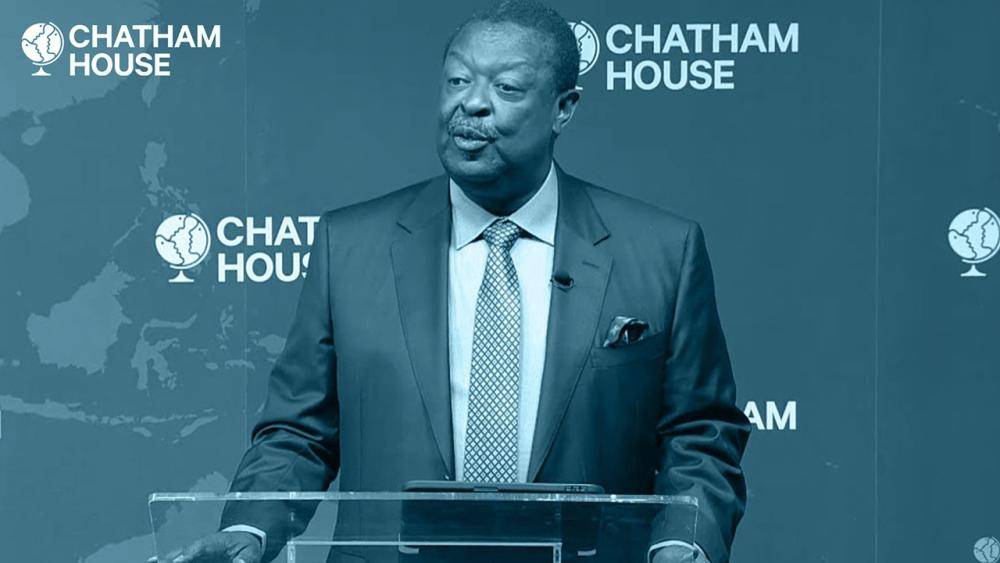
HE Dr Musalia Mudavadi EGH
Ms Tighisti Amare, director of the Africa Programme at Chatham House and chair of today’s event, distinguished guests, ladies and gentlemen, I am grateful for your invitation to address this gathering and appreciate your warm welcome here at Chatham House in London.
It is a great honour to engage with you on Africa’s agency within a rapidly mutating global geopolitical landscape. In this context, my address will focus on Kenya’s expanding foreign policy interests in a changing world order and how our state is recalibrating its diplomacy to navigate the evolving global dynamics.
At the onset, allow me to briefly comment on the weighty crisis confronting the Middle East and the wider world before delving into the subject of my engagement with you. I convey the condolences of the government and people of Kenya to the families of those who have been killed and comfort those who have been impacted by the unprecedented war. We also call for the protection of civilians and join the international community in urging de-escalation by the warring parties.
We believe that longstanding multilateral institutions offer the only and best frameworks for resolving the violent conflict in the Middle East. Certainly, the established principles of diplomacy including peaceful conduct of international relations, negotiations and mutual reciprocity, should now take precedence as they are more vital than ever for safeguarding global stability and advancing development for shared prosperity.
Kenya has not aligned with any party in the Middle East crisis. It has consistently called for de-escalation, dialogue, multilateral engagement, and adherence to international law. We remain a neutral and principled voice advocating for peace, restraint, humanitarian protection, and international legality. We are also focused on the safety and well-being of more than half a million Kenyan nationals living, working and studying in the Middle East.
The more prolonged the violence and insecurity, the more the harm, especially if traffic through the Strait of Hormuz remains blocked. Disruptions to energy supply, air travel and trade will have greater ramifications economically and security-wise. Clearly, our region, still batting terrorism, must remain vigilant during this crisis.
The Middle East war, like other global crises including COVID-19, and the Russia-Ukraine violent conflict, reinforces the need for African states to diversify supply chains and more importantly, accelerate integration including the full realization of the objectives of the African Continental Free Trade Area.
Additionally, we must accelerate the transition to renewable energy. Let us reimagine the future: if Africa were powered by clean energy including solar, geothermal and hydro, would the Middle East crisis carry the same distressing impact?
The overlap of the Red Sea crisis and the closure of the Strait of Hormuz, which handles 20% of global oil, signals a looming crisis and potential anarchy. We appeal to the Organization of the Petroleum Exporting Countries to help diffuse the tensions and be considerate of the looming crisis facing African countries from the impact of the Middle East war.
Sudan’s dire humanitarian crisis which was drawing international attention, now risks receding into a forgotten conflict as global attention shifts once again to the Middle East, as was the case during the Gaza and Russia-Ukraine conflicts.
Now, back to today’s theme, my presentation is structured around three key areas:
- Our understanding of the current global environment
- Kenya’s response to the changing world order
- Kenya’s expanding foreign policy interests
The evolving global environment
Today, international relations stand at a historic turning point. The global balance of power is changing, as new alliances emerge, old rivalries resurface, and middle as well as emerging powers continue to assert influence. Apparently, we have entered into a more complex, perilous and contested global order.
We are witnessing an international system increasingly marked by interest-driven alliances supplanting multilateral collectivism, and geoeconomic strategies that prioritise protectionism while constraining global supply chains. Transactional calculations and militarism are eclipsing long-standing principles of diplomacy such as peaceful co-existence, negotiations, sovereign equality and mutual reciprocity. In the process, the foundational values of international relations including human rights, inclusive rules-based global order and shared prosperity are waning.
The implications of these global changes are most felt in the Global South, particularly in Africa. The net effect is disrupted economic growth, escalating conflicts, a new scramble for critical minerals, and resurgence of Cold War-style geopolitics. Furthermore, democratic governance is increasingly coming under strain, marked by a troubling rise in unconstitutional changes of government.
Altogether, these global trends threaten peace and security, and erode Africa’s hard-won economic development gains. In this moment of global turbulence, African states face a twofold strategic choice: either to transform their immense potential into strategic influence on the global stage, or to remain at the geopolitical periphery as passive actors and perpetual recipients of international assistance.
Africa must deliberately transform its immense potential in technology, digital innovation, critical minerals, natural resources and youthful population, into geoeconomic influence and an assertive international voice.
Kenya’s strategic response to the changing world order
As the global environment gets more intricate, Africa must engage more in south-south cooperation to strengthen solidarity, advance self-reliance and develop collective resilience against global uncertainty.
For Kenya, these shifts are not abstract phenomena; they are lived realities that shape our development prospects, influence our security dynamics, and redefine the parameters of our diplomatic engagement.
In response to the evolving international landscape, Kenya advocates for continental peace, promotes Pan-Africanism, advances intra-African trade, and deeper regional integration. We embrace a multialliance approach that balances national interests with diversified international partnerships without ascribing to competing geopolitical and ideological narratives.
Kenya is simply looking for opportunities and diversifying relations in a pragmatic manner, clearly guided by our national interests. Our aim is not to take sides but to choose mutually beneficial partnerships anchored in mutual respect and shared prosperity.
Kenya’s expanding foreign policy interests
Kenya has long served as a regional anchor state in the Horn of Africa and the Great Lakes Region, and as a consistent advocate of African interests on the international stage. Today, that role carries even greater responsibility, particularly due to the compelling need for champions of African agency.
Furthermore, Kenya remains firmly committed to deepening integration within the East African Community, a bloc of over 300 million people across eight member states. As the largest economy in the EAC, Kenya has a vital stake in a cohesive and fully functional Community. It maintains a significant trade surplus, and encouragingly, intra-EAC trade expanded by 24.5 percent in the second quarter of 2025 to reach USD 4.6 billion.
At the continental level, Kenya’s diplomatic engagement prioritises trade facilitation, infrastructure development and connectivity, and the operationalization of the AfCFTA as a vehicle for industrial growth and competitiveness.
In February 2026, during the 39th Ordinary Session of the African Union Assembly, Kenya’s President, H.E. William Ruto, underscored the importance of ensuring national policies do not become unintended barriers to continental integration. He emphasised that this is a critical moment to advance free movement of persons and build on progress already made, including the expansion of electronic travel authorization systems across Africa.
Additionally, Kenya firmly supports the African Union Border Programme (AUBP) and its aspiration for a more integrated and ultimately borderless Africa. We believe that African borders should serve as bridges rather than barriers to continental unity and cooperation. Africa must therefore consider boundary questions with far-sightedness and a spirit of cooperation, ensuring that shared resources, especially in borderlands, generate wealth and collective prosperity for our peoples rather than trigger conflict and disunity.
Security remains central to our regional engagement. Kenya continues to support peace processes and mediation efforts across the Greater Horn of Africa. We hold that Africa should be at the centre of its own solutions. African-led peace initiatives should be respected and supported as per the principle of subsidiarity. Too often, conflicts persist because international attention always fades after ceasefires, without long-term solutions. Strengthening African institutions is essential for sustainable peace.
Kenya’s multilateral engagement reflects our conviction that global challenges demand collective solutions and that is why we have consistently advocated for reforms, not abandonment, of multilateral institutions.
In this regard, Kenya’s contribution to the Multinational Security Support Mission in Haiti underscores our belief in shared responsibility and the indivisibility of international peace and security. Our participation was guided by human solidarity, and our experience in peace support operations.
I wish to inform that Kenya concluded her mandate following the United Nations Security Council Resolution 2793 (2025) that transitioned the Multinational Security Support Mission (MSSM) to the Gang Suppression Force (GSF). To this end, I look forward to final draw down in the coming weeks and seamless transition to anchor the GSF take off in the pursuit of sustainable security for Haiti.
Kenya’s global positioning is further defined by diversified and strategic partnerships. We maintain deep economic and security ties with longstanding Western partners, including the United States, the United Kingdom, the European Union among others, spanning trade, defence cooperation, climate action, health, security and technology.
Notably, Kenya is set to jointly host the Africa Forward Summit 2026 with France in Nairobi from 11th–12th May 2026 under the theme, “Africa-France Partnership for Innovation and Growth.” The Summit, which will be the first to be hosted in a non-Francophone African country, underscores the growing pan-African and inclusive character of Africa’s partnership with France. It will showcase Africa’s innovation and talent, foster co-investment, and generate ideas to shape future industrial transformations.
It is worth noting that Kenya signed an Economic Partnership Agreement with the European Union in Nairobi on 18th December 2023. This Agreement came into force on 1st July 2024 granting duty-free and quota-free access for Kenyan exports to the 18 trillion euros market of the 27 Member States.
Also, China-Africa relations are transitioning beyond the primary focus on aid and infrastructure towards enhanced trade and investment. The announcement by China of zero-tariff treatment for African countries marks an important milestone. Kenya is engaging constructively to actualise these commitments in line with our international obligations. Kenya is prioritising local manufacturing, value-addition, and technology transfer.
At the annual Raisina Talks in India in which I participated before coming here, discussions focused on global realignments, including maximization of African economic and demographic potential. Historically, Europe, mainly the EU, has been Africa’s leading trading partner but over the years, Africa’s trade patterns have notably shifted, with Asian partners, mainly China and India, emerging as the main trading partners.
As part of diversifying the foreign policy priorities, Kenya’s partnership with the Gulf states including the United Arab Emirates reflects the expanding South–South cooperation across logistics, renewable energy, financial services, and agricultural value chains. These partnerships reinforce our commitment to a multidirectional foreign policy anchored in adaptability, diversification and mutually beneficial partnerships.
The icing on the cake is a testament of how Kenya’s expanded foreign policy has contributed to its socioeconomic transformation journey, anchored on the Bottom-Up Economic Transformation Agenda. Economic data show how the country has stabilized since 2023, after a year of upheavals that included high inflation, foreign exchange crisis and high cost of basic food commodities in 2022/2023.
Growth in Gross Domestic Product (GDP) improved from 4.7 percent in 2024 to an estimated 5 percent in 2025, driven by strong recovery in construction, mining, agriculture and tourism sectors. Inflation declined to 4.5 percent at the end of 2025, from a high of over 9 percent the previous year. Forex reserves rose earlier this month to USD 14.6 billion, a new record equivalent to 6.2 months of import cover. Expanded and diversified trade partnerships, together with high diaspora remittances that hit over USD 5 billion in 2025, have helped Kenya to maintain a stable exchange rate which has greatly improved its business confidence and economic outlook.
Kenya will continue to pursue a balanced, inclusive, and progressive diplomacy in the rapidly changing and complex world order. We will champion equitable economic growth, climate justice, digital transformation, and peace-building. We reject the notion that African states are passive arenas for external competition. Rather, we are strategic actors capable of shaping our outcomes, building coalitions, and contributing meaningfully to global stability and prosperity.
The world order may be evolving, but our commitment to responsible global citizenship remains constant. Kenya stands ready to engage, to partner, and to lead, guided by the conviction that a more representative and stable international system is both necessary and achievable.