Galip Dalay
Hello, and welcome, everyone. It is very nice to have this quite the full house, experts, panellists, attendees, with us, and I think one benefit that probably the UK is getting from the changing climate is that nowadays, you have more Mediterranean weather in UK than you do in many parts of the Mediterranean itself. So, that’s – in itself, you can see it as a positive side of the climate change, at least for the UK.
Today, we will be discussing “The new Eurasian chessboard,” the position – how the position of Eurasia and Central Asia is changing in international politics. Obviously, more and more, when you look at Eurasia and Central Asia, as well, it is turning into an central location for the great power rivalry. You see how the different external power are repositioning themselves in this space and it is also becoming an emerging – a pivotal place for the East-West connectivity, for the energy transition, for the critical raw materials. So, the interest in the area is increasing significantly. You can see this based on the expert discussions, the political visit that you are seeing by the leaders of the region to the difference or the important location in the world, but by the leaders of the important global powers to the region.
Today we will be discussing the region, the different dimension of it. We will also try to sort out why, all of a sudden, we are seeing that much interest in the region and with also, a view how Europe, the UK, Turkey, US, can become more collaborative in this space, rather than competitive, given the nature of the great power competition that is unfolding.
I have to mention, also, the great partnership that we are cherishing, we are very much valuing, with the GMF. So, this is an event that we are co-organising with the GMF, so it is – has been part of the series of events that we have organised here, but also in Brussels. So, we are very much grateful for this partnership, and we very much hope that this partnership is going to cover many more events and many more partnership in the coming period.
I have a stellar panel of speakers with me. So, we have Kate Mallinson. She is with us here at Chatham House as our Associate Fellow in the Russia and Eurasia Programmes. She is also the Director of PRISM, which is a political risk consultancy focusing on Eurasia and Central Asia. We have Domitilla Sagramoso. She is a Senior Lecturer at the War Studies Department at the King’s College London. We have also Kadri Tastan, who is a Non-Resident Senior Fellow at GMF in Brussels.
So, without further ado, I would like to start with you, Kate, and asking you the – actually, probably the most conventional question, which is, why do we see that much interest in Eurasia, Central Asia, increasing in recent times?
Kate Mallinson
Thank you very much, Galip.
Member
Could you tell us which the countries are in Central Asia?
Kate Mallinson
I am going to be talking about Central Asia, which is Kazakhstan, Kyrgyzstan, Uzbekistan, Tajikistan and Turkmenistan, but thank you, Galip.
So, to, kind of – yes, there’s a, kind of, confluence of interest, kind of, hitting Central Asia today and I’m going to talk about some of them, why now, and how this is all, kind of, unfolding. Most immediately, the closure of the Hormuz Strait has, sort of, put focus again on the Trans – well, put focus on the Transcaspian Middle Corridor route. With the Northern Route through Russia largely constrained and Southern Route through Iran out of access, even though the Central Asian governments had been really engaging with Iran over the last few years. The Central Asian countries are looking for ways to diversify their exports more than ever, and this aligns with Western support, major support, for the Middle Corridor.
Domitilla’s going to be talking about Russia’s weakened influence in the region, so I’m not really going to touch upon that, but just to say that it’s really emboldened the Central Asian states to seek out their new economic partnerships and diversify their investor bases. But also, what we’re seeing, and we’ve been seeing for the last few years, is a commodities super story in Central Asia. There’s a lot of investment going into oil and gas, gold, renewables and uranium, and this is the result of higher commodity prices that have really improved Central Asian states’ balance sheets and driven strong investor interest. Particularly in, kind of, debt offerings and some listed equities, like the Kazakh miner, Kazatomprom.
But Western governments are particularly focusing at the moment on – well, they’re looking for new supply chains for critical minerals and trying to reduce the West’s reliance on China. And this comes at time with this more transactional, unconditional, kind of, way of doing business under the new – well, the US administration, we’re seeing a lot of, kind of, deals coming fast and furious into Central Asia. And I think – you know, there was a deal that took place last week that crystalised the forces at play that we’re seeing, which was a shell company which was backed by Donald Trump Jr. and Eric Trump, which agreed to merge with a US critical minerals group, that secured up to 1.6 billion last year. Yeah, so it was, like, last [inaudible – 10:46] visit, to support a mine – to mine tungsten in Kazakhstan.
And tungsten is a highly sought after high-density metal that’s used in drilling tools, armour piercing bullets and kinetic energy missiles. Currently, China produces 80% of this and so, the West is very keen to secure other, you know, places to supply it. And this would give the Americans and the US President’s son a stake in a company that, you know, could potentially sever America’s reliance on China for it. And the majority of Kazakhstan’s minerals at the moment are sent to China and to a lesser extent, Russia. In 2023 and in 2024, 100% of Kazakh rare earth production was sent to China. So, the West really sees it as a, you know, an important time to undermine their supply.
But at the same time, China’s interest in the region and influence is really developing quickly as this, kind of, geoeconomic fragmentation takes place and deepens because of the war in Iran. And this has a lot of economic benefits for Central Asia, and there’s a lot of Chinese investment going into oil and gas and mining, but also into new sectors, such as consumer goods, technology and the auto industry. But, you know, for the first time ever, the – America’s, sort of, willing to compete with China in areas of interest in Central Asia that – where it previously hasn’t. And we’ve seen huge announcements on technology development, datacentres, data connectivity and artificial intelligence, and this is a really new thing for the Central Asian region and a welcome development for the Central Asian governments that want to engage with China but also want to have some kind of balance in this new technological revolution.
Relative to America and China, EU is institutionally more locked into Central Asia than the US. Most of its engagement has centred around this Middle Corridor with the Transcaspian International trade Route, and it launched an enormous package, 12 billion Global Gateway for transport infrastructure last year. And the UK is also deepening its strategic, economic and security ties with the region, but the – both the EU and the UK really risk falling behind the US and China. They haven’t been able to match the scale of investment and equity stake that we have seen coming from Washington and Beijing. They can’t match the firepower of the Development Finance Corporation, or the EX – or EXIM Bank, these develop – massive development financial institutions that the US has and that operate at these, kind of, enormous scales and at very fast speed and have these huge mandates. And this difference has been particularly evident in the critical minerals sphere.
Turkey, I think my colleagues are going to speak about later, so I’m not going to talk too much, but it’s also strengthening its role as a key influential partner in Central Asia. But I think – I lived in the Central Asia in the 90s and there was a, kind of, flurry of investment and a lot of excitement when the Soviet Union collapsed. But it’s very different, the environment there now, than it was then, and this is particularly because the Central Asian countries have much more agency. You know, then, in those days, the risk premium was really high, but today, the Central Asian countries are able to dictate what kind of investment they want and how they wan – you know, how they see their projects developing. And I’ll just talk a bit – give a few reasons about this and then I’ll hand over.
But prosperity. The region is much more prosperous than it was previously, mostly middle-income countries, and the collective GDP of Central Asia is something like 700 billion. And there’s now – they’ve got this, kind of, geopolitical balance with the relative weakening of Russia because of the war in Ukraine and the rise of China. You know, we’ve seen the rise of other political player – geopolitical players in the region, Turkey and the Gulf. And this has given Central Asia options in terms of who and how it is engaging with external partners.
And integration I think is my third point here. Perhaps the most critical change we’ve seen in Central Asia is that the region is far more united than it ever has been before. And those of us who’ve studied Central Asia over a long period will, kind of, remember the, kind of, Sisyphean task of trying to, you know, get Central Asian, the, kind of, leadership to co-operate, even to meet, sometimes. And now we’ve seen the emergence of the C5, a really powerful regional organisation that’s now spreading across to Azerbaijan in the form of the C6. And this, kind of, demonstrates that the region is really thinking not only about its own economic integration, but also sec – to secure export routes out of the region.
I’ll hand over on that.
Galip Dalay
No, well, that has been very good. I will be – in the second round, particular, I would be interested, given this great power competition, as you also mentioned. Both the US is deepening its footprint, China is becoming much more visible there, the Russian position is weakening. How the region is responding to its strengths? Are they probably becoming more autonomous or are they becoming more closer to the certain countries than the others?
But before that, Domitilla, I mean, Kate also touched on the role of the Russia, because that was the traditional actors in the region previously, but how the, you know, the war on Ukraine is redefining the Russian position in this Eurasian space?
Domitilla Sagramoso
Thank you. Thank you, Galip, thank you very much, also, to Chatham House for inviting me. I think what is interesting to note is that Russia still has an important presence in Central Asia. And although its influence is waning in the region and it’s being increasingly challenged, as Kate noted, by China and other actors, such as Turkey or the United States or Europe, I think it’s still a relevant actor in the region, and it’s still, trying to keep, in a way, a, sort of, a sphere of influence. But I would argue that its ability to exert this influence is really challenged by its limited, sort of, capabilities, and it’s not only military, but also economic, and these have been suffering very much from the impact of the war in Ukraine.
But the first point that I want to mention in that respect is how, sort of, the war in Ukraine and the sanctions that were imposed by the West on Russia resulted, really, in a spike in trade between many Central Asian states and Russia, as a way to bypass sanctions. So, if we look at some of the data, it’s quite interesting. For example, Kyrgyzstan exports to Russia soared to a 250% volume increase in 2022, so from the previous year. Then, the figures are also quite high between 2021 and 2023, with Kazakhstan, exports to Russia increased by five – 39%. In the case of Uzbekistan, by 77%. Armenia is also a country that has been part of this, sort of, bypassing and triangulation of sanctions.
So – and this is – what is interesting is that many of these goods that are exported from the Central Asian states of Russia, they are not really produced in the Central Asian states. And at the same time, we really see an increase in the trade of European countries, with some of the Central Asian states. For example, you know, dual good – dual-use goods increased by around 800% in 2022 from the European Union to Kyrgyzstan, and then there was also a very sharp increase of dual good – dual-use goods from Kyrgyzstan to Russia. So, as a result of that, you really see an increase in trade between Russia and Central Asian states, which is quite significant, and this is – it’s really quite interesting.
Of course, it doesn’t match the increase in trade turnover with China, which China more than doubles it to 106 billion in 2025, but it’s still important in that respect. And it’s also facilitated, of course, by the geographical proximity, but by the fact that countries such as Kazakhstan, Kyrgyzstan and Armenia are part of the Eurasian Economic Union, so there is much more fluidity with their transit in goods. Also, what is interesting is that China is using a similar mechanism to send, you know, dual-use goods to China through Cent – to Russia through Central Asia. So, that, I thought, was really very, very interesting.
Russia also remains relevant in the energy field, because it’s an exporter of gas to Uzbekistan and to Kazakhstan. It is also investing in a nuclear power plants in Kazakhstan and in Uzbekistan, and it also controls import and export routes. Especially if we think of the oil export route from Kazakhstan, from its oil fields in the West, through the CPC, the Caspian Pipeline Consortia, that travels through Russia and it carries almost 78/79% of the oil from these fields in Kazakhstan to a global market. So, to a certain extent, Russia has the ability to, sort of, exert leverage and pressure, as we have seen recently with exports to Germany originally from Kazakhstan.
Also, Russia’s trying to invest in rare earth, but as was mentioned by Kate, you know, the challenges are quite strong in that respect from China. The Chinese and the Americans also trying to invest in these countries that have significant rare earth metals. But also, China is investing in other, sort of, traditional energy sectors, like oil and gas. It has the oil and gas pipelines that link the region of Central Asia to China and as a result of that, it offers alternative markets to Central Asia. But – and China also, of course, has this strong presence in Central Asia through what we call the Belt and Road Initiative, which involves a series of roads, railways, custom facilities and also, trade agreements, which really facilitate the trade between the Chinese regions, specifically in the Western parts of China and Central Asia, and potentially, Russia. But of course, now there is competition from the Middle Corridor, which Kate mentioned, which is intended to link Central Asia, through the Caspian, through the South Caucasus, potentially to Turkey or the Black Sea, to European markets.
So, there is – there are these challenges that are emerging, and if I have a few minutes, I would like to say a bit about, also…
Galip Dalay
Maybe asking on Russia especially, because you mentioned that the trade between Central Asia and Russia has increased and probably this is due to the sanctions, so the…
Domitilla Sagramoso
Yes.
Galip Dalay
…Central Asia saw it as a substitute. But if we put this aside, how is the Russian position in the strategic aspect of the Central Asian economy, defence industry, or the elite perception of the Russia? It is changing? Is it deteriorating?
Domitilla Sagramoso
It’s – I mean, there is a perception that Central Asia – acro – from Central Asia, that Russia is no longer a very strong security provider, which is what I was going to mention now. I mean, but it remains a significant – I mean, it has still a very significant military presence in Central Asia. It is a deployment of troops in Tajikistan and some of these troops have participated, apparently, in the operations in Ukraine. It has a joint Russian-Kyrgyz military base in Kant, and I can say – provide more details on that. There is a missile testing range in Kazakhstan.
So, there is im – there is still an important military presence of Russia and through the Collective Security Treaty Organization, Russia is theoretically the provider of security. But what we have seen in the past, and not just now but also before, in the 2010s, is that Russia has not really been able to deploy massive forces to support situations when there were, for example, instabilities in Tajikistan related to crime and to the drug smuggling and Islamist violence in Afghanistan. We also know that there is a challenge of ISIS Khorasan, with Tajik and Uzbek participation. So, that remains problematic.
We’ve seen Russia participating in support of internal instability in Kazakhstan in January 2022, but in other instances, Russia has not really been able to act effectively when there was inter-ethnic violence in Kyrgyzstan in 2010 and the Kyrgyz Government asked Russia for support and it wasn’t really forthcoming. And really, what we see is that in a way, Russia is not really able, entirely, to provide security along the so-called, you know, Afghan Tajik challenging border, and instead, the Chinese are increasingly coming in, providing military support and establishing a military presence there to address the challenges of warlords, criminal gangs. Also, because the Chinese suffered from some of their workers being injured and killed as a result of some of these, sort of, gang operations.
So, China is increasingly a provider of military support, but I still think that Russia plays a part in what we sometimes call soft power and remittances. I mean, it really is important in terms of, you know, what we call cultural diplomacy. Russian language is still relevant. It plays a role in education. We must remember that, for example, Kazakhstan has a very significant, almost 20% part of the population, that is originally Russian speaking in the north. We can call it, sort of, ethnic Russians. There is also a legacy of connections, and these remittances bring these people together. But of course, there are limitations to that, because I think the younger generations in Central Asia are moving a bit away from Russia. There is a move, also, away from Cyrillic into the Latin, and I think the Turkish influence in that respect, which probably you’re going to mention, is going to be very, very significant.
And let me just finish, if I may, by…
Galip Dalay
One minute.
Domitilla Sagramoso
…a few points about the institutional arrangements. Ri – you know, Russia set up organisations when the Soviet Union collapsed, the CIS, the Collective Security Treaty Organization, and the now Eurasian Economic Union, where Russia really remain the dominant power. I’m very happy to discuss those in greater detail. But that has now been challenged, not only by the Shanghai Cooperation Organisation, where the Chinese are quite strong, by the Belt and Road Initiative, as I mentioned, on the economic sphere, but also by the Chinese, what we call institution building. They are also developing some kind of partnerships and their own mechanisms of co-operation, of institutional arrangements, which are challenging the presence of Russia.
And I think that, you know, China, of course, has a lot more to offer in terms of capital technology and markets, but what is interesting is that today, if you compare the way that China operates with Russia in Central Asia, it’s much less controversial and conflictual than the kinds of, you know, operations or, sort of, the – it contrasts with the European involvement in countries of the Soviet – former Soviet space in the European side, in their European theatre. It seems that Russia, also because of its, sort of, now much more reduced strength in its relation with China, it is forced to accept a Chinese presence without really challenging it quite significantly, and I think that’s very interesting. So, thank you very much.
Galip Dalay
Thank you. Kadri, but also a reminder, this is on the record, so please feel free to, you know, pause by using #ChathamHouse_Events, hashtag, and also the one that is following us online, please, like, pose your question in the Q&A box. So, I will be posing these question to the speakers.
Kadri, so there has been quite a few emphasise on the question of connectivity, and the question of connectivity has become more important following the Ukraine war and now the Iran wars, because the main connectivity lines has been very much affected by it. So, how the connectivity question, more specific the Middle Corridor question, is evolving nowadays?
Kadri Tastan
Well, thank you very much. It’s a great pleasure to be here, of course. We are really happy to organise this joint event with Chatham House for a second time, I think.
Well, before coming to the connectivity, let – and Middle Corridor, let me to say also something about Central Asia. And just to say that, actually, Central Asia is not anymore only a space where there is a great power competition, but it’s true that the countries of the region are more and more having their own di – own autonomy and the direction relatively, I have to say. Especially it was mentioned by my fellow colleagues, also, that the Russian occupation is creating an – a lot of space and this is creating a lot of opening, of course, for European Union and for UK or Turkey and other countries.
And of course, Central Asia is – it matters today because – much more because – it’s not because the geography changed, but the geopolitics around the region change enormously. So, once it was just a, you know, a remote region, but the interest is not new, actually. The interest in this region is quite old, especially in the resources of this region, but what is new now that is the region is becoming a, kind of, strategic hinge between the – you know, when it’s come to the routes, systems and the connectivity issues, infrastructure, etc. So, this is, I think, is something new.
Let me – so, to make five brief points. The first one is I think that it is important to mention that the geopolitics and the geoeconomics are fully intertwined today. So, nothing is – I mean, the connectivity, infrastructure, trade, they’re not natural anymore. So, the geopolitics is playing a huge role here, and supply chains are not, you know, in the happy – the glo – the happy year of globalisation. We wouldn’t maybe consider these kind of things, but today supply chains are shaped by the security, by control and even sanctions, more and more.
So – and the second point is – the second points that I would like to make, that the Central Asia is, as I said at the beginning, is not anymore a region that we are interested because of the resources, energy resources. The region is becoming a connector, an important connector, direct – connecting directly Europe to Asia and also, Europe to Central Asia, through the South Caucasus. And I think all this is really related to the – in which kind of global conditions we are living and the disruption that we are seeing globally when it comes to the supply chain issues and also the – especially the – I mean, even with the recent conflict in Iran and the – all the disruption that we see, even when it comes to the – to maritimes chokepoints.
And this is bringing me, actually, to the connectivity issues – issue, and the Middle Corridor, and the Middle Corridor, of course, is the – is becoming important because – it’s not because is the easiest – is the best, basically, corridor, but basically, it responds many challenges. Bypass Russia, it’s created new – and it is becoming an alternative, and those countries are – and Russia is occupied by Ukraine. Those countries, as I said at the beginning, they are much more autonomous in their research for the diversification, and all this is creating opportunity for the Middle Corridor.
And also, as Kate also mention, this re – the connectivity is one important aspect, but also, the research and the interest in the critical raw materials is very important. The region is, basically, hosting a lot of critical minerals and to diversify, and the European Union is, especially, it’s trying to diversify and to decrease its dependency on China on those minerals, in many regions, but the Central Asia, also, will play, I think, an important role in this sense.
Another point that I – the fourth point, actually, that I want to make is – sorry, the fifth one, as – is that in theory, everything is fine. I mean, the – it seems to be an interesting, you know, alternative, but there are a lot of challenges, of course, and I think there are a lot of rhetoric about the Middle Corridor, connectivity, diversification, but there are also a lot of challenges. And let me also to mention that there is a huge dilemma here. These kind of projects, they need a lot of investments, a lot of finance, and there the challenges are huge, but you need a lot of time to invest and to bring particularly private investments. But the global conditions are also changing incredibly quickly. We can already here, for example, from some European countries, that we should maybe go back to the business as usual with structure, or to – maybe again, in the future, we will be obliged to use the Northern Corridor. And with the climate change, we also see the North Pole, actually, there, also, the trade route is opening.
So, it’s not easy. Until we get the investments, we are investing and this route is becoming operational, many things might change, but this is not the important – the most important one. As I said again, there are a lot of chokepoints, also, in that corridor that we are defining, and even if there are also some cognitive development, like the normalisations between Azerbaijan and Armenia and also /Armenia-Turkey normalisations. But I think the countries of the region, in Central Asia, they’re not expecting just to become a corridor for, you know, Chinese and European trade, but they want to have a much more important role and an integration in the supply chain globally.
Maybe I should stop here.
Galip Dalay
Well, I think that is one of the big question about the Middle Corridor? Is it a corridor, is it a region building initiative? Is it, you know, creating a economic space? So, in a sense, there are elements of all of them in the Middle Corridor, but none of them will exclusively probably define the Middle Corridor, and I already see in the chat box quite many question and a few of them on Middle Corridor. Let me – since I’m with you, so let me ask you the questions on the Middle Corridor. So, this one is quite a long question, but to cut it short, “The Hormuz crisis showed once again the importance of the Middle Corridor and the actuality of the Belt and Road Initiative. Taking into account the said this, will the EU’s Global Gateway Initiative, or similar initiative of Western powers, pivot more to the Middle Corridor via the Caspian Sea?” So, anyone would like to take this? And – or also, “Will the Middle Corridor cause any friction between the neighbouring states?” is another questions. And there’s one on the UK on the Middle Corridor, “How does the UK sees the future of the trip with the wider Middle Corridor architecture?”
Kadri Tastan
Yeah, actually, let me to say something about Middle Corridor first. Let me look at, actually, the discourse or – of different countries and region on the Middle Corridor. We see that actually, each country has its own vision about the Middle Corridor, and they are not always really similar. It – they are – they can be quite contradictional, even. From – for example, from European perspective, the Middle Corridor, even if we hear really different messaging or rhetoric from the different European DGs, trade, will have a different vision on that, DG, intra – will have another, maybe, discourse. But it’s obvious that the European Union doesn’t want that the Middle Corridor it’s becoming one-way route for the Chinese products. So, here the dilemma would be how to separate, really, BRI and also the investment that did come from the Global Gateway into the Middle Corridor. This is one thing, and for the Central Asian countries, they is – the vision will be different, from Turkey’s perspective, it will be different. So, there are these kind of differences that I think is men – is important to mention.
But about your question, Galip, I don’t believe that – I mean, it’s obvious that Middle Corridor is incredibly small, still. I mean, even if the importance of the Middle Corridor is there, we saw that the trade that is passing through the Middle Corridor, and even if the data is not really easy to collect the data, you can maybe have some data from Kazakh Government, some from Uzbek Government, etc., but no-one knows how many really transport is happening through this region. But we know that actually, the trade through this route increased and the trade through the Northern, means the Russian one, decrease, but is still not comparable.
So, yeah, I don’t believe that the Middle Corridor will replace the Northern Corridor or Hormuz, etc. I mean, it’s impossible, the relevant infrastructure, etc., you know, but it will be an alternative. I think that this is the key word, I think, the diversification. So, the Middle Corridor, it will be just diversification strategy via one of the corridor.
Galip Dalay
Sure. I will take some question from the – yes, the back and then…
Houman
Thank you very much. I really appreciate this amazing event. My name is Houman. I’m a PhD Researcher on financial crime and intelligence. I focus on Russia, China and Iran. My question is, if partners in Caspian corridor, including Azerbaijan, are perceived as a potential knot of sanction evasion linked to Russia, what specific policy tools are available to EU, UK, US and Turkey to strengthen the compliance mechanism, while maintaining energy security and regional connectivity? Thank you.
Galip Dalay
Let’s collect a few questions. George.
George Hajipavli
Thank you. My name is George Hajipavli from the University of Oxford. My question is, is China – are China and Russia partners or rivals in the Belt and Road Initiative? Obviously, the initiative begins in China and some speakers mentioned that Russia’s now increasingly willing to acquiesce to Beijing. However, what I hear from Moscow is that they will be really enthusiastic about, for instance, the prospect of India joining the BRI instead of IMEX. So, are the two – so, this sounds a bit more than acquiescing. Sounds a bit like enthusiasm, so are the two partners or rivals?
Galip Dalay
Thank you. Here.
Anthony Robinson
Anthony Robinson, formerly…
Galip Dalay
The mic is coming.
Anthony Robinson
Sorry?
Galip Dalay
The mic is coming.
Anthony Robinson
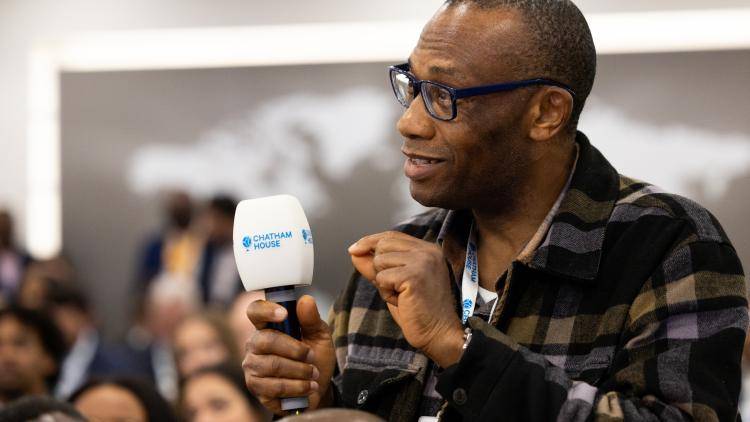
Oh, I’m sorry. Thanks. Hi, Anthony Robinson, formerly of the FT. China’s a big place and – but what is significant about the Chinese aspect of this is that Western China was essentially landlocked. It’s Western China, the development of Western China, that’s had the major impact and made it more – most important for the – you know, for that connectivity both to the West and to the South.
A second point is Iran. Now, Iran used to be if the pigs could fly and there were no politics, that would be a great solution, and for a long time, the Kazakhs very much would like to ship their oil to Kaza – to Teh – to the ports on the northern – on the Caspian shore of Iran, to serve the refineries which serve the populated area around Tehran, especially that part there. And export and get the southern Iranian ports, which are now blockaded, of course, and to actually export, directly, without pipeline, send it. So, it’s a – economically, it makes an awful lot of sense.
What – my question, excuse me, it’s a bit longwinded, but it – my question is, what does the weakening of American prestige and American power mean and -to this overall geopolitical situation? Thanks.
Galip Dalay
That’s an excellent question, what is the impact of? I will come for the second round, so I have – will collect the three and also limit at one more question and then, I will start with you, Kate, and then to Domitilla. There are more than 12 question here, so I will only pick one up as few of them. “Is the engagement of great powers like China and the US, with issues of mineral supplies, reflected in the increasing autonomy of Central Asian countries, or is it resulting in a sustained increase in the collective power and strength,” you know, “of organisation like C5?” Would you – and any other question that you would like to pick that’s…?
Kate Mallinson
And then the question you asked me before, but yeah, okay.
Galip Dalay
Yeah.
Kate Mallinson
Yeah, I’ll answer that one first.
Galip Dalay
Yeah.
Kate Mallinson
Okay.
Galip Dalay
And then, Domitilla and then, Kadri.
Kate Mallinson
Okay. Just the answer to the compliance question in Azerbaijan, which was interesting. I wasn’t quite sure where the violations were that you were talking about, but I think it’s a really interesting topic. Today, when we’re seeing this new American admini – not new, American administration which is, kind of, less – adheres less to the rules-based Western order, and I think that’s why the Trump administration is doing so well in the South Caucasus and in Central Asia, to a degree, that they, sort of, understand how they do business. It’s much more transactional, it’s much more informal and with much less regard to all the, kind of, compliance building bricks that have been put in place over the last few years. And, you know, there’s a real question about, you know, what comes next post-Trump? And, you know, we’ve just seen the EU in its latest sanctions package, put more sanctions on Kyrgyzstan and, you know, the region is at risk of sanctions violation and circumvention. So, that is one to watch.
And you had another question about…
Galip Dalay
Well, basically, the great power competition.
Kate Mallinson
Yes.
Galip Dalay
How the regional states are adjusting to it.
Kate Mallinson
Yes. I mean, that’s really interesting, and I think because the region sees Western governments just come and go and so, they have a lot of respect for seeing President Xi, and also – in power and other, kind of, Presidents in the region who’ve been there for a long time. But also, at the end of the day, geography matters a lot and we tend to look at the region through this, kind of, slightly hubristic Western prism and think they want to be like us, but it – they know that they’re going to have to live with their neighbours. And as Domitilla said, you know, there’s so much, kind of, economic dependency, the, kind of, inter-trade relationship, particularly with Russia.
So, I think that, you know, they’re being pragmatic, they’re being short-termism. They can see, you know, there’s this – suddenly, you know, they’re the belle of the ball. There’s a lot of capital coming in from the West into their critical mineral assets, in particular, and into building infrastructure. You know, why would you not take it? But long-term, I think, you know, they see the relationship with China developing more, you know, as a, kind of, more solid relationship because of the, kind of, trade links and, sort of, cultural affinities. There’s lots of Central Asians now learning Chinese. And, you know, they really admire the economies of China and the Gulf, and those are the models that they want to emulate. In the 90s, you know, it was the right time, perhaps, to look at the Western economic liberal order, but now, they really admire what they see that’s been done in China, Singapore and the Gulf.
Galip Dalay
And nowadays you see the number of Gulf-Central Asia meetings is increasing in the Gulf states, and that’s quite indicative, as well. There is one question that is very much pertinent to what you’ve just said, Kate. “What can Western actors do to support intraregional co-operation in Central Asia without turning it into another geopolitical competition with Russia and China?” So, $1 million question, anyone would like to answer?
Kate Mallinson
Do you want to answer that one?
Galip Dalay
Or Domitilla.
Domitilla Sagramoso
Well, I think it’s very hard to become engaged in the region without thinking that there is competition from other sources. I think the question is not the competition per se, but how that is translated in the relationship and whether it becomes conflict or – so, I think there is a tendency to see any kind of interaction as creating some kind of competition. And this is what I wanted to know, that it doesn’t – of course, there is competition, but it doesn’t reach the level when there is a real conflict and also, when it results in some kind of military intervention. So, I think that the competition will always be there, but what is important is to understand that, you know, it can be accommodated, you know, considering the interests of the countries locally, and therefore, not, sort of, become an issue of either/or, sort of, forcing them into particular choices.
But if I may, Galip, answer some of the…
Galip Dalay
Yes.
Domitilla Sagramoso
…questions that were…
Galip Dalay
Sure.
Domitilla Sagramoso
…asked, which I think were directed at me. The question of sanctions, what is interesting is that Turkey also became a, sort of, a country of circumvention of some of the sanctions. But overall, I think it’s very challenging to address this question because there are so many different countries that are involved at many different, sort of, shell companies and schemes that are set up, that it makes it really, really hard, that some of the payments are carried out in cryptocurrencies. Like, Kyrgyz set up a, sort of, a stable currency in roubles, which was addressed by the Europeans. As Kate mentioned, now there is also sectorial, sort of, sanctions imposed on Kyrgyzstan.
But I think it’s – there is a limit or – of what Europe is really effectively able to do, because not every country has really subscribed to the sanctions. So, in a way, we’re forcing what we call these secondary sanctions, and that becomes a lot more complicated and it makes it much harder. For example, there was also a problem with transshipment, with trade that was lost in the transit because it was transiting through Russia, in theory to Central Asia, but it got lost, and this was now addressed in 2023, with new sanction packages. So, at each one of these sanction packages, more elements are being addressed, but there is a risk, as well, that these countries become alienated from Europe and the West, because – and on the other hand, they would like to continue with the benefits of these trade.
To the question regarding India, China and the Belt and Road Initiative. Yes, Russia has its own, sort of, North-South initiative via Iran, to the Persian Gulf and through Armenia, initially, and that is being challenged. But at the same time, I think that, you know, the opening that could occur between Armenia and Azerbaijan and the Trump, sort of, interconnector, I think that really opens a lot of possibilities, because it also involves rail connections from the South Caucasus to Turkey, Belize Kars railway. So, I think there i – the potential is there for the region to become much more open and now moving to the South Caucasus and the potential to involve this region also, not just as transshipment, but also as an area where their own products can be sold and they can trade internally. Because it’s – some big problems of the South Caucasus was this, sort of, this division that was a result of the Karabakh, you know, the legacies of the war. But because now there is a more agreement between Armenia and Azerbaijan and the challenges around that, it seems that there is a possibility that the region might benefit.
There are some bottlenecks, for example, Georgia doesn’t have deep sea water ports that can handle a lot of the cargo. So, you know, we – the whole transit, trans-shipping through the Caspian, also faces challenges, necessary port infrastructure there. The Anaklia Port in Georgia, which is not really taking as it should have. So, there are issues there and I think that the Russians, again, I’m not saying that they are – they don’t mind about the One Belt One Road. I mean, in a way, the Eurasian Economic Union was a response to the Chinese penetration into Central Asia, which dates to the 2010s already, in terms of trade, investment, infrastructure. So, Russia tried to create its own, sort of, customs system to keep the area closer to Russia in terms of trade and investment.
So, the competition is there. I’m not saying it’s not there. I’m just saying that it doesn’t result in a collapse of the relationship between these main actors.
Galip Dalay
Thank you. Kadri, only one and a half minutes, because then we have a few more questions. The question that you pick and also, there is a question in terms of the financing of Middle Corridor and then the Global – Europe’s Global Gateway. So, how the financing question is being addressed in one and a half minutes.
Kadri Tastan
Half minute, okay.
Galip Dalay
One and half.
Kadri Tastan
One half, okay. Well, Global Gateway, let’s not forget that is, as the name itself, it speaks, is a global. I mean, it’s not only about – so, some portion might go in the Middle Corridor, but for the moment, we are not there. I mean, there are some – you know, during the EU-Central Asian Summit, the EU promised to bring maybe €12 billion of investments. There would be different European institutions. You know, Global Gateway is bringing all European, kind of, national or supranational institution, financial institution, all together. So, there would be EBRD, Eur – EIB and even some, you know, like, French, how you say, Agence Française de Développement or other European national, the all financial institutions, etc.
But there is no still, like concrete, I mean, and it’s not really – it’s just in rhetoric. We ha – we don’t have still, something concrete on that. And what’s – the Global Gate – what make Global Gateway in theory, and what should make Global Gateway powerful, is if you succeed to bring private money – sorry and finance, actually, and private investment, and this is still not there. So, it’s too early to say how it will work in this sense and it’s – as I said, is not very – is quite fragmented, etc. There are all these issues.
Galip Dalay
Without private money, it’s unlikely to be realised…
Kadri Tastan
Of course.
Galip Dalay
…as far as that. We’ll pick three questions and then, we’ll – please, like, very short questions. I saw this gentleman and David Priestland and Tim Ash.
Jason Spalding
Jason Spalding, Department of War, retired. What do you think the role of super empowered individuals, so Stack, essentially the Facebook Marketplace of Russia, and Geofencing? Starlink connectivity is basically, cutting off interserve – internet services to Central Asia. Thank you.
Kate Mallinson
And David.
Galip Dalay
David Priestland.
Professor David Priestland
Yeah, David Priestland, Oxford University.
Galip Dalay
Yeah, and…
Professor David Priestland
Although clearly, there is…
Galip Dalay
If you introduce yourself.
Professor David Priestland
Sorry, David Priestland, Oxford University. Yeah, there – I mean, clearly, there is a lot of appeal of the Chinese model, as Kate was saying, but there’s also been an anxiety for some time among Central Asian elites about dependence on China. And I’m – and so, I suppose I’d like to ask the speakers about their, sort of, longer-term perspect – projections. That, you know, clearly there are challenges from the US, particularly, as Kate was talking about, but how far are they going to be able to, you know, really challenge Chinese dominance of infrastructure and the need – and the standards that the Chinese will be intro – will be requiring compliance with?
You know, is investment in critical minerals really, you know, bit of investment by private sector and Trump relatives, really is – how far is that really going to challenge? Or indeed, the Europeans or the Turkish interests, how far are they really going to be able to challenge, say in 20 years’ time, this really being – becoming a dependent area of China?
Galip Dalay
Here.
Isabel Hilton
Thank you very much. Isabel Hilton, member of Chatham House. I was struck, Kate, by your remark about cultural affinity. It certainly used to be thought that Central Asian people’s cultural affinity was with the people of Western China who identified as Turkic rather than as – and Chinese. So much so that what became the Shanghai Cooperation Organisation began as a Beijing security move on the collapse of the Soviet Union to shore up that border in case ethnonationalism infected Xinjiang. And since then, we’ve seen Chinese minority policy move from the Soviet style to forced assimilation.
I’m – I wonder if the panel thinks, and I would include Turkey in this, Turkey used to host the exiled Uyghur leaders, for example, whether you think this is a dead issue or merely a dormant one which could return.
Galip Dalay
Thank you. Tim.
Timothy Ash
Tim Ash, Russia and Eurasia Programme, Chatham House, as well. Two questions, one very similar to this one, in a way, that I wonder how far leaderships in Central Asia are in line with their affinities of the populations. In terms of changing cultural shifts, I mean, do Central Asians look to Moscow or Russia and they speak Russian or Turkish, or they watch Russian TV or Turkish TV, or they buy products from Turkey? I mean, are you seeing a changing narrative there? And then the second question, really, in terms of Russia, do you think Russia has accepted its diminished role in Central Asia, and when the war in Ukraine eventually ends, do you think Russia goes back to trying to – to reset back to where it was?
Galip Dalay
And the final question, [inaudible – 56:49].
Member
Thank you very much. My name is [inaudible – 56:52] and I am a Research Fellow at the LSE, and my question is about Turkey. So, Turkey’s projection of power of influence and outreach to this region has many dimensions, of course, from energy and economy, to cultural affinity and kinship, also related to its status of a middle power. So, my question is, how is this perceived by Central Asian countries and what are the areas of convergence and divergence between Turkey and Central Asian countries? Thank you.
Galip Dalay
Thank you. We have five minutes, so each of you have two minutes and so if we – and so, pick the question that is most relevant to you. Kate, yes.
Kate Mallinson
I’ll talk a little bit about China. I mean, I think yeah, it was a very valid question. You know, there is a real risk of some of the countries becoming, sort of, protectorates of China in the next 20 to 30 years, if, you know, if they don’t, sort of, hedge relationships and balance, just because of the sheer appetite for resources in the region and then, kind of, the ambitions of the Chinese. I think President Tokayev’s been a great leader for a very difficult time, kind of, navigating this. You know, he was shored up by Russia, both – and there’s a Russian CSTO in 2022. He’s now going onto the Board of Peace with Trump, but he’s also very much respected in China. He’s a Mandarin speaker and, you know, he’s been – he’s doing the job as well as he can do, but it’s a very difficult situation being so near to China and them needing all the resources.
As in, kind of, cultural ties, I mean, you know, a lot of Kazakhs I speak to, kind of, middle classes, they’re sending their children to China these days. I speak to Kazakh friends who used to live in Europe and they say, “No, actually, we’ve gone back to Kazakhstan. The opportunities are much bigger for us there,” and I think, you know, that’s true. You know, they don’t see the opportunities in Europe. They’re trading with China. The soft power, the Confucius, kind of, Institutes and things, has been working quite a bit in China, and there was – there were protests a lot before about the Chinese relationship, but I think the tide has turned and there is a lot of respect for the Chinese model. So, culturally, yes, you’re right, they’re not – you know, don’t feel that affinity, but they’re just – their, kind of, acceptance and, sort of, respect for China has grown, I think, over the last five years and changed dramatically.
And how far the leadership? Tim’s question, how much they align with the people. So, I think yeah, that’s, yeah, a very good question, but I think it’s slightly answered with that – with the one I just said, about the, you know, Kazakhs, kind of, respecting the, kind of, the trade and the economic model that the Chinese have got. But I don’t think they’re having much say in what’s – decisions that are being taken at the top. I’ll let Domitilla…
Galip Dalay
Domitilla next, yes.
Domitilla Sagramoso
I’ll try to be very brief. Will Russia accept a diminished role? It probably will try to restore its influence, but a lot depends on its capabilities and to what extent it will actually be able to operate that and to regain a stronger presence. I think that it will remain for quite some time in a supporting position to China. I think China will remain very much the dominant power, both in terms of infrastructure, investment, trade. I think that it’s so much ahead, it’s, sort of, double in terms of trade in relation to China’s trade with Central Asia. So, I think that, you know, for – from the Russian perspective, I think the European theatre will remain really the focus of attention, of resources, of military presence. I don’t see them, sort of, diverting resources away, even though, of course, there is a challenge of, as I said, of Islamist violence, you know, from Central Asia. But I think that focus will remain European.
And, you know, to the question of Starlink, I don’t know if I understood it correctly, but it’s certainly, sort of, expanding in Central Asia, so that’s also a challenge.
Galip Dalay
Kadri.
Kadri Tastan
Well, on the Chinese model and what actually EU and…
Galip Dalay
The Turkish question.
Kadri Tastan
Oh, yes, exactly. I mean, the – I think that those – the countries of Central Asia, the – especially in the – as the global – I mean, when it’s come to the, even, the trade, etc., and the transactionalism is becoming, kind of, the dominant approach. What they would expect, I think for those countries that are quite small or poor countries, I think those countries, they give much more importance to the ver – let’s say when it’s come to the trade, etc., they want some institutional base, value base, let’s say relationship.
In this sense, I think the European Union and other countries, like UK or Turkey, the middle powers, there – they might propose something different, I mean, not dominance, but more co-operation. And what they expect, probably, from European Union, mostly, is to bring not, like, Chinese – I mean, especially when it’s comes to the critical minerals, etc., just to come, to extract and to process in China, but to bring also, some development, infrastructure, technology and development together. And this can be something, I think, value-added that can come to this region, and I think when I meet and I see those – the representative of those countries in process, I have this impression.
The perception of Turkey and those countries when it’s comes to their – if I understood well, when it’s come to their relationship or – right, what – this was the question? I think both sides are quite pragmatic. The Central Asian countries, they want to use Turkey’s connection to the Western value chain, to the Western institutions, despite there are some tensions sometimes, issues, etc. But they know they see – I mean, compared to those countries, Turkey’s quite Westernised country in terms of economic terms, geopolitics, institution that you belong. So, they want to use this value that Turkey has and Turkey want to use, basically, its cultural affinity and also, its, I mean, economic power, military power and it’s a much bigger country, much powerful. And so, I think both sides are quite pragmatic in this sense.
Galip Dalay
I mean, that reminds me one of the two different friends, one from Balkans, one from Middle East, one’s commenting on the nature of how the Turkish uprise were received in these different countries. The one from Balkans told me that “Turkish uprise are liked because it reminds them the traditional values.” The one in the Middle East told me that “It represent modernity from an, you know, Muslim majority country.”
So, with this, I’m really grateful and thankful to our speakers and to you, and I’m so sorry the question that I could not pose. So, I tried to pose 13/14 questions, but still there is seven more question that we could not touch here and there was more than ten in the audience, so that shows the interest in the subject and why we need to do more works on the subject. So, with this, thank you very much and we’ll see you soon for the next one [applause].