Galip Dalay
Hello and welcome, everyone. I hope that you are hearing me, because I think I was told, unless I get on the stage, this mic will not work. So, therefore, I hope it is working now, and it is a fantastic day, a very nice day. I hope that you are not experiencing the hay fever that I am experiencing. So, this is the only downside of today with the hay fever. We have a great panel, and we have a great lineup of the speakers. I’m very pleased to also see every – you know, all of you could join us today. So, with such nice weather, with many other possibilities to ditch such an event, so very great that you could join us.
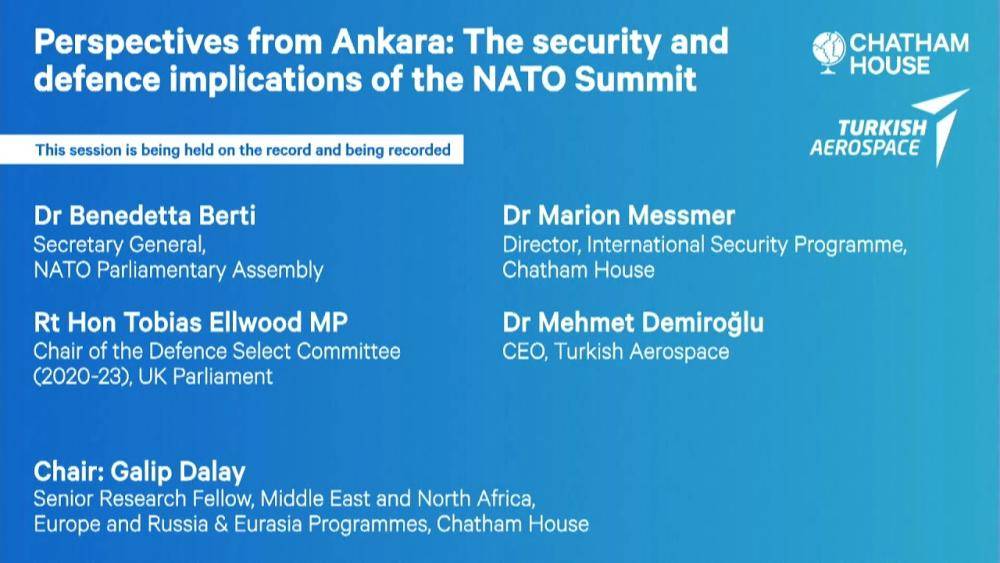
Obviously, we will be discussing the NATO Summit, the ‘Perspective from Ankara,’ with the particular focus on ‘defence and security’ commitments ‘of the NATO Summit,’ and for this we have, like, a really expert panel and panellists and we are also very much pleased that this event is taking place in partnership with Turkish Aerospace, so whose CEO is with us, with Dr Mehmet Demiroğlu. We will be actually starting with him with the opening speeches and afterwards, we will be engaging in a nice conversational discussion on the subjects.
But just few remarks. This event is on the record, so therefore, feel free to tweet, feel free, you know, to share anything from the event. So, it will – it’s a recorded, on the record event, and after the event, there will be refreshments served upstairs. So, please do join us for the refreshment, as well. So, not only be part of the food for thought, but also be part of the refreshment phase. So, without further ado, I would like to introduce both our panellists and then invite Mehmet bey for his opening remarks.
So, we have, obviously, the Dr Mehmet Demiroğlu, the CEO to Turkish Aerospace industry. We have the Honourable Tobias Ellwood; the Chair of the Defence Select Committee of the UK Parliament between 2020/2023. And more relevantly for today, his book about ‘Ten Steps to Prevent a World War Three’ is just out, so please, I highly recommend you buy it. So, we have seen quite many depressing titles, so at least a title that is telling us how we can prevent a World War Three is quite a nice one to have. And I’ve suggested that under this title he should have added also the word Inshallah, but maybe this is something the audience can do it. We have Marion Messmer, Dr Marion Messmer, who is the Director of the International Security Programme at Chatham House, who is also my colleague, and also Dr Benedetta Berti, the Secretary General of the NATO Defense – NATO Parliamentary Assembly. We are very grateful to have all of you.
Without further ado, I would like to invite Mehmet betu offer some opening remarks and then we will be having a moderator conversation following up.
Dr Mehmet Demiroğlu
[Pause] Good afternoon, distinguished guests, ladies and gentlemen. There are moments when the events force us to rethink, reconsider our assumptions, those assumptions that make us, shape us, shape our thoughts and shape our actions. The assumptions of strength, the assumptions of how to win a war, the assumptions of the role of a NATO member or alliances around – you know, in hope. I believe we are going through such moments these days. For much of the Cold War period, defence planning rested on the assumptions that technological superiority would decide the fate of any war or future conflict. We invested increasingly on – in more sophisticated weapons, air systems, naval systems, land systems, precision-guided munitions and network-centric platforms. Product efficiency and maximum capability became the dominant principle. Production capacity was optimised for the peacetime era.
The recent wars in Europe and Middle East have tested and radically changed many of those assumptions. It has shown that military power cannot be measured solely by the sophistication of the weapons. It also depends on the ability to replenish inventories, to sustain production, adapt technologies, existing technologies, available technologies, and maintain the resilience of supply chain through a prolonged period. In other words, industrial capacity has become a strategic capability. Perhaps the most significant shift in defence thinking since end of the Cold War era.
The question is no longer simply who can build the most advanced aircraft, aircraft carrier, land vehicles, missiles or autonomous systems. Increasingly, the decisive question is now whether those capabilities can produce – can be produced, delivered, maintained at the pace today’s security requirements demand. Industrialisations is no longer only an economic consideration. It has become an essence – essential element of deterrence.
This changing reality affects every member of NATO. For decades, the alliance naturally focused on interoperability, operational readiness and collective defence. Those principles remain fundamental, still today, but today’s environment requires something more, an industrial base capable of sustaining the alliance – supporting the alliance through sustained competition as well as crisis, a product line which is simple, cost effective and mass manufacturable. Defence cannot – can no longer be weaved solely through the lens of military organisations. Universities, research institutions, technology companies, manufacturing facilities and engineering, talent and creative thinking have become equally, if not more, important component of national security. Who would think a toy or a hebbily – hobby equipment would radically change the fate of the war?
The closing statement of NATO’s Ankara Summit was a loud declaration that NATO’s collective strength increasingly depends on industrial co-operation, technological innovation and resilient defence ecosystem. This broader perspective also change how we should look at Türkiye and its defence industry. For many years, Türkiye’s contribution to NATO was defined primarily be geography and military capability, understand the – understandably so. Stewardship at the intersection of Europe, the Black Sea, the Caucuses, the Eastern Mediterranean and the Middle East, Türkiye occupies one of the alliance’s most strategically important location. Combined with NATO’s second largest armed forces, this has made our country an indispensable contributor to collective security for more than seven decades.
Those contributions remain just as important today, but they no longer tell the whole story of Türkiye. Over the past two decades, Türkiye has undergone a remarkable industrial transformation. Through sustained investment in engineering, research, advanced manufacturing, technological innovation, we have built a defence and aerospace ecosystem capable of developing increasingly sophisticated, yet cost-effective, indigenous capabilities. Today, Türkiye, Turkish companies, designs, develops, manufacture advanced defence systems that not only our own operational requirements, but also support the security needs of partners around the world. Our defence and aerospace products are currently in service more than 175 countries and more than half of those exports goes to our NATO allies.
These figures matter for reasons beyond commercial success. They reflect confidence in Turkish engineering, in the reliabido – reliability of our industrial base, in – and in Türkiye’s long-term partner in the collective security of alli – of the alliance. This transformation is not the work of one company or institution alone. It reflects the combined effort of government, industry, university, research organisations, SMEs and perhaps most importantly, a generation of highly talented Engineers who have reshaped our technical – technological capabilities.
Let me make this concrete through one example, Turkish Aerospace, where I humbly and proudly serve as the CEO. TUSAŞ, or Turkish Aerospace, was established in 1973 to develop Turkish aerospace industry. Starting since its inception, it primarily focused on production of licensed platforms, such as F-16s, such as A400M, A320, in military side, as well as in commercial side. But today, especially in past 20 years, Turkish Aerospace has develop 15 plus indigenous platforms, ranging from helicopters to unmanned systems, from Trainers to 5th generation fighters, from commercial programmes to satellites. Ranking 47th on the Defense 100 – Top 100 list, with five billion projected revenue in 2026. It employs more than 16,000 skilled employees, highly qualified professionals, with an average age of 34.
Today, Turkish Aerospace is an integrated aerospace company capable of designing, developing, testing, certifying, supporting advanced progra – platforms across their entire life cycle, from training aircraft to helicopters, to unmanned systems. But I would rather argue that this is not the most important income. Yes, these platforms are important, but the real achievement is the industrial capability each programme creates. Every major aerospace programme strengthens the in-house expertise in flight control systems, avionics, composite manufacturing, system integration, advanced testing and digital engineering, and more importantly, it develops people. Engineers who solve today’s challenges, become the mentors who prepare the next generation.
Wherever I spend time with our young Engineers, I am reminded that our greatest asset isn’t the platforms that we created. It is their curiosity, it is their ambition, it is their confidence that they can solve problems once thought beyond our reach. That confidence may be the most valuable thing our industry produced today. Knowledge and experience from one programme accelerates the next. Suppliers improve, universities expand their researches, innovating begins reinforce itself. That is how an industrial ecosystem matures. Industrial capability, after all, is not built by factories alone, it is built by people.
If industrial capability is about people, it is also about partnership. Discussions about defence industries too often reduced to export figures, or platform counts. These matter, but they don’t capture the strategic value of mature industrial base. The more important question is whether an industry can become a trusted partner, one that contributes not just to products, but to knowledge, innovation and long-term resilience to the wider defence ecosystem of the airlines. That is the direction we see the future taking. For example, one of the products, platforms, Hürjet. We design the Hürjet in a enormous short period of time. Unlike others, it’s – from scratch to flight it took five years. It is often esc – described as ‘advanced jet trainer,’ which is used to prepare Pilots for fifth generation combat aircraft. Accurate but only part of the story. For us, Hürjet leflext – reflects the engineering capability, system integration expertise and industrial maturity built over many years.
The recent agreement with Spain is not simply because – it’s not simply a sale to a NATO member. It also brings one of our ingenious platforms into the European market. It shows the technology developed in Türkiye and it shows that platforms developed in Türkiye can contribute the greater alliance’s need and supply. It also shows that we can be partners with formidable defence companies, such as Airbus, to achieve our shared goals. I, myself, and we, as Turkish Aerospace, would like to see Hürjet as the training platform for, if not all, many of the – our NATO alliance allies. It is not because it gives us a proud – it makes us proud. It is because that common platforms and shared training strength, the alliance far more than iso – better, far more than isolated programmes. It is directed aligned with the outcome of NATO’s Ankara Summit. The same philosophy guides our intentions for partnership in – with BAE and same philosophy is there within partnership between Baykar and Leonardo.
Türkiye is well positioned to contribute that effort. Our defence industry is built on an ecosystem that includes many companies, such as ASELSAN, Baykar and 15 thou – 1,500 more companies. Factories can be expanded, production lines can be modernised, new digital tools introduced, but developing our industrial partnership, industrial base, developing our outstanding Engineers and a culture of innovation, take patience and sustained commitment. But there are still some obstacles in front of us, one of them export licences.
I genuinely struggle to understand why such lengthy export licensing process which is resulting in denial or no response in a lot of time, should stand between a NATO ally and the equipment or the sub-system it needs from another NATO ally. We share the same goals, we abide the same rules and regulations, we have signed the same agreements, we are part of the same security alliance. Yet, we cannot proceed with the much-needed speed and resilience. We need to change that. We need to create faster, simpler ways to supply the necessary equipment and sub-systems to any allied needs, without any delay that our alliance to share more shared commitments, should have made unnecessary long time ago.
Let me close with one thought. Throughout much of modern history, alliances were judged by size of their armies, the strength of their fleets or the sophistication of their weapons. Those measures still matter, but I believe that in the years and decades ahead and during strategic advantage, will increasicly be – increasingly be determined by something deeper. The ability to educate exceptional Engineers, train skilful technicians, sustain resilient industrial ecosystems, translate innovation into operational capability and build partnership based on trust. If NATO succeeds in doing that collectively, it is greatest strength will not be the capabilities it possess today. It will be the capabilities it is able to create tomorrow. Thank you [applause].
Galip Dalay
So, I would like to invite Tobias Ellwood, Marion Messmer and Benedetta Berti, so we will have a spirited conversations. So, Tobias, please [pause]. I think – I mean, obviously, the two things was particularly on the agenda of the NATO Summit. One of them is the defence industry, rearmament, that was also the Europe meeting the commitments that it has made, but the other one is obviously, the European security question was high on the agenda, but also on the minds of everyone there. So, in a sense, the Ankara Summit, one aspect of it was whether we will see a unity, the family unity picture. With the President Trump coming, obviously, the picture was delivered, but the other things, whether the Summit would have served as a graduation ceremony for Europe to be in charge of its security destiny and being a centre of gravity for its neighbourhood.
So, we have been discussing what has been discussed in Ankara Summit, but I think Tobias, it would be good if you tell us, also, what you think should have been discussed but were not discussed there.
Rt Hon Tobias Ellwood MP
Well, great to see you again and thank you very much…
Galip Dalay
And you.
Rt Hon Tobias Ellwood MP
…indeed, and wonderful to follow our guest speaker here. We had a wonderful exchange in the greenroom earlier discussing the importance of NATO. For me, this question is, you know, the elephant in the room, if I can be bold here. I mean, thanks to Turkey, because without Turkey, without the President’s words, I suspect that Donald Trump wouldn’t even arrived – wouldn’t even have been…
Dr Mehmet Demiroğlu
He said so.
Rt Hon Tobias Ellwood MP
He said so. So, that is not the greatest backdrop to what is supposed to be the most formidable, most potent military alliance the world has ever seen at a time when the world is getting more dangerous, more unstable and you expect greater things from our alliances working together to try and hold our world together. And that, for me, is the first big elephant in the room, is what on Earth is Donald Trump doing? Where is he taking America? What is his relationship with Europe?
And much as many leaders, including Britain’s, have gone on bended knee to say, ‘Stay with us because a strong Europe means that we can be there to support you in your time of need, as well,’ history shows that, but there is an isolationism creeping in. And a worry, and I’ll be blunt here, to suggest that Donald Trump’s approach is to abandon any sense of duty, as previous Presidents had, to support our global order. Instead, treat it as a jungle where there are big beasts in this jungle, each with their sphere of influence, and Donald Trump’s is, sort of, the South and North America, hence Venezuela and Greenland, okay? And Ukraine, well, Russia can have that; China, that’s over there. So, these and other beasts can operate in their own smaller beasts. Sort of, middle powers can operate in their areas, as well, Turkey being one of them, for example.
That, for me, is what I believe is Trump’s strategy, giving up on any sense of purpose to repair what we see as our global order, and that makes it very difficult for NATO, that has worked so well, has been so forceful and I think successful in maintaining European peace, to work out where to go, what to do next. And it isn’t simply just because our global order is fragmenting, but sir, you gave – spelled this out very clearly, indeed, is the character of warfare is changing abruptly and that is challenging exactly what NATO’s purpose actually is.
Go back to the 1990s, I served in places like Bosnia and [zone like that – 28:18]. It was very clear. It was usually to do either to maintain peace or to deal with state-on-state action. What it’s not geared to do is bunfights in space, for example. What it’s not geared to do right now is grey zone warfare. What do we do when we’ve got a frigate off Plymouth doing live firing exercises? I’m less worried about that. I’m more worried about what they’re doing to distract us while they’re looking at our undersea cables. It’s this sort of warfare, this beneath the threshold of full war, that concerns me and the worry that the fact that while NATO on paper looks pretty solid, in reality, we’ve lost that sense of purpose.
You were very kind to mention my book, ‘Ten Steps to Prevent World War Three.’ The first step is to ask ourselves, what do we stand for? What do we believe in? What are we willing to fight for? I remember meeting Chris Cavoli, General Cavoli, in December 2021, before Russia had invaded, and he – Russia was accumulating troops on the Ukraine border. You might remember everybody saying would they, would they not actually invade? And I looked at Chris, I met him at a function similar to this in the outback, and I said to Chris, who was in charge of US forces in Europe, he then went onto be SACEUR, the Head of NATO.
Dr Benedetta Berti
He already was.
Rt Hon Tobias Ellwood MP
But I asked him, I said, ‘Why don’t we just slide in some NATO forces into Ukraine before Russia invades, so we look Putin in the eye and say, ‘Come on’? And obviously, that is a Cuban Missile moment, but I believe that today.’ And he said, ‘I’ve done my homework. I’ve already ma – wa – made my plans, they’re already there, 16 Air Assault Brigade, 82nd Airborne. He had listed all the regiments that he was going to slide across the table and four days he could get them into Ukraine. And he then, with his big finger, stuck it in my chest, and I was Defence Minister at the time, and said, ‘It’s up to you guys to tell me what to do. The politicos have to make a decision.’ And that for me, is…
Galip Dalay
But did you tell him what to do?
Rt Hon Tobias Ellwood MP
Sorry?
Galip Dalay
Did you tell him what to do?
Rt Hon Tobias Ellwood MP
I couldn’t. I would love to be…
Galip Dalay
Why?
Rt Hon Tobias Ellwood MP
…able to command – well, because I was in no position. I was a Junior Minister in the British Government and even Jan Stoltenberg said later that NATO should have done more prior to the invasion to support Ukraine. This excuse that somehow Ukraine wasn’t a member of NATO, that’s the reason why we’re not stepping into – Iraq, as far as I remem – recall, is not a member of NATO.
Galip Dalay
But…
Rt Hon Tobias Ellwood MP
People are there, and then there’s – and likewise with Afghanistan, but we dipped our toes into those two theatres.
Galip Dalay
I mean, effectively, you are suggesting remaking NATO, right?
Rt Hon Tobias Ellwood MP
I’m suggesting we need to advance and recognise the changing forms of warfare. Let me offer, okay, when they say, ‘What are the domains of war?’ Air, land and sea immediately jump out, don’t they, as the traditional forms of warfare? We need more tanks, more jets and more ships. I offer 11 realms of warfare, or realms of conflict, 11, and if you’re not strong in all those areas, weak in any one of them you’ll be exploited. So, air, land and sea are the first ones. You then have nuclear as another dimension. You then have space as well, that takes us up to five. You then have disinformation and you have cybersecurity, or cyberattacks, as well, another realm of warfare.
And then you have another four, which perhaps aren’t so obvious. Soft power, if you want to tackle extremism, you can’t do that in Africa, for example, with more tanks, you’ve got to do it with soft power. Industrial capacity, which is something that’s been mentioned, the ability to replenish. We’re building 150 battle tanks today, but they will win their first battle. They’re state of the art, but how do we replace them with the next 150? We haven’t got the British capacity, industrial capacity, to do that. It’s simply not there, and then societal resilience. We have no air defence here in the UK. If a drone came down Whitehall and hit Big Ben, we wouldn’t know what to do. If the power went off for 72 hours, there is no co-ordination in communities to know who to do what, who should do what, as you find in places like Finland and Sweden. And then, the final one is, just to finish off…
Galip Dalay
Yes, sure.
Rt Hon Tobias Ellwood MP
…is political will, is the willingness to step up and say we’re going to do something which is important to us, rather than hesitate, rather than become risk averse. Every single bit of equipment, if we think about Ukraine, there was a debate, ‘Should we send anti-tank missiles? Should we send tanks? Should we send F-16s?’ A massive public debate, storm Shadows and so forth, long-range missiles. That’s not the way to actually fight a war. The first time Russia should know that the long-range missile has been gifted to Ukraine is when it lands on an industrial base in Russia.
Galip Dalay
But I mean, precisely where you finish is my biggest concern. The political will, do you see the existence of this political will across all the NATO members, including the United States? And secondly, you are referring to quite a bit a transformation of NATO, so a NATO that is adapted to today’s world and meets today’s challenges. So, this is quite a new NATO actually, in a sense. So, do you see the possibility of this in the coming years?
Rt Hon Tobias Ellwood MP
Well, that is exactly the conversation we need to have or NATO will become obsolete, and you touched on the biggest point, is the fact that we must persuade our closest security ally, the United States, to recognise that going solo, that retracting, becoming isolationist, having transactional relationships with everybody else, is not the way to keep that alliance strong. When Europe and America are on the same page, then we can make advances. We can keep the world a – make the world a safer place. When they’re not on the same page, that’s when our adversaries will try and take advantage of us.
Galip Dalay
Well, I mean, obviously, the big question is when Europe and US is on the same pages, and recently it seems that they are not seems to be on the same pages…
Rt Hon Tobias Ellwood MP
Exactly.
Galip Dalay
…more often than is the case. Marion, I mean, there has been a lot of commitments that the states met at the Ankara Summit, and it did work, you know, in the previous summits as well. What – like, how do you see them meeting, like, you know, concretely meeting these commitments? Will these commitments turn into actionable policy steps?
Marion Messmer
Well, I think the Ankara Summit has already shown, you know, as colleagues have already pointed out, that the allies are making concrete progress on their commitments…
Rt Hon Tobias Ellwood MP
Hmmm hmm.
Marion Messmer
…right? I think something that was a great success at the Summit was to have the Defence Industrial [means Industry] Forum as such a…
Rt Hon Tobias Ellwood MP
Hmmm hmm.
Marion Messmer
…key part of the summit. Of course, the presence of the defence industry and the role that it plays in strengthening the alliance has always been an important part of the summit, but the difference this year was that it was really a key focus and took up a significant part of the first day. And we have seen so many different commitments come out of that, you know, concrete announcements of new industrial co-operation, concrete announcements of procurement decisions and so on, and I think this is, essentially, what you ask. This is the allies showing how they are meeting their commitments and how they are strengthening NATO going forward. So, I thought that was actually a really successful way of showing how we have moved from 2025 to 2026, you know, showing how commitments to spend more on defence are actually translating into capabilities.
At the same time, of course, you know, there are some challenges that remain. So, procurement reform is taking place across all member states, but it’s not necessarily moving at the same speed. It’s often quite a legislative heavy process that essentially, takes some time and I think there are also some challenges. As we have heard and as we have discussed, both here today and over the last weeks and months, there are some newer procurement decisions that don’t as neatly fall into the traditional ways how procurement is done, right? So, traditionally, if we think of defence procurement, we think of big-ticket items that take a long time to procure and that will then remain in your arsenals for a long period of time.
Galip Dalay
Hmmm.
Marion Messmer
Whereas if we think about something like drones, for example, that would require much faster procurement cycle. And we’ve seen some really interesting adaptations in the alliance, where, for example, the Netherlands has adopted a model that’s similar to a model that Ukraine is using, whereby it’s a much more direct procurement process. But I think, you know, these are, essentially, the things that we need to think through as an alliance much more, and where not all member states are, sort of, on the same page. So, I think that’s one of the challenges that…
Galip Dalay
Can I ask a question on this procurement, because…
Marion Messmer
Sure.
Galip Dalay
…there has been different ideas floated. That Canada had a different idea…
Marion Messmer
Hmmm hmm.
Galip Dalay
…the UK with I think, Netherland, Finland or Norway, had different ideas for the procurement. So, where do you see this conversation about this procurement conversation taking us?
Marion Messmer
Well, so are you talking there about different models of financing?
Galip Dalay
Yes.
Marion Messmer
Because I think here we’ve had lots of different suggestions made and I think importantly, given that defence investment is a big challenge that’s going to stay with all NATO member states, it’s important to have a range of options there. So, while, you know, of course, I hope that member states will not replicate models that don’t need to be replicated, I think having a range of options, whether that’s the, sort of, defence bank approach…
Dr Benedetta Berti
Hmmm hmm.
Marion Messmer
…whether that’s attracting more private investment and having more, sort of, public-private partnerships, I think those are all good approaches that will all help in the long-term and there won’t be one perfect solution. So, I think it’s about figuring out how we can make sure that we can fund all of the investment processes that need to take place across the alliance.
Galip Dalay
Hmmm hmm, but here, particularly one big, obviously, conversation is bridging the gap between the NATO’s EU and non-EU members, with – so, with the SAFE conversation. Do you see and do you expect any progress there?
Marion Messmer
Yeah, absolutely, and I think this is what I mean when I say that we need a range of different approaches, right? Because SAFE is one mechanism that the NATO members that are also EU members have put on the table, because, you know, this is an area where the EU has led. But that doesn’t have to be the only process, and there can be ways how non-EU NATO members can also be brought into the process. So, I think, you know, I think what’s important here is also thinking about NATO unity and so, I think we sometimes are perhaps a bit too public in litigating those kind of conversations very openly and perhaps if we can remember that actually, as an alliance, we are pursuing a common goal at the moment, perhaps some of these challenges could be resolved more privately, so as not to send perhaps false signals about a lack of NATO unity.
Galip Dalay
Well, I hope that they can just resolve more privately, but it’s difficult in today’s Twitter world, obviously. So, Benedetta, I think we need some good news, so I hope that you can give us some good news, particularly from the NATO perspective. So, what do you see in terms of the accomplishments of the Ankara Summit…
Dr Benedetta Berti
Sure.
Galip Dalay
…and where do you see the gaps…
Dr Benedetta Berti
Hmmm.
Galip Dalay
…are awaiting us?
Dr Benedetta Berti
Sure. Thank you for that question. Great to be here. Lots – many I can put things into perspective in terms of where we were and where we’re…
Galip Dalay
Very nice.
Dr Benedetta Berti
…going. I think that would work. Having spent nine years of Director of Policy for the NATO Secretary General, having those conversations about getting to 2% and then having those conversation about waking up from the decades of post-Cold War peace dividend thinking and arguing to get those new plans and return to a core focus on collective defence. If I go back to 2016 and think where we were and where we are now, I think that’s first – that’s absolutely the right starting point. After the nex – and I’ll take 30 seconds to describe that and then I’ll go to the accomplishment of Ankara, ‘cause I think we can only understand the progress if we know where we were coming from.
2014, after Russian illegally annexes Crimea, the alarm bells goes off in NATO, and the question is, how do we completely restructure our way of thinking after decades of thinking that threats and challenges will come from out of area, that conventional deterrence and defence is a thing of the past, that your European Continent is a continent of peace? That we can comfortably spend 1.3% of our GDP on defence and have armies that are ready to fulfil the main missions, right? So, essentially, we tailored ourself for peace as a constant, with def – with what – and with the consequences on forces, capabilities, readiness, industrial capacity, etc., etc. So, that was a starting point.
Fast-forward to Ankara, a completely different alliance. For the first time since the Cold War, we have defence plans that link forces to territory. We have plans for the collective territorial defence of Europe. We have the most – if you look at capabilities, NATO is the most cap – militarily capable today’s – at – since the end of the Cold War, there is no question about that. One of the ways that we got there, and I will get there – I will also mention all the homework that we still have to do, but I think it’s important to recognise the progress, ‘cause otherwise, the conversation is a little bit skewed. One of the first challenges we had was to increase the cash, increase the amount of investment in defence.
I give you just one number to put this in perspective. During the Cold War, we used to spend 3.5, on average. Then we – for roughly three to four decades, we spent 1.3, on average. I’m talking about NATO Europe and Canada, so not the United States. If you were to calculate how much money we didn’t spend on defence during those 30 years, you would get to US$8.6 trillion. That is a lot of money, a lot of money. So, that’s what we’re trying to make up. Come to Ankara and we have – after having agreed a 5% invest invest – defence investment spending in The Hague, where – we are taking stock and we are seeing well over – between 2016 and 2026, European allies and Canada have added 1.2 extra trillion to their defence spending. In the last two years, 250 extra billions.
Are we now on 5% on average? No, we’re not, but we are all meeting the 1.5 investment spending on resiliency and we are 2.5, on average, on the hard defence expenditure. That’s miles ahead of where we were just three short years ago and the projection says by 2030, there will be an extra 800 billions added to def – to European defence spending. I start with this because everything else is – there’s a lot of work to be done, yes, but for the first time in ten years, we can talk about how do we scale up and build credible industrial strength and military strength? Because there is the cash. So, that was Ankara one, taking stock of progress.
Two, and that’s the homework for the next ten years, I’m afraid, cash into capabilities. It’s not enough to spend more. You need to spend on the right things, and you need to have the right incentives, and here’s where the NATO Defence Industry Forum showcase what that looks like. It looks like signing over one day over 50 billions in defence deals, ‘cause that’s what’s industry wants, the demand signal. And then it was about everybody has to do homework, and we can talk about what governments, industry, have to do, but NATO is putting on the table a few tools to help.
One is industry want signals, mult – and those demand signals means for multi-year signed contracts. One of the things industry have been telling us is, ‘We want to see that your dema – the defence demand will not die out in two years. We want to see that there is going to be sustained demand in defence.’ And to do that, NATO, for the first time, is going to release aggregate capability targets, so is going to industries saying, ‘Over the next year, this is what we’re going to need,’ and that’s going to provide an important defence demand signal. NATO is also – and the EU, as well, and for that matter, is also trying to aggregate procurement, ‘cause one of the problems we have is that if we all buy nationally, we don’t aggregate demand, we end up competing with each other, there is defence escalation, there is more money. Mind you, we don’t get more money for a buck. So, the summit was also useful to bring that joint procurement acquisition process.
There’s a bunch of other things, but I want to be – I’m mindful of time and just giving you the headlines. And then, the – an initiative that was introduced in Ankara, which I also think is going to be – it sends the right signal. By itself it’s not enough, but sends absolutely the right signal, is the Scale-Up Package, which essentially, talks about how do we support industry in scaling up production so that we can outproduce our adversaries and competitors? Which is very much a part of the fr – of the keynote speech today, and I very much agree.
And here NATO is doing a few things. One is to try to match more industrial capacity with civilian manufacturing capacity. We have, across Europe, quite a bit of unused civilian manufacturing capacity. We have a surge in demand on the military side. Matchmaking can generate a win-win, can generate gains. Another issue is how do we mobilise private capital? Because we cannot sustai – we cannot have a defence industrial renaissance only on borrowed money. We cannot just use public debt for everything. So, we do need – and we do need a sustainable approach to mobilising private capital, and these are conversation that even two years ago were science fiction for NATO. So, that’s the – and I’ll stop here because I know I…
Galip Dalay
I will ask you here, actually.
Dr Benedetta Berti
Yeah.
Galip Dalay
I mean, for a long time, every crisis we treated them as a wakeup call. Finally, the NATO member woke up. I mean, you know, maybe it woke up 2014, but then, when you wake up, usually, sometimes you spend a lot of time in bed before getting into the action. So, it seems from 2014 until 2024 – 22, the NATO woke up but was still in the bed. So, after the Ukraine invasion, it went into the action. Now, after the action, now we are saying, ‘Okay, we know what to do, but the question is how to do it, because everything – the way that we do it might carry a cost.’ And obviously, one of the biggest cost could be the transatlantic…
Dr Benedetta Berti
Hmmm hmm.
Galip Dalay
…the rupture in the transatlantic relationship. So, do you see a light at the end of the tunnel in which the Europe, like, a stronger Europe on – Europe within NATO, but also with a stronger transatlantic relationship, or a stronger Europe will inevitably be, some extent, the NATO that we knew and it existed in the previous form would be weakened?
Dr Benedetta Berti
So, that’s a great question and I agree with your assessment that after 2014, we took our time. There is no question that we could’ve moved…
Galip Dalay
Well, it was, like, you know, a bit, like…
Dr Benedetta Berti
We could’ve moved faster.
Galip Dalay
…enjoying the time.
Dr Benedetta Berti
We could’ve moved faster, but…
Galip Dalay
Took time to have coffee.
Dr Benedetta Berti
…to – albeit I remember those conversation to implement the time of mindset shift that we are trying, it’s not something you do overnight, but I take your point. So, where are we now? We know what we need to do. The good news is we’re doing it. The gla – the other side of the equation is, of course, there is a lot more to be done to…
Galip Dalay
Hmmm hmm.
Dr Benedetta Berti
…reform procurement, get our indus – in defence terms, Atlantic defence industrial base, up to speed, innovate the way we do capability development and defence planning. There’s a lot of things that we need to do, but we are in – on the right track.
And I think the best way to ensure that NATO as an alliance remains strong and the transatlantic bond which continues to underpin it remains valid, is to actually implement this NATO 3.0, which means to make sure that European allies in Canada do their fair share. And now, for the first time since the end of the Cold War, we actually know what that means. We have agreed what that fair share looks like and it looks like, over time, and that’s already a process that is in the making, European allies in Canada take the lead when it comes to conventional deterrence and defence of Europe. Again, easy to say, hard to do, but that’s the goal.
If you get there, NATO will look differently…
Galip Dalay
Yeah.
Dr Benedetta Berti
…will look different. It will still look transatlantic. It will need…
Galip Dalay
Yeah.
Dr Benedetta Berti
…to rely – it will continue to rely on the United States for some strategic enablers, for nuclear deterrence and for some exquisite capabilities, but the balance is going to be entirely different. Now, the homework is today, we cannot do that because we don’t have the capability or the forces. So, that’s the direction of travel.
Galip Dalay
Marion, a stronger European NATO, will it be not also a stronger NATO and stronger transatlantic bond, or do you think probably this will be more competitive?
Marion Messmer
Well, I think a stronger European NATO will be a stronger NATO. I hope that that will also mean that the transatlantic bond will remain strong, but I can see some challenges that, in part, depend on how well we are able to communicate. So, one of the key challenges that I could foresee is, for example, if it means that in the future, European states prioritise purchasing European capabilities, which is, of course, something that we want and we want a strong European industrial base. But if that then leads to tensions with US suppliers and US interests, then I could see that, you know, being a challenge for the transatlantic relationship. Of course, a lot there will depend on how politics play out in the US, and I don’t think that anything is necessarily guaranteed at the moment. But to me, that’s one of the, sort of, implicit, or maybe hidden downstream risks, that you can foresee at the moment.
Galip Dalay
Will ten years from now, US like a stronger European NATO, or do you think that it might regret it? And then I’ll come to Tobias.
Marion Messmer
Well, I hope so, right? I mean, if you look at the history of NATO, the goal was always to have the strongest alliance possible to work together on common interests. So, if that is something that we can keep in mind, then that should be in the US interest, and part of the stated goal of the US is that they want to be able to focus on other strategic priorities. So, if European states are able to pick up some of what the US is currently providing in Europe, then that rebalancing will be possible, but ten years is a long time in politics.
Galip Dalay
Sure. Tobias, same question and then I will go to Mehmet bey, how does he see a stronger European NATO…
Rt Hon Tobias Ellwood MP
Sure. I think…
Galip Dalay
…for Turkey?
Rt Hon Tobias Ellwood MP
…we’re all in agreement that America and Europe, NATO, all together makes sense and is in everybody’s interests, but the evidence points exactly the opposite way.
Galip Dalay
Hmmm hmm.
Rt Hon Tobias Ellwood MP
You’ve got Donald Trump demanding, quite rightly, that we spend more on defence. I would argue, though, that over the last 15/20 years, whenever America’s called for Europe, Britain particularly, but other nations too, to step up, to deal with threats, such as Iraq and Afghanistan, we have not hesitated, regardless what percentage of GDP defence spending we are on. We have been there. The idea that somehow, we haven’t got the capabilities there to step up is simply wrong. But quite rightly, the threats are increasing and it’s important that we do spend more and head towards the NATO targets which have been agreed.
My concern is that Russia is the biggest threat. That’s exactly why we’re having to increase defence budgets, but the United States is actually courting our adversary. In Ukraine, let’s be clear, which is the biggest threat, what’s going on there, the biggest threat to European security, Donald Trump is not helping at all, whatsoever. Every bit of kit, every bit of equipment that is actually slid across the table to Ukraine from the United States is paid for by the rest of NATO. So, America, under Trump, has absented himself to the supporting the effort to liberate Ukraine. On top of that, to make it worse, he’s actually courting Putin, bringing him in from the cold, rolling out the red carpet, doing deals as well.
So, we are in denial if we don’t think that somehow, Donald Trump is deliberately taking America to a very different place, seeing Europe, actually, as a commercial threat, seeing the EU as a commercial threat. So, much as I would absolutely desire to see America stay, we have to prepare for the worst-case situation, which could include not having access to GPS. That’s the world that we need to prepare for.
Galip Dalay
Mehmet bey, one – but…
Dr Benedetta Berti
Yeah…
Galip Dalay
…two finger?
Dr Benedetta Berti
Yeah, it’s a two finger, it’s just…
Galip Dalay
And then…
Dr Benedetta Berti
It i – it really is. It’s just factually speaking, when it comes to capability, the capabilities required for out of area operation, like, Afghanistan, Iraq and what we need for the territorial defence of Europe are very different. And today, as Europeans, and we’re getting better and I have full confidence we’ll get there, but it’s just factually speaking, we do not have the capabilities.
Galip Dalay
Yeah.
Dr Benedetta Berti
When it come to integrated air missile defence, just one, we need 400% increase to be able to do it by ourselves. So, just facts matter.
Galip Dalay
And also, one-minute questions, does…?
Dr Benedetta Berti
Done.
Galip Dalay
Like, ho – what is Turkey’s view on a more European NATO?
Dr Mehmet Demiroğlu
I’ll de…
Galip Dalay
You ever are concerned?
Dr Mehmet Demiroğlu
That is a more political question than the national one.
Galip Dalay
Yeah.
Dr Mehmet Demiroğlu
But as a businessperson in Türkiye, we definitely would like to see more stronger NATO supported by – from both side of the Atlantic.
Rt Hon Tobias Ellwood MP
Atlantic.
Dr Mehmet Demiroğlu
US and Canada from one end, the rest of the Europe from other end. But when it comes to capabilities and spending, it – we might be missing something if we are just focused on the spending only. Because for example, if I use three-billion-million-dollar missile to shoot down $50,000 equipment, I am missing something.
Dr Benedetta Berti
Hmmm hmm.
Dr Mehmet Demiroğlu
If I go ahead and buy, you know, 100 of them, so I spend a lot, but what happened to my capability? Am I going to be able to replenish that, in, you know, in a timely and sustainable manner, or should I look for something else? So, we need to look at – from threat and capability perspective, to counter that threat. It is not just the spending. Yeah, spending is, kind of, a easier part. Yeah, increase the prices, then you spend more.
Dr Benedetta Berti
Hmmm hmm.
Dr Mehmet Demiroğlu
But what did you get in return? You know, did I get the capability that I need, or am I wasting my time and money?
Dr Benedetta Berti
Hmmm hmm.
Dr Mehmet Demiroğlu
So, with the current conflict going on, especially with the drones and the cheaper ones, and FPV has changed the way we look at the capabilities drastically, in my opinion. That’s what we are doing in Türkiye.
Rt Hon Tobias Ellwood MP
Absolutely.
Dr Mehmet Demiroğlu
We are not – we are focusing on the more expensive long-range, you know, high quality or te – superior technology equipments. Yes, it’s needed, but not sufficient, not enough. You have to have much more cheap – you know, cost effective equipment to counter that threat and then sustain that production so that you have the deterrence, whether as a country alone or as a alliance.
Rt Hon Tobias Ellwood MP
Sure.
Galip Dalay
Well, obviously, the big question is whether the new NATO will have the same strategic clarity and shared track procession as the previous one. Now we will be taking the questions, but please make it questions, not statement. So, if it is more than one minute, I will cut you off, not because I’m not a nice person, but because I have to because there is almost more than 20 questions here, as well. So, state who you are…
Member
Ah, just…
Galip Dalay
…and finish your question with question mark. I saw you first and then I, yeah, I saw you at the back there and then, you.
Prashanie Dharmadasa
Thank you.
Galip Dalay
Please state who you are. Yes.
Prashanie Dharmadasa
Hello, thank you for that discussion. It was very interesting. My name is Prashanie Dharmadasa from SORAA3. I have a question which is probably a little bit leftfield, but Benedetta, you mentioned about the importance of bringing civilian, you know, startups and tech firms into the defence supply chain and absolutely agree, we need to have that innovation coming through. But my question is, by broadening this very ecosystem of civilian organisations, we also inevitably broaden the attack surface of military – of…
Dr Benedetta Berti
Hmmm hmm.
Prashanie Dharmadasa
…adversarial threats. I’m really keen to understand, you know, as we broaden the defence innovation base, is there any focus on how we’re looking at adapting our security architecture so we keep up the pace with innovation and also protect these civilian startups from being prime targets, in the same way that we protect our critical…
Galip Dalay
Thank…
Prashanie Dharmadasa
…capabilities?
Galip Dalay
Thank you.
Dr Benedetta Berti
It’s a very good question.
Galip Dalay
Tim there and then I will come here and then here.
Tim Chattell
Tim Chattell, British Armies Visiting Research Fellow here at Chatham House. Thank you very much to the panel for their remarks. Many countries are re-evaluating their reliance on American equipment at quite a lot of pace and are trying to transition to European alternatives, or sovereign alternatives, where they’re able. If the news last week that the S-400 saga might finally be coming to a close and Turkey is readmitted to the F-35 programme, should Turkey be worried about relying so heavily on American equipment? And if the Kaan fighter turns out to be a suitable fifth generation alternative, should they be worried about their reliance on General Electric to supply the engine? Thank you.
Galip Dalay
Thank you.
Dr Mehmet Demiroğlu
Yes.
Galip Dalay
Yes, here.
Dr Benedetta Berti
Oh, dear God.
Issa Ayash
Hi.
Galip Dalay
Where is it?
Issa Ayash
Oh, here, just here.
Galip Dalay
Okay.
Issa Ayash
Yeah.
Galip Dalay
You ask it.
Issa Ayash
Yeah.
Galip Dalay
It was this one. Okay, you go, you go.
Issa Ayash
Yeah, okay, cool, thank you. My name’s Issa Ayash, I’m a Senior Supervisor at the Bank of England. I’d like to ask – it’s a little bit – I’m reading my notes, they’re a little bit of scribble, but I will try to…
Galip Dalay
A question.
Issa Ayash
Yeah. I guess, has Ukraine shown that deterrence and I guess strategy, is no longer just about military strength, but rather, also economic statecraft, and how does NATO think about vulnerabilities in things such as critical minerals, defence supply chains, Central Bank reserves, payment systems, as part of a broader collective strategy?
Galip Dalay
Yeah.
Issa Ayash
Thank you.
Galip Dalay
The second floor here, and then I will take some of the questions in the second round. Yes.
Sara
Hi, I am Sara from, like, the boya – Compass Institute. I just wanted to say that Tobias and Mehmet have made the typical remarks about defence on NATO were good. How do you think NATO, with the recent developments in the Black Sea – I mean, especially the targeting of Turkish ships and with Russia, in Russia, in nearby the UK, with the US aligning itself with Putin, especially Trump, is it likely and should we just see a NATO where there is no, or less US, especially under Trump?
Galip Dalay
Thank you. Well, I mean, this question in itself is quite telling. I will be posing, also, two questions here, because we have more than 20, also, online, and then I will be asking each of you just pick one question and one minute. So, here one of them is, ‘Do the panel members foresee the expansion of the nuclear club within NATO?’ That’s one of them. Is also, ‘NATO has a likely increasingly diverse membership. Is there a danger or fragmentation of groupings, divergence of priorities, interests, permeating the alliance?’ So, one minute each of you, because I want to get a second round of questions. There are a tonne of it, so Tobias, why don’t we start with you and then I will go down?
Rt Hon Tobias Ellwood MP
I think there are better – people better placed to answer some of that as…
Galip Dalay
Okay, well, maybe let’s start and so…
Rt Hon Tobias Ellwood MP
No, no, I can do…
Galip Dalay
Okay.
Rt Hon Tobias Ellwood MP
I can only do – I’d…
Galip Dalay
One question.
Rt Hon Tobias Ellwood MP
Firstly, on – oh, just one question, then I’ll choose Ukraine. Absolutely right, there is so many lessons to be learnt there. I mean, countries are now going to Ukraine to see how warfare is advancing and it’s absolutely – I mean, I touched on the spectrum of warfare, of how it’s changing. We haven’t woken up here. Our economy is being targeted here in the UK, and we don’t have that resilience capabilities that Ukraine is actually developing, as well, the weaponisation of just about everything. Minerals, what’s our plan for that? Energy, keeping the lights on, what is our plan for that?
I would add to that quantum. The Quantum Day, if you’re familiar with that, the quantum computer will soon be – exist and challenge the conventional computers. Whoever harnesses that, which’ll happen in the next three or four years, they will be able to break every single code there is, crypto, Bank of England codes, nuclear codes and so forth, and we seem to be oblivious to the fact that this is going to happen literally in the next three or four years, or something like that. And China are working very, very hard to harness this capability. It will change that, quantum, harnessing quantum will change warfare forever. So, these are the sort of things we have to wake up for. It’s not just the old 1990s or Cold War types of warfare that we should be focusing on anymore.
Galip Dalay
Thank you. Benedetta.
Dr Benedetta Berti
Alright, I’ll – one minute, right? Okay.
Galip Dalay
Yes.
Dr Benedetta Berti
So, let me…
Galip Dalay
One minute, two second.
Dr Benedetta Berti
I got – let’s see how many I get. On the resilience writ large question, 100%, we absolutely understand that there is no credible deterrence and defence if it’s not backed by resilient, prepared civil societies and societies writ large. Critical infrastructure from the transport to the digital satellites and from cyber and digital infrastructure to ports and transportation infrastructure writ large, to financial institutions for that matter, to startups and research security. So, it is that whole ecosystem and without that whole ecosystem, we’re not going to be able to have strong militaries ‘cause they – strong militaries depend on strong society. So, NATO is very much looking at that, very much looking at the issue of critical supply chain dependencies for defence in – def – for defence industry. That is an issue where we have massive one-sided dependencies, predominantly on China and there are, of course, critical vulnerabilities related to that.
On the other question on sovereignty, I’ll try do 20 seconds, so I’ll be reductive, but I think we need to think about it in a little bit more of on a spectrum. Understand that when it comes to the – our main platform and equipments, the supply chain look at the second and level third suppliers, we really have a defence industrial base that is transatlantic, it’s integrated. And the notion that you have – you can achieve a purely sovereign capability when it comes to larger integrated platforms, it really doesn’t exist. From a – I could should you a map of where the different components and parts of the F-35 are manufactured. I think that’s – I think I will just invite everyone to go to Farnborough and do – and to have a little bit of a show around to understand how deeply interconnected our transatlantic industrial base really is, and that’s an asset. That’s not something we want to mess with.
Galip Dalay
Thank you. Marion.
Marion Messmer
Thanks. Yeah, I was intrigued by the question about the expansion of the nuclear club in NATO, because it could be interpreted in a few different ways and that would really change my answer, right? So, if we’re talking about the expansion of the US Extended Deterrence provision, the dual-capable aircraft programme, that has already expanded, right? I mean, the UK has joined that club, despite of course, having its own sovereign nuclear capability. And so, I think, you know, that that is, of course, a good sign for NATO deterrence, because it signals really strongly that at a time when there have been concerns about the US commitment to NATO, US is actually doubling down and providing additional deterrence capabilities.
If we’re talking about the nuclear club expanded because additional states are acquiring nuclear weapons, I don’t think that that’s a risk, at all. That is something that is – you know, that’s, of course, being discussed, because there are security concerns that have made nuclear weapons much more salient. But all NATO member states are also signatories of the Non-Proliferation Treaty and are committed to upholding the values of that treaty, so I don’t think that that is something that we have to worry about.
Rt Hon Tobias Ellwood MP
Can I just quickly just…
Galip Dalay
Yes.
Rt Hon Tobias Ellwood MP
…add on that? Because it’s…
Galip Dalay
20.
Rt Hon Tobias Ellwood MP
…important clarification, I hope you’d agree, that Britain’s advance in its nuclear weapons, we are buying low yield, tactical nuclear weapons. That’s why we’re joining that club in NATO.
Marion Messmer
No, the UK is not buying them. They are US weapons.
Rt Hon Tobias Ellwood MP
Well, yeah, we’re pr – we’re participating…
Marion Messmer
Nuclear weapons…
Rt Hon Tobias Ellwood MP
…in that club. The point, though, is that – and it could be that we end up buying them ourselves in the longer-term. The point, though, is that we have the city killers, we don’t have anything smaller, and that’s why we’re advancing in our armoury. And that’s the danger, is if a small nuclear weapon was used, that breaches that taboo that has lasted for decades of nobody using a nuclear weapon.
Galip Dalay
Mehmet bey.
Dr Mehmet Demiroğlu
Yeah, I think the question directly came to me related to F-35 part.
Galip Dalay
Was F-35.
Dr Mehmet Demiroğlu
Yeah.
Galip Dalay
Are you worried about…
Dr Mehmet Demiroğlu
The…
Galip Dalay
…you’re giving too much fuss?
Dr Mehmet Demiroğlu
…reliance of the equipment. As I said in my speech, there shouldn’t be any problem between allies, but that’s not the case, unfortunately. We have seen this many times in last 50 years and that’s why we are, yes, relying on American equipment. As we speak, everybody else does the same, but we are also building our own capability. We are going to u – be using F110 engines as an interim solution, until we develop our own engine for Kaan.
But that should not be the case, in my opinion. As long as we are allies and we should abide by the rules of allies, that there shouldn’t be any restrictions to use any of the equipment that one ally manufactures that the other one can use. But unfortunately, so far, that’s not the case. I hope after Ankara Summit, I hope after NATO 3 decisions, this changes, not entirely, but as much as possible.
Rt Hon Tobias Ellwood MP
Possible.
Galip Dalay
Well, I mean, the questions are quite revelous – revealing, as well, whether you are worried about being too dependent on US. Yes.
Giuseppe Sacchi
Okay, thank you very much for this report. My name is Giuseppe Sacchi and I’m a Journalist of an Italian newspaper, Corriere della Sera. Two points, if I may, in less than a minute. The first one is we don’t know exactly how much United States spend to defend Europe. There are no official figures, I wonder why. Second point is US is asking Europe to spend more for defence, but is not the case, also, to change the governance of NATO at this point and have, for instance, a SACEUR Commander-in-Chief European. Thank you.
Galip Dalay
Thank you very much. Here at the front row and then behind. So, front row and behind.
Member
Me.
Member
Thank you.
Galip Dalay
Probably less than a minute.
Member
My name’s [inaudible – 69:31] from the Institute for National Policy. With the United States encouraging European allies to take greater responsibility for their own security, what practical leadership role should the UK play over the next five years to strengthen NATO, while maintaining the transatlantic alliance?
Galip Dalay
You got your questions.
Dr Benedetta Berti
Hmmm hmm.
Galip Dalay
So, prepare for it, one minute.
Dr Benedetta Berti
So, the question…
Galip Dalay
Yes.
Marion Messmer
Hmmm hmm.
Galip Dalay
Yes, the second row.
Member
I think it’s mine.
Rt Hon Tobias Ellwood MP
Excellent, here you are.
Member
Thank you. So, [inaudible – 70:00] from Cranfield University. We talked about a lot how warfare and the environment and lo – warfare form is changing a lot, and as NATO stated that there are huge investments on defence spending. And I am wondering that how is the plan for balancing the investments between the emerging technologies and the one that we have currently, and what are the criterias that we can balance those, because…
Dr Benedetta Berti
Hmmm hmm.
Member
…the warfare is …
Galip Dalay
Thank you.
Member
…just changing a lot?
Galip Dalay
And then this one and then, it will be last from the audience, yes.
Dr Benedetta Berti
Are we to answer in one minute?
Galip Dalay
You waited patiently. Yeah.
Marion Messmer
Yeah.
Galip Dalay
Yes, yes, you wanted patiently. Okay, you and then the last.
Member
Yeah, thank you very much for your illuminating lecture. Why is NATO provoking Russia all the time? Russia is no threat to Europe. Russia has abolished war’s effect. Russia has shown sincerity that they, Russia, will keep peace. Russia has accused NATO as a terrorist country, terrorist organisation and until NATO is abolished – if NATO is abolished, the world will be safer.
Marion Messmer
It is doing what?
Member
NATO is provoking a war with Russia, and the Third World War will be nearer. So, the British Empire is over for a long time ago, so your, actually, profound analysis, I disagree profoundly. Thank you.
Galip Dalay
Ah, oh, please introduce yourself…
Rt Hon Tobias Ellwood MP
I want to…
Galip Dalay
…who you are. Who you are, please say who you are.
Member
I am an Author and a Journalist by profession and a member of Chatham House.
Galip Dalay
Thank you very much, and…
Member
And you should read my book about journalism, thank you.
Galip Dalay
Thank you, and then…
Dr Benedetta Berti
He is a what?
Galip Dalay
And then, yes, the last one…
Dr Benedetta Berti
Does it work?
Galip Dalay
…is – will last one minute and then…
Dr Benedetta Berti
A Journalist?
Galip Dalay
…we are going to…
Rt Hon Tobias Ellwood MP
I think he’s from India, I think.
Dr Benedetta Berti
Oh, hmmm hmm, hmmm.
Dr Isaiah Ishaka Shitu Al-Mustapha
Thank you very much…
Rt Hon Tobias Ellwood MP
India, yeah.
Dr Isaiah Ishaka Shitu Al-Mustapha
…all the distinguished panellists. I am Dr Isaiah Ishaka Shitu Al-Mustapha, a Lecturer at the University of West London and Port Consultant.
Dr Benedetta Berti
Yeah.
Dr Isaiah Ishaka Shitu Al-Mustapha
My question is to the Chairman of the Turkish Aerospace. Few weeks ago, or two months ago, there was an issue with the missile that you release a AI video on Yildiham missiles?
Dr Mehmet Demiroğlu
Yildirimhan.
Dr Isaiah Ishaka Shitu Al-Mustapha
What is the allegations about it’s not – capability is very low, it’s not capable, it’s 18m long and I think the me – the travel distance is around 6,00km. And second, what is your strategic plan for Africa – West Africa nations that is a partner with the Boko Haram and other insurgency in Nigeria and part of the West African nation, like Niger Republic?
Galip Dalay
Thank you. I will have one less and we are finishing. I know that there are more than 25/30 other questions, so apologies. Question from the online, ‘Albania will host the 2027 Summit, the first ever in the Western Balkans.
Dr Benedetta Berti
Yeah.
Galip Dalay
If you could write one deliverable into that Summit Declaration today for the region, what would it be?’
Dr Benedetta Berti
Hmmm hmm.
Galip Dalay
So, please…
Dr Benedetta Berti
Hmmm hmm.
Galip Dalay
…one minute, just take one questions and we will be finishing on time. It seems people are very optimistic about the future NATO, by the way. So, oh, Tobias, you got many questions, so…
Rt Hon Tobias Ellwood MP
Yeah, I’ll take the UK leadership one. One of the takeaways…
Galip Dalay
And take also Russia provocation, if you want.
Rt Hon Tobias Ellwood MP
I…
Galip Dalay
You may.
Rt Hon Tobias Ellwood MP
I was trying to hand that off, actually. The – firstly, I would say my feedback from being in Turkey for the summit was a sadness that privately was said to me, is, ‘Where is Britain? Where is Britain’s role on the international stage when it comes to security? Please up your game.’ You know, the last ten years, we’ve been distracted. Brexit I’m afraid didn’t help. Sorry if you were in favour of that, but it’s – the leadership that you normally see from Britain, stepping forward perhaps when other nations hesitate, as we’ve seen over the last 100 years or so, and our DNA, it’s still in there, but I’m afraid our politics, British politics, has prevented us from perhaps showing greater security leadership.
I hope we return there, but we’re still quibbling about whether to spend 3%. When do we actually get there? When there was a NATO Summit talking about all these difficult issues, which we can agree or disagree, but it is – these are tough times, what are we doing here? We’re having another Prime Minister, the seventh in ten years. We’re on our eighth Defence Secretary in that same period. So, we’ve got a wakeup call in Britain to have. We’ve got to have a, I think, a responsible conversation with the British people just how dangerous our world is becoming and then we will see some, I think, improved leadership, collaboration, encouraging strength with our closest security ally, United States, and working absolutely with our European allies, as well. That’s where I would like to see Britain go.
Galip Dalay
Thank you. Benedetta.
Dr Benedetta Berti
What about the Russia programme?
Rt Hon Tobias Ellwood MP
Oh, my goodness, well, I mean, there’s a warship off…
Dr Benedetta Berti
Sorry, I’m sorry, you’re the Politician.
Galip Dalay
No, 20 second, 20 second.
Rt Hon Tobias Ellwood MP
There’s a warship in the English Channel and they’re not sightseeing, okay? They are firing guns and what they’re doing underneath, they are trying to clip our cables. We had a cyberattack on Land Rover Jaguar, that cost 1.1 billion. That was Russia.
Dr Benedetta Berti
Okay.
Rt Hon Tobias Ellwood MP
That’s what Russia does. They are a threat to Europe and they invaded Ukraine.
Galip Dalay
Benedetta.
Dr Benedetta Berti
And yeah, I’m glad I yielded my 30 seconds on…
Galip Dalay
Okay, you got 30 seconds.
Dr Benedetta Berti
…to the gentleman. No, but now I will take the – I will take very, very briefly the one about the transition of NATO’s command and control. That’s actually already happening. Just for example, in the spring, our three Joint Force Commands, the one in Naple is now led by Italy. The one in Norfolk is now led by United Kingdom. The one in Germany, in Brunssum Germany, is now led rotationally by Poland and Germany. So, this change in command and control is already happening. The more Europeans step up, the more this can evolve. On SACEUR, I put a pin on it because the question of SACEUR is also been in charge of nuclear deterrence as dual-hatted Commander of EUCOM and NATO. So, that’s’ a specific role where actually being able to have direct access to US nuclear deterrence is fundamental, but for the rest, it is changing.
And on how do we integrate, how do we think? There was an excellent question about the role of emerging and disruptive technologies. In 20 seconds, I will not give it justice, but I will say that’s why we’re restructuring, very much in line with what was just said, and we were doing capability planning, defence planning, thinking more in terms of what are the effects we want to achieve? And as opposed to only go for multi-year contracts to secure legacy platforms, are there other ways to achieve the same effects? That’s, for example, the – that’s, for example, how NATO has changed its approach to detecting Russian shadow fleet or other threats in the Baltic Sea, by relying on tasks for X and using unmanned systems, aerial system, so drones. So, basically, yes, we need to completely restructure this and in…
Galip Dalay
Yes.
Dr Benedetta Berti
This will be one of the most important deliverables for the next summit.
Galip Dalay
Fantastic, okay…
Dr Benedetta Berti
Yeah.
Galip Dalay
…perfect, you answered it. Marion.
Marion Messmer
Thank you.
Dr Benedetta Berti
Thank you.
Marion Messmer
I also wanted to pick up on the great question on how to balance emerging and existing technologies, and so, to add to Benedetta’s great answer, I think what we’re seeing, essentially, is that we’re focusing on the capabilities that are most needed immediately, while at the same time, investing in further innovation and horizon scanning, right? And this is done both within NATO HQ, it’s done at the member state level and I think one of the, probably, most interesting instruments is also the DIANA, the Innovation Accelerator, that has headquarters or campuses in different member states and plays a really important role in interfacing NATO and local startups in local industry and universities.
And so, I think, you know, one of the strengths that NATO really has as an alliance is that we have lots of really excellent research centres, we have really strong economies, we have a strong startup ecosystem, so it’s about making sure to connect those dots and making sure that our horizon scanning is, sort of, at the forefront of identifying which emerging technologies are becoming more important.
Galip Dalay
Mehmet bey.
Dr Mehmet Demiroğlu
Yeah, I don’t have to pick my questions, they pick me. So, the Yildirimhan issue, it is a research project as far as we know, and it came be surprise, it went by surprise. That’s all I can say. In terms of West Africa, yes, we are working with the countries in West Africa, Niger, Nigeria and many others, supporting governments in their endeavour to defence their country. Of course, this is being done with – in consultation with our government authorities, greater world peace and other requirements to be satisfied. We cannot just go ahead and sell any product, especially if it’s military, to anyone, and we are – we – being diligent in that front. And as long as there is a need, we will try to do our best to support it.
Galip Dalay
Well, I mean, with this one, I think all of you will agree that has been an engaging, insightful conversation, so thank you for joining us for the ‘Perspective from Ankara, the security and defence implication of the NATO Summit.’ We very much hope to see you soon again and we also hope that, you know, your optimism in the future of NATO has been increased. Actually, raise your hand, which one of you got more optimistic about the future of NATO after the session?
Rt Hon Tobias Ellwood MP
Oh, dear.
Galip Dalay
What are you doing? Come on.
Dr Benedetta Berti
They were already optimistic.
Galip Dalay
Okay.
Rt Hon Tobias Ellwood MP
Yeah, yeah, maybe they…
Galip Dalay
So, the other one doesn’t count…
Rt Hon Tobias Ellwood MP
Good point, yes.
Galip Dalay
…thank you very much [applause].
Dr Benedetta Berti
I mean, that…
Galip Dalay
The refreshment is upstairs [applause].
Dr Benedetta Berti
That’s not too bad.