Perhaps most importantly of all, chokepoints matter to governments (see Box 2). Food is a strategic resource, and a government unable to ensure sufficient, affordable food for its population is a government at risk, as recent bouts of instability in international markets illustrate. For example, the 2007–08 global food price crisis was accompanied by protests in 61 countries and riots in 23. In late 2010 and early 2011, prices climbed higher still, following a poor wheat harvest in the Black Sea region and subsequent export bans. This contributed to protests in North Africa – one of the world’s major wheat-importing regions – that became the Arab Spring.
Despite the importance of chokepoints to market functioning, and the importance of market functioning to political stability, chokepoints are rarely, if at all, considered in assessments of strategic food security. This stands in marked contrast to energy markets, which are also crucial to global stability but where analysts pay particular attention to the security of chokepoints. Obvious examples in the energy sector include pipelines, refineries and critical sea lanes such as the straits of Hormuz and Malacca, through which 30 per cent and 27 per cent respectively of all seaborne-traded oil passes each year. A temporary closure of the Strait of Hormuz that resulted in oil exports falling by 10 million barrels a day for three months, for example, could create a supply shortfall in Asian markets equivalent to 26 per cent of consumption, with profound implications for the region and international prices more generally.
Chokepoints are rarely, if at all, considered in assessments of strategic food security
There is a need for similar scenario-based risk assessment in global food markets, as the temporary closure of a critical trade chokepoint could have a destabilizing effect on food security and on global security more widely. This implies three tasks. Firstly, the chokepoints of systemic importance to global food trade need to be identified. Secondly, an exploration of the potential for disruption to these chokepoints is required, together with an assessment of the likely impact of such disruption at global and national level. Thirdly, on the basis of this assessment, robust risk management strategies need to be formulated, both to reduce the likelihood of a disruption and to prepare for its eventuality.
1.4 Aims and structure of this report
In order to undertake this assessment, Chatham House has developed two new analytical tools: the Chatham House Maritime Analysis Tool (CH-MAT, see Chapter 2) and the Chatham House Food Security Dashboard (CH-FSD, see Chapter 4). Together, these tools allow for a first-of-its-kind analysis of grain and fertilizer volumes transiting critical chokepoints in the global food system. They also allow for a hazard assessment to pinpoint locations of systemic vulnerability.
In this report, we build a picture of the systemic importance of chokepoints to global trade in grain and fertilizer. We augment this with a qualitative assessment of the threats of disruption, in order to assess chokepoint risk at national level and the implications for food security.
We find that chokepoint risk matters to food security in various ways, ranging from worst-case scenarios in which a global harvest shock coincides with major interruptions at one or more critical chokepoints, to the insidious ‘background’ consequences of weather, congestion, disrepair and weak governance. Importantly, we argue that the degree of chokepoint risk in the global food system is likely to increase due to the growing dependency of food security on international trade, and to the increasingly disruptive influence of climate change.
Accordingly, we recommend strategies to strengthen risk assessment, risk mitigation and risk preparedness. We assess opportunities for governments – and for a range of private actors involved in agricultural production, trade and transport logistics – to manage the threat of chokepoint disruption to food security.
1.4.1 Report structure
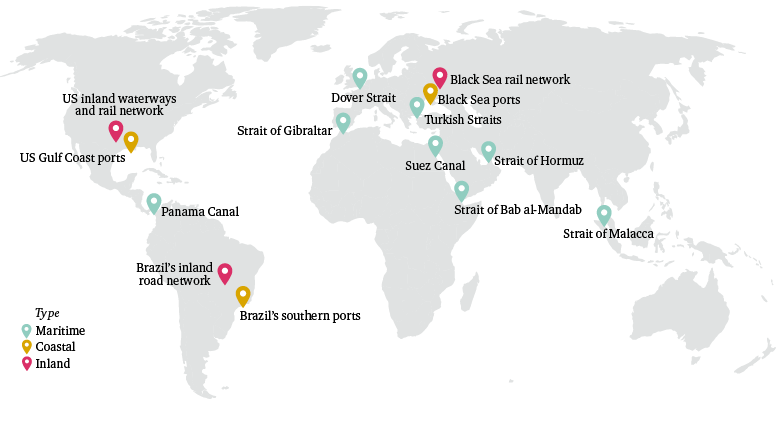
Chapter 2 introduces 14 food trade chokepoints of global strategic importance – eight maritime, three coastal and three inland. It also considers trends and potential changes affecting food trade, as well as developments in transport and technology – such as the possible opening up of new trade routes – that could be of future relevance to chokepoint risk.
Chapter 3 explores the range of hazards to which food trade chokepoints are exposed. It assesses the relative risk profiles of the 14 chokepoints and considers the way in which hazards interact to create compound and cascading risks through global food markets.
Chapter 4 outlines Chatham House’s approach to assessing chokepoint risk and food insecurity at national level. It considers chokepoint risk for individual countries, exploring how exposure and vulnerability differ across national settings, and identifies the countries most exposed to chokepoint risk.
Chapter 5 assesses the efficacy of existing policy responses and commercial responses to food supply risk, and the extent to which the risk of chokepoint disruption is currently addressed at national and international level. It identifies major gaps in investment and governance.
Chapter 6 draws conclusions on the importance of food trade chokepoints, the relevance of robust risk management policies and international cooperation, and the implications of inaction for food security in the near and long term. It then offers a series of recommendations for management of chokepoint risk at national and international level.