Box 4: Potential game-changing disruptions in the food system
New methods of environment-controlled agriculture are emerging that limit resource inputs and protect against climate damage, disease and pests. Hydroponics (water-based systems that do not require soil and that deliver optimal supplies of nutrients to plants through fortified water solutions), aeroponics (soil-less systems, using minimal water, in which plants are fed nutrient-rich solutions at timed intervals) and aquaponics (combining aquaculture and hydroponics to cultivate fish and plants in one closed-loop system) are already in use to grow fruit and vegetables.
Use of such systems is expected to expand rapidly. They allow for food to be produced in urban and peri-urban centres where demand is high, lessening dependence on rural–urban transport connections and, potentially, on imported food. Scaling up these systems could help dampen the rapid rise in demand for imported food that has been driven by urbanization, particularly in Asia, in recent years. In the near to medium term, environment-controlled agriculture could provide a buffer for urban populations in the event that imported supply is disrupted.
With rapidly falling costs, genome-editing technologies such as CRISPR could soon be employed across the globe on ‘orphan crops’ such as sorghum and millet, as well as on cash crops such as soybean and maize. This would enable farmers to diversify production and would support yield growth in regions where agro-climatic conditions have, until now, stunted expansion and intensification.
Alternative means of fertilization are under development. Enabling nitrogen fixation by grain crops could radically reduce modern agriculture’s dependence on artificial fertilizers. Research is under way into two distinct approaches to doing so. One uses microbial-based products in which bacteria and fungi serve as natural fertilizers, insecticides and fungicides. Major agribusiness and pharmaceutical firms, including Bayer, DuPont and Monsanto, have invested in research and development around these products; the Bill & Melinda Gates Foundation is also funding research in sub-Saharan Africa. Should start-up costs fall, these technologies could offer a low-cost alternative to imported fertilizer, which is prohibitively expensive for many small-scale producers in developing countries.
The other alternative approach to fertilization involves experimental genome-editing technologies that are designed to mimic in grains the nitrogen-fixing capacity of legumes. Research in this area is also receiving Gates Foundation support. If hoped-for advances are made in the coming years, the gains in crops yields in developing countries could be massive.
Refrigeration allows for strategic stockpiling to regulate supply over the course of a season or year, and to create a buffer against sudden supply shocks
Industrial disruptions in the fertilizer sector may also occur as use of renewable energy sources takes off. Assuming that the environment-controlled agriculture, genome-editing and alternative fertilization technologies mentioned above are not deployed at scale in the near term, renewable energy could transform the geo-economics of nitrogen fertilizer production. The use of electricity from wind power, biogas and woody biomass has the potential to decentralize ammonia production and extricate countries from globalized supply chains. Countries that are investing heavily in solar and/or wind power – such as Brazil, China, India, Morocco, the US and Western European countries – could ramp up domestic production, precipitating the localization of fertilizer markets. This would reduce the dependence of global ammonia supply on a handful of major production centres.
While not a new technology, cold-chain logistics and cold storage, if deployed at scale, could be a game-changer in developing countries – particularly in remote areas – where the risk of damage to crops and/or stocks from weather is high. As well as reducing waste along supply chains, refrigeration allows for strategic stockpiling to regulate supply over the course of a season or year, and to create a buffer against sudden supply shocks.
Interest in alternative protein products, including cultured meat, is mounting. Media attention around the world’s first lab-grown burger and around vegetarian imitations of meat products reflects interest in a rapidly evolving sector with the potential to disrupt agribusiness incumbents. Meat alternatives are already on the market in China and the US, with consumption expected to grow rapidly in global markets. Were this nascent industry to materially reduce demand for meat and dairy products, the vast volumes of soybean and maize grown and traded to support livestock production could decline dramatically.
Continued growth in Asian demand for meat would put an increasing strain on the inland and coastal chokepoints of the US and Brazil, as well as on the maritime chokepoints linking them to Asian markets
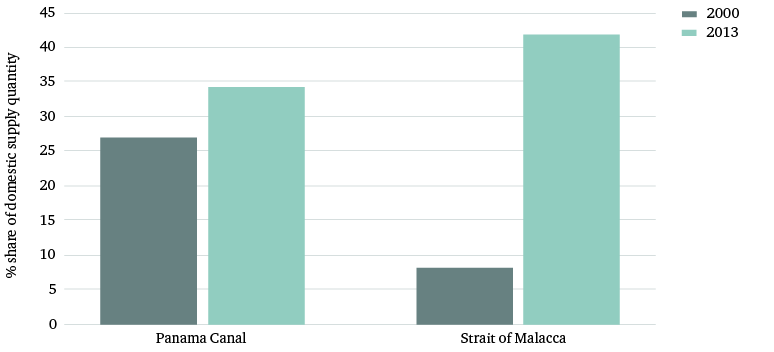
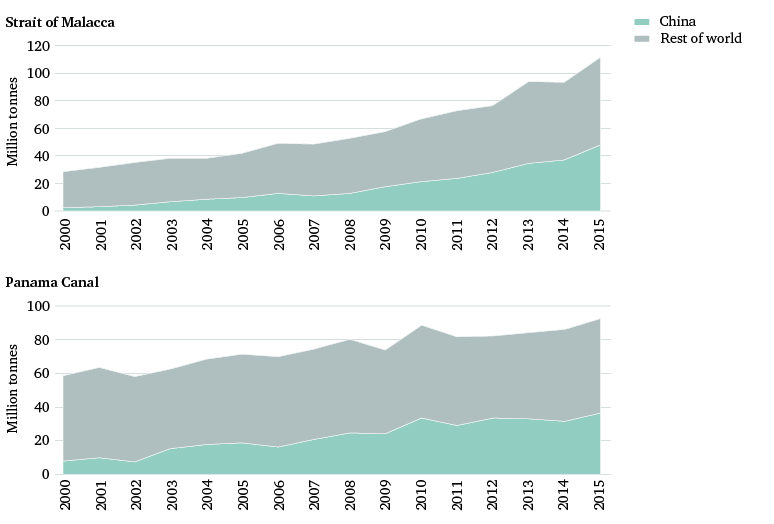
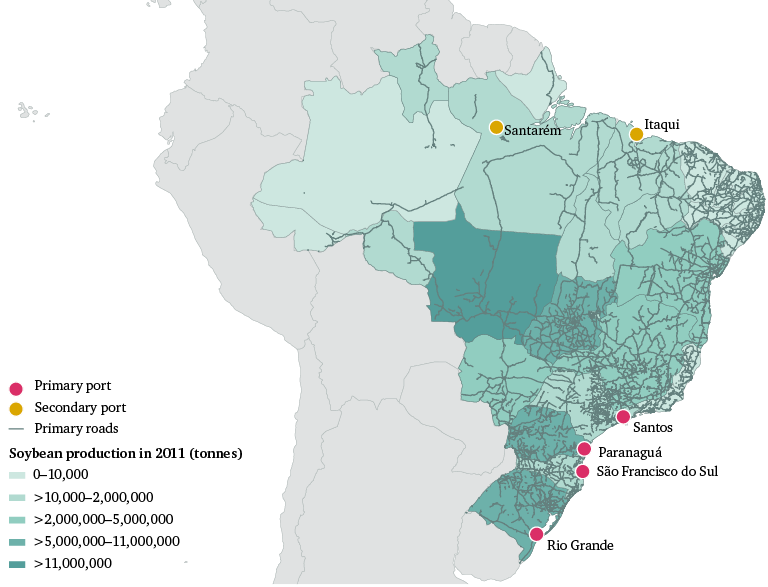
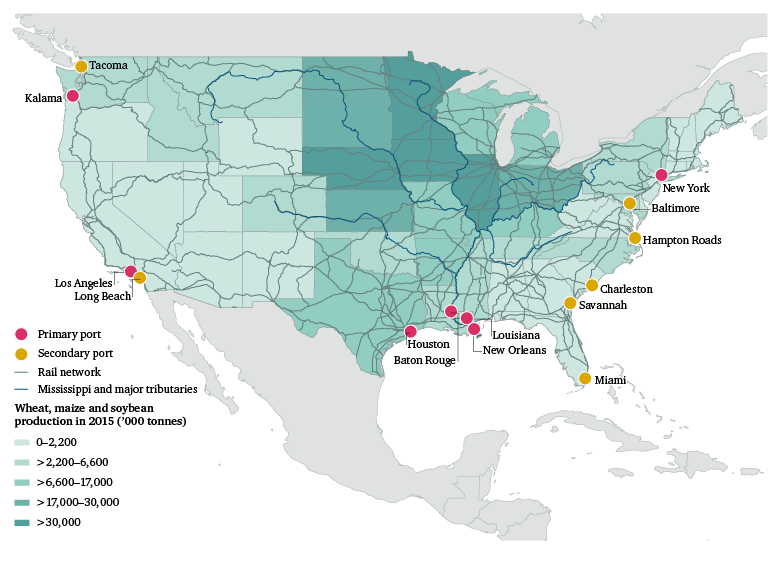
While not strictly a technological disruption, the nutrition transition unfolding across many middle- and low-income countries is having an appreciable impact on the shape of global grain trade. Rapidly rising demand for protein-rich and calorie-intense foods, most notably meat and dairy products, is driving up demand for grain and fertilizer inputs to support intensive livestock production systems in middle- and high-income countries. Global demand for meat and dairy products is expected to rise by 76 per cent and 65 per cent respectively by 2050, with China accounting for a significant share of this growth. The boom in pig and poultry production in China has already transformed the global soybean market over the past 15 years. It has prompted a dramatic rise in soybean exports from South America, the US and Europe, shipped through the Strait of Malacca and Panama Canal. Continued growth in Asian demand would put an increasing strain on the inland and coastal chokepoints of the US and Brazil, as well as on the maritime chokepoints linking them to Asian markets. On the other hand, if demand plateaus sooner than expected – in response to government efforts to limit meat intake, for example – soybean exports from Brazil and the US could diminish.
Disruptive technologies will also create opportunities for more effective and comprehensive risk management in the food system. Machine learning and the Internet of Things will likely have a transformative impact on risk monitoring and forecasting, allowing for more expansive and accurate climate predictions and for the modelling of possible disruptions and their cascade effects.