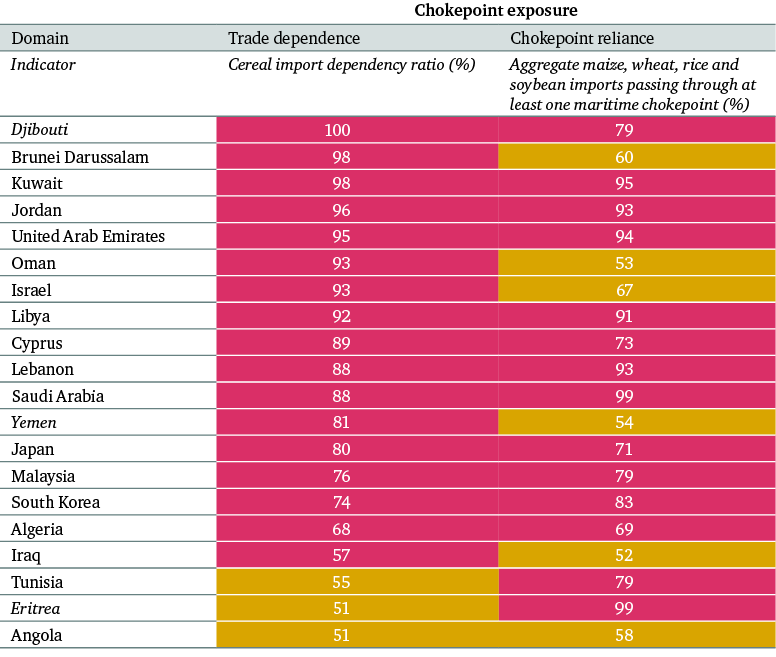
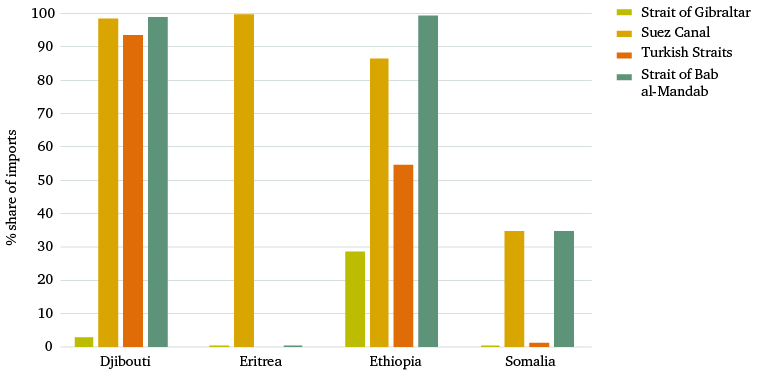
Most troubling among the list of highly exposed markets is the presence of a handful of low-income food-deficit countries: Djibouti, Eritrea and Yemen. As the CH-FSD reveals, these countries are highly vulnerable to international food market instability. For example, in Yemen over a quarter of the population is undernourished, nearly half of all household income is spent on food, stock levels of staple crops are very low, and social protection measures for the country’s poorest people are far short of adequate. Yemen is an extremely fragile country, destabilized by ongoing war that has had a ruinous impact on infrastructure. At the time of writing, the country was on the brink of famine. With a dependence on imports for four-fifths of its cereal supply, and with half of these shipments passing through chokepoints, Yemeni food consumption is at high risk from supply interruptions, as has happened in recent months due to the Saudi-led coalition’s naval blockade of the country.
4.1.2 China
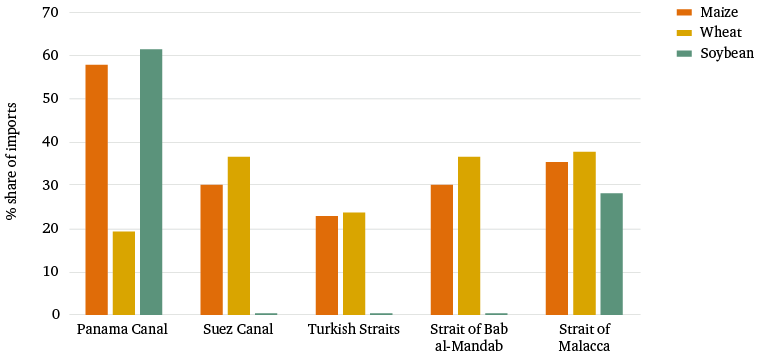
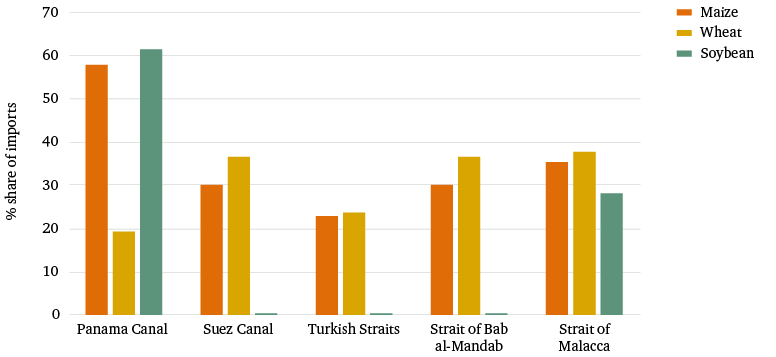
As discussed in Chapter 2, Chinese imports of strategic commodities, particularly soybean, have been growing, and so has its dependency on the Strait of Malacca and Panama Canal. Despite this, China’s maritime chokepoint exposure remains relatively low: its policy of self-sufficiency in cereals means that it has only small trade deficits in wheat and maize, although rising demand on the one hand and soil depletion, water scarcity and an ageing rural workforce on the other mean that these deficits may gradually widen.
China has maintained self-sufficiency in cereals by increasing its imports of foodstuffs that compete for land – in particular oilseeds. In 2015, Chinese imports accounted for nearly 40 per cent of the global trade in soybean. This import dependence is expected to rise: in 2000, the country’s net annual soybean imports were 10 million tonnes; by 2025, this figure is projected to reach 106 million tonnes. Just under 90 per cent of China’s grain and fertilizer imports can be expected to pass through the Strait of Malacca or the Panama Canal. Yet with improving levels of food security (only 9 per cent of the population is undernourished, and less than a fifth of household income is spent on food), and with the majority of agricultural imports being fed to livestock rather than humans, China is relatively resilient to a chokepoint hazard directly affecting its population’s caloric needs. Nevertheless, as will be explored in the next chapter, China is acutely aware of this (limited) exposure and is actively seeking to reduce it.
4.2 Highly vulnerable countries
As the discussion of Yemen illustrates, exposure to chokepoint disruption poses a more serious threat to food security in countries in which vulnerability is high. It is therefore important to pay particular attention to the chokepoint risks of the most vulnerable countries.
Table 5 shows vulnerability indicators from the CH-FSD for the most vulnerable countries according to traditional measures of food insecurity. More than a quarter of the population in these countries is chronically undernourished, and on average households spend more than a quarter of their income on food. Selected other food-insecure countries with significant chokepoint exposure are also shown. For vulnerable countries, even a relatively small chokepoint shock may result in disproportionately large impacts.