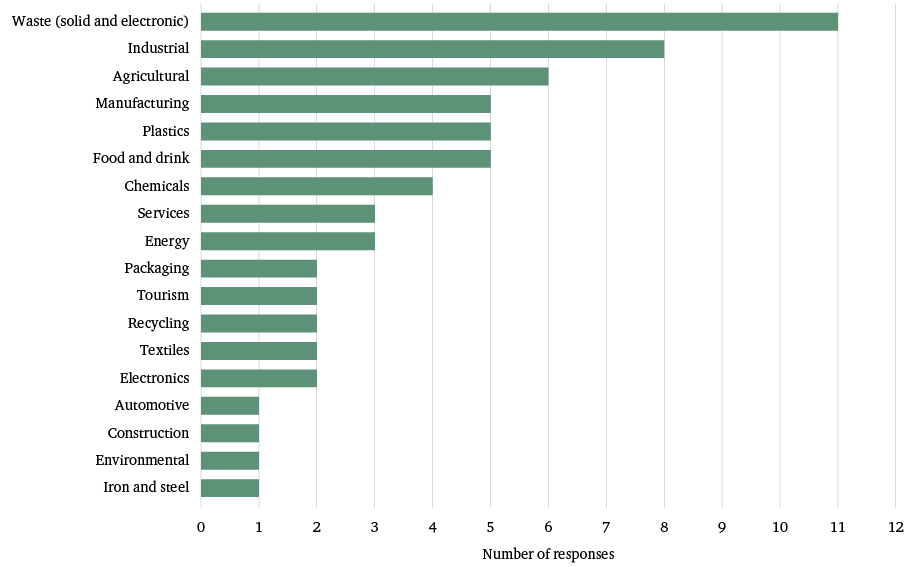
To galvanize buy-in and coordination across ministries, proponents of the CE should use it as an organizing principle that is mainstreamed across government strategies and sectoral plans, highlighting the ways in which CE principles and practice can be employed to accelerate the delivery of existing national development goals as well as the objectives of industrial strategies.
3.1 Delivering on industrial strategy
3.1.1 Job creation
Commitments to increase the number and quality of jobs in the economy are a pillar of development strategies in most lower- and middle-income economies. The potential for the CE to contribute to job creation and economic development is significant, not least because many CE activities centre on local service delivery. While there have been few comprehensive studies of the employment effects of the CE in developing countries, case studies of relevant activities are encouraging. In the Nigerian city of Lagos, for example, where formal collection methods are used for only 40 per cent of the 10,000 tonnes of waste generated daily, entrepreneurs are designing solutions that reflect local skills and capabilities. ‘Wecycle’, a social enterprise, employs a fleet of cyclists to collect waste from low-income communities. Residents who supply their rubbish are rewarded with vouchers that can be exchanged for household items and common services, including crockery, food and mobile phone airtime. In addition to recycling, other start-ups in the region give this waste a second life as furniture, textiles or lumber.
Meanwhile, in China 1 per cent of all new jobs created in the first half of 2018 were in the bike-sharing industry. The 100,000-strong national workforce in this sector includes those employed in bicycle manufacture, repair and distribution, as well as software development and maintenance (to support user access). In India, car-sharing firms have generated 30,000 new jobs in the state of Tamil Nadu.
Government-backed waste management projects can have a significant short-term impact on employment. An e-waste dismantling and recycling facility opened in Rwanda in 2017. The $1.5 million operation employs 1,000 people and has the capacity to process 7,000 tonnes of electrical and e-waste each year. Similarly, an e-waste recycling facility in Nairobi, established in 2013 through a public–private initiative between Hewlett-Packard, the Kenyan government and other partners, created 2,000 jobs in its first four years of operation.
CE activities may also offer a buffer against increasing automation in industry and manufacturing. Much has been written about the potential for digital technologies, such as robotics and additive manufacturing, to displace low-skilled workers. For developing countries, where manufacturing and services provide only a limited share of employment but are prominent in state development plans, the prospect of increased automation is a strategic concern. The CE may provide a critical part of the response. Many tasks involving disassembly, repairs and remanufacturing are non-routine and involve a high level of knowledge. Compared with manufacturing assembly lines, it will take a long time before these tasks can be widely performed by robots, at least at a cost that can compete with the abundant labour found in many developing countries. The sorting of waste by product type and state of disrepair is difficult enough to automate; more complicated still are tasks involving collection from the streets and redistribution. Yet this will not always be the case. If waste streams become more regular and reliable, robots can play a role in their sorting and management, as demonstrated by Apple’s robot, Liam, which disassembles 1.2 million iPhones a year.
3.1.2 Economic diversification
Another common goal in developing-country industrial strategies is the desire to ‘move up the value chain’, i.e. to gradually move away from agriculture and raw material extraction towards higher-value-added industrial activities such as manufacturing and ultimately a higher-tech, service-led economy. Engagement in circular practices can support value addition and can be supported with minimal investments in infrastructure. Countries with a significant existing manufacturing base, for example, may already have the requisite skills and infrastructure to support product repair and remanufacturing at scale. Remanufacturing can be seen as a complementary rather than competing approach to manufacturing, capable of having a positive impact on employment and economic output. Both China and India (see Box 4) have signalled policy support for remanufacturing and other CE approaches because of the potential for employment creation and value addition.
In resource-intensive economies, shifting towards a CE may present an opportunity to pursue economic diversification and access higher-value markets. In the medium to long term, however, continued dependence on natural resource extraction will present significant challenges for resilient economic growth.
In resource-intensive economies, shifting towards a CE may present an opportunity to pursue economic diversification and access higher-value markets. In the medium to long term, however, continued dependence on natural resource extraction will present significant challenges for resilient economic growth. Many resource-intensive economies are highly exposed to commodity price fluctuations, with the recent slowdown in growth in African countries closely tied to lower commodity prices. Many resource-rich countries already have ambitious plans to diversify their economies by moving up the value chain. The transformation of industrial assets and resource-processing facilities into regional reprocessing and remanufacturing hubs could support a transition away from quantity-driven resource export strategies towards value-added strategies. Whereas exports of raw, primary or scrap materials will often be relatively low-value, significant value can be added through their processing and remanufacturing into usable goods and materials. The production of car doors from scrap steel sheets is an example.
One notable exception to this model is that economies that export certain metals and minerals will likely feel less pressure to diversify. The central role of digital technologies in many circular activities and sectors will continue to support demand for commodities such as copper, lithium, gold, uranium and rare earth elements. Nonetheless, producers and exporters in the minerals and metals sector can boost their competitiveness in the short and long term through the early adoption of robust environmental and health standards in (re)processing and (re)manufacturing processes: as buyers and investors increasingly integrate the CE and sustainable business commitments into their business models, high-end materials that perform well against environmental and social governance metrics may attract a premium.