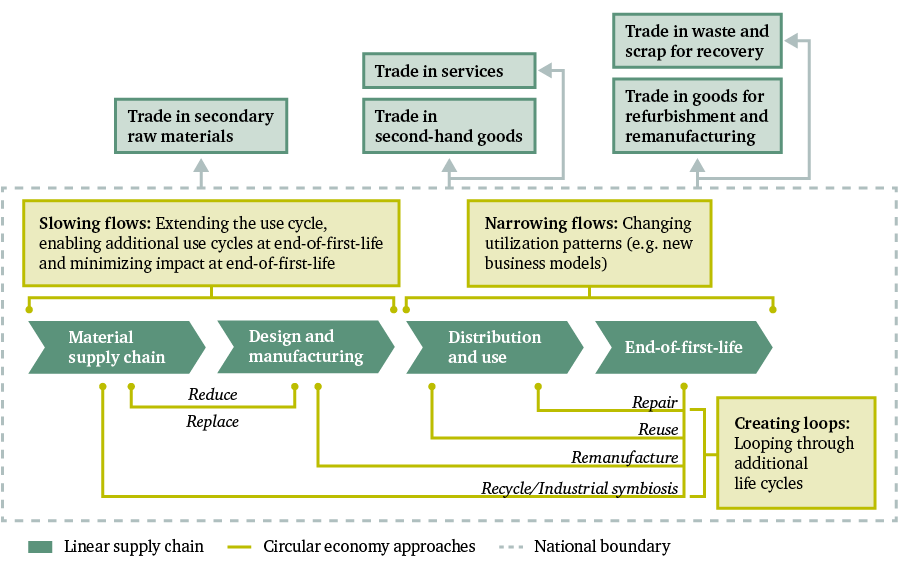
National strategies to support the transition to a CE have the potential to deliver industrial growth that mitigates negative environmental externalities. But without parallel investment in regional and global circular value chains, and in the sharing of knowledge and innovation, it is unlikely that the CE will reach meaningful scale. A transformation is needed not only at the level of domestic industry but across international resource and material supply chains; for this, collaboration will be key.
Optimizing the impact of CE investments will depend on ensuring that activities are aligned with existing sustainable development programmes and investments, and that the potential trade-offs associated with CE approaches (for example, reconciling environmental sustainability and inclusive growth) are carefully managed. Here, government-to-government collaboration will play a critical role, through bilateral investments, cross-border partnerships to encourage the emergence of regional and international circular value chains, and cooperation in agreeing common terms for the global trade in secondary materials and CE-related services.
5.1 Mainstreaming the CE in the global sustainability agenda
The Paris Agreement and adoption of the SDGs in 2015 set in motion global efforts to promote sustainable and resilient growth that tackles poverty and inequities while safeguarding finite natural resources and biodiversity. Central to both agendas is the tenet of sustainable resource production and consumption. Goal 12 of the 17 SDGs consists of ensuring responsible production and consumption patterns. Ongoing dialogues at the G7 and G20 have acknowledged that, with roughly 70 per cent of global resource extraction ultimately ending up in the atmosphere as greenhouse gas emissions, the transformative changes envisaged by the Paris Agreement can only be achieved alongside a decoupling of economic growth from natural resource use and environmental degradation.
Various studies have identified linkages through which the CE can support delivery on the SDGs, and vice versa. According to the International Resource Panel (IRP), 12 of the 17 SDGs rely directly on society-wide changes in the management of resources; another analysis identified 10 SDGs that depend on the CE. One detailed analysis identifies particularly close links between CE practices and the following SDGs:
-
SDG 6 – clean water and sanitation. More effective use of water should reduce overall consumption and wastage. The safe and effective recycling and reuse of wastewater can further reduce wastage while providing greater access to water for circular manufacturing processes. CE practices can contribute to more sustainable sanitation, e.g. through composting toilets. CE initiatives can also reduce the release of hazardous waste into water sources, reducing the risks of harm to people and to marine and fluvial ecosystems.
-
SDG 7 – affordable and clean energy. CE approaches have the potential to limit energy use in the extraction of raw materials and manufacturing of primary products. Renewable energy initiatives, including small-scale waste-to-energy technologies, can improve access to clean energy, particularly in rural areas. Waste heat recovery initiatives can contribute to greater energy efficiency. End-of-life battery recovery and reuse can lower the costs of stabilizing mini-grids, thereby supporting rural electrification.
-
SDG 8 – decent work and economic growth. The CE will bring new employment opportunities and greater market access for workers in a range of industries, including waste management, textiles, remanufacturing and CE services. At the same time, CE technologies will allow for a greater geographical distribution of employment opportunities. Regional and circular value chains should enable developing countries to position themselves as key players in the trade of high-value circular goods.
-
SDG 12 – responsible consumption and production. CE practices and innovations will be critical to achieving more sustainable use of resources, including water and energy. Small-scale waste-to-energy practices can reduce food waste. Sustainable procurement guidelines can incentivize CE business models. Greater valorization of waste products and secondary materials, together with promotion of the sharing economy, will be central to reducing waste generation.
-
SDG 15 – life on land. Regenerative and organic agriculture can dramatically reduce fertilizer and land use, while contributing to improved soil health and ecosystem conservation. Circular water management can support the restoration of ecosystems in arid and climate-affected regions. Circular means of food production can limit demand for land-use change.
In many cases, success in delivering on the SDGs will facilitate the transition to a CE. Targets under SDG 9 – industry, innovation and infrastructure – to increase access to financial services and value-chain integration (target 9.3) among SMEs should also, for example, support their participation in innovative practice and value chains, while investment in domestic technology development, research and innovation in developing countries (target. 9.B) can drive the emergence of digital platforms for CE practices such as asset sharing.
Several analyses have highlighted the CE as a framework for identifying additional mitigation opportunities not currently included in NDCs. A report by Material Economics suggests that a more circular economy can cut emissions from heavy industry in the EU by 56 per cent by 2050. The European Commission, in developing its strategic long-term vision for 2050, considered the role of a highly circular economy in generating consumer demand for less carbon-intensive goods, as well as in maximizing opportunities to sequester carbon in the land and reduce the need for negative emissions technologies in meeting commitments under the Paris Agreement.
To advance understanding of the synergies between the CE and the SDGs, CE strategies could be incorporated into existing multi-stakeholder discussions on pathways to sustainable consumption and production (SCP), such as those instigated in early 2019 in the Republic of the Maldives by the country’s Ministry of Environment and supported by the EU SWITCH-Asia Sustainable Consumption and Production Facility. Bringing together policymakers, civil society organizations and practitioners to explore challenges to the implementation of SCP and set national priorities, such dialogues provide a means to gather a range of perspectives on the opportunities and risks associated with the transition to a CE.
Further opportunities for mainstreaming the CE into the global sustainable development agenda will come in 2019 and 2020, with a number of key moments set to occur in global climate and biodiversity negotiations: at the UNFCCC’s 25th Conference of the Parties (COP 25) in November 2019, countries will be expected to demonstrate a ratcheting up of ambition in their NDCs; while at the Convention on Biodiversity, also in November 2019, a post-2020 global biodiversity framework is expected to be agreed. In 2020, a number of CE-relevant SDG targets are also expected to be met. These include target 11.b – to ‘substantially increase the number of cities and human settlements adopting and implementing integrated policies and plans towards inclusion, resource efficiency, mitigation and adaptation to climate change, resilience to disasters’; and target 12.4 – to ‘achieve the environmentally sound management of chemicals and all wastes throughout their life cycle, in accordance with agreed international frameworks, and significantly reduce their release to air, water and soil in order to minimize their adverse impacts on human health and the environment’.
The next two years therefore offer a moment of opportunity for development actors to align efforts on the Paris Agreement, the SDGs and global biodiversity targets with those of the CE, and to galvanize political and financial support for ambitious policies that deliver on multiple global commitments at once.
5.2 Focusing multilateral and bilateral cooperation
5.2.1 Multilateral investments
For international financial institutions seeking to support the implementation of the SDGs and the Paris Agreement, investments in CE innovations or value chains could be used to reinforce and accelerate existing programmes of sustainable development. Many multilateral development banks (MDBs) are scaling up their activities in the CE space through activities that build on existing funds targeted in these areas, and are also setting aside specific funding pots for CE approaches. Some examples of MDB activity include the following:
-
European Investment Bank (EIB): Between the start of 2013 and the end of 2017, the EIB provided €2.1 billion of co-financing for CE projects. While most of this funding is directed at European projects, a growing number are in developing countries. In 2015, for example, the EIB signed a €8 million loan to finance a carbon burn-out facility in Mauritius which converts coal fly ash – a waste product from coal combustion – into an additive for local cement producers.
-
European Bank for Reconstruction and Development (EBRD): The EBRD funds CE activities through its Green Economy Transition approach, agreed in 2015 as a means of mainstreaming environmental criteria in investment decisions. One example of the EBRD’s investments that align with the CE is a €30 million loan to the Şişecam Group, which hopes to increase glass recycling rates to over 50 per cent in cities across Turkey.
-
World Bank: The bank’s technical assistance programme ‘China: Promoting a Circular Economy’ supported the development of national legislation on the CE in China in 2009. The bank has continued to work on CE activities in China, supporting solid-waste minimization and recycling schemes. It also works with other countries to develop green growth strategies expanding integrated waste management.
-
African Development Bank (AfDB): The AfDB is examining how the CE can support the industrial development pillar of its strategy and has financed the implementation of plastic waste collection and recycling infrastructure in a number of African countries. In 2018, the AfDB signed a cooperation agreement with UNIDO to develop joint activities of shared interest, including in the CE.
Given the challenges for multilateral donors in investing in CE solutions outlined in Section 2.1, increasing the flow of investment from MDBs into the CE may depend on a collaborative approach that unifies CE-related strategies across the banks. Cooperative financing arrangements in which multiple MDBs or donor agencies pool their resources to support CE investments would create a lower-risk environment in which to expand engagement in the CE. An equally important approach might be to reorient investment strategies and revise eligibility criteria to allow CE projects to benefit from existing schemes, such as the Global Environment Facility (GEF). The GEF’s seventh framework programme has the CE as one of its Impact Programmes. The facility has helped to foster collaborations involving the AfDB, the World Economic Forum, and the World Bank in Rwanda and Nigeria; in January 2019, the Nigerian government announced a $2 million (£1.53 million) initiative, supported by the GEF and UN Environment, to kickstart the recycling of waste electric and electronic equipment.
5.2.2 Bilateral cooperation
For many developed countries, the more labour-intensive components of the CE, including reverse logistics, are unlikely to be economically viable in domestic contexts until such time as they become automated. The development of resilient international circular value chains will be an important enabler for the scaling up of domestic remanufacturing and recycling commitments, while at the same time supporting delivery on commitments to global sustainable development frameworks. The CE may offer opportunities for bilateral investments and partnerships which simultaneously contribute to the CE at home and overseas.
The EU, China and Japan have been proactive in seeking out cross-border opportunities for partnership on the CE. The EU has dispatched CE missions to Chile, China, India and South Africa. The focus of these missions is to communicate the opportunities from transitioning to a CE, as well as to support European businesses in expanding their activities in these countries. In June 2018, the EU and India signed a joint declaration of intent to foster resource-efficient practices in India and support recommendations made in the Strategy on Resource Efficiency. A number of joint initiatives will be undertaken, including support for an eco-labelling scheme for secondary products; assistance in developing recycling standards for e-waste, plastics, and construction and demolition waste; promotion of R&D in resource efficiency; and development of a ‘Waste Exchange Platform’, a marketplace for by-products and industrial waste.
President Xi Jinping has stipulated that the Belt and Road Initiative should promote a ‘green, low-carbon, circular and sustainable’ form of development.
In China, President Xi Jinping has stipulated that the Belt and Road Initiative (BRI) – an ambitious set of foreign and economic policies centred on infrastructure building to connect China’s less developed border regions with Southeast Asia, Central Asia and Europe – should promote a ‘green, low-carbon, circular and sustainable’ form of development. While the specific activities remain to be determined, China’s recycling industry is preparing to expand its activities abroad. Many of China’s partner or prospective partner countries for BRI projects are still in the early stages of developing modern recycling and waste management, and some of the infrastructure investment planned under the BRI is focused on that sector. At the same time, China is seeking to capitalize on its experience in industrial symbiosis and the use of eco-industrial parks to pilot new business models and activities. One example is the planned construction of a China-African Circular Economy Industrial Park in South Africa, led by GEM Co. Ltd, a Shenzhen-based company specializing in resource recycling.
Japan, meanwhile, has demonstrated regional leadership in the CE through its inauguration of the Regional 3R Forum in Asia and the Pacific. This cooperative platform enables governments from 39 countries in the region to promote policy coordination; network building; research cooperation; the piloting of CE projects; and knowledge-sharing with international organizations, the private sector and civil society stakeholders. As G20 chair in 2019, Japan has an opportunity to take its domestic and regional experience on to the international stage, building on the work started by Germany two years ago, and to promote policy alignment and knowledge exchange on resource efficiency and the CE among G20 countries and developing-country partners.
Several other donors are discussing the CE as a potential new focus area for development assistance. Few detailed strategies have yet emerged, but early examples include Denmark’s DKK 900,000 ($136,000) strategic sector cooperation agreement with Indonesia on ‘circular economy and waste management’; a similar agreement with Kenya on ‘circular economy, cleaner manufacturing, regulation and enforcement’; and the Norwegian international development minister’s highlighting in April 2018 of the CE as a priority in Norway’s international development policy, with a focus on cooperation with developing countries to establish profitable value chains for waste. Commitments to supporting CE initiatives in the developing world have also emerged in other countries, in response to a surge in public awareness of the global waste challenge (see Box 8).
The Memorandum of Understanding on Circular Economy Cooperation between the EU and China, signed in July 2018, could provide a vehicle through which to broaden CE cooperation and leadership. Under the MoU, the EU and China agree to cooperate on ‘dialogue on the design, planning and implementation of strategies, legislation, policies, and research’, ‘strategic exchanges on management systems and policy tools such as eco-design, eco-labelling, extended producer responsibility and green supply chains’, ‘strategic exchanges on best practices of circular economy’, and ‘exchanges on investments in and financing of circular economy’. Such modes of cooperation could, in theory, be extended to third countries, including in sub-Saharan Africa where both the EU and China have significant investment interests and existing donor programmes.
Initiatives that marry donor funds with multilateral expertise may be used to encourage donor or private investments in novel areas of research and innovation, mitigating the risk of the unknown by capitalizing on sectoral expertise and existing knowledge-sharing networks.
Cooperation between donors and multilateral agencies can provide a further avenue through which to advance CE activities and strategies. The UK’s Department for International Development (DFID), for example, has partnered with the UN Conference on Trade and Development (UNCTAD) to develop the Sustainable Manufacturing and Environmental Pollution (SMEP) programme. SMEP will fund research and technical solutions that focus on mitigating the environmental pollution and degradation associated with certain industrial and manufacturing processes in sub-Saharan Africa and South Asia. Similar initiatives that marry donor funds with multilateral expertise may be used to encourage donor or private investments in novel areas of research and innovation, mitigating the risk of the unknown by capitalizing on sectoral expertise and existing knowledge-sharing networks.