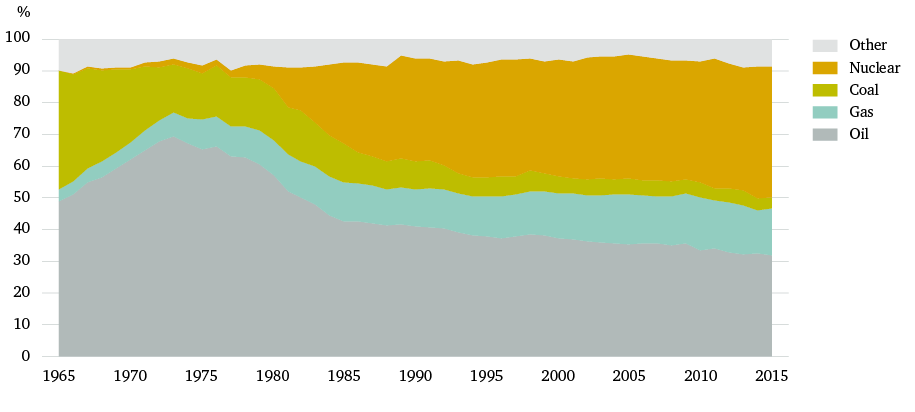
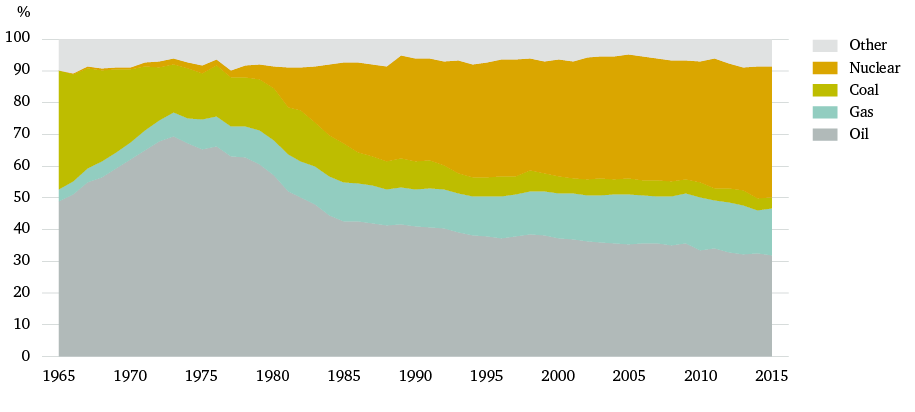
The result was that oil was increasingly superseded by nuclear as a source of power, a process entirely driven by government intervention.
The lessons from history
From these case studies, and indeed many others, certain lessons can be learnt that are relevant to the current energy transition.
The first is that any transition has triggers. Once the trigger has been activated, various reinforcing factors come into play. These may be the result of markets working through adjustments in relative prices, government intervention, or a combination of the two. The process, once triggered, is very much driven by technological change, although other factors can play a key role. Fouquet (2010) identifies three major changes that have historically featured in the transition: changes to the supply network; changes to the energy source; and changes to the energy service provided. In all cases, the key to the transition has been the creation and delivery of better or different services. This has normally meant that the energy price has needed to fall, and/or that the technology’s efficiency has needed to improve. This has allowed ‘the diffusion of the technology and the new energy source through the broader market’ (ibid.: p. 6592). The transition is invariably complex, involving many different services and sectors.
Any transition has triggers. Once the trigger has been activated, various reinforcing factors come into play. These may be the result of markets working through adjustments in relative prices, government intervention, or a combination of the two.
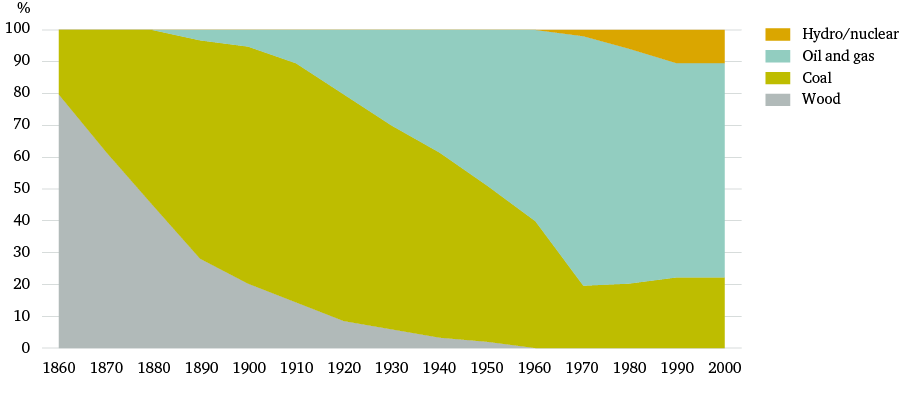
The second lesson is that the time frame can vary enormously. For example, the transition in Great Britain in domestic heating – i.e. moving from wood to coal – took more than 200 years (Fouquet, 2010). In contrast, the French experience of moving to nuclear power, as described above, took only around 15 years. An illustration of the time dimension can be seen in the concept of ‘phases’ developed by Grubler, in which a core or innovation phase is followed by expansion to early adopters (‘the rim’), and then by another phase of uptake by late adopters (‘the periphery’) (Grubler, 2012). His research suggests that the duration of each phase is shortening. That said, ‘the historical record does seemingly support the mainstream view that energy transitions all take time’ (Sovacool, 2016: p. 205). However, in support of the main thesis of this paper, that the current transition will happen much faster than many realize, recent evidence and experience suggest that ‘some energy transitions can occur much more quickly than commonly believed’ (ibid.: p. 203).
A third lesson is that the current transition is also more complex than many originally believed. In the words of a recent study of the subject by the Saudi Arabia-based King Abdullah Petroleum Studies and Research Center (KAPSARC): ‘As awareness of the complexity of the energy transition increases, many scenarios are raising the number of possible pathways, a phenomenon that serves to reduce, rather than increase, clarity’ (KAPSARC, 2018: p. 4).
A fourth lesson is that the pattern of energy transitions has been one of moving from low-energy-density resources to higher-energy-density resources. It was always the energy density of oil that made it an attractive option, especially in the transport sector. This could raise doubts over the speed of the current transition, suggesting that it might proceed more slowly than the evidence in this paper indicates.