The COVID-19 pandemic has accelerated structural trends driving the reconfiguration of global supply chains. A new balance is emerging between efficiency and resilience as well as between globalization and national self-sufficiency.
Global supply chains – sometimes called global value chains or global production networks – have become a key feature of the world economy. In fact, approximately 70 per cent of international trade is for the purpose of production in global supply chains, whereby intermediate goods and services are exchanged across borders before being incorporated into a final product which can be delivered to consumers around the world. Supply chains are actually more regional in character than the term ‘global’ suggests: they are often structured around intra-regional links and are mostly clustered around Europe, North America and Asia. These major supply-chain blocs interlink, with a significant degree of interregional production-sharing. Despite the rise of China, the US and Germany remain the most important hubs in complex global production networks.
Since 2011, the expansion of global value chains has slowed, according to the Organisation for Economic Co-operation and Development (OECD). In other words, even before the rise of economic nationalism (or protectionism) and the outbreak of the COVID-19 pandemic, the reconfiguration of supply chains has been driven by several structural factors in the last decade. These factors include:
- A slowdown in growth of trade volumes, relative to the growth in global GDP, following the global financial and economic crisis which began in 2007, as well as a shift in orientation by China away from exports and towards supplying its domestic market;
- Diminishing labour cost arbitrage, as wages have risen in many emerging countries and the differential between countries in terms of labour costs has become less important as a determining factor for locating production;
- Increased political risk and trade tensions, with firms facing higher costs as a consequence of the imposition of tariffs and policy uncertainty;
- A higher frequency of business interruptions stemming from natural disasters or other disruptive events such as the COVID-19 pandemic;
- Shifting social values and consumer preferences, including popular demands for a more sustainable and responsible sourcing of products;
- The rise of the so-called ‘service economy’ (which often implies production closer to consumers) and the ‘servicification of manufacturing’ (which means that firms are increasingly reliant on services as inputs, or are producing services that are bundled with the goods they sell);
- Technological change – for instance, the increasing availability of 3D printing and robotics technologies, allowing production facilities to be located closer to the end-consumer and reducing cost arbitrage between countries (by means of automation, which has reduced the contribution of labour in the production process). At the same time, however, cyberattacks have become a source of supply-chain vulnerability.
The COVID-19 pandemic has given added impetus to many of these trends. Resilience has become the new buzzword in relation to supply chains: however, there is no agreed definition. Some authors distinguish between resilience (returning to normal operations post-disruption) and robustness (the ability to maintain operations during a crisis).
For the purposes of this paper, supply-chain resilience is defined as an adaptive capability to prepare for, respond to and recover from unexpected disruption by returning quickly to normal operations.
The coronavirus pandemic has also given rise to some common misperceptions. First, while it highlighted the pressure points on global production networks, supply chains were able to adapt to the stresses of the pandemic, proving to be quite resilient. Imports and increased domestic production helped to overcome initial shortages and supply-chain disruptions for personal protective equipment (PPE), food products and other goods. And while discussions around an over-reliance on imports for COVID-19-related products have mostly framed the latter as a problem specific to China, the information available points to a more complex picture (see Box 1).
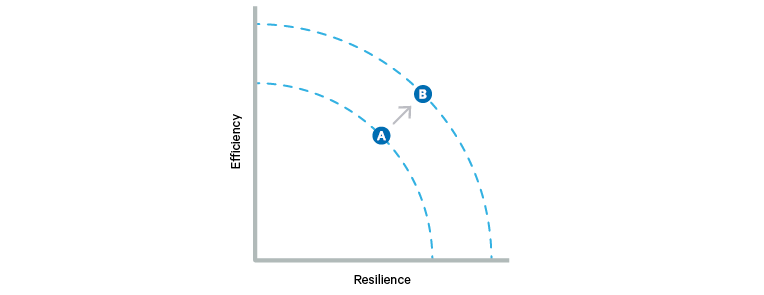
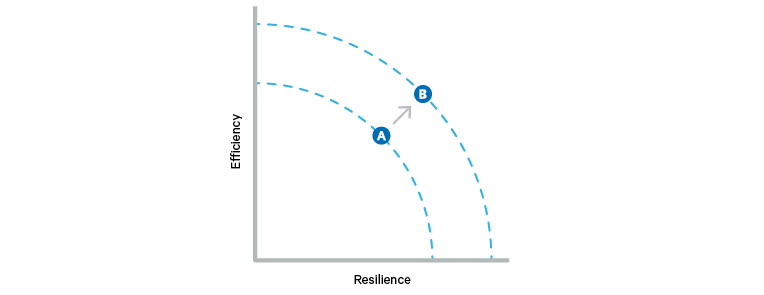
Second, there seems to be a false dichotomy between efficiency and resilience. While it is true that companies have prioritized efficiency in recent decades (for instance, by optimizing both the cost and the speed of production) and have paid less attention to potential vulnerabilities, the two objectives are not necessarily mutually exclusive. Some scholars have argued that both efficiency and resilience need to be maintained for companies to survive in the long term. In the short term, tensions certainly exist between the two. This does not mean that companies need to focus solely on one or the other: rather, they need to balance the two objectives, and manage any resulting trade-offs.
It should be noted that, as Figure 1 shows, there is not always a trade-off, since certain steps can be taken to benefit both objectives, thereby moving beyond the traditional trade-offs facing supply chains. For instance, by moving the curve outwards, Point B is both more efficient and resilient compared to Point A. As a practical example, the appliance manufacturer Whirlpool boosted both the efficiency and the resilience of its supply chains by using standardized components in a wide range of products. By utilizing the same screw in a washing machine and a clothes dryer, supply chains could be simplified, and more flexible production was facilitated across different sites. As outlined in Chapter Four, digital technologies can play a major role in resolving the traditional tensions between efficiency and resilience.